💥Join UPSC 2027,2028 Mentorship (July Batch) + XFactor Notes & Microthemes PDF

Subject: Fundamental Rights,DPSP

1. History + Evolution
2. Features
3. Amendments
4. Basic Structure

  • [18th June 2024] The Hindu Op-ed: Constitutional respect should not be reduced to optics

    [18th June 2024] The Hindu Op-ed: Constitutional respect should not be reduced to optics

    PYQ Relevance:

    Q The size of the cabinet should be as big as governmental work justifies and as big as the Prime Minister can manage as a team. How far is the efficacy of a government then inversely related to the size of the cabinet? Discuss.(UPSC IAS/2014)

    Q To what extent, in your view, the Parliament is able to ensure accountability of the executive in India? (UPSC IAS/2021)

    Mentor comment: In a parliamentary democracy, the Prime Minister (PM) is the head of government, responsible for running the country and implementing policies. Chosen from the majority party in parliament, the PM leads the executive branch, oversees the cabinet, and represents the government domestically and internationally. The PM must maintain the confidence of the parliament to remain in power.

    Why in the News?

    • On June 7, 2024, Prime Minister Narendra Modi surprised the nation by paying his respects to the Constitution of India at the Alliance meeting.
    • This move was probably in response to the accusations by the opposition who alleged the threat of ‘changing’ the constitution.

    Role of the Prime Minister in a Parliamentary Democracy

    • Head of the Council of Ministers: The Prime Minister is the head of the Council of Ministers.
    • Constitutional Mandate: Article 74 of the Constitution mandates that the Prime Minister advises the President in their functions.
    • Choice of System: B.R. Ambedkar and the framers chose the parliamentary system over the presidential system to ensure greater responsibility of the executive to the Legislature and the electorate.

    Row over Immediate Actions

    • Oath of Office: On June 9, 2024, Mr Modi and his Cabinet Ministers took the oath of office administered by the President of India.
    • Pre-emptive Financial Sanction: On June 10, the Prime Minister pre-emptively cleared a significant financial sanction of PM-KISAN without the formal allocation of ministerial portfolios, raising questions about the constitutional validity of such actions.

    Optics over Procedure

    • Cabinet Meeting Decisions: The first cabinet meeting, without allocated portfolios, approved significant welfare measures like the Pradhan Mantri Awas Yojana.
    • Procedural Concerns: Questions arise about the initiation, circulation, and approval process of these decisions, suggesting a focus on optics rather than constitutional procedure.
    • Extended Tenures: Mr. Modi extended the tenures of key officials without reconstituting the Cabinet Committee, relying on the old Appointments Committee, raising further procedural concerns.

    Coalition Dharma and Constitutional Morality

    • Disregard for Norms: These actions reflect a disregard for coalition principles and constitutional norms.
    • Dr. Ambedkar’s Emphasis: B.R. Ambedkar emphasized the need for constitutional morality and the cultivation of democratic sentiments, which appear to be lacking in the current scenario.
    • Article 77: It provides for the President to make rules for government business transactions, ensuring ministerial accountability, which seems undermined by the centralization of power in the PMO.

    Current Government’s functioning

    • Shift in Power: There is a noticeable shift towards an extraordinary accumulation of power in the Prime Minister’s Office, contrary to the principles of collective responsibility.
    • Business Rules: The Government of India (Allocation of Business) Rules designate business to specific ministries and departments, not the PMO.
    • Cabinet Secretariat: The Cabinet Secretariat’s role is to provide secretarial assistance, but recent actions suggest a breakdown of this framework.

    Role of opposition in parliamentary democracy

    • Accountability and Oversight: The opposition scrutinizes government actions and policies, ensuring transparency and preventing abuses of power.
    • Alternative Policies: It offers constructive criticism and proposes alternative solutions to address national issues and improve legislation.
    • Representation of Diverse Interests: The opposition voices the concerns and interests of various segments of society, ensuring a balanced and inclusive democratic process.

    Way forward

    • Strengthen Institutional Checks: Implement stricter enforcement of constitutional mandates and parliamentary procedures to ensure balanced power distribution and prevent centralization in the PMO.
    • Enhance Opposition Collaboration: Foster a cooperative environment where the opposition can effectively scrutinize government actions, propose constructive alternatives, and represent diverse societal interests, promoting a more transparent and accountable government.
    https://www.thehindu.com/opinion/lead/constitutional-respect-should-not-be-reduced-to-optics/article68301227.ece

  • CIC upholds decision of Rashtrapati Bhavan on RTI query

    Why in the News? 

    • The Central Information Commission (CIC) upheld Rashtrapati Bhavan’s response to an RTI query regarding the number of times former President Kovind returned decisions by the Prime Minister/Union Council of Ministers for reconsideration.
      • The President’s Secretariat stated that no information was available on record regarding such returns.

    Back2Basics: Right to Information (RTI)

    • The RTI Act of 2005 grants Indian citizens the right to access government-held information, with exceptions.
    • Its goal is to enhance transparency and accountability in public authorities.
    • This Act replaced the earlier Freedom of Information Act of 2002.
    • RTI aligns with Freedom of Speech and Expression (Article 19) in India’s Constitution.

    About Central Information Commission (CIC)

    Details
    Establishment Set up under the Section 12 of the Right to Information Act, 2005.
    Function
    • Oversees implementation of RTI Act in Central Government and Union Territories.
    • Resolves complaints and decides appeals related to the Act.
    Headquarters New Delhi
    Composition
    • Chief Information Commissioner (CIC)
    • Up to 10 Information Commissioners (IC), (appointed by President on recommendation of PM-led Committee consisting Leader of Opposition and Cabinet Ministers.)
    Qualifications CIC and IC must be persons of eminence in public life with wide knowledge and experience in: Law, Science and Technology, Social Service, Management, Journalism, Mass Media, Administration, and Governance.

    NON-ELIGIBLITY: Members of Parliament or Legislature of any State or Union Territory, hold any office of profit, be connected with any political party, or carry on any business or profession.

    Tenure
    • CIC and IC hold office for such term as prescribed by Central Government or until they attain age of 65 years, whichever is earlier.
    • NO Reappointment.
    • IC can be appointed as Chief Information Commissioner, but total tenure including term as IC should not exceed 5 years.
    Removal
    • President can remove CIC or IC on grounds like insolvency, conviction for moral turpitude, engaging in another office of profit, etc.
    • Removal for misbehaviour requires Supreme Court enquiry and recommendation.
    Salary & Conditions Salary, allowances, and service conditions determined by Central Government, cannot be varied to their disadvantage during service (After RTI Amendment Act,2019)
    How RTI amendment, 2019 has changed CIC?
    • Before the 2019 amendment to the RTI Act, ICs at the CIC held a 5-year fixed term and were considered equal in status to the Chief Election Commissioner and Supreme Court judges.
    • The 2019 amendments granted the Centre the power to alter these terms at its discretion.
    Functions
    • Receives and inquires into complaints related to RTI Act violations, including non-appointment of Public Information Officer, refusal or delay in information, unreasonable fees, incomplete or false information.
    • Submits annual report on Act’s implementation to Central Government, presented to Parliament.
    Powers
    • Can suo-moto order inquiries, summon persons, enforce oaths, access and inspect documents, receive evidence on affidavit, requisition public records, summon witnesses, and enforce compliance of decisions.
    • Can direct public authorities on information access, officer appointments, record management, training, and impose penalties or compensation for non-compliance.


    PYQ:

    [2018] The Right to Information Act is not all about citizens’ empowerment alone, it essentially redefines the concept of accountability. Discuss. (150 words)

    [2019] There is a view that the Officials Secrets Act is an obstacle to the implementation of RTI Act. Do you agree with the view? Discuss.

    [2020] “Recent amendments to the Right to Information Act will have a profound impact on the autonomy and independence of the Information Commission”. Discuss.

  • What are the standards for awarding death sentence, the President’s ‘Mercy’ power?

    Why in the News?

    • The President of India has rejected a Mercy Petition to pardon a Pakistani terrorist.
      • The accused was one among the Lashkar-e-Tayyeba terrorists who attacked the Red Fort in 2000, killing two soldiers and a civilian guard.

    What is the process of Mercy Petition?

    • Step 1: The convict facing a death sentence can file a mercy petition within 7 days of the Supreme Court dismissing their appeal.
    • Step 2: The convict or their relative submits a written petition to the President or governor, citing grounds such as sole breadwinner, physical/mental health, perceived harshness of the law, or judicial errors.
    • Step 3: The petition is forwarded to the Ministry of Home Affairs for assessment and recommendations, including consultation with the relevant State government.
    • Step 4: Based on Home Ministry recommendations and the Council of Ministers’ advice, the President can accept or reject the mercy plea without a specified time limit.
    • Step 5: While governors cannot pardon death sentences, they can commute, remit, or reprieve sentences under their state’s executive powers for offences against state laws.

    Judiciary on Mercy Petitions:

      • Bachan Singh v. State of Punjab (1980): The Supreme Court, upheld the death penalty but set the stringent criteria. It emphasized that the death penalty should be awarded only in the “rarest of rare” cases when all mitigating circumstances are considered.
      • In Maru Ram v. Union of India (1981), the Supreme Court ruled that the power to grant pardons under Article 72 of the Constitution must be exercised based on the advice of the Council of Ministers.
      • In Kehar Singh vs Union of India (1989) case, the court asserted that presidential pardon is an act of grace, not a right that can be claimed. The exercise of this power is purely administrative and not subject to judicial review.
      • In the Dhananjoy Chatterjee vs State of West Bengal (1994) case, the Supreme Court clarified that the pardoning powers under Articles 72 and 161 of the Constitution can only be exercised by the Central and State Governments, respectively, and not autonomously by the President or Governor.
      • In Epuru Sudhakar & Anr. v. Government of Andhra Pradesh (2006), the Supreme Court ruled that the clemency powers of the President and Governor under Article 72 and Article 161 are subject to judicial review.
      • In Shatrugan Chauhan v. State of U.P. (2014), the appex court has also commuted the death sentence in cases of inordinate delay in deciding mercy petitions. The court commuted the sentence of one Gurmeet Singh after he spent 27 years in custody (and 21 years on death row). 
      • In Mohd. Afzal Guru vs State of Delhi (2014) case, the court-mandated a minimum 14-day gap between the rejection of a mercy petition and the execution of a death penalty, ensuring adequate time for legal recourse.
      • Report of the 262nd Law Commission (2015): Recommended abolishing the death penalty for all crimes except terrorism-related offenses and waging war.
      • In April 2023, the Supreme Court upheld the Mumbai High Court’s decision to commute the death sentence of a woman and her sister due to significant delays in deciding their mercy petitions.

    About Presidents’ Pardoning Powers under Article 72

    • According to Article 72, the President of India has the power to grant pardons, reprieves, respites, or remissions of punishment or to suspend, remit, or commute the sentence of any person convicted of any offense: In cases where the punishment or sentence is by a Court Martial;
      • According to Article 161, the Governor of a State has the power to grant pardons, reprieves, respites, or remissions of punishment or to suspend, remit, or commute the sentence of any person convicted of any offence against any law relating to matters under the executive power of the State.
    • In the recent Supreme Court Ruling of 2021, the apex court held that the Governor of a state can pardon prisoners, including those on death row, even before they have served a minimum of 14 years of their prison sentence.

    Did you know?

    1. Pardon means completely absolving the person of the crime and letting him go free. The pardoned criminal will be like a normal citizen.
    2. Commutation means changing the type of punishment given to the guilty into a less harsh one, for example, a death penalty commuted to a life sentence.
    3. Reprieve means a delay allowed in the execution of a sentence, usually a death sentence, for a guilty person to allow him some time to apply for a Presidential Pardon or some other legal remedy to prove his innocence or successful rehabilitation.
    4. Respite means reducing the quantum or degree of the punishment to a criminal in view of some special circumstances, like pregnancy, mental condition etc.
    5. Remission means changing the time period of the punishment without changing its nature, for example reducing twenty years of rigorous imprisonment to ten years.

    Cases as specified by Art. 72

    In all cases where the punishment or sentence:

    1. is by a court-martial.
    2. is for an offence against any law relating to a matter to which the executive power of the Union extends.
    3. is a sentence of death.

    Nature of the Pardoning Power

    • The pardoning power of the president is not absolute.
    • At a procedural level, the apex court in Epuru Sudhakar & Anr. v. Government of Andhra Pradesh (2006) has held that the President’s power must be exercised based on the aid and advice of the Council of Ministers and can be challenged on multiple grounds including that relevant material was not considered, the power was exercised based on political considerations, or there was no application of mind.
    • This has not been discussed by the Constitution but is the practical truth. Further, the constitution does not provide for any mechanism to question the legality of decisions of presidents or governors exercising mercy jurisdiction.


    PYQ:

    [2014] Instances of President’s delay in commuting death sentences have come under public debate as denial of justice. Should there be a time specified for the President to accept/reject such petitions? Analyse.

  • Arrest, agencies, and criminal courts

    Why in the news?

    In May 2024, the Supreme Court clearly stated its stance in two important rulings that affect the rights of individuals accused of crimes.

    About Supreme Court’s Decision on Detention:

    • Custody Not Necessary Before Charge Sheet: The Supreme Court ruled that the custody of an accused is not mandatory before filing a charge sheet in certain criminal cases.
    • Relief for Investigating Agencies: This decision, if adhered to by lower courts, could alleviate pressures on investigating agencies.

    Filing of Charge Sheet:Siddharth v. State of Uttar Pradesh and Another (2021)

    • Non-obligatory Arrest: Section 170 of the CrPC does not require investigating officers (IOs) to arrest every accused at the time of filing the charge sheet.
    • Acceptance of Charge Sheet: Courts cannot refuse to accept charge sheets solely because the accused is not in custody if the accused has been cooperating and is unlikely to abscond.
    • Practical Issues: Despite the ruling, IOs face challenges in filing charge sheets due to court practices and logistical constraints, such as the absence of all accused or arbitrary limits on the number of charge sheets accepted daily.

    Grounds of Arrest:

    1.  Pankaj Bansal v. Union of India and Others (2023):

    • Written Notification Required: Grounds of arrest must be provided in writing to the accused to comply with constitutional and statutory mandates, specifically under Section 19(1) of the PMLA.

    2. Prabir Purkayastha v. State (NCT of Delhi):

    • Application to UAPA: The requirement for written grounds of arrest under PMLA applies equally under UAPA.
    • Formal vs. Personal Grounds: Differentiates between formal reasons for arrest and personal grounds, necessitating detailed written reasons for arrest.

    3. Criminal Procedure Code (CrPC):

    • Section 50(1) Compliance: Requires that every police officer inform the arrested person of the full particulars of the offence and grounds of arrest.
    • Arrest Memo: While arrest memos detail charges and are signed by the IO and the accused, there is no legal requirement to provide a copy to the accused.
    • Recommendation for Amendment: To comply with constitutional rights, it is suggested to amend the law to provide a copy of the arrest memo to the accused, enhancing transparency and legal support.

    Conclusion: The Supreme Court’s decisions regarding the necessity of detention before charge sheet filing and the requirements for informing an accused of the grounds of arrest, highlight the implications for legal and procedural practices in India.


    Mains PYQ:

    Q Human right activists constantly highlight the fact that the Armed forces (Special Powers) Act, 1958 (AFSPA) is a draconian act leading to cases of human right abuses by security forces. What sections of AFSPA are opposed by the activists. Critically evaluate the requirement with reference to the view held by Apex Court.  (UPSC IAS/2015)

  • Is it time for Proportional Representation?     

    Why in the News?

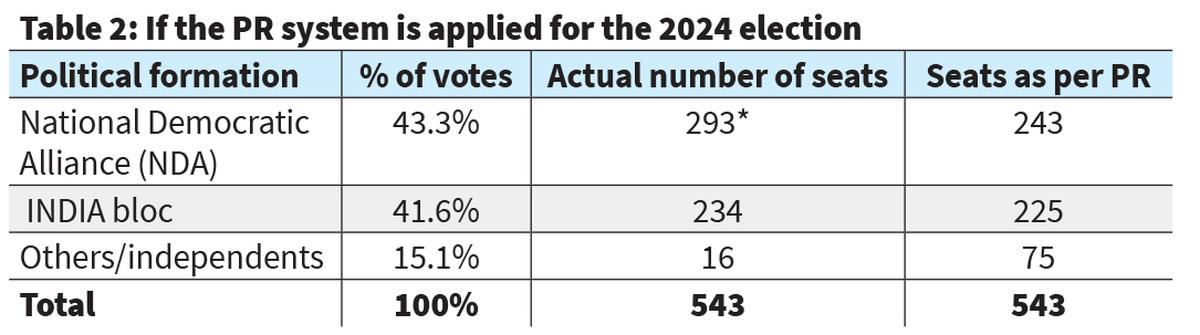
    India should contemplate proportional representation to ensure fairer political outcomes, given NDA’s 293 seats (43.3%) compared to INDIA bloc’s 234 seats (41.6%).

    First Past the Post (FPTP) System

    • First Past the Post (FPTP) is a voting system where the candidate with the most votes in each constituency wins, regardless of whether they achieve an absolute majority.
    • Simple and feasible method used in large democracies like India, the U.S., the U.K., and Canada.
    • Provides stability to the executive as the ruling party/coalition can enjoy a majority in the legislature without obtaining a majority of the votes across constituencies.
    • Criticized for potentially resulting in over or under-representation of political parties compared to their vote share.

    Proportional Representation (PR) System:

    • Ensures representation of all parties based on their vote share. Commonly implemented through party list PR, where voters vote for parties rather than individual candidates. PR system applied at each State/Union Territory (UT) level in federal countries like India.

    Pros and Cons Comparison between FPTP and PR

    First Past the Post (FPTP):

    • Pros: Simple, stable majority governments, clear constituency representation.
    • Cons: Disproportionate representation, underrepresentation of minorities, many wasted votes.

    Proportional Representation (PR):

    • Pros: Fairer representation, inclusivity of smaller parties, fewer wasted votes.
    • Cons: Complex, potential for unstable coalitions, weaker direct constituency representation.

    International Practices:

    • The PR system is used in presidential democracies like Brazil and Argentina, as well as parliamentary democracies like South Africa, the Netherlands, Belgium, and Spain.
    • Mixed Member Proportional Representation (MMPR) system employed in Germany and New Zealand.
    • Germany: Germany uses MMPR for elections to the Bundestag. Half of the seats are filled through FPTP constituencies, and the other half are allocated to ensure proportional representation based on party votes, provided parties receive at least 5% of the vote.
    • New Zealand: New Zealand’s House of Representatives is elected using MMPR, with 60% of seats filled through constituency elections and 40% allocated proportionally based on party votes.
    • The Mixed Member Proportional Representation (MMPR) system is a hybrid electoral system that combines elements of First Past the Post (FPTP) and Proportional Representation (PR) to ensure both local representation and proportionality in election results.

    Way Forward:

    • The Law Commission, in its 170th report titled ‘Reform of the Electoral Laws’ (1999), recommended the experimental introduction of the Mixed Member Proportional Representation (MMPR) system. It suggested that 25% of seats in the Lok Sabha could be filled using a Proportional Representation (PR) system by increasing the total number of seats.
    • Incremental implementation of MMPR system for additional seats during delimitation exercises to address population disparities while ensuring fair representation for all regions.
  • What are Cabinet Committees, and why is the CCS the most important of them all?

    Why in the News?

    After the swearing-in ceremony of PM Modi, he is set to share the four big portfolios of Home, Defence, Finance, and External Affairs with its alliance partners.

    What are the Cabinet Committees?

    • Cabinet committees in India are groups of ministers formed by the Prime Minister to handle specific tasks or issues more efficiently.
    • The PM sets up these committees with selected members of the Cabinet and assigns specific functions to these committees.
    • The PM may change the number of committees, and modify the functions assigned to them.
    • Usually, only Cabinet ministers are members of these committees. However, non-Cabinet ministers are not unheard of to be members or special invitees to committees.
    • If the PM himself is a member of any such committee, he acts as the head of that committee.

    Evolution of Cabinet Committees in India’s Governance

    • Cabinet committees operate under the Government of India Transaction of Business Rules, 1961.
    • These committees are categorized as Standing (Permanent) or Ad-Hoc (Temporary).
    • They are established based on Article 77(3) of the Constitution, allowing the President to make rules for efficient transaction of government business and allocation among ministers.
    • Membership varies from three to eight, predominantly comprising Cabinet ministers, with the Prime Minister often presiding.
    • The number, terminology, and composition may change over time.

    Note: All Cabinet Committees except the Cabinet Committee on Accommodation and the Cabinet Committee on Parliamentary Affairs are headed by the Prime Minister.

    There are 8 Cabinet committees at present — 

    1. Appointments Committee of the Cabinet (composed of the PM (ex-officio Chairman) and the Minister of Home Affairs),
    2. Cabinet Committee on Economic Affairs (headed by the PM himself),
    3. Cabinet Committee on Political Affairs (headed by the PM),
    4. Cabinet Committee on Investment and Growth,
    5. Cabinet Committee on Parliamentary Affairs,
    6. Cabinet Committee on Employment & Skill Development,
    7. Cabinet Committee on Accommodation, and
    8. Cabinet Committee on Security.
    • The Committees on Investment and Employment were innovations introduced in 2019  by the Modi government.

    About Cabinet Committee on Security

    • Head of the Committee: The Prime Minister assumes the role of the committee’s head.
    • Membership: Cabinet ministers of Finance, Defense, Home Affairs, and External Affairs serve as members.
    • Key Responsibilities: The committee addresses issues related to law and order, internal security, and foreign affairs policy with security implications, including matters concerning atomic energy.
    • Economic and Political Considerations: It also examines economic and political issues relevant to national security.
    • Financial Oversight: The CCS reviews cases involving capital defence expenditure exceeding Rs 1,000 crore.
    • Departmental Considerations: Additionally, it evaluates matters concerning the Department of Defence Production, Department of Defence Research and Development, Services Capital Acquisition plans, and procurement of security-related equipment.

    Why is CCS so important?

    • The CCS, led by the Prime Minister, includes key ministers overseeing finance, defence, home affairs, and external affairs, playing a pivotal role in national security discussions and appointments.
    • It makes major decisions regarding significant appointments, national security issues, and defence expenditure, indicating its crucial role in India’s security framework.
    • Apart from defence matters, the CCS addresses law and order, internal security, foreign policy on security issues, and matters related to atomic energy, showcasing its broad spectrum of responsibilities.

    Alliance Partners in the Cabinet Committee on Security (CCS)

    • 1996 Government Transition: A notable instance was during the 1996 H.D. Deve Gowda government, following Atal Bihari Vajpayee’s resignation as Prime Minister. Deve Gowda, then CM  of Karnataka, took office as Prime Minister on June 1. Mulayam Singh Yadav from the Samajwadi Party served as Defence Minister, P. Chidambaram, founder of the Tamil Manila Congress earlier that year, became Finance Minister, and Indrajit Gupta of CPI assumed the role of Home Minister.
    • 2001 Appointment: During Vajpayee’s tenure leading the NDA government in 2001, George Fernandes, founder of the Samata Party, was appointed Defence Minister, holding the position for three years. Notably, during his tenure as Defence Minister in Vajpayee’s second and third ministries (1998–2004), Fernandes oversaw critical events such as the Kargil War and nuclear tests at Pokhran.
    • Party Distribution: However, during the UPA government, the Congress retained all CCS positions, whereas in the Modi government, the BJP held all four positions.

    PYQ:

    [2014] The size of the cabinet should be as big as governmental work justifies and as big as the Prime Minister can manage as a team. How far the efficacy of a government then is inversely related to the size of the cabinet? Discuss.

    [2017] Out of the following statements, choose the one that brings out the principle underlying the Cabinet form of Government:

    (a) An arrangement for minimizing the criticism against the Government whose responsibilities are complex and hard to carry out to the satisfaction of all.

    (b) A mechanism for speeding up the activities of the Government whose responsibilities are increasing day by day.

    (c) A mechanism of parliamentary democracy for ensuring collective responsibility of the Government to the people.

    (d) A device for strengthening the hands of the head of the Government whose hold over the people is in a state of decline.

  • President appoints Narendra Modi as PM-Designate

    Why in the News?

    Narendra Modi will take the oath as the Prime Minister for a third consecutive term, following an invitation from President Droupadi Murmu to form the government.

    Constitutional Provisions for PM Post

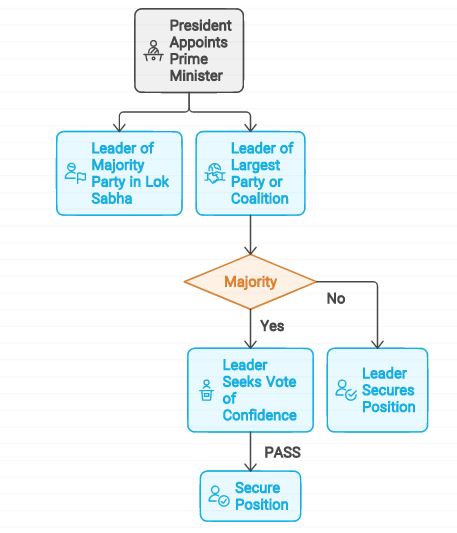
    • Article 75: It states that the President shall appoint the Prime Minister, who is usually the leader of the majority party in the Lok Sabha (House of the People).
    • Article 74: The Prime Minister is the head of the Council of Ministers and provides advice to the President on matters of governance.

    Appointment of the Prime Minister

    The appointment of the Prime Minister of India involves specific constitutional provisions supervised by the President. Key features related to the appointment of the Prime Minister as mentioned in the Constitution of India include:

    • The Prime Minister is appointed permanently by the President of India.
    • The President invites the leader of the majority party in the Lok Sabha to form the government.
    • If no political party holds a majority, the President can use discretionary powers to appoint the Prime Minister.
    • The President may invite the leader of the largest party or coalition to seek a vote of confidence from the Lok Sabha, with a tenure of about a month to secure this vote.

    Position of Prime Minister in India’s Democratic set-up         

    • Head of Government: The Prime Minister is the chief executive authority in the country, responsible for leading the government and overseeing the functioning of various ministries and departments.
    • Leader of the Council of Ministers: The Prime Minister is the leader of the Council of Ministers, which comprises cabinet ministers, ministers of state, and deputy ministers. They coordinate the activities of the government and guide policy decisions.
    • Advisor to the President: While the President of India is the head of state, the Prime Minister acts as the president’s chief advisor and assists in exercising executive powers.
    • Principal Link between President and Parliament: The Prime Minister communicates the decisions of the Council of Ministers to the President and represents the government in Parliament.
    • Symbol of Unity and Stability: The Prime Minister symbolizes the unity and stability of the country’s governance. They provide leadership and direction to the nation, fostering a sense of unity and purpose among the citizens.
    • International Representation: The Prime Minister represents India on the international stage and plays a significant role in foreign policy formulation. They engage in diplomatic relations, attend international summits, and represent India’s interests globally.
    • Crisis Management: During times of crisis, such as natural disasters, security threats, or economic challenges, the Prime Minister takes charge of crisis management efforts and leads the government’s response to address the situation.

    Powers and Functions of the Prime Minister

    The Indian Constitution outlines the powers and functions of the Prime Minister, who is appointed by the President and holds significant authority over the President, Council of Ministers, and parliamentary houses. These powers include:

    • Function Relative to the President: The Prime Minister serves as the main channel of communication between the President and the Council of Ministers, overseeing the administration of Union affairs and appointing key administrative officials.
    • Functions Relative to the Council of Ministers: The Prime Minister advises on the nomination and selection of Council Ministers, can allocate and shuffle ministerial departments, and has the authority to demand resignations from ministers. The resignation of the Prime Minister leads to the dissolution of the Council of Ministers.
    • Parliamentary Functions: The Prime Minister leads the lower parliamentary house (Lok Sabha), can suggest the dissolution of the Lok Sabha, and is responsible for announcing and introducing government policies in parliamentary sessions.
    • Miscellaneous Functions: The Prime Minister holds additional roles such as chairman of the National Water Resource Council, NITI Aayog, National Integration Council, Inter-State Council, and NDA, among others.

    Appointment, Tenure, and Removal

    Eligibility: According to Articles 84 and 75 of the Constitution of India, the Prime Minister must:

    • Be a citizen of India.
    • Be a member of the Lok Sabha or the Rajya Sabha, or become a member within six months of selection.
    • Be above 25 years of age if a Lok Sabha member, or above 30 years if a Rajya Sabha member.
    • Not hold any office of profit under the government of India or any state government.

    Oaths of Office and Secrecy:

    Before entering office, the Prime Minister must take an oath of office and secrecy in the presence of the President of India, as per the Third Schedule of the Constitution.

    Tenure and Removal from Office:

    • The Prime Minister serves at the “pleasure of the President,” but must maintain the confidence of the Lok Sabha.
    • The term can end if a simple majority of Lok Sabha members no longer have confidence in the Prime Minister, known as a vote of no-confidence.
    • A Prime Minister can also resign from office. Morarji Desai was the first to do so while in office.
    • Additionally, ceasing to meet the qualifications under the Representation of the People Act, 1951, can lead to removal from office.

    PYQ:

    [2015] Consider the following statements:

    1. The Executive Power of the union of India is vested in the Prime Minister.
    2. The Prime Minister is the ex officio Chairman of the Civil Services Board.

    Which of the statements given above is/are correct?

    (a) 1 only

    (b) 2 only

    (c) Both 1 and 2

    (d) Neither 1 nor 2

    [2019] Consider the following statements:

    1. The 44th Amendment to the Constitution of India introduced an Article placing the election of the Prime Minister beyond judicial review.
    2. The Supreme Court of India struck down the 99th Amendment to the Constitution of India as being violative of the independence of judiciary.

    Which of the statements given above is/are correct?

    (a) 1 only

    (b) 2 only

    (c) Both 1 and 2

    (d) Neither 1 nor 2

  • [4th June 2024] The Hindu Op-ed: Property is real, and so should the ‘compensation’

    [4th June 2024] The Hindu Op-ed: Property is real, and so should the ‘compensation’

    Mains PYQ Relevance: 

    Q) Starting from inventing the ‘basic structure’ doctrine, the judiciary has played a highly proactive role in ensuring that India develops into a thriving democracy. In light of the statement, evaluate the role played by judicial activism in achieving the ideals of democracy. (UPSC IAS/2014)

    Q) The Supreme Court of India keeps a check on the arbitrary power of the Parliament in amending the Constitution. Discuss critically. (UPSC IAS/2013)

    Note4Students: 

    Prelims:  Article 300-A;

    Mains: The decision of the Supreme Court in Kolkata Municipal Corporation;

    Mentor comments: A frequently cited maxim regarding property rights is that of President John Adams, who stated, “Property is surely a right of mankind as real as liberty.” This notion of property as a fundamental right has undergone significant developments in the post-colonial era, with the right to property being fiercely contested between courts and the legislature.

    Let’s learn

    Why in the News?

    The recent Supreme Court decision in “Kolkata Municipal Corporation & Anr. v. Bimal Kumar Shah & Ors” has clarified that Article 300-A of the Indian Constitution, which guarantees that no person shall be deprived of their property except by authority of law, encompasses seven essential procedural sub-rights that must be protected during land acquisition.

    Background 

    • Origin: The genesis of the power struggle over the right to property in India dates back to the case of Bela Banerjee, which involved the interpretation of Articles 19(1)(f) and 31(2) of the Constitution before the amendment. The Supreme Court held that the word “compensation” in Article 31(2) implied a just equivalent of what the owner had been deprived of. To undo this interpretation, the Constitution (Fourth) Amendment was passed in 1955, amending Article 31(2) to explicitly state that courts could not question the adequacy of compensation.
    • Substituting the word “compensation” with “amount,”: they held that although the final compensation was non-justiciable, the principles fixed by the legislature to determine such compensation were open to scrutiny. Parliament realised that the word “compensation” in Article 31(2) was the source of the problem. The Constitution (Twenty-Fifth) Amendment Act, 1971, substituted the word “compensation” with “amount,” effectively keeping the courts from interpreting the adequacy of such “amount” through judicial review.
    • Supreme Court response: The validity of the Constitution (Twenty-Fifth) Amendment Act, 1971, was upheld in Kesavananda Bharati, but the Supreme Court watered down the intended effect of the amended Article 31(2) through an interpretive process. The majority in Kesavananda Bharati held that though the adequacy of the amount paid was not justiciable, the courts could still examine whether the principles fixed for determining such compensation were relevant, effectively reinstating what Justice Shah had said in the Bank Nationalisation Case. After this decision, Parliament was convinced that the Right to Property remained a thorn in the goal of achieving a socialist state, as it was seen as a citadel of the bourgeoisie.

    Major changes:

    • Constitution (44th Amendment) Act, 1978: The Janata Party, which came to power after the 1977 general election, passed the Constitution (44th Amendment) Act, 1978. This amendment deleted Article 19(1)(f) and Article 31 from Part III of the Constitution and rehabilitated the right to property as a constitutional right under Article 300-A.
    • Right to property is not absolute: Article 300-A states that “no person shall be deprived of his property save by authority of law.” This provision emphasizes that the property right is not absolute and can be regulated by law.
    • Impact on the Right to Property: The deletion of Article 19(1)(f) and Article 31 led to a significant change in the Right to Property. The Right to Property was no longer a fundamental right, but a constitutional right that could be regulated by law.
    The arguments in the favour of Right to property

    Justice K.K. Mathew’s Observation: Justice K.K. Mathew, a dissenting judge in Kesavananda Bharati, believed that the right to own and acquire property was a fundamental right and should not have been excluded from the basic features of the Constitution.

    Professor P.K. Tripathi’s Views: Professor P.K. Tripathi argued that the deletion of Article 31 was a mistake and that the Right to Property was still protected by Article 300-A. He believed that “compensation” in Article 300-A meant the market value of the property at the time of acquisition.

    Supreme Court Interpretations: The Supreme Court has held that the Right to Property is not only a constitutional right but also a human right. In cases like M.C. Mehta and B.K. Ravichandra, the Court emphasized that laws depriving individuals of their property must be just, fair, and reasonable and that Article 300-A’s guarantee cannot be read down

    The recent decision of the Supreme Court in Kolkata Municipal Corporation has fleshed out seven different facets which are protected under Article 300-A-

    Seven Facets Protected:

    1. The right to notice
    2. The right to be heard
    3. The right to a reasoned decision
    4. The duty to acquire only for public purpose
    5. The right of restitution or fair compensation
    6. The right to an efficient and expeditious process
    7. The right of conclusion
    • Right to Restitution or Fair Compensation: The Supreme Court has reiterated that a person deprived of land by the state in the exercise of its power of eminent domain is entitled to be paid compensation which is just and reasonable.
    • Position in the Bela Banerjee Case: The Court has judicially affirmed the position prevailing when the unamended Article 31 was in force, and the interpretation expounded in the Bela Banerjee case on the aspect of payment of compensation.
    • Protection of Property: The decision in Kolkata Municipal Corporation vindicates the prophetic words of Prof. P.K. Tripathi, that in enacting the Forty-Fourth Amendment and deleting Articles 19(1)(f) and 31, Parliament has unwittingly given the property of a citizen the kind of protection it has never enjoyed before either in British or in independent India

    Way forward:

    • Ensure that the acquisition process is transparent and follows the prescribed procedures outlined in the Land Acquisition Act, 1894, and the Right to Fair Compensation and Transparency in Land Acquisition, Rehabilitation and Resettlement Act, 2013. 
    • Ensure that the procedures are documented and easily accessible to all stakeholders.
  • [29 May 2024] The Hindu Op-ed: The Constitution, a surprise entrant in poll battlefield

    [29 May 2024] The Hindu Op-ed: The Constitution, a surprise entrant in poll battlefield

    PYQ Relevance:

    Mains: 

    Q. Discuss each adjective attached to the word ‘Republic’ in the preamble. Are they defendable in the present circumstances stances? (UPSC IAS/2016)
    Q. ‘Constitutional Morality’ is rooted in the Constitution itself and is founded on its essential facets. Explain the doctrine of ‘Constitutional Morality’ with the help of relevant judicial decisions. (UPSC IAS/2021)

    Prelims:
    Which one of the following objectives is not embodied in the Preamble to the Constitution of India?  (UPSC IAS/2017)
    (a) Liberty of thought
    (b) Economic liberty
    (c) Liberty of expression
    (d) Liberty of belief

    Note4Students: 

    Prelims: Preamble; Constitutional Values;

    Mains: Democratic Political System;

    Mentor comment: Do you know what is the meaning of the word, ‘values’? You may immediately say that truth, non-violence, peace, cooperation, honesty, respect, and kindness are values, and you may continue to count many such values. In fact, in a layman’s understanding, value is that which is very essential or ‘worth having and observing’ for the existence of human society as an entity. The Indian Constitution contains all such values, the values that are universal, human, and democratic of the modern age. The constitutional values are reflected in the entire Constitution of India, but its Preamble embodies ‘the fundamental values and the philosophy on which the Constitution is based’. Political Democracy contributes to stability and continuous progress in society and it secures peaceful political change. But, during the recent General Elections, the interplay between the Constitution and political mobilization has fundamentally shaped the trajectory of democratic politics.

    Let’s learn.

    Why in the News?

    The General Elections of 2024 have established larger concerns over the Constitution constraint and the democratic legitimacy of the government, regardless of the election’s outcome.

    • The silences around secularism and the focus on caste-based discrimination and reservations reveal critical fault lines. 

    The Constitution as a Battleground in the 2024 Indian Election:

    • Political Tussle: The BJP’s declaration of winning 400+ seats and remarks about changing the Constitution if they achieve electoral dominance.
      • Opposition leaders portray this election as a battle to “save the Constitution” and it resonates with voters on the ground.
    • Constitutional Principles vs Ordinary Laws: Ordinary laws in India are often seen as discriminating and are used coercively by the state to undermine freedoms and disempower citizens. However, the Constitutional values provide the basis for challenging discriminatory laws. 

    The Constitution’s commitment to secure Liberty, Equality, and Dignity:

    • Liberty: The Preamble prescribes liberty of thought, expression, belief, faith and worship as one of the core values. These have to be assured to every member of all the communities.
    • Equality: Inequality based on the concept of rulers/caste/gender is to be eliminated. All citizens of India should be treated equally.
      • Similarly, equal opportunities imply that regardless of the socioeconomic situation, he/she will have the same chance as everybody else to develop his/her talents and choose a means of livelihood.
    • Dignity: The promotion of ‘Fraternity’ is essential to realize the dignity of the individual. It is essential to secure the dignity of every individual without which democracy cannot function.
      • It ensures equal participation of every individual in all the processes of democratic governance.
      • Although the word ‘dignity’ has no textual mention in the Constitution, the Supreme Court has held dignity to be the “founding faith” of the Constitution and the “core of Fundamental Rights.”
    Other core Constitutional values are expressed in the Preamble as objectives of the Constitution. Some of these are as follows:

    Sovereignty: Being sovereign means having complete political freedom and being the supreme authority. It implies that India is internally all-powerful and externally free. It is free to determine for itself without any external interference (either by any country or individual) and nobody is there within to challenge its authority.

    Socialism: Our Constitution directs the governments and the people to ensure the prevention of the concentration of wealth and power in a few hands. The Constitution has specific provisions that deal with inequalities in the chapters of Fundamental Rights
    and Directive Principles of State Policy.

    Secularism: India is home to almost all major religions in the world. In the context of this plurality, secularism is seen as a great Constitutional value. The Constitution strictly prohibits any discrimination on the grounds of religion.

    Democracy:
    The people elect the rulers of the country and the elected representatives remain accountable to the people. It allows dissent and encourages tolerance. More importantly, it is based on the principles of the rule of law, independence of the judiciary, free and fair elections, and freedom of the press.

    Contradictions in Contemporary Indian Politics:

    • Secularism vs Equality: Dalit voters emphasize the Constitution’s principles of Right to equality, while Muslim voters primarily express concerns about Secularism.
    • Secularism vs Equity: Ordinary young citizens have mobilized around Constitutional principles throughout India’s history to secure their Rights and challenge Socioeconomic deprivation.
      • For much of this decade, the logic of caste-based mobilization seemed to have receded in the background, for example, the introduction and passage of the 103rd Amendment to the Constitution mandated 10% reservations for economically weaker sections (EWS) amongst unreserved ( upper caste) categories.
      • A young BJP supporter fears that a “Hindu Rashtra” would lead to discrimination, while a Yadav farmer believes the Constitution protects them and gives them reservations.

    Conclusion: If the 2024 election is indeed a battle for the Constitution, the silences around secularism and the focus on caste-based discrimination and reservations reveal critical fault lines that the polity must confront. However, the heightened concerns over the Constitution also constrain the democratic legitimacy of the government, regardless of the election’s outcome.

    https://www.thehindu.com/opinion/lead/the-constitution-a-surprise-entrant-in-poll-battlefield/article68225687.ece

  • No Legal Mandate to share Voter Turnout Data: ECI to Supreme Court

    Why in the News?

    The Election Commission of India (ECI) told the Supreme Court that there is no legal mandate to provide Form 17C (account of votes recorded) to any other person other than the candidate or his agent.

    What does Article 329(b) say?

    • It specifically bars courts from intervening in any disputes related to the electoral process during the active phase of an election—from its notification to the final declaration of results.
    • This is to prevent any potential delays or disruptions caused by litigation during the election.

    About Forms 17A and 17C  

    As per the Conduct of Elections Rules, 1961, there are two forms that have data on the number of electors and voters — Forms 17A and 17C.

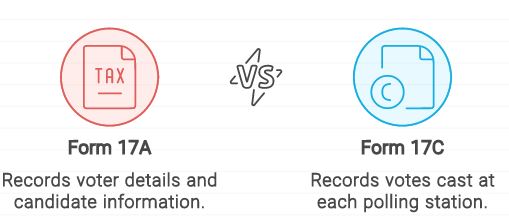
    1. Form 17A: This document, compiled by the Returning Officer for each constituency, lists contesting candidates and registers voter information, including names and symbols.
    2. Form 17C: Form 17C contains the account of votes recorded at each polling station during the election. It is prepared by the Presiding Officer of the polling station after the conclusion of polling. It includes:
    • EVM identification numbers.
    • Total number of electors and voters at the polling station.
    • Number of voters who did not record their votes after signing the register.
    • Number of voters not allowed to vote.
    • Total number of votes recorded per EVM.
    • Part-II of Form 17C: It carries counting results entered on counting day. This form is crucial for any legal challenges to the election results and for candidates to verify results on counting day.

    Why is there a Demand to Make Form 17C Data Public?

    • Activists advocate for greater transparency in election processes.
    • The high number of polling stations makes it hard for candidates to compile all data.
    • The Election Commission of India (ECI) is not legally required to publish aggregate voter turnout data.
    • The ECI ensures that all statutory requirements, including providing Form 17C to candidates, are met.
    • Discrepancies noted in Form 17C can be contested to maintain election integrity.

    Back2Basics: Conduct of Election Rules, 1961

    • The Conduct of Election Rules, 1961, commonly referred to as the 1961 Rules, outline the procedural framework governing various aspects of the electoral process in India.
    • These rules were formulated under the authority of the Representation of the People Act, 1951.
    • It serves as the foundational legislation for conducting elections in the country.
      • Activities covered: Preparation of electoral rolls, the nomination of candidates, the conduct of polling, counting of votes, and the declaration of results.
    • Regulatory Function: The 1961 Rules incorporate provisions for addressing electoral malpractices, disputes, and grievances, thereby safeguarding the sanctity of elections.


    PYQ:

    [2017] For election to the Lok Sabha, a nomination paper can be filed by

    (a) Anyone residing in India.

    (b) A resident of the constituency from which the election is to be contested.

    (c) Any citizen of India whose name appears in the electoral roll of a constituency.

    (d) Any citizen of India.