💥Join UPSC 2027,2028 Mentorship (July Batch) + XFactor Notes & Microthemes PDF

Subject: Fundamental Rights,DPSP

1. History + Evolution
2. Features
3. Amendments
4. Basic Structure

  • Premium- Indian Federalism as a Mad Hatter’s Tea Party

    Why in the News? 

    In recent times, the Central government has exerted significant political and financial control over the regional states.

    What is Federalism?

    • Federalism is a system of government in which power is divided and shared between a central authority (usually a national government) and constituent political units (such as states or provinces). 
    • Both levels of government have their spheres of authority, and they coexist within the same political framework.


    Indian Federalism:

    • India opted for a federal form of government because of linguistic and regional diversity. It has dual objectives, to safeguard and promote the unity, and to accommodate regional diversity.
    • However, Indian Federalism has been described as quasi-federal since it contains major federation and union features (Article 1 says, “India that is ‘Bharat’, shall be the Union of the states”).
    • The central government has more authority, especially in fiscal matters (due to which it is sometimes called “asymmetrical federalism”).
    • Federalism is part of the basic structure which cannot be altered or destroyed under the constituent powers of the Parliament without undergoing judicial review by the Supreme Court.

    Federal Features

    Non-federal features

    The Present Political Federal Issues in India:

    • Centralization of Power: Certain propositions laid down in the Supreme Court’s judgment, have upheld the prospects of Federalism in India
      • For example, the abrogation of Article 370 concerning Jammu and Kashmir’s special status by the central government without adequate consultation with the state government was seen as a move towards the Centralization of power.
    • Reorganization of States: The provision under Article 3 of the Constitution states that the President shall refer the Bill for the reorganization of any State to the legislature of the State concerned to elicit its opinion. 
      • The recent SC’s verdict that dismissed the challenges to the abrogation of Article 370 led to a serious undermining of federalism and the rights of the elected State legislatures.
    • Lack of clarity in Division of Powers: Although the subjects are enlisted in the Seventh Schedule and Emergency Provisions of the Constitution, the distribution of power between the Central government and the states lacks clarity and equity. 
      • For example, internal security assumes utmost importance with the Maoist challenge and cross-border terrorism, which threaten all the states across the country.
      • The Constitution does not refer either to ‘security’ or ‘internal security’ anywhere. However, it mentions five related terms namely ‘pubic order’ (List II, Entry 2), ‘war’ (Article 352), ‘external aggression’ (Article 352), ‘armed rebellion’ (Article 352), and ‘internal disturbance’ (Article 355).
      • Further, the imposition of President’s Rule in states under Article 356 has been recently criticized for being used arbitrarily by the central government.
    • Unequal Representation in Rajya Sabha: The representation of states in Parliament and other federal institutions does not accurately reflect their population, size, or contributions. Some states are over-represented while others are under-represented.
      • For example, the allocation of 80 Lok Sabha seats to Uttar Pradesh and only one to Sikkim results in unequal representation, impacting resource distribution and decision-making.
    • Simultaneous Elections: Measures discussed and recommended like the “One Nation One Election” undermined India’s federal structure and conflated the different priorities voters had for National, State, and “Panchayati raj” institutions, degrading each one’s different sphere of responsibility. 

    The Present Fiscal Federal issues in India:

    • Fiscal Divisible Pool: The states often face financial constraints due to their dependence on the central government for funds. The unequal distribution of resources can exacerbate disparities among states. 
      • For example, states like Bihar and Uttar Pradesh receive more funds from the central government under various schemes. However, recently the Kerala government faced serious financial crunches due to a lack of funds.
    • Implementation of Goods and Services Tax (GST): GST’s implementation has raised issues related to fiscal autonomy. States have voiced concerns about the loss of their taxation powers and uncertainties regarding compensation from the central government for revenue losses.

    Bodies related to the Federal System in India:

    • The Inter-State Council: It was constituted under Article 263 of the Constitution, and serves as a constitutional entity aimed at fostering coordination and collaboration between the Central government and the states regarding shared interests and issues of significance.  
    • The Finance Commission: It is a Constitutional Body established under Article 280 of the Constitution to recommend the distribution of revenues between the Centre and the states.
    • The NITI Aayog: Established in 2015 to replace the Planning Commission. It fosters cooperative federalism by involving states in policy formulation and implementation.

    Committee Recommendation:

    • Sarkaria Commission (1983):
        • Balanced Distribution of Powers: Recommended a balanced distribution of powers between the central government and states, ensuring that each level of government has adequate authority to perform its functions.
        • Cooperative Federalism: Emphasized the need for cooperative federalism, where the central and state governments work together in the spirit of partnership and collaboration.
    • Punchhi Commission (2007):
      • Strengthening Inter-State Council: Recommended strengthening the Inter-State Council, an institution tasked with promoting cooperation among states and between the center and states.
      • Revisiting Center-State Relations: Suggested revisiting and updating the provisions related to center-state relations to address contemporary challenges and promote cooperative federalism.


    Way Forward: The Centre cannot afford to ignore the importance of states to effectively respond to the Federal issues:

    • Empowerment of State Governments: Strengthen the powers and autonomy of state governments in decision-making processes, allowing them greater authority over issues within their jurisdiction, and revenue management is necessary.
    • Promoting Co-operative Federalism: Enhance the effectiveness of the Inter-State Council as a forum for dialogue and cooperation between the Centre and states on matters of common interest, ensuring meaningful participation of state leaders in decision-making processes.
    • Need a Balanced Approach: First, the government needs to review and make necessary amendments to clarify the distribution of powers, ensuring a more balanced and transparent framework for political governance.  Second, implement a balanced system of grants where states with weaker fiscal capacities receive adequate support to address developmental disparities.
    • Bringing Clarity: Clearly define revenue-sharing boundaries and internal security mechanisms between the Centre and states to ensure equitable distribution of resources.

    Prelims PYQ 

    Q) Which one of the following is not a feature of Indian federalism? (UPSC IAS/2017)

    1. a) There is an independent judiciary in India.
    2. b) Powers have been clearly divided between the Centre and the States.
    3. c) The federating units have been given unequal representation in the Rajya Sabha.
    4. d) It is the result of an agreement among the federating units.


    Q) Consider the following statements: (UPSC IAS/2020)

    1) The Consititution of India defines its ‘basic structure’ in terms of federalism, secularism, fundamental rights and democracy.

    2) The Constitution of India provides for ‘judical review to safeguard the citizens’ liberties and to preserve the ideals on which the Constitution is based.

    Which of the Statement given above is/are correct?

    1. a) 1 only
    2. b) 2 only
    3. c) Both 1 and 2
    4. d) Neither 1 nor 2

    Mains PYQ 

    Q1 How far do you think cooperation, competition and confrontation have shaped the nature of federation in India? Cite some recent examples to validate your answer. (UPSC IAS/2020) 

    Q2 The concept of cooperative federalism has been increasingly emphasised in recent years. Highlight the drawbacks in the existing structure and the extent to which cooperative federalism would answer the shortcomings.

  • The limitations of Ambedkarite Dalit politics today

    Why in the news?

    Organising grand events and celebrations in April to commemorate Babasaheb Ambedkar’s birth anniversary has become a national ritual now.

    Ambedkar’s Vision for Dalit Political Power

    •  Ambedkar envisioned the Dalit-Bahujan mass as the prime claimant of state power, aiming to form a greater social alliance with Adivasis, poor working classes, and agrarian laborers against exploitative orders.

    Historical Significance of Dalit Political Movements 

    • The mid-1990s saw the emergence of powerful Dalit political leadership, such as the Bahujan Samaj Party (BSP) under Kanshi Ram and Mayawati in Uttar Pradesh, as well as leaders like Prakash Ambedkar and Ramdas Athawale in Maharashtra.

    Limitation in Dalit politics today

    • Fragmentation in Dalit Political Legacy: Despite the unity seen in commemorations, there is a growing splintering in Ambedkar’s political legacies, resulting in Dalit political parties becoming passive and relegated forces.
    • Disintegration of Contemporary Ambedkarite Dalit Politics: Current Dalit politics lacks visionary leadership, a strong social base, and effective political strategies to emerge as a crucial player in democratic battles. It has disintegrated into segments.
    • Political Alliances and Vacillations: Dalit parties have sometimes formed alliances with parties like the BJP, despite Ambedkar’s ideologies being fundamentally opposed to Brahmanical and exploitative orders. This has led to criticism and accusations of abandoning core principles.

    Way Forward 

    • Building Stronger Intra-Dalit Unity: Encourage dialogue and collaboration among different Dalit political factions to foster a sense of unity and common purpose.
    • Investing in Leadership Development: Support initiatives aimed at nurturing visionary leadership within the Dalit community.
    • Strengthening Grassroots Mobilization: Focus on building a strong social base by actively engaging with Dalit communities at the grassroots level.

    Mains PYQ 

    Q Debate the issue whether and how contemporary movements for assertion of Dalit identity work towards annihilation of caste.(UPSC IAS/2015)

  • Easement Rights and Recent Supreme Court Ruling

    Why in the news?

    • The Supreme Court observed that a claimant of an Easementary Right cannot claim an Easement by necessity if there exists an alternative way to access the property owned by the claimant, known as the ‘Dominant Heritage‘.
      • The court referred to Section 13 of the Indian Easements Act, of 1882, which deals with easementary rights by necessity.

    What is Easement Right?

    • An Easement is a legal right to use someone else’s property for a specific purpose without possessing it.
    • Essentially, it’s a permission or privilege granted by the owner of one property (the servient land) to someone else (the dominant land) to use the servient land in a particular way.

    Legal backing for Easement Rights

    • Section 13 of the Indian Easements Act, 1882, serves as the cornerstone in adjudicating easementary rights disputes.
    • It mandates that such rights can only be claimed if no alternative access to the Dominant Heritage exists, providing clarity in legal proceedings.
    • Understanding terms like ‘Dominant Heritage’ (represents the property for enjoyment) and ‘Servient Heritage‘ (property over which rights are sought) is crucial in comprehending easementary rights disputes.

    Features of the Indian Easements Act, 1882:

    • Definition of Easements: The law defines what an easement is and the different types, like rights of way (to pass through someone’s land), rights to light and air, and rights to use water.
    • Acquisition of Easements: It explains how easements can be created. For example, by agreement between the parties or through long-time use.
    • Rights and Liabilities: It outlines the rights and responsibilities of both the person who has the easement (the beneficiary) and the person who owns the land over which the easement exists (the servient owner). For instance, the beneficiary must not do anything to increase the burden of the easement, and the servient owner must not obstruct the use of the easement.
    • Termination of Easements: It describes the circumstances under which an easement can come to an end. For example, if the purpose for which the easement was created ceases to exist, or if the beneficiary expressly gives up their right.
    • Customary Easements: It recognizes certain easements that arise due to local customs or traditions.

    Back2Basics: Fundamental Rights vs. Legal Rights

    Fundamental Rights Legal Rights
    Source Enshrined in the Indian Constitution, specifically Part III Derived from various sources such as Legislation, contracts, Judicial decisions, etc.
    Enforcement Directly enforceable against the state through constitutional remedies like writ petitions under Article 32 Enforceable through the legal system, but may vary in enforceability depending on the nature of the right and available legal mechanisms
    Scope Typically includes rights essential for the Protection of Individual Liberty, Equality, and dignity, such as the Right to Equality, Freedom of Speech, Right to Life and Personal Liberty, etc. Encompasses a wide range of rights recognized by law, including Property Rights, Contractual Rights, Tort Rights, Family Law Rights, Labor Rights, Consumer Rights, etc.
    Nature Paramount and inviolable, subject to limited exceptions as prescribed by the Constitution Subject to limitations or restrictions imposed by law, and may be subject to changes or modifications through Legislative action or Judicial Interpretation
    Examples Right to Equality, Right to Freedom of Speech, Right to Life and Personal Liberty, etc. Right to Property, Right to Contract, Right to sue for damages, Right to Vote, etc.


    PYQ:

    [2018] What is the position of Right to Property in India?

    (a) Legal right available to citizens only.

    (b) Legal right available to Persons only.

    (c) Fundamental Right available to citizens only

    (d) Neither Fundamental Right nor Legal Right

  • Is Transparency lacking in Candidate Disclosure?

    Why in the news? 

    The Supreme Court held that candidates need not to disclose every piece of Information and Possession in their Election Affidavit unless it is Substantial in Nature.

    What are the Legal Provisions?

    • Nomination paper with Affidavit: Section 33 of the Representation of the People Act, 1951 (RP Act) read with rule 4A of election rules, requires every contesting candidate to file their nomination paper for elections along with an Affidavit in a ‘prescribed format’.
    • Association of Democratic Reforms (ADR) Vs Union of India (2002): The Supreme Court held that voters have the right to know about the criminal antecedents, income and asset details of the candidate and his/her dependants and educational qualification of contesting candidates.
      • This judgement resulted in Section 33A being added to the RP Act that requires details of criminal antecedents to be part of the election affidavit.
    • Punishable Offence: Section 125A of the RP Act further provides that failure to furnish required information, giving false information or concealing any information in the nomination paper or affidavit shall be punishable with imprisonment up to six months or fine or both.

    Present Dilemma of Accountability:

    • Candidates with Criminal Charges: The significant issue of candidates with serious criminal charges contesting elections raises questions about the integrity and suitability of such candidates for public office.
      • According to a report by ADR, 19% of candidates in the 2019 Lok Sabha election faced charges of rape, murder or kidnapping.
    • Circumvention of Disclosure Requirements: Some candidates attempted to circumvent disclosure requirements by leaving certain columns blank and filing incomplete affidavits, indicating loopholes in the electoral process.

    Recommendations by Election Commission and Law Commission in its 244th report:

    • A conviction for filing a false affidavit should attract a punishment of a minimum of 2 years imprisonment and be a ground for disqualification.
    • The Trials in such cases must be conducted on a day-to-day basis.
    • Persons charged by a competent court with offences punishable by imprisonment of at least 5 years should be debarred from contesting in the elections provided the case is filed at least 6 months before the election in question.

    Supreme Court’s Judgement to resolve this issues: 

    • In Public Interest Foundation Vs Union of India (2018) directed candidates as well as political parties to issue a declaration about criminal antecedents, at least three times before the election, in a newspaper in the locality and electronic media.

    Way Forward:

    • Debarring from contesting elections : Debarring chargesheeted candidates from contesting elections is likely to be misused by various ruling parties.
    • Increasing Punishment for False Affidavits: Increasing punishment for filing false affidavits and making it a ground for disqualification need to be implemented.
    • Strict Implementation of SC order:The Supreme Court’s order to provide wide publicity of criminal records should also be strictly implemented.

    Conclusion: Addressing challenges in candidate disclosure, enhancing electoral integrity can be achieved through measures such as imposing stricter penalties for false affidavits, enforcing disclosure laws rigorously, and ensuring widespread dissemination of candidates’ criminal records.

  • Candidates have a Right to Privacy from Voters: SC

    Why in the news?

    • The Supreme Court affirmed a candidate’s right to privacy from voters, stating that candidates need not divulge every aspect of their personal lives and possessions to the electorate.
    • It held that Voters Right to Know about the electors is NOT ABSOLUTE.

    Right to Privacy in India:

    • The Right to Privacy under Article 21 of the Indian Constitution is interpreted as an intrinsic part of the fundamental right to life and personal liberty.
    • Article 21 states that “No person shall be deprived of his life or personal liberty except according to procedure established by law.”
    • In the landmark judgment of Justice K.S. Puttaswamy (Retd.) v. Union of India (2017), the Supreme Court explicitly recognized the Right to Privacy as a fundamental right under Article 21.
    • The court held that privacy is an essential aspect of personal liberty and dignity, encompassing informational privacy, decisional autonomy, bodily integrity, and spatial privacy.
    • This right protects individuals against unwarranted intrusions into their private lives by the state or any other entity.
    • It includes the right to keep personal information confidential, to make decisions about one’s life and body without interference, and to maintain physical and spatial autonomy.


    A candidate doesn’t need to declare every item of movable property, such as clothing, shoes, crockery, stationery, and furniture, unless these items are of such value as to constitute a sizeable asset in itself or reflect upon the candidate’s candidature in terms of their lifestyle – Supreme Court. 

    What are Corrupt Practices under the RPA?

    • Section 123 of the Representation of People Act, 1951 defines “corrupt practices” to include bribery, undue influence, false information, and promotion of enmity among citizens based on religion, race, caste, etc.
    • Section 123(2) deals with “undue influence,” involving interference with electoral rights through threats or promises.
    • Undue influence can manifest in various forms, including threats of physical harm, coercion, intimidation, promises of reward or benefit, or exploitation of vulnerabilities.

    Supreme Court’s Verdict

    1. Emphasis on Candidate’s Right to Privacy:
    • Upholding the appeal, the Supreme Court emphasized the candidate’s right to privacy, stating that not every non-disclosure automatically constitutes a defect.
    • The court highlighted that a candidate is not required to disclose every item of movable property unless it reflects upon their candidature or lifestyle.
    1. Case-specific Evaluation:
    • The court emphasized that each case must be judged on its own merits, without applying a blanket rule.
    • The Court emphasized that non-disclosure of certain personal possessions does not amount to a “defect of a substantial nature” under Section 36(4) of the 1951 Act.
    1. Example of “High-value” Assets:
    • Suppression of high-priced assets, indicating a lavish lifestyle, would constitute undue influence.
    • However, ownership of simple, low-value items may not be considered a defect.

    PYQ:

    [2017] For election to the Lok Sabha, a nomination paper can be filed by-

    (a) Anyone residing in India.

    (b) A resident of the constituency from which the election is to be contested.

    (c) Any citizen of India whose name appears in the electoral roll of a constituency.

    (d) Any citizen of India.

  • In news: Cantonment Boards

    Why in the news?

    • The Centre has reportedly initiated measures to reduce the land jurisdiction of 10 major cantonment boards across five states.
    • In May 2023, the Centre had kicked off a plan to abolish all 62 colonial-era Cantonments across the country.

    What are Cantonments?

    • Cantonments are Permanent military stations where a group of military personnel are stationed for administrative purposes.
    • They are governed by the Cantonments Act, 2006, which provides for municipal administration and control of these areas.
    • India currently has 62 cantonments spread across various states, with some areas known for their better infrastructure and facilities compared to other parts of the country.
    • Cantonments are managed by Cantonment Boards, which are democratic bodies comprising elected and nominated members.
    • The Station Commander of the Cantonment serves as the ex-officio President of the Board.

    Historical Background

    • The Cantonments Act, 1924, was enacted by the British to regulate the municipal administration of cantonments.
    • After India’s independence, the Cantonments Act was modified to suit the democratic setup of the country.
    • The current Cantonments Act, 2006, replaced the previous version, aiming to provide greater autonomy and accountability to the Cantonment Boards.

    Categories of the erstwhile Cantonments

    Cantonments are categorized based on the population size residing within them:

    1. Category I: Cantonments with a population of over 50,000.
    2. Category II: Cantonments with a population of 10,000 to 50,000.
    3. Category III: Cantonments with a population of less than 10,000.
    4. Category IV: Industrial or training Cantonments, irrespective of their population size.

    Centre’s plan to re-regulate Cantonments

    • Conversion to Exclusive Military Stations: Under the plan, military areas within all cantonments will be carved out and designated as “exclusive military stations.” The Army will exercise “absolute control” over these areas, streamlining their administration and operations.
    • Merger with Local Municipalities: The civilian areas of cantonments will be integrated with the respective local municipalities. These municipalities will take up the responsibility of maintaining these areas, along with providing essential services and infrastructure.
    • Move Away from Traditional Cantonment Concept: Post-independence, the Indian Army moved away from the traditional cantonment concept, primarily due to friction between military and civilian authorities. However, certain major cantonments continued to exist, such as Pune Cantonment and Agra Cantonment.
  • The citizen’s ‘climate rights’

    Why in the news? 

    The Supreme Court recently held that people have a fundamental right to be free from the adverse effects of climate change while emphasizing that countries like India must uphold their international obligations for healthy and sustainable development [M K Ranjitsinh & Ors. vs Union of India].


    Background of M K Ranjitsinh & Ors. vs Union of India Case:

      • The case was related to the conservation of the critically endangered Great Indian Bustard (GIB).
      • In 2021, a writ petition was filed by retired government official and conservationist M K Ranjitsinh, seeking protection for the GIB and the Lesser Florican, which are on the verge of extinction.
      • On April 19, 2021 order by SC was imposed restricting the setting up of overhead transmission lines in a territory of about 99,000 sq km in the GIB habitat in Rajasthan and Gujarat.
    • The Supreme Court has ruled that people have a “right to be free from the adverse effects of climate change”, which should be recognized by Articles 14 and 21 of the Constitution.
    • This judgment was by a three-judge Bench of Chief Justice of India (CJI) D Y Chandrachud and Justices J B Pardiwala and Manoj Misra.

    The Recent Modification over Earlier Judgement given by the SC:

    Who applied for modification of an earlier case?

    • The Ministry of Power, the Ministry of Environment, Forest and Climate Change, and the Ministry of New and Renewable Energy had applied to modify the 2021 order on grounds that
    • It had adverse implications for India’s power sector, and undergrounding power lines was not possible
    • The Paris Climate Treaty (2015) is one of the key grounds for seeking a modification of the 2021 order.

    What SC did say in this case?

    • Underground powerlines: The apex court modified its April 2021 order giving directions for underground high-voltage and low-voltage power lines, and directed experts to assess the feasibility of undergrounding power lines in specific areas after considering factors such as terrain, population density, and infrastructure requirements
    • The earlier direction was not feasible: The ruling acknowledged that its earlier directions, “besides not being feasible to implement, would also not result in achieving its stated purpose, i.e., the conservation of the GIB”.
    • Suitable relationship between FR and DPSP: The court emphasized that when addressing environmental concerns outlined in the Directive Principles of State Policy, they must be interpreted in conjunction with the right to life and personal liberty as enshrined in Article 21.

    How have the Courts interpreted Article 21 earlier?

    • Article 21 as the Heart of Fundamental Rights: The Supreme Court (SC) recognizes Article 21 of the Constitution as central to fundamental rights, emphasizing that the right to life encompasses more than mere existence but includes all rights necessary for a meaningful and dignified life.
    • Inclusion of Environmental Rights within Article 21: In the 1980s, the SC expanded Article 21 to include the right to a clean environment, along with various other rights such as education, shelter, clean air, livelihood, and medical care.
    • Actualizing New Rights: Despite the recognition of these new rights, citizens often face challenges in exercising them, particularly in cases concerning environmental issues like clean air.


    What are the implications of the judgment for environmental jurisprudence?

    • Strengthening Environmental and Climate Justice: The judgment emphasizes bolstering environmental and climate justice by recognizing the multifaceted impacts of climate change on various communities.
    • Expansion of Article 14 and Right to Life: The judgment expands the scope of Article 14 of the Constitution, which guarantees equality before the law, to encompass environmental concerns.
    • Influence on Public Discourse and Government Policies: The judgment is expected to influence public discourse on environmental issues, shaping perceptions and priorities regarding environmental protection.
    • Establishment of Legal Precedent: By acknowledging the “right against adverse effects of climate change,” the judgment establishes a significant legal precedent.

    Conclusion: The Supreme Court’s recognition of citizens’ “right to be free from adverse effects of climate change” expands constitutional protections, strengthens environmental justice, influences policy discourse, and sets a crucial legal precedent.

    Mains PYQ 

    Q Does the right to clean environment entail legal regulation on burning crackers during Diwali? Discus in the light of Article 21 of Indian Constitution and judgements of the apex in this regard.(UPSC IAS/2015) 

    Q The most significant achievement of modern law in India is the constitutionalization of environmental problems by the Supreme Court.” Discuss this statement with the help of relevant case laws. (UPSC IAS/2022) 

  • [6 April 2024] The Hindu Op-ed: Parliaments past, a mirror to changing dynamics

    [6 April 2024] The Hindu Op-ed: Parliaments past, a mirror to changing dynamics

    PYQ Relevance:

    Mains: 

    Q. The role of individual MPs (Members of Parliament) has diminished over the years and as a result healthy constructive debates on policy issues are not usually witnessed. How far can this be attributed to the anti-defection law, which was legislated but with a different intention? (UPSC CSE 2013)
    Q. To what extent, in your view, the Parliament can ensure accountability of the executive in India? (UPSC CSE 2021)

    Prelims:

    We adopted parliamentary democracy based on the British model, but how does our model differ from that model?​ (UPSC CSE 2021)

    1. As regards legislation, the British Parliament is supreme or sovereign but in India, the power of the Parliament to legislate is limited.
    ​2. In India, matters related to the constitutionality of the Amendment of an Act of Parliament are referred to the Constitution Bench by the Supreme Court.​

    Select the correct answer using the code given below.​

    (a) 1 only ​(b) 2 only​(c) Both 1 and 2 ​(d) Neither 1 nor 2

    Note4Students: 

    Mains: Parliamentary Democracy; 

    Mentors Comment: We Indians have been through ‘thick and thin’ as our Democracy has evolved. Since the 16th and 17th Loksabha, all have been doubts relating to the accountability of people’s Representation in Parliament due to the reduced Debates and discussions in Parliamentary sessions. Now, as we move towards the general election of 2024, the question arises: will history repeat itself? Or, will a new precedent be set? This prompts us, as citizens of India, to reflect on the performance of our Parliament as we wait to usher in the 18th Lok Sabha.

    Let’s learn. 

    Why in the News?

    The present conduct of business in both Houses of Parliament points out the need for a revitalization of legislative engagement in a more constructive manner.

    • The 17th Lok Sabha (2019-2024) concluded its proceedings marking the culmination of a journey with unexpected twists and turns.

    How did Ministries fare during the 17th Loksabha?

    • Decline in Executive Accountability: The PMO found itself flooded with 1,146 questions from Rajya Sabha Members of Parliament, of which only 28 were answered. Similarly, the House of the People also witnessed a sharp decline, from 5,000 during the 15th and 16th Lok Sabhas to a mere 1,700 in the 17th Lok Sabha.
      • Ministry of Finance tasked with steering the nation’s fiscal destiny, has witnessed a gradual erosion of parliamentary interest, declining to the fourth and fifth position in the Parliament.
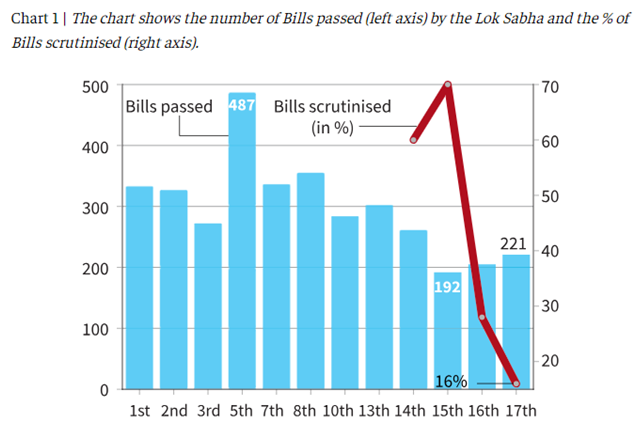
    • Decline in Legislative Process: The annual average of Bills passed declined from 65 in the 1952-1990 period to 48 in 1991-2023. The number of Bills sent to committees for scrutiny also dwindled consistently, with the 17th Lok Sabha sending only 16% of Bills for scrutiny, the lowest in the past four Lok Sabhas.
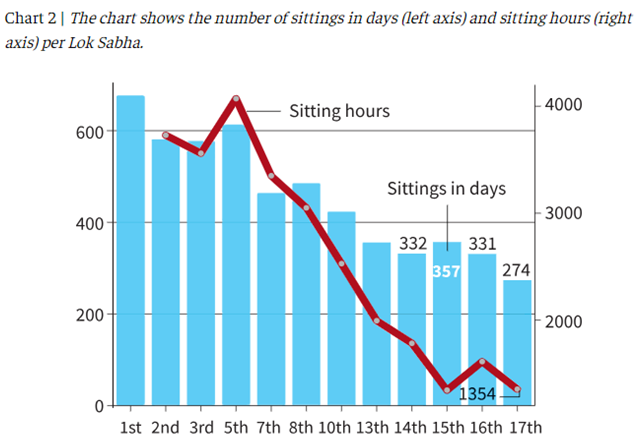
    • A decline in Debates and Discussions: Before 1990, each Lok Sabha typically convened for over 550 days on average, spanning 3,500 hours. The 17th Lok Sabha had the least number of sittings, only 274 days on average.
      • The Ministry of Home Affairs, which was the Ministry with the second most number of questions directed towards it till the 15th Lok Sabha, has now faded. This shift raises questions about the nation’s priorities.
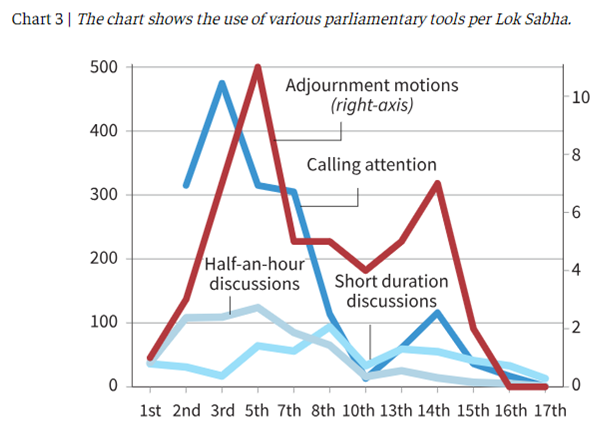
    • Decline in the use of various parliamentary tools:
      • Calling Attention Motion: It is a vital tool allowing MPs to draw attention to issues and elicit responses from ministers was extensively used between 1957 and 1990, with an average of 300 notices allowed per Lok Sabha. Post-1990, only 40 notices have been allowed per Lok Sabha. The 17th Lok Sabha allowed only one such discussion.
      • For example, the Winter Session, 2023 of the Rajya Sabha missed a crucial discussion on the sensitive and key issue of ‘Suicides among students due to competitive exams’.
    • The Adjournment Motion: It is employed to address urgent issues with a subsequent vote, and serves as an expression of disagreement with the government’s policies. Pre-1990, the Lok Sabha permitted discussion and voting on four such motions on average. Post-1990, this number decreased to three. The 16th and 17th Lok Sabha allowed no adjournment motions.
    • Ministries such as Health and Family Welfare, Home Affairs, Defence, Agriculture and Farmers’ Welfare, and Finance, made up 36.6% of all disallowed questions in Rajya Sabha. In contrast, in the Lok Sabha, they made up 37.8% of the disallowed questions, underscoring systemic challenges.

     Way Forward:

    • Need for 15-point Reform: As recommended by the Vice President, it is required to make the Charter function effectively and efficiently by ensuring that the members of the committee are nominated based on domain knowledge and for a longer assured term.
    • Need to work on Democratic Principles: To maximize the Parliament’s ability to hold the executive accountable, it is crucial to promote a conducive environment for constructive debate, scrutiny, and oversight.

    https://www.thehindu.com/opinion/lead/parliaments-past-a-mirror-to-changing-dynamics/article68033393.ece

    https://www.thehindu.com/data/the-many-lows-of-the-17th-lok-sabha-data/article67852889.ece

  • Why Supreme Court bar unregulated soil extraction for linear projects?

    Why in the News?

    Recently, the SC revoked the notification given by the Environment Ministry to exempt the extraction of ordinary earth for linear projects, such as road and railway construction.

    • It was challenged before the National Green Tribunal (NGT), which asked the Ministry to review it within three months. However, the Ministry did not take any action, leading the matter to reach the SC.

    What are the linear projects? 

    Linear projects refer to Construction or Development Projects. It includes the construction of linear structures like utility lines, pipelines, railroad tracks, highways, stormwater channels, and stream restoration activities.

    What was the 2020 exemption?

    • September 2006: The Environment Ministry issued a notification under the Environment (Protection) Act, 1986, on activities that would require prior Environmental Clearance.
    • January 2016: A second notification was issued, exempting certain categories of projects from this requirement.
    • March 2020: It added “Extraction or sourcing or borrowing of ordinary earth for the linear projects such as roads, pipelines, etc” to the list of exempted activities.
      • The general purpose of the 2020 notification was to conform to the amendments made to the Mines and Minerals (Development and Regulation) Act, 1957, in March 2020, allowing new lessees to continue mining for two years with the statutory clearances and licenses issued to their predecessors.

    Nexus between the Judiciary and the Union Government (Ground for Challenges)

      • Judicial stand: The SC invalidated the broad and random exception, highlighting that the announcement was rushed during the COVID-19 lockdown without seeking feedback or objections through prior notification.
    • The exemption granted without incorporating safeguards was deemed arbitrary and violative of Article 14 of the Constitution.
    • The court emphasized that the absence of safeguards defeats the purpose of the Environment Protection Act (EP Act).
    • An argument by the center: The Center contended that the exemption was essential “to benefit the general public” and would support “the kumhars (potters), farmers, gram panchayats, banjaras, roads of Gujarat,” and all non-mining activities recognized by the states.
      • However, the Apex court stated that the Centre had failed to provide reasons for concluding that the notification was issued in the public interest.

    Similar Judicial Scrutiny in the Past:

    • January 2018: The NGT quashed an exemption offered by the Ministry’s 2016 notification from the requirement of prior EC for building and construction activities having built-up areas of more than 20,000 sq m. According to the Tribunal, there was nothing to suggest an improvement in the quality of the environment to justify the exemption.
    • July 2015: Underlining that the EP Act mandates prior approval, the NGT struck down two Office Memorandums issued by the Ministry in December 2012 and June 2013 for granting ex-post facto EC to projects under the 2006 notification.
    • July 2021: Another notification of the Ministry that sought to perpetuate an amnesty window opened for just six months in March 2017 to clear projects under the “violation category” and issued ex-post facto approval to more than 100 projects, until the SC stayed it in January this year.
    • March 2024: The Kerala HC quashed a 2014 notification that exempted educational institutions and industrial sheds with built-up areas of more than 20,000 sq m from obtaining EC.


    Conclusion: The Supreme Court invalidated the Environment Ministry’s exemption for earth extraction in linear projects due to a lack of justification and safeguards, emphasizing compliance with Environmental Clearance to minimize environmental harm, safeguarding the Environment Protection Act’s purpose.

    Mains PYQ

    Q How does the draft EnvironmentImpact Assessment(EIA)Notification, 2020 differ from the existing EIA Notification, 2006? (UPSC IAS/2020)

  • In news: Central Administrative Tribunal (CAT)

    Why in the News?

    • The Allahabad High Court clarified the appellate jurisdiction concerning orders issued by the Central Administrative Tribunal (CAT) in contempt proceedings.
    • The court ruled that appeals against CAT contempt orders must be filed exclusively before the Supreme Court under Section 19 of the Contempt of Courts Act, 1971.

    What is Central Administrative Tribunal (CAT)?

    • The CAT is a specialized quasi-judicial body in India established under Article 323-A of the Constitution of India.
    • Its primary function is to adjudicate disputes and complaints related to recruitment and service conditions of government employees.
    • CAT was set up to provide a speedy and inexpensive remedy to government employees in matters concerning their service conditions and employment disputes.

    Establishment of CAT:

    • The Administrative Tribunals Act in 1985 enacted by the Parliament authorizes the central government to establish Central Administrative Tribunal and the State Administrative Tribunals.
    • There are 17 Benches and 21 Circuit Benches in the Central Administrative Tribunal all over India.

    Jurisdiction of CAT:

    • The Administrative Tribunal is distinguishable from the ordinary courts with regard to its jurisdiction and procedure.
    • It exercises jurisdiction only about the service matters of the parties covered by the Act.
    • CAT exercises jurisdiction over all service matters concerning the following:
    1. A member of any All-India Service
    2. A person appointed to any civil service of the Union or any civil post under the Union
    3. A civilian appointed to any defence services or a post connected with defence

    Services NOT Covered:

    The following members are NOT covered under the jurisdiction of CAT:

    1. Defense forces, Officers,
    2. The staff of the Supreme Court and
    3. Secretarial staff of the Parliament.

    Procedure:

    • The CAT is guided by the principles of natural justice in deciding cases and is NOT bound by the procedure, prescribed by the Civil Procedure Code.
    • It is empowered to frame its own rules of procedure and practice.
    • Under Section 17 of the Administrative Tribunal Act, 1985, the Tribunal has been conferred with the power to exercise the same jurisdiction and authority in respect of contempt of itself as a High Court.

    Composition:

    • The CAT comprises of a chairman, and other members who are appointed by the President of India.
    • The membership of CAT is filled by members from judicial and administrative fields.
    • The term of the service is 5 years or until the age of 65 years for chairman; 62 years for members, whichever is earlier. (minimum age is 50 years)
    • The chairman or any other member may address his resignation to the President in between his term of office.


    PYQ:

    2019: The Central Administrative Tribunal (CAT) which was established for redressal of grievances and complaints by or against central government employees nowadays is exercising its power as an independent judicial authority. Explain.


    Practice MCQ:

    Consider the following statements about the Central Administrative Tribunal (CAT):

    1.    The CAT is a specialized quasi-judicial body.

    2.    It adjudicates disputes and complaints related to recruitment and service conditions of government employees.

    3.    Personnel of the armed forces are covered in the jurisdiction of CAT.

    How many of the above statements is/are correct?

    (a) One

    (b) Two

    (c) Three

    (d) None