💥Join UPSC 2027,2028 Mentorship (July Batch) + XFactor Notes & Microthemes PDF

Subject: Fundamental Rights,DPSP

1. History + Evolution
2. Features
3. Amendments
4. Basic Structure

  • How are courts protecting personality rights?

    Introduction

    Personality rights, the right to control one’s name, image, likeness, and voice, have become a critical issue in India’s courts. With AI enabling deepfakes, voice cloning, and digital impersonation, Bollywood celebrities like Aishwarya Rai Bachchan, Abhishek Bachchan, Anil Kapoor, and Jackie Shroff have approached courts to restrain unauthorised commercial exploitation of their persona. While these judicial interventions protect individual dignity and brand equity, they also raise complex questions about the balance between Article 21 (privacy and autonomy) and Article 19(1)(a) (freedom of speech and expression).

    Why is this in the news?

    The Delhi High Court recently issued orders protecting Aishwarya Rai Bachchan and Abhishek Bachchan from AI-generated misuse of their images and voices. This is significant because:

    1. Novel threat: It highlights how AI deepfakes and voice cloning are creating unprecedented risks for identity and privacy.
    2. Judicial trend: Courts are extending personality rights protections to celebrities such as Karan Johar, Amitabh Bachchan, Anil Kapoor, Jackie Shroff, and Arijit Singh.
    3. Big problem: Without regulation, AI-driven impersonation undermines trust, dilutes brand equity, and strips individuals of control over their identity.
    4. Turning point: Courts are now explicitly linking personality rights to Article 21 of the Constitution, signalling a constitutional recognition of digital dignity.

    How are personality rights defined in India?

    1. Safeguards: Personality rights protect name, likeness, image, voice, signature, and other unique traits.
    2. Legal foundation: Rooted in common law doctrines of privacy, publicity, and defamation, supported by judicial precedents.

    Statutory framework:

    1. Copyright Act, 1957: Sections 38A & 38B grant performers exclusive and moral rights over their performances.
    2. Trade Marks Act, 1999: Allows registration of names/signatures as trademarks (e.g., Shah Rukh Khan, Priyanka Chopra).
    3. Tort of Passing Off: Prevents misrepresentation of a celebrity’s persona as endorsement.

    How have courts shaped personality rights?

    1. R. Rajagopal v. State of Tamil Nadu (1994): Supreme Court recognised the right to control one’s identity, grounding it in privacy under Article 21.
    2. Rajinikanth case (2015): Madras HC restrained unauthorised use of the actor’s persona in a film.
    3. Anil Kapoor case (2023): Delhi HC granted wide-ranging protection, clarifying that free speech covers parody/satire but not commercial misuse.
    4. Jackie Shroff case (2024): Court restrained misuse of his persona on e-commerce and AI platforms.
    5. Arijit Singh case (2024): Bombay HC recognised risks of voice cloning through AI.

    Do personality rights restrict free expression?

    Free speech scope: Article 19(1)(a) allows criticism, parody, satire, and lampooning of public figures.

    Judicial caution:

    1. DM Entertainment v. Baby Gift House (2010): Caricatures and parodies do not usually infringe publicity rights.
    2. Digital Collectibles v. Galactus Funware (2023): Material already in the public domain may be used without implying endorsement.
    3. Balancing test: Courts strike a balance between creative freedom and protection of dignity/brand equity.

    Why is regulation urgently needed?

    1. Fragmented protections: Enforcement is currently piecemeal, relying on case law.
    2. Digital threats: Generative AI expands risks of impersonation and deepfakes.
    3. Disproportionate impact: Ordinary citizens, especially women targeted through revenge porn, face greater harm.
    4. Policy need: Experts call for a comprehensive legislative framework to clearly define exceptions and ensure free speech is not chilled.

    Conclusion

    The judiciary is laying down crucial guardrails for personality rights in the digital age, particularly against AI-driven impersonation. However, without a clear legislative framework, judicial interventions remain reactive. The challenge lies in balancing dignity and privacy with freedom of speech, ensuring that protections do not turn into censorship while still safeguarding individuals, from Bollywood celebrities to ordinary citizens, against misuse of their identity.

    [UPSC 2024] Right to privacy is intrinsic to life and personal liberty and is inherently protected under Article 21 of the constitution. Explain. In this reference discuss the law relating to D.N.A. testing of child in the womb to establish its paternity.

    Linkage: The PYQ on Right to Privacy under Article 21 examines autonomy over personal identity, like in DNA testing. This article is relevant as it shows courts extending privacy into personality rights against AI misuse, with case laws and statutes providing examples to balance privacy and free speech in UPSC answers.

    Value Addition

    Global Context & Reports

    1. WIPO Intellectual Property Report (2022): Notes rapid rise of personality/IP litigation due to digital commerce.
    2. UNESCO Report on AI & Ethics (2021): Warns against deepfakes undermining democratic discourse and human dignity.
    3. US “Right of Publicity” Laws: Celebrities can sue for unauthorised commercial use of their persona, providing comparative perspective.
    4. EU GDPR (2018): Protects personal data, extending indirectly to digital identity misuse.


  • [24th September 2025] The Hindu Op-ed: Criminal Defamation is incompatible with democratic debate

    PYQ Relevance

    [UPSC 2014] What do you understand by the concept ‘freedom of speech and expression’? Does it cover hate speech also? Why do the films in India stand on a slightly different plane from other forms of expression? Discuss.

    Linkage: The 2014 PYQ on freedom of speech, hate speech, and films directly links with criminal defamation as both test the limits of Article 19(1)(a) under Article 19(2). Just as films and hate speech face special restrictions, criminal defamation raises the question of whether jail for reputational harm is a proportionate curb on free expression.

    Mentor’s Comment

    The debate around criminal defamation in India has resurfaced with the Supreme Court itself acknowledging the growing misuse of the law. What began as a safeguard for reputation has increasingly turned into a tool of intimidation, propaganda, and political retribution. This article examines why criminal defamation is incompatible with democratic debate, the disproportionate nature of its penalties, and how its misuse has shaped India’s political and media landscape. We will also provide value additions, practice questions, and related UPSC linkages.

    Introduction

    In 2016, the Supreme Court upheld the constitutionality of criminal defamation in the Subramanian Swamy v. Union of India case, equating reputation with the right to life. However, recent developments show that this reasoning has produced more problems than it has solved. On September 22, Justice M.M. Sundresh expressed concern over the growing use of criminal defamation by political actors and private individuals as a shield against criticism and as a weapon of retribution. With imprisonment prescribed as a penalty, the law now threatens democratic debate, fosters self-censorship, and risks turning the judiciary into a tool for silencing dissent.

    Criminal Defamation in the News

    The issue has returned to the spotlight because of rising judicial unease over its misuse. Justice M.M. Sundresh’s recent remarks highlight how criminal defamation cases are no longer rare or exceptional but routine weapons used by politicians, business interests, and individuals to stifle criticism. From Rahul Gandhi and Shashi Tharoor to journalists and opposition leaders, many face disproportionate litigation that results in prolonged trials, loss of political time, and harassment. This represents not just isolated misuse but a systemic problem that undermines free speech and democratic accountability.

    Defamation (criminal) — statutory text & essentials

    1. Statutory definition: Section 499 of the Indian Penal Code defines defamation as making or publishing an imputation concerning any person intending to harm, or knowing or having reason to believe that such imputation will harm, that person’s reputation.
    2. Punishment: Section 500 prescribes simple imprisonment up to two years, or fine, or both.
    3. Exceptions: Section 499 contains ten exceptions (e.g., truth for public good, fair comment on public conduct, parliamentary proceedings, etc.) — these are crucial in practice and often determinative in defamation disputes.
    • Under Bharatiya Nyaya Sanhita (BNS), 2023:

      • Section 354(2) – punishment up to 2 years simple imprisonment, or fine, or both, or community service.
      • Section 356 – covers words, signs, or visible representations harming reputation.
    • Scope: Applies to individuals, companies, and deceased persons if family reputation is harmed.
    • Essential Elements: False statement, harm to reputation, communication to third party, and intent/knowledge of likely harm.
    • Nature of Offence: Non-cognizable and bailable – requires a warrant for arrest; bail available.
    • Digital Extension: Covers defamatory posts on social media, websites, and messaging platforms.
    • Defences/Exceptions: Truth in public interest, fair comment on public servants, judicial proceedings, public performances, and cautionary statements made in good faith.

    Supreme Court timeline (select landmark decisions on defamation) 

    1. S. Rangarajan v. P. Jagjivan Ram (1989): refined the reasonable-restriction test under Article 19(2); held that state action to restrain expression must demonstrate proximate danger (not remote/conjectural). Important when courts assess whether alleged speech is dangerously likely to cause harm.
    2. R. Rajagopal v. State of Tamil Nadu (Auto-Shankar case) (1994): balanced freedom of press with right to privacy; held privacy has constitutional status but public interest/public record may limit privacy claims. Relevant to defamation where publication concerns public servants/official acts.
    3. Subramanian Swamy v. Union of India (2016): Supreme Court upheld constitutionality of Sections 499 and 500, treating reputation as part of human dignity under Article 21 and holding criminal defamation a reasonable restriction on Article 19(1)(a). This remains the leading authority sustaining criminal defamation in India

    Why is criminal defamation disproportionate?

    1. Imprisonment for speech: Criminal defamation proposes jail time for reputational injury, which is disproportionate compared to civil remedies like damages or injunctions.
    2. Nature of harm: Unlike physical injury, reputational harm can be addressed through compensation and retractions, not imprisonment.
    3. Global comparison: Many countries such as the U.K. have abolished criminal defamation laws as incompatible with democratic debate.

    How has the law been misused in politics and media?

    1. Weaponisation of complaints: Political actors distort or take statements out of context, using the threat of jail to suppress opponents. Examples:
      • Editors of The Hindu faced cases under Jayalalithaa’s government.
      • Rahul Gandhi faced criminal defamation for remarks against political leaders.
      • Nitin Gadkari and Arun Jaitley’s cases against Arvind Kejriwal and AAP tied up governance in litigation.
    2. Judicial burden: Lower courts often issue summons without assessing whether the speech crosses the threshold of defamation.

    What is the impact on journalism and public debate?

    1. Intimidation of journalists: Local reporters face harassment from politicians and business groups, including threats of arrest and travel to distant courts.
    2. Self-censorship: The chilling effect forces media houses and individuals to avoid criticism of powerful actors.
    3. Distortion of democratic debate: Criminal defamation converts political disagreements into legal battles, weakening accountability and transparency.

    Are civil remedies a better alternative?

    1. Civil courts as recourse: Aggrieved individuals can seek damages, injunctions, or retractions through civil suits.
    2. Balanced protection: Civil remedies protect reputation without curbing free expression.
    3. Reduced misuse: Without the threat of imprisonment, civil proceedings reduce the scope of intimidation.

    Comparative perspective and lessons for India

    1. U.K. model: Abolished criminal defamation, relying instead on civil law to handle reputational disputes.
    2. Global democratic practice: Democracies increasingly view criminal defamation as incompatible with free speech.
    3. India’s opportunity: Reforms are needed to align India’s legal framework with global standards and democratic values.

    Conclusion

    Criminal defamation in India has shifted from being a safeguard for dignity to a political weapon that curtails free expression and democratic accountability. Justice Sundresh’s remarks signal a broader judicial recognition that the law’s misuse has become systemic. Moving toward civil remedies while abolishing criminal defamation is necessary for strengthening free speech, protecting journalists, and ensuring political debates remain democratic rather than litigative. India must now act to strike the right balance between dignity and liberty.

  • Criminal Defamation in India

    Why in the News?

    Justice M.M. Sundresh of the Supreme Court remarked that the time has come to decriminalise defamation, reflecting concern over its growing misuse.

    Free Speech and Defamation: Constitutional Provisions

    • Article 19(1)(a): Freedom of speech & expression.
    • Article 19(2): Allows reasonable restrictions in the interests of:
      • Sovereignty & integrity of India.
      • Security of the State.
      • Friendly relations with foreign States.
      • Public order, decency or morality.
      • Contempt of court, defamation, or incitement to an offence.
    • Article 21: Right to reputation is part of right to life (Subramanian Swamy v. UOI, 2016).

    What is Criminal Defamation?

    • Overview: Offence of harming a person’s character, fame, or reputation with false and malicious statements.
    • Forms:

      1. Libel: False defamatory statement in writing.
      2. Slander: False defamatory statement spoken orally.
    • Indian Context: Both libel & slander are criminal offences if made publicly.
    • Earlier IPC Section 499: Criminalised communication of false info harming reputation; punishment under IPC Section 500 – up to 2 years imprisonment.
    • Law under Bharatiya Nyaya Sanhita (BNS), 2023:

      • Section 354(2) – punishment up to 2 years simple imprisonment, or fine, or both, or community service.
      • Section 356 – covers words, signs, or visible representations harming reputation.
    • Scope: Applies to individuals, companies, and deceased persons if family reputation is harmed.
    • Essential Elements: False statement, harm to reputation, communication to third party, and intent/knowledge of likely harm.
    • Nature of Offence: Non-cognizable and bailable – requires a warrant for arrest; bail available.
    • Digital Extension: Covers defamatory posts on social media, websites, and messaging platforms.
    • Defences/Exceptions: Truth in public interest, fair comment on public servants, judicial proceedings, public performances, and cautionary statements made in good faith.

    Judicial Pronouncements related to Defamation:

    • Subramanian Swamy v. Union of India (2016): SC upheld constitutionality of IPC Sections 499 & 500; held that reputation is part of Article 21; criminal defamation valid under Article 19(2) restrictions.
    • Kaushal Kishore v. Union of India (2017): SC held no extra restrictions on free speech beyond Article 19(2).
    • Shreya Singhal v. Union of India (2015): SC struck down Section 66A of IT Act, calling it vague and violative of free speech.
    • Imran Pratapgarhi Case (March 2025): Court adopted the “reasonable person” test (Clapham omnibus standard), not that of overly sensitive individuals.
    • Recent Stays: SC stayed multiple cases (incl. against Rahul Gandhi and Shashi Tharoor) stressing courts should not be tools for political vendetta.
    [UPSC 2014] What do you understand by the concept of “freedom of speech and expression”? Does it cover hate speech also? Why do the films in India stand on a slightly different plane from other forms of expression? Discuss.

    [UPSC 2021] ‘Right to Privacy’ is protected under which Article of the Constitution of India?

    Options: (a) Article 15 (b) Article 19 (c) Article 21 * (d) Article 29


  • SC on amended Waqf Act: What has been stayed, what remains

    Introduction

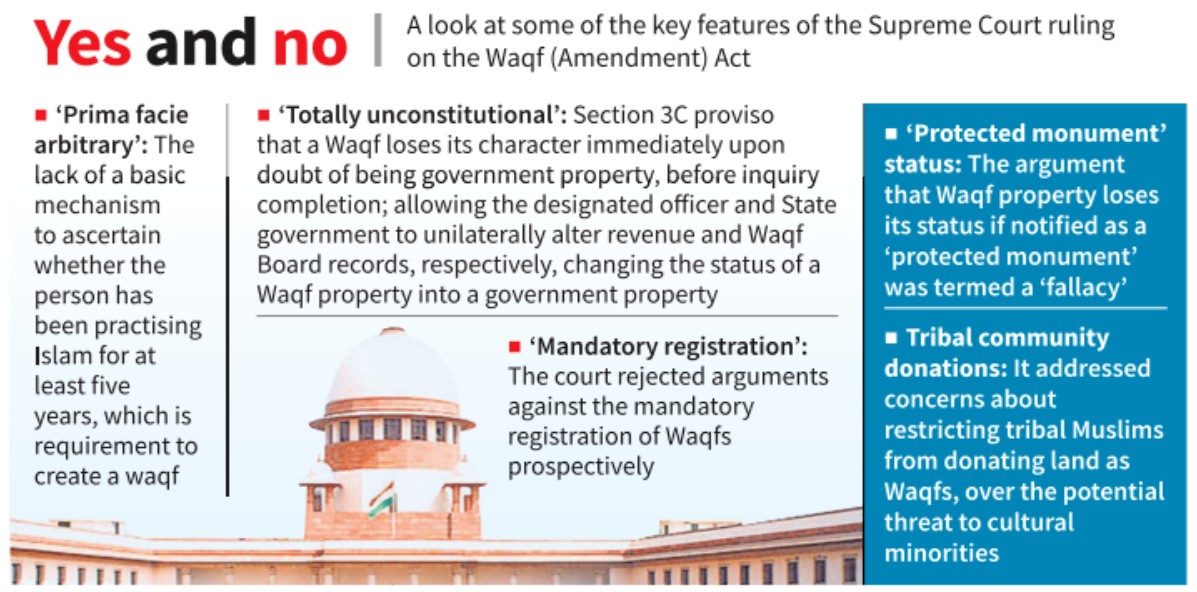
    The Waqf (Amendment) Act, 2025, passed by Parliament earlier this year, faced widespread opposition from political leaders, religious organisations, and civil society. Over 65 petitions were filed, challenging its constitutional validity. On September 15, the Supreme Court issued an interim order staying several key provisions, particularly those expanding the powers of district collectors, imposing a five-year Islam practice condition for creating a waqf, and capping non-Muslim representation in Waqf boards. At the same time, the Court upheld other significant changes such as the removal of “waqf-by-user” and the applicability of the Limitation Act. This selective intervention reflects the judiciary’s cautious approach in balancing equity, religious freedom, and governance.

    Waqf

    Why is the Supreme Court’s interim stay significant?

    1. First major judicial intervention: The SC’s order is the first substantive check on the Waqf (Amendment) Act, 2025 since its passage.
    2. Large-scale impact: With nearly 65 petitions filed, the matter affects thousands of properties and the rights of the Muslim community across India.
    3. Balance of powers: The Court flagged violation of the separation of powers doctrine by preventing revenue officers from adjudicating property titles.
    4. Guardrails against misuse: While not striking down the Act, the Court has added interim safeguards to prevent dispossession and misuse of powers.

    What powers of District Collectors were stayed?

    1. Section 3C inquiry power: District Collectors could declare that land claimed as waqf is government property. The SC stayed the clause that made waqf status cease immediately upon inquiry.
    2. Arbitrariness highlighted: Entrusting title determination to a revenue officer was held to be prima facie arbitrary.
    3. Safeguard applied: Waqf properties will retain their status until adjudicated by a Waqf Tribunal. However, no third-party rights can be created until final resolution.

    How did the Court deal with non-Muslim representation in Waqf Boards?

    1. Capping membership: Central Waqf Council (22 members) shall not have more than 4 non-Muslims; State Waqf Boards (11 members) shall not have more than 3 non-Muslims.
    2. Community rights upheld: This ensures that the Muslim community’s right under Article 26 to manage religious affairs is not diluted.
    3. Avoiding ambiguity: The SC clarified numbers to prevent misinterpretation of the law.

    What about the ‘five years of practising Islam’ rule?

    1. New definition of waqf: The 2025 Act required proof of practising Islam for five years to create a waqf.
    2. Provision stayed: SC stayed this rule until the government frames rules and mechanisms for proof.
    3. Judicial caution: The Court noted concerns of arbitrariness and discrimination, but also recognised historical misuse of waqf as a tool to evade creditors.

    Which provisions were not stayed?

    1. Abolition of ‘waqf by user’: The Court upheld its removal, citing misuse to encroach upon government lands.
    2. Applicability of the Limitation Act: Waqfs must now act within statutory limitation periods. This was upheld as removing previous discrimination.
    3. Registration compliance: SC emphasised that waqfs had 102 years (since 1923) to register, hence claims of arbitrariness were weak.

    What is the larger constitutional and governance context?

    1. Presumption of constitutionality: Laws passed by Parliament carry weight until struck down.
    2. Balancing equities: The SC avoided blanket suspension, staying only contentious clauses.
    3. Protection of minority rights: Ensures Article 26 freedoms are not eroded.
    4. Preventing property misuse: Legislative intent to protect government property and curb misuse was acknowledged.

    Conclusion

    The Supreme Court’s interim order on the Waqf (Amendment) Act, 2025 reflects a nuanced judicial approachprotecting religious freedoms while respecting legislative authority. By drawing constitutional boundaries for state power and emphasising procedural fairness, the Court has reinforced its role as a guardian of equity and minority rights. The final verdict will have long-lasting implications for governance of religious endowments and minority trust in legal institutions.

    PYQ Relevance:

    [UPSC 2019] What are the challenges to our cultural practices in the name of secularism.

    Linkage: The Waqf (Amendment) Act, 2025 has been challenged for allegedly curbing the Muslim community’s right under Article 26 to manage its religious endowments, showing how state intervention can threaten cultural practices. The Supreme Court’s interim stay on provisions like non-Muslim majority in Waqf Boards and “five years of practising Islam” directly reflects the tension between secular governance and religious autonomy. Thus, the case exemplifies the broader challenge of balancing secularism with protection of cultural practices, as asked in the 2019 question.

  • RTE Act and Minority Educational Institutions

    Why in the News?

    The Supreme Court has referred to a larger Bench the question of whether Minority Educational Institutions (MEIs) are completely exempt from the purview of the Right to Education (RTE) Act, 2009.

    About Minority Educational Institutions (MEIs):

    • Constitutional Basis:
      • Article 30(1) grants religious and linguistic minorities the right to establish and administer educational institutions of their choice.
      • Article 29 protects their cultural and educational rights.
    • Legal Framework:
      • Defined under the National Commission for Minority Educational Institutions (NCMEI) Act, 2004.
      • The NCMEI adjudicates disputes, grants recognition, and safeguards the autonomy of such institutions.
    • Recognized Minority Communities: Muslims, Christians, Sikhs, Buddhists, Jains, and Zoroastrians (Parsis) are notified as minorities by the Government of India.
    • Judicial Principles:
      • In T.M.A. Pai Foundation vs. State of Karnataka (2002), SC held that minority status is determined state-wise, not nationally.
      • Minority institutions can reserve seats for their community and enjoy greater control over administration and recruitment.
    • Purpose and Role:
      • Preserve the cultural, linguistic, and religious heritage of minority groups.
      • Provide quality education with constitutional protection from excessive state interference.

    What is the Right to Education (RTE) Act, 2009?

    • Genesis: Stemming from Unnikrishnan vs. State of Andhra Pradesh (1993), where SC declared education as a Fundamental Right under Article 21.
      • Later given constitutional backing through the 86th Amendment Act (2002), which inserted Article 21A – free and compulsory education for children aged 6–14 years.
    • Enactment: To operationalize Article 21A, Parliament passed the Right of Children to Free and Compulsory Education Act, 2009.
    • Key Provisions:
      • Free and compulsory education for all children aged 6–14 in a neighbourhood school.
      • 25% reservation in private schools for children from disadvantaged groups and weaker sections.
      • No detention, expulsion, or board exams up to Class VIII (amended in 2019 to allow states discretion).
      • Teacher norms: TET (Teachers Eligibility Test) qualification mandatory; ban on private tuitions by teachers.
      • School Management Committees (SMCs): Parents, local authority reps, and teachers oversee school functioning.
      • Curriculum & Standards: Developed by an academic authority (often NCERT/SCERT).
    • Amendments:
      • 2012: Included children with disabilities; exempted minority/religious institutions.
      • 2019: Abolished uniform “no-detention policy,” left to states’ choice.


    [UPSC 2018] Consider the following statements:

    1. As per the Right to Education (RTE) Act, to be eligible for appointment as a teacher in a State, a person would be required to possess the minimum qualification laid down by the concerned State Council of Teacher Education.

    2. As per the RTE Act, for teaching primary classes, a candidate is required to pass a Teacher Eligibility Test conducted in accordance with the National Council of Teacher Education guidelines.

    3. In India, more than 90% of teacher education institutions are directly under the State Governments

    Which of the statements given above is/are correct?

    Options: (a) 1 and 2 (b) 2 only* (c) 1 and 3 (d) 3 only


  • False righteousness

    Introduction

    In a democracy, the judiciary acts as the guardian of fundamental rights, ensuring that executive and legislative actions remain within constitutional limits. However, recent judicial pronouncements urging the executive to tighten controls over online speech raise a worrying question: Is the Court inadvertently enabling state encroachment into constitutionally guaranteed freedoms? This concern is sharpened by the backdrop of the IT Rules, 2021, which already tilt power heavily towards the government in regulating digital speech.

    Expanding Powers of the Executive over Free Speech

    1. Judicial Instructions: The Supreme Court recently directed the Union government to frame guidelines on regulating online speech.
    2. Problematic Precedent: Instead of protecting rights, the Court’s instructions risk empowering the executive to expand censorship powers under vague grounds like “misuse of freedom of speech.”

    Digital Speech: Between Regulation and Censorship

    1. IT Rules, 2021: These rules already allow the government to flag and order removal of online content, with penalties for intermediaries.
    2. 2023 Amendment: Expanded scope to hold social media companies accountable for user-generated content, giving the state wide-ranging discretionary powers.
    3. Challenge Pending in SC: These rules are already under constitutional challenge, making further expansion questionable.

    The Risk of False Righteousness

    1. Distasteful vs. Criminal: While hate speech and incitement to violence are already criminalised, regulating distasteful humour or dissenting opinions risks expanding censorship beyond constitutional boundaries.
    2. Chilling Effect: Citizens begin to self-censor, fearing repercussions for expressing views.
    3. Suppression of Creative Expression: Film producers, directors, and journalists face FIRs and restrictions, stifling art, reporting, and debate necessary for a vibrant democracy.

    Judiciary’s Institutional Role under Question

    1. Protector of Rights: The Court is constitutionally mandated to check executive overreach.
    2. Risk of Overstepping: By urging executive rulemaking, the judiciary risks acting like an unquestioned lord in a feudal setup rather than a rights-protecting institution.
    3. Misplaced Priorities: Instead of fortifying existing protections against hate speech, the Court seems to encourage executive expansion into grey zones.

    Broader Democratic Implications

    1. Weaponisation of Laws: Governments have a record of using regulations to target political opponents and inconvenient voices.
    2. Threat to Democratic Discourse: An atmosphere of censorship undermines deliberation, dissent, and innovation—all vital for a progressive society.
    3. Global Comparison: Mature democracies often rely on civil remedies and self-regulation, rather than empowering the state to police thought and humour.

    Conclusion

    The judiciary’s role is not to expand executive power but to ensure constitutional freedoms are protected. Hate speech and incitement to violence are already criminalised; expanding censorship to regulate humour, dissent, or artistic expression risks creating an atmosphere of fear and conformity. The Supreme Court must remember its constitutional role as the sentinel on the qui vive—guarding liberty, not enabling its curtailment.

    PYQ Relevance

    [UPSC 2014] Discuss Section 66A of the IT Act, with reference to its alleged violation of Article 19 of the Constitution.

    Linkage: The present debate on the Supreme Court urging the executive to frame guidelines for regulating social media echoes the concerns raised in Section 66A of the IT Act, where vague terms led to misuse against free expression. Just like 66A, expanding executive powers risks creating a chilling effect on speech beyond Article 19(2)’s reasonable restrictions. Both highlight the judiciary’s responsibility to act as a protector of rights, not an enabler of censorship.

  • [25th August 2025] The Hindu Op-ed: The new Constitution Bill, the need for a balancing act

    Mentor’s Comment

    The Constitution (One Hundred and Thirtieth Amendment) Bill, 2025 has sparked intense debate in Parliament and across the country. While it appears to be a strong step toward cleaner politics, it also raises deep constitutional and democratic concerns. For UPSC aspirants, this issue is important not only for its immediate political relevance but also for its intersection with constitutional morality, criminalisation of politics, separation of powers, and due process. This article breaks down the Bill, its context, judicial linkages, and its broader implications for democracy.

    Introduction

    India has long grappled with the paradox of demanding clean politics while being governed by leaders facing serious criminal charges. The Constitution (130th Amendment) Bill, 2025, introduced in the Lok Sabha on August 20, seeks automatic resignation or removal of Ministers, Chief Ministers and even the Prime Minister if they remain in custody for over 30 days in offences punishable with five years or more. While aimed at restoring public trust, the Bill risks undermining due process and democratic safeguards.

    Why is this Bill in the news?

    The Bill marks the first time Parliament has proposed automatic removal of top executive leaders on mere detention without conviction. This is in sharp contrast with the current legal position under the Representation of the People Act, where disqualification begins only upon conviction. The stakes are high: India already faces a staggering rise in criminalisation of politics, with 46% of MPs in 2024 declaring criminal cases, up from 30% in 2009. Against this backdrop, the Bill seeks to restore public trust but also risks political misuse, raising concerns of democratic erosion.

    Judicial foundations and constitutional morality

    1. Articles 75, 164, 239AA: Provide for ministerial tenure “at the pleasure” of President/Governor, limited by constitutional morality.
    2. S.R. Bommai case: Stressed that integrity and accountability are core to constitutional morality.
    3. Manoj Narula case: Warned against entrusting power to those with serious criminal charges.
    4. Lily Thomas case: Held that disqualification of legislators must occur upon conviction, striking down earlier appeal window.
    5. Tension: While courts upheld high ethical standards, they stopped short of mandating automatic removal before conviction, the Bill goes further, creating friction with Article 21 (right to life and liberty).

    Risk of Bill being misused as a political weapon

    1. Executive discretion: PM/CM advice governs removal; if withheld, automatic removal applies after 30 days. This dual mechanism may be exploited politically.
    2. Selective shield or target: PM may protect allies temporarily, while hostile leaders may allow rivals to fall under automatic removal.
    3. Politicisation of accountability: Instead of insulating governance, it may embed accountability in partisan strategies.

    Inconsistency in the treatment of legislators and Ministers

    1. RPA framework: Legislators disqualified only on conviction.
    2. Ministerial paradox: A Minister under arrest is removed after 30 days, but a legislator convicted of corruption may still technically hold ministerial office until disqualification proceedings.
    3. Asymmetry: Creates harsher standards for Ministers than legislators, risking deterrence for capable leaders.

    Political instability and the “revolving door”

    1. Reappointment clause: Once released, Ministers can be reinstated.
    2. Cycle of instability: Arrest → resignation → release → reinstatement may lead to political uncertainty without improving accountability.
    3. Tactical misuse: Legal proceedings could be manipulated to weaken opponents through timed arrests.

    Why do critics demand a more nuanced model?

    1. Criminalisation of politics: Rising trend demands reform, 251 MPs (46%) with criminal cases in 2024.
    2. Judicial milestone approach: Removal linked to framing of charges by a competent court rather than arrest alone ensures judicial scrutiny.
    3. Independent review: Tribunal/judicial panel could prevent executive misuse.
    4. Interim suspension: Instead of removal, suspension of ministerial functions during trial could balance governance and accountability.
    5. Scope refinement: Apply only to corruption and moral turpitude offences, not all crimes with five years’ punishment (which may include minor offences).

    Conclusion

    The 130th Amendment Bill embodies India’s long-standing demand for clean politics. However, its blunt approach risks weakening constitutional safeguards like presumption of innocence, creating political instability, and enabling misuse of arrest as a weapon. The Joint Parliamentary Committee must recalibrate the Bill with judicially tested safeguards, narrowing its scope to serious offences and ensuring impartial mechanisms for enforcement. Only then can India achieve the delicate balance where power is exercised with integrity without sacrificing fairness.

    UPSC Relevance:

    [UPSC]: “There is a need for simplification of procedure for disqualification of persons found guilty of corrupt practices under the Representation of Peoples Act.” Comment.

    Linkage: The 130th Amendment Bill echoes the long-standing concern flagged in the 2020 PYQ on RPA disqualification: India needs clearer and fairer procedures to ensure accountability in politics. While the PYQ emphasised simplification post-conviction, the Bill risks moving the trigger point too early (mere custody), thereby complicating rather than simplifying the disqualification process.”

  • Sedition Redux: On trampling on press freedom

    Why in the News?

    On August 12, 2025, The Wire’s editors Siddharth Varadarajan and Karan Thapar were summoned by the Assam Police under Section 152 of the BNS, even as the Supreme Court had that very day issued protection while examining the constitutional validity of the new sedition law. This open defiance of judicial authority and the use of procedurally defective summons marks a serious blow to press freedom. What makes this moment significant is that the law being challenged is wider and harsher than colonial sedition provisions, despite India claiming to have moved away from such colonial baggage.

    Introduction

    The sedition debate in India has returned in a new form. While Section 124A IPC was suspended in 2022, the government introduced Section 152 of the BNS, which critics say is “sedition by another name.” The law widens state powers and lowers the threshold for prosecution, making legitimate criticism vulnerable to criminalisation. Recent cases against journalists show how easily this provision can be misused.

    Section 152 and Its Differences from the Old Sedition Law

    • Expanded scope: Goes beyond “disaffection” against government, criminalising acts deemed to endanger sovereignty, unity, and integrity.
    • Lower bar for prosecution: Words like “knowingly” dilute intent requirements; mere criticism can be dragged into criminality.
    • Colonial continuity: Despite being marketed as decolonisation, Section 152 retains the same suppressive essence as 124A IPC.

    The Wire Case and Procedural Violations

    • Summons despite SC protection: Assam Police issued notices on the very day of SC’s order, reflecting executive defiance.
    • Lack of transparency: Summons omitted FIR dates, details of offence, and copies of FIR, violating BNSS safeguards.
    • Political overtones: Linked to The Wire’s report on Operation Sindoor, raising concerns of vendetta-driven policing.

    Threats to Press Freedom

    • Chilling effect: Journalists may self-censor for fear of harassment.
    • Vague definitions: Broad terms like “unity” and “sovereignty” give unchecked power to authorities.
    • Targeting dissent: Questioning government policy risks being equated with undermining national integrity.

    Judicial Response and Challenges

    • Supreme Court scrutiny: SC is examining the constitutional validity of Section 152.
    • Precedent of 2022: Earlier suspension of sedition cases showed judicial recognition of misuse.
    • Executive overreach: Assam Police’s defiance underlines the need for stronger judicial safeguards and guidelines.

    Broader Democratic Implications

    • Freedom of expression at stake: Democracy thrives on criticism; silencing it weakens accountability.
    • Comparative perspective: UK repealed sedition in 2009; US limits it only to violent overthrow.
    • Governance paradox: Instead of transparency, India risks sliding into a majoritarian security state.

    Way Forward

    • Clear legislative safeguards: Narrow the scope of Section 152 with precise definitions of terms like “unity” and “sovereignty” to prevent misuse.
    • Judicial guidelines: The Supreme Court can lay down binding principles (on the lines of Kedar Nath Singh and Shreya Singhal) that limit sedition to cases of direct incitement to violence or armed rebellion
    • Independent oversight: A judicial or quasi-judicial body should vet sedition cases before FIR registration, reducing frivolous prosecutions.
    • Strengthening press freedom: Institutional mechanisms like a Media Commission or independent ombudsman can address grievances without criminalisation.
    • Comparative best practices: India can draw from the UK model of repeal and the US model of narrow application, balancing national security with democratic freedoms.
    • Civic education: Promoting awareness among citizens, journalists, and law enforcement about constitutional morality and reasonable restrictions can ensure a culture of restraint and accountability.

    Conclusion

    Section 152 represents the persistence of colonial-style suppression under a new name. Unless the judiciary firmly strikes it down or introduces robust safeguards, it will continue to erode press freedom and democratic dissent, pillars without which India’s constitutional promise cannot stand strong.

    Value Addition

    Constitutional Angle

    • Article 19(1)(a): Freedom of speech.
    • Article 19(2): Reasonable restrictions (sovereignty, unity, public order, etc.).
    • Basic Structure Doctrine: Democracy, liberty, and rule of law as inviolable.

    Judicial Precedents

    • Kedar Nath Singh vs State of Bihar (1962): Sedition valid only when incitement to violence/public disorder is proven.
    • Shreya Singhal vs Union of India (2015): Vague terms in laws (like IT Act Section 66A) struck down for chilling free speech.
    • SC Order 2022: Suspended all 124A cases, acknowledging misuse.

    Reports & Perspectives

    • Law Commission of India (2018): Recommended clearer safeguards; questioned necessity of sedition.
    • Global practices: UK repealed sedition; US restricts it narrowly.
    • BNSS debate: Marketed as decolonisation but seen as repackaging colonial control.

    Mapping Microthemes

    • GS Paper II: Freedom of speech, judiciary, Centre-State federalism
    • GS Paper III: Internal security vs. dissent.
    • GS Paper IV: Misuse of power, ethics in public life, constitutional morality.

    PYQ Relevance

    [UPSC 2014] What do you understand by the concept “freedom of speech and expression”? Does it cover hate speech also? Why do the films in India stand on a slightly different plane from other forms of expression? Discuss.

    Linkage: The 2014 question on freedom of speech, hate speech, and films mirrors today’s debate on Section 152. Just as films face stricter scrutiny due to mass impact, the new sedition law risks wrongly placing legitimate criticism and dissent in the same bracket as hate speech or violent incitement. This makes the boundary of free expression a central issue in both contexts.


  • ‘Creamy Layer’ condition in OBC Quota

    Why in the News?

    The government is considering measures to ensure uniform application of the ‘creamy layer’ condition in OBC reservations across central and state government jobs, public sector enterprises, universities, and autonomous bodies.

    About the Concept of Creamy Layer:

    • Origin: Emerged from Indra Sawhney vs Union of India (1992); excluded affluent Other Backward Class (OBC) groups from reservations.
    • 1993 DoPT Rules: Defined creamy layer – children of Group A/Class I officers, early-promoted officials, Group B parents, senior armed forces, high constitutional functionaries, professionals, traders, and large landowners.
    • Income Criteria:
      • Ceiling: ₹1 lakh in 1993, revised to ₹8 lakh in 2017.
      • Exclusions: Salary and agricultural income not counted.

    2004 Clarification & Implementation Issues:

    • Clarification: DoPT directed separate assessment of salary and other income (except agriculture).
    • Rule: If either exceeded limit (₹2.5 lakh then) for 3 consecutive years → creamy layer.
    • Problem: Poor enforcement (2004–14) due to political sensitivities; stricter checks after 2014.
    • Impact: Between CSE 2015–23, over 100 OBC caste certificates rejected under new interpretations.

    Equivalence Efforts:

    • Consultations: Involved Social Justice, Education, Law, Labour Ministries, DoPT, NITI Aayog, NCBC.
    • Goal: Standardise creamy layer rules across universities, Public Sector Undertakings (PSUs), and autonomous bodies.
    • Proposal: Retrospective relief suggested by Home Minister Amit Shah and NCBC.

    Key Proposals Under Consideration:

    • University Teachers: Salaries start at Group A-equivalent → children to be creamy layer.
    • Autonomous Bodies: Posts aligned with central pay scales.
    • Non-Teaching Staff: Categorisation based on equivalence with government jobs.
    • PSU Executives: Already included since 2017; those ≤₹8 lakh excluded.
    • Aided Institutions: Staff categorised based on parity with govt. employees.

    Likely Beneficiaries:

    • Lower Govt. Staff: Children of employees earning just above ₹8 lakh gain most.
    • Correction of Anomalies: Ensures parity between teachers and aided staff.
    • State PSU Issues: Fixes cases like fuel pump attendants in PSUs being declared creamy layer.
    • Private Sector: No change; creamy layer based only on income/wealth criteria.
    [UPSC 2023] Consider the following organizations/bodies in India:

    1. The National Commission for Backward Classes

    2. The National Human Rights Commission

    3. The National Law Commission

    4. The National Consumer Disputes Redressal Commission

    How many of the above are constitutional bodies?

    Options: (a) Only one *(b) Only two (c) Only three (d) All four


  • Section 152 of the Bharatiya Nyaya Sanhita (BNS)

    Why in the News?

    The Supreme Court has raised a key question—whether the “potentiality of abuse” of Section 152 of the Bharatiya Nyaya Sanhita (BNS), which punishes acts endangering the sovereignty, unity, and integrity of India, could be a ground to declare the provision unconstitutional.

    Section 152 of the Bharatiya Nyaya Sanhita (BNS)

    About Section 152 BNS:

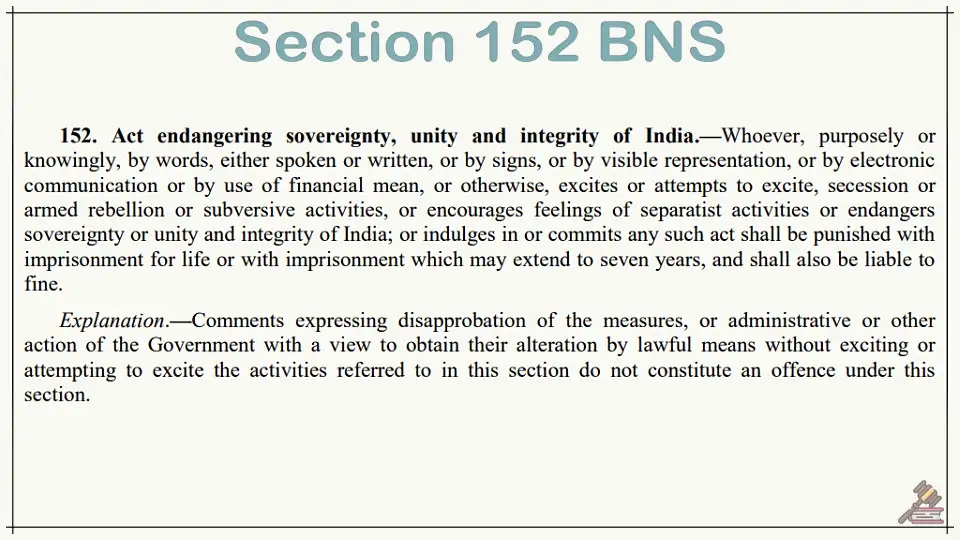
    • Deals with: Acts endangering sovereignty, unity, and integrity of India.
    • Origin: Introduced in the Bharatiya Nyaya Sanhita, 2023, effective 1 July 2024, replacing Section 124A IPC (sedition).
    • Scope: Criminalises purposeful or knowing acts that:
      • Excite secession, armed rebellion, or subversive activities.
      • Encourage separatist feelings.
      • Endanger sovereignty, unity, or integrity of India.
    • Means Covered: Words (spoken/written), signs, visible representation, electronic communication, financial means, or any other method.
    • Punishment: Life imprisonment or imprisonment up to 7 years + fine.
    • Nature of Offence: Cognizable, non-bailable, triable by Court of Session.
    • Exception Clause: Lawful criticism of government measures to seek change—without inciting rebellion/secession—is not an offence.
    • Key Difference from Section 124A IPC: Focus shifted from “disaffection against Government” to direct threats against the nation’s unity and sovereignty, with explicit recognition of digital-era methods.

    Issues with Section 152 BNS:

    • Potential for Misuse: Broad and subjective terms like “endangering sovereignty” can be stretched to target political dissent, journalism, and activism.
    • Vagueness: Undefined concepts (e.g., “sovereignty” in context of speech) create uncertainty, enabling arbitrary interpretation by authorities.
    • Similarity to Sedition Law: Despite rewording, its core effect mirrors Section 124A IPC, which is under constitutional challenge for curbing free speech.
    • Chilling Effect on Free Speech: Risk of self-censorship among journalists, activists, and citizens due to fear of prosecution.
    • High Punishment and Cognizability: Harsh penalties combined with arrest without warrant heighten scope for harassment before judicial scrutiny.
    • Digital Surveillance Concerns: Explicit coverage of electronic communication and financial means may widen investigative reach into personal digital activities.
    • Judicial Burden: Courts will need to repeatedly interpret the law to balance Article 19(1)(a) freedom of speech with state security.
    [UPSC 2025] Sedition has become my religion” was the famous statement given by Gandhiji at the time of:

    (a) the Champaran Satyagraha (b) publicly violating Salt Law at Dandi* (c) attending the Second Round Table Conference in London (d) the launch of the Quit India Movement