💥Join UPSC 2027,2028 Mentorship (July Batch) + XFactor Notes & Microthemes PDF

Subject: Fundamental Rights,DPSP

1. History + Evolution
2. Features
3. Amendments
4. Basic Structure

  • [15th December 2025] The Hindu OpED: Courts must protect, not regulate free speech

    PYQ Relevance

    [UPSC 2020] Judicial Legislation is antithetical to the doctrine of separation of powers as envisaged in the Indian Constitution. In this context justify the filing of large number of public interest petitions praying for issuing guidelines to executive authorities.

    Linkage: This question directly aligns with the article’s core concern that recent judicial suggestions on online content regulation risk crossing from constitutional adjudication into judicial legislation, thereby unsettling the separation of powers framework.

    Introduction

    The Supreme Court has historically protected freedom of speech under Article 19(1)(a) through a doctrine of judicial restraint. In Sahara India Real Estate Corp. Ltd. v. SEBI (2012), the Court cautioned against prior restraint and blanket prohibitory orders on the media, permitting restrictions only as a last resort and subject to strict reasonableness. In Ardhish Cooperative Housing Society Ltd. v. Union of India (2018), the Court refused to interfere in film certification, reiterating that content regulation lies with statutory bodies, not courts. More recently, in Kaushal Kishor v. State of Uttar Pradesh (2023), a Constitution Bench reaffirmed that the grounds for restricting speech under Article 19(2) are exhaustive and cannot be expanded judicially.

    Against this settled jurisprudence, Supreme Court observations on November 27, 2025, made while hearing cases relating to obscene and improper online content, suggested that existing laws may be inadequate and proposed the creation of neutral, autonomous regulatory bodies along with draft government guidelines. This signals a shift from judicial restraint to regulatory engagement, raising constitutional concerns that form the core of this debate.

    Why in the News?

    The issue gained prominence after the Supreme Court indicated that self-styled online bodies are insufficient to regulate online content. It invited the government to publish draft regulatory guidelines. This represents a significant departure from earlier judicial positions that confined courts to assessing constitutionality rather than designing regulatory frameworks. The development is critical because it potentially alters the balance between free speech protection and content control at a time when digital expression has become central to democratic participation.

    Existing Legal Framework Governing Speech

    Statutory Regulation of Content

    1. Information Technology Act, 2000: Penalises obscene online content under Section 67, hacking and cyber offences under Section 66, and cyber terrorism under Section 66F.
    2. Bharatiya Nyaya Sanhita, 2023: Sections 294-296 criminalise obscene acts and materials.
    3. IT (Intermediary Guidelines and Digital Media Ethics Code) Rules, 2021: Establish content moderation obligations and grievance redressal mechanisms, though criticised for enabling executive overreach.

    Centralised Oversight

    1. Executive Control: IT Rules empower the Centre to issue directions, raising concerns of prior restraint and chilling effect on speech.
    2. Judicial Caution: Despite existing regulation, courts have traditionally avoided endorsing additional controls.

    Expansion of Judicial Scope in Online Content Cases

    Shift in Case Consideration

    1. Scope Enlargement: The Court extended proceedings beyond the validity of FIRs to examine broader regulatory mechanisms.
    2. Moral Standards Inquiry: Consideration of content offensive to societal morality reflects a regulatory approach.
    3. Constitutional Risk: Such expansion risks judicial entry into legislative policy-making.

    Separation of Powers and Institutional Competence

    Limits of Judicial Function

    1. Legislative Primacy: Content regulation requires democratic deliberation and accountability.
    2. Technical Expertise: Courts lack institutional capacity to design digital media regulation.
    3. Constitutional Restraint: Judicial intervention must remain confined to legality review.

    Judicial Tests on Prior Restraint

    Sahara India Doctrine (2012)

    1. Last-Resort Principle: Pre-publication bans are permissible only in exceptional cases.
    2. High Threshold: Orders must meet strict necessity and proportionality standards.

    Ardhish Cooperative Housing Society (2018)

    1. Statutory Authority: Film certification lies with the Censor Board.
    2. Judicial Non-Interference: Courts rejected content-based directions such as mandatory disclaimers.

    Constitutional Exhaustiveness of Speech Restrictions

    Article 19(2) Framework

    1. Enumerated Grounds: Sovereignty, security of the state, public order, decency, defamation, among others.
    2. Kaushal Kishor (2023): Held that no additional grounds beyond Article 19(2) can justify speech restrictions.
    3. Article 19(1)(a) Protection: Judicially created restrictions undermine constitutional text.

    Role of Courts in Free Speech Governance

    Constitutional Arbiter

    1. Judicial Review: Courts assess reasonableness of restrictions enacted by law.
    2. Non-Regulatory Role: Law-making lies outside judicial mandate.
    3. Democratic Safeguard: Preserves separation of powers and civil liberties.
    4. Legislative Domain: Content regulation requires democratic deliberation.
    5. Institutional Competence: Courts lack technical expertise for media governance.
    6. Precedent Risk: Judicial law-making bypasses parliamentary accountability.
    7. Constitutional Design: Courts act as arbiters, not regulators.

    What lessons emerge from global experiences?

    Democratic Regulation

    1. European Union: Digital Services Act prescribes structured content removal.
    2. Germany: Network Enforcement Act mandates timely takedown of unlawful content.
    3. United Kingdom and Australia: Online Safety laws impose compliance penalties.

    Authoritarian Risks

    1. China and Russia: Surveillance-driven censorship regimes.
    2. Judicial Capture: Courts used to legitimise executive control.
    3. Democratic Erosion: Demonstrates risks of excessive regulation.

    Conclusion

    The constitutional position on free speech has remained clear across decades: restrictions must flow only from Article 19(2), be legislatively enacted, and meet the tests of reasonableness and proportionality. Constitutional propriety requires that courts act as arbiters of legality, not architects of regulation. In a democracy governed by the rule of law, the protection of free speech is best ensured when courts guard constitutional limits rather than expand them.
  • [9th December 2025] The Hindu OpED: Democracy’s paradox, the chosen people of the state

    UPSC Relevance

    [UPSC 2022] ‘‘While the national political parties in India favour centralisation, the regional parties are in favour of State autonomy.’’ Comment

    Linkage: This question directly relates to GS-2 Federalism. It links to issues of Centre-State powers, identity-based politics, and recent debates like citizenship verification/NRC/SIR, where states contest central authority.

    Mentor’s Comment

    This article examines the constitutional, legal and administrative paradox emerging from India’s ongoing attempts to verify citizenship through the Special Intensive Revision (SIR) of electoral rolls. The debate highlights the tension between documentation vs. status, state power vs. individual rights, and democracy vs. exclusion. For UPSC aspirants, this issue is significant because it intersects with federalism, citizenship law, administrative reforms, constitutional morality, and voter rights.

    Introduction

    India’s constitutional framework treats citizenship as a matter determined solely by law and Parliament, not routine administration. However, the recent use of SIR to verify electoral rolls has created friction between constitutional citizenship (status) and documentation-based citizenship (evidence). The article argues that the burden of proof is being pushed onto individuals despite ambiguities in law, unclear Census-NPR linkages, and historical inconsistencies in Assam’s NRC. This creates a paradox in which the state constructs legitimacy but simultaneously demands individuals prove they belong to that very state.

    Why in the News?

    The Election Commission’s Special Intensive Revision (SIR) of electoral rolls has reignited India’s long-running citizenship debate by shifting the burden of proving citizenship onto individuals, something the Constitution never intended. For the first time since independence, a nationwide administrative exercise mirrors the logic of NPR-NRC processes without legislative mandate, raising fears of wrongful exclusions, ethnic profiling, and contradictions between constitutional citizenship and administrative citizenship. This marks a sharp and controversial departure from earlier electoral roll revisions that assumed all residents are citizens unless proven otherwise.

    How does citizenship verification create a conflict between status and evidence?

    1. Constitutional Citizenship:
      1. Citizenship status is determined only by Parliament under Articles 5–11, not by administrative bodies like the Election Commission.
      2. Substantiation: The Home Ministry alone has the authority to decide citizenship; EC cannot adjudicate it.
    2. Evidence vs. Status Conflict:
      1. Documents like passports, Aadhaar, NPR data are not conclusive proof of citizenship.
      2. Substantiation: Passports can be forged; Aadhaar is given to all residents; NPR data’s legal basis remains unclear.
    3. Presumption Principle: EC’s SIR breaks with the established assumption that all residents on electoral rolls are citizens unless proven otherwise.

    What legal inconsistencies arise while proving Indian citizenship?

    1. No Clear Proof Mechanism: India lacks a single definitive document that proves citizenship. Example: A person may hold a passport but still be unable to prove citizenship in court.
    2. Ambiguity in NPR and NRC linkage: NPR 2010 & 2015 updates used Census infrastructure but lacked stable legal clarity on how citizenship data would be used.
    3. Birth-Based Citizenship Limits: Citizenship by birth is restricted after 1987 and 2004, parental citizenship must also be established. Example: Post-2003 rules exclude “illegal migrants” even if born in India.

    How do historical precedents shape current anxieties?

    1. Assam NRC Experience: 19 lakh+ residents excluded, many of whom were ethnic Assamese or Bengali Hindus.
    2. Pilot Projects of 2008 & 2010: Early verification exercises in border states showed high error rates and mass exclusions.
    3. Legacy Documents Problem: Citizenship linked to pre-1971 documents (Assam Accord) created practical hardships for ordinary people.

    How does state authority expand through documentation?

    1. Shift of Burden to Individual: SIR and NPR-type exercises place responsibility on residents to prove citizenship instead of the state to verify it.
    2. Expansion of Administrative Power: Local officials gain disproportionate authority to decide who is “doubtful.” Electoral officials examine documents and decide eligibility on daily basis.
    3. Security-State Logic: Administrative citizenship becomes aligned with policing, not inclusion.

    Why is this a “Democratic Paradox”?

    1. State Creates People, Not Vice Versa: The state assumes the power to determine who counts as “people,” instead of people creating the state.
    2. Contradiction with Republic’s Founders: Founders envisioned territorial citizenship, not ethnicity-based citizenship.
    3. Democratic Exclusion: Verification processes may disenfranchise genuine citizens, violating equal political rights.

    Conclusion

    India’s citizenship verification debate reflects a deeper constitutional tension between democracy’s inclusive promise and bureaucratic exclusion driven by identity, documentation, and administrative power. A citizenship regime based on presumption of inclusion is now shifting toward suspicion and proof-based inclusion. The article highlights the urgent need for legal clarity, transparent processes, and alignment between constitutional citizenship and administrative citizenship, ensuring that democracy’s foundation, universal franchise, is not undermined.


  • All about Karnataka’s new Hate Speech Bill, how the issue is regulated across India

    Introduction

    India has long relied on scattered provisions of the IPC to address hate speech. However, these provisions primarily protect “public order” rather than define or penalise hate speech as an independent offence. The Karnataka Hate Speech and Hate Crimes (Prevention) Bill, 2025 attempts to fill this vacuum by clearly defining offences, expanding penalties, and bringing collective responsibility for organisations. The Supreme Court’s own proactive interventions, directing suo motu action on hate speech complaints, highlight both the urgency and the institutional recognition of the problem.

    Why in the news

    The Karnataka government has introduced India’s first state-level Bill focused solely on hate speech and hate crimes. It proposes imprisonment of 2-10 years and collective liability for organisations, something not attempted before. This marks a sharp contrast to India’s earlier fragmented approach relying only on IPC Sections 153A, 295A, and 505. The urgency is underscored by data: despite frequent arrests, conviction rates for analogous offences such as Section 153A IPC stood at only 20.2% in 2020, exposing serious enforcement gaps. The Bill also aligns with the Supreme Court’s growing frustration with non-action in hate speech cases, including contempt warnings to police officers.

    Key Constitutional Angles

    1. Article 19(1)(a): Guarantees free speech but is not absolute.
    2. Article 19(2): Allows restrictions for public order, decency, morality, security of the State, the primary grounds invoked for hate speech laws.
    3. Article 21: Dignity & Privacy (Post-Puttaswamy Expansion)
      1. Protects individuals from:
      2. Psychological harm
      3. Targeted hostility
      4. Dehumanising speech; This forms the modern basis for regulating hate speech beyond mere public order.

    How does India currently regulate hate speech?

    1. No statutory definition: India has no dedicated central law defining “hate speech,” creating ambiguity in enforcement.
    2. Fragmented provisions: IPC Sections 153A, 295A, 505 are used to maintain public order, not specifically to penalise hate speech.
      1. Section 153A: “Promoting enmity between different groups” on grounds such as religion, race, language; punishment includes arrest without warrant.
      2. Section 295A: Deliberate and malicious acts intended to outrage religious feelings.
      3. Section 505: Statements conducing to public mischief, including incitement between groups.
    3. Bharatiya Nyaya Sanhita (BNS) 2023 Provisions:
      1. Section 196 BNS: Criminalizes promoting or attempting to promote disharmony, hatred, or ill-will between different groups (based on religion, race, place of birth, residence, language, caste, or community) through spoken or written words, signs, visible representations, or electronic communication.
      2. Section 197 BNS: Addresses imputations or assertions prejudicial to national integration.
      3. Section 299 BNS: Deals with deliberate and malicious acts intended to outrage religious feelings (previously Section 295A IPC).
    4. Low conviction rate: NCRB shows 20.2% conviction rate under similar provisions in 2020, despite frequent arrests.

    What has been the role of the Supreme Court?

    1. Proactive interventions: Court has shifted from passive stance to active monitoring of hate speech incidents.
    2. 2022 Bench direction: Ordered Delhi, Uttarakhand, and UP police chiefs to take suo motu action without waiting for complaints; warning of contempt for inaction.
    3. 2023 expansion: Directions extended to all States/UTs.
    4. Implementation challenges: Union government noted difficulty in effective execution.
    5. 2023 Vikram Nath-Sandeep Mehta Bench: Emphasised courts must monitor, not simply register FIRs; referred guidelines from Tehseen Poonawalla judgment on mob violence.

    Challenges in regulating hate speech

    Administrative Challenges

    1. Police discretion: It leads to selective enforcement.
    2. Low conviction: Due to weak evidence, hostile witnesses, and poor digital forensics.
    3. Political misuse: hate speech often goes unpunished when linked to ruling coalitions.
    4. Overlapping IPC sections confuse enforcement (153A, 295A, 298, 505, IT Act).

    Digital-Age Problems

    1. Viral dissemination magnifies harm instantly.
    2. Anonymity complicates attribution.
    3. Algorithmic amplification pushes extreme content.
    4. Cross-border servers limit state jurisdiction.
    5. Short-form content (Reels, Shorts) increases inflammatory rhetoric.

    How has hate speech been defined in earlier policy attempts?

    1. 2017 Law Commission (267th Report): Proposed inserting new IPC sections to criminalise incitement to hatred and provocation to violence.
    2. 2022 Private Member’s Bill: Sought explicit definition of hate speech including incitement, justification, promotion of hatred, hostility, discrimination, violence.

    Why States Are Introducing Their Own Laws

    1. Central vacuum: No codified hate speech law.
    2. Rising incidents noted publicly by courts.
    3. Growing digital footprint demanding clear takedown powers.
    4. Administrative uniformity required for police action.

    What does the Karnataka Hate Speech Bill propose?

    1. First state-level dedicated law: Unique attempt to create a specific, standalone statute targeting hate speech and hate crimes.
    2. Clear definition: Treats hate speech as expression that causes injury or discriminatory harm against individuals/groups based on religion, race, caste, gender, sexual orientation, residence, etc.
    3. Collective liability: If hate speech comes from an organisation, persons in positions of responsibility can be held guilty.
    4. Digital control provisions: Empowers State to block or remove online content containing hate speech.
    5. Range of imprisonment: Proposes 2–10 years, signalling stricter penalties.

    Why is the Karnataka Bill significant?

    1. Addresses legislative vacuum: India has no statute explicitly defining hate speech; Karnataka becomes the first mover.
    2. Aligns with SC directions: Reinforces suo motu action and strengthens enforcement capacity.
    3. Targets rising incidents: Attempts to tackle the increasing climate of hate noted by the Supreme Court.
    4. Institutional accountability: Introduces organisational responsibility, previously absent in IPC.

    CONCLUSION

    India’s scattered legal approach to hate speech has led to low conviction rates and inconsistent enforcement. The Karnataka Bill represents a major structural attempt to define, penalise, and prevent hate speech with clearer mechanisms, higher penalties, and organisational accountability. While implementation challenges remain, it aligns the legal landscape with Supreme Court directions and may initiate broader legislative reform across states and the Union.

    PYQ Relevance

    [UPSC 2017] Examine the scope of Fundamental Rights in the light of the latest judgement of the Supreme Court on Right to Privacy.

    Linkage: The Karnataka Hate Speech Bill and the Supreme Court’s suo motu directives derive legitimacy from this expanded interpretation, linking free speech limits under Article 19(2) with protection of dignity and privacy under Article 21.

  • Decoding personality rights in the age of AI

    Introduction

    Personality rights, traditionally rooted in privacy, dignity, and control over one’s identity—are facing unprecedented stress due to generative AI. Deepfake technologies, synthetic media, and AI-generated impersonation are creating new risks of deception, reputational harm, financial loss, and large-scale identity exploitation. Recent legal disputes involving celebrities highlight widening vulnerabilities and the absence of a robust legal framework in India.

    Why in the News? 

    Amitabh Bachchan and Aishwarya Rai recently approached the Delhi High Court seeking protection against AI-generated videos that imitated their identity, voice, and catchphrases. This marks a major turning point because AI deepfakes are now powerful enough to replicate personalities at scale and for commercial misuse, something never seen before. The case exposes how India lacks a unified personality-rights legislation even as misuse grows rapidly, contrasting sharply with the stricter frameworks in the US, EU, and China.

    Erosion of Personality Rights in the AI Era

    1. AI Deepfakes: Enable face swaps, voice clones, and synthetic content that manipulate identity and support misinformation, malice, extortion, and erosion of trust.
    2. Unchecked AI Use: Generates mass commodification of human identity, intensifying reputational and financial vulnerabilities.
    3. Technological Trigger: The rise of generative AI tools has amplified impersonation risks and blurred lines between authenticity and deception.

    How Does Indian Law Currently Address Personality Rights?

    1. Fragmented Framework: India relies on privacy principles, constitutional protection, and selective case law but lacks a dedicated statute.
    2. Judicial Protection:
      1. Justice K.S. Puttaswamy case (2017) upheld privacy as a fundamental right.
      2. Amitabh Bachchan v. Rajat Nagi (2022) recognised personality rights.
      3. Anil Kapoor v. Simply Life India (2023) banned misuse of his catchphrase “jhakaas” and likeness for diluted brand value.
      4. Arijit Singh v. Golden Ventures LLP (2024) protected his voice from AI replication.
    3. Regulatory Limits: IT Act 2000 and Intermediary Guidelines 2021 address impersonation and deepfakes but lack enforcement clarity, especially for cross-border misuse.

    How Do Global Jurisdictions Handle Personality Rights?

    1. United States
      1. Right of Publicity: Treated as transferable property.
      2. Tennessee’s ELVIS Act (2024) bans unauthorized AI voice cloning and deepfake performances.
      3. Character.AI Cases: Highlight how AI models create digital personas that blur reality.
      4. First Amendment Constraints: Free speech limits over-regulation.
    2. European Union
      1. GDPR: Provides dignity-based protection over personal and biometric data.
      2. EU AI Act (2024): Classifies deepfakes as high risk, mandates transparency and labelling.
    3. China
      1. Internet Court Rulings (2024): AI-generated synthetic voices must not deceive consumers.
      2. AI-related cases treat voice actors and media workers as harmed individuals needing redress.

    Why Does India Need a Comprehensive Personality-Rights Law?

    1. Legal Vacuum: No dedicated statute addressing AI impersonation, deepfakes, monetisation of likeness, and cross-border exploitation.
    2. AI Platforms’ Liability: Lack of clear obligations for watermarking, transparency, and algorithmic accountability.
    3. Global Pressure: AI’s transnational nature demands compliance with international standards.
    4. Growing Harm: Cases of identity theft, synthetic celebrity endorsements, and psychological impact from digital cloning are rising.

    What Should India’s Legal Framework Include?

    1. Explicit Definition: Clear categorisation of personality rights, covering image, voice, likeness, name, gestures, and distinctive traits.
    2. Platform Accountability: Mandatory watermarking, AI content labelling, and traceability.
    3. Consent Architecture: Requirement of explicit consent for any AI-generated replication.
    4. Civil and Criminal Remedies: Compensation mechanisms and penalties for willful impersonation.
    5. Cross-Border Enforcement: Harmonisation with EU, US, and global regulatory practices.
    6. Ethical AI Standards: Transparency norms, audit trails, and safeguards against dataset misuse.

    Conclusion

    AI has radically transformed the nature of identity and personhood, challenging traditional legal doctrines surrounding privacy and personality rights. India must move from fragmented protections to a comprehensive, future-ready framework that secures individual autonomy while supporting responsible AI innovation. Without such reform, the risks of impersonation, exploitation, and identity erosion will only multiply.

    PYQ Relevance

    [UPSC 2024] Right to privacy is intrinsic to life and personal liberty and is inherently protected under Article 21 of the Constitution. Explain.

    Linkage: This question directly links to personality rights and AI deepfakes, as both derive from the privacy-autonomy framework under Article 21. It is relevant because the erosion of digital identity through AI impersonation tests the very constitutional protection the Puttaswamy judgment established.

  • Digital Personal Data Protection (DPDP) Rules, 2025

    Why in the News?

    The Centre has notified major provisions of the Digital Personal Data Protection (DPDP) Act, 2023 under the DPDP Rules, 2025, operationalising India’s first comprehensive digital privacy law. The notification is a major shift from years of unregulated data collection where companies faced minimal obligations for consent, breach reporting, or user rights.

    Key Features of the DPDP Rules, 2025:

    • Phased Compliance: All entities receive 18 months; full compliance by May 2027 for large entities and SDFs.
    • Consent Management: Consent must be explicit, purpose-specific, and revocable, managed through licensed Consent Managers (Indian-registered entities).
    • Protection for Children & Persons with Disabilities: Requires verifiable parental consent for minors and lawful guardian consent for persons unable to provide consent.
    • Transparency Obligations: Data Fiduciaries must publish Data Protection Officer (DPO) details and respond to access/deletion requests within 90 days.
    • DPBI: Fully digital grievance-redressal and enforcement body monitoring compliance and imposing penalties.
    • Enhanced Oversight for SDFs: Includes regular audits, data protection impact assessments, and appointment of independent DPOs.
    • Exemptions: For activities related to national security, judiciary, law enforcement, and academic/statistical research.
    • Cross-Border Transfers: Allowed under approved conditions; data localisation can be required for national interest.

    What Counts as Personal Data and Who Can Process It

    1. Digital Personal Data: Covers only digital data, including digitised versions of non-digital inputs.
    2. Specified Categories: Government will determine kinds of data that can be processed by “significant data fiduciaries”, entities requiring higher safeguards due to volume/sensitivity.
    3. Cross-border Transfer Rules: Transfers to certain jurisdictions may be restricted, with details notified separately.

    Breach Reporting, Accountability and Penalties

    1. Breach Notification Requirement: Mandatory reporting of personal data breaches to individuals and the Data Protection Board of India (DPBI).
    2. Penalty Regime: Fines can go as high as ₹250 crore for inadequate safeguards, making the Act one of the strongest deterrent frameworks in India
    3. Government Exemptions: Certain exemptions apply to government agencies processing data for national security or other notified purposes.
    4. Past Controversies: Previous allegations involving the National Health Authority triggered scrutiny over exemptions, highlighting need for strong safeguards.

    Key Concerns and Regulatory Gaps

    1. Narrow scope (digital-only coverage): Limits protection by excluding non-digital personal data.
    2. Broad government exemptions: Allows wide-ranging State access without strong necessity-proportionality safeguards.
    3. Lack of independent regulator: Data Protection Board remains executive-controlled, reducing autonomy and accountability.
    4. Vague “legitimate use” clauses: Enables processing without consent under broadly defined categories.
    5. Weak child data safeguards: No explicit bar on profiling or behavioural targeting despite mandatory parental consent.
    6. Uniform obligations for all fiduciaries: Absence of sensitive data classification under-protects high-risk sectors.
    7. Unclear cross-border data transfer norms: Pending notifications create uncertainty for global data operations.
    8. Delayed enforcement timeline: 12-18 month rollout slows effective protection and compliance.

    Way Forward

    1. Independent oversight mechanism: Reform Board appointments to ensure autonomy similar to global regulators.
    2. Narrower exemptions with safeguards: Introduce necessity, proportionality, and audit requirements for government agencies.
    3. Clearer child protection standards: Explicitly prohibit profiling, targeted ads, and manipulative algorithms for minors.
    4. Higher safeguards for sensitive data: Introduce tiered protection for health, biometric, and financial data.
    5. Transparent cross-border criteria: Notify clear principles for permitted and restricted jurisdictions.
    6. Privacy-by-design compliance: Mandate encryption, data minimisation, and privacy impact assessments.
    7. Capacity-building and templates: Provide model compliance tools, especially for MSMEs and public agencies.
    8. Digital literacy and awareness: Enhance user understanding of consent rights and grievance mechanisms.

    Precursor to the Digital Personal Data Protection (DPDP) Act, 2023:

    • Constitutional Trigger: The Justice K.S. Puttaswamy vs Union of India (2017) judgment recognised the Right to Privacy as a Fundamental Right under Article 21, creating the constitutional basis for a dedicated data protection law.
    • Earlier Regime: India previously relied on the Information Technology (Reasonable Security Practices and Procedures and Sensitive Personal Data or Information) Rules, 2011, which were limited and sector-specific.
    • Legislative Evolution: The 2023 Act was preceded by the Personal Data Protection Bill, 2018, the Personal Data Protection Bill, 2019, and the Data Protection Bill, 2021.
    • Data Localisation Debate: Earlier drafts mandated strict localisation; later relaxed to enable interoperability and simplify compliance.
    • Final Outcome: The 2023 Act introduced a principle-based, simplified, globally aligned digital privacy framework.

    What is the Digital Personal Data Protection (DPDP) Act, 2023?

    • Overview: India’s first comprehensive digital data protection law, enacted on 11 August 2023, governing how personal data is collected, processed, and stored.
    • Seven Core Principles:
      1. Lawful Consent
      2. Purpose Limitation
      3. Data Minimisation
      4. Accuracy
      5. Storage Limitation
      6. Security Safeguards
      7. Accountability
    • Applicability: Applies to all digital personal data processed in India, and to processors abroad if they offer goods/services to people in India.
    • Rights of Data Principals (Individuals): Right to access, correct, update, erase, obtain grievance redressal, and nominate a representative for incapacity or death.
    • Obligations of Data Fiduciaries: Must ensure accuracy, prevent misuse, report breaches, erase data after purpose is fulfilled, and maintain security safeguards.
    • Significant Data Fiduciaries (SDFs): Must appoint a Data Protection Officer (DPO), conduct independent audits, and prepare Data Protection Impact Assessments (DPIAs).
    • Exemptions: For functions involving sovereignty, security of the state, public order, judicial activities, and statistical/research purposes.
    • Penalties: Fines up to ₹250 crore for major violations such as breach, unlawful processing, or failure to protect personal data.
    • Global Alignment: Creates an Indian framework aligned with global standards such as the European Union General Data Protection Regulation (EU-GDPR), while remaining simpler and business-friendly.
    [UPSC 2024] Under which of the following Articles of the Constitution of India, has the Supreme Court of India placed the Right to Privacy?

    Options: (a) Article 15 (b) Article 16 (c) Article 19 (d) Article 21*

    [UPSC 2024] Describe the context and salient features of the Digital Personal Data Protection Act, 2023.

    Linkage: The PYQ is directly relevant as the DPDP Act operationalises India’s first privacy law after the Supreme Court’s right-to-privacy ruling. Its recent rules on consent, fiduciary duties and breach reporting make it a high-priority current topic for UPSC.


  • Right to Vote NOT same as Freedom of Voting: Centre

    Why in the News?

    The Union Government has submitted before the Supreme Court that the ‘right to vote’ is distinct from the ‘freedom of voting’.

    About the Case and Centre’s Affidavit:

    • Petition: Filed by Vidhi Centre for Legal Policy and the Association for Democratic Reforms (ADR).
    • Context: Concerns Section 53(2) of the Representation of the People Act (RPA), 1951, which allows uncontested candidates to be declared elected without polling.
    • Core Challenge: Argues that uncontested elections deny voters the right to dissent through NOTA, violating Article 19(1)(a) of the Constitution.
    • Centre’s Argument: Draws a distinction between the “Right to Vote” (statutory) and “Freedom of Voting” (fundamental right).
    • Legal Basis:
      • Right to Vote – Granted by Section 62 of RPA, 1951, subject to statutory limits.
      • Freedom of Voting – A form of free expression under Article 19(1)(a), as held in PUCL v. Union of India (2003).
    • Government’s Position: The freedom of voting exists only when a poll occurs; in uncontested elections, no poll means no expressive act under Article 19.

    Legal Reasoning by the Government:

    • Poll Dependency: Freedom of voting arises only during active polling; without a poll, no expressive right is engaged.
    • Statutory Framework:
      • Section 53(1) – Poll required when candidates exceed seats.
      • Sections 53(2) & 53(3) – If candidates ≤ seats, no poll needed; candidate declared elected.
    • NOTA’s Legal Status: NOTA is not a “candidate” under Section 79(b); it is merely an expression option, not an electoral participant.
    • Administrative Rationale: Holding polls solely to include NOTA would waste resources and delay electoral outcomes.
    • EC’s View: The Election Commission concurred, treating NOTA as a candidate would need legislative amendment.
    • Empirical Data: Only 9 uncontested elections since 1951, making such instances rare exceptions in Indian democracy.

    About Right to Vote in India:

    • Overview: It is also known as suffrage, allows citizens to elect their representatives in democratic institutions.
    • Constitutional Basis: Guaranteed under Article 326 of the Constitution of India, which provides for universal adult franchise.
    • Eligibility: Every citizen of India aged 18 and above is entitled to vote, unless disqualified by law.
    • Supervision: Organised and overseen by the Election Commission of India.
    • Supporting Laws:
      • Representation of the People Act, 1950: Defines voter eligibility and grounds for disqualification.
      • Representation of the People Act, 1951: Governs the procedures for conducting elections.
    • Current Legal Status: : It is legally a statutory right.
    • Constitutional Context: It is shaped by constitutional provisions but does not hold the status of a fundamental right.

    Judicial Interpretation:

    • N.P. Ponnuswami v. Returning Officer (1952): Declared the Right to Vote as a statutory right.
    • Jyoti Basu v. Debi Ghosal (1982): Reiterated that the Right to Vote is neither a fundamental right nor a common law right.
    • People’s Union for Civil Liberties v. Union of India (2003): Recognised the Right to Vote as at least a constitutional right.
    • Kuldip Nayar v. Union of India (2006): Held that the Right to Vote continues to be a statutory right.
    • Raj Bala v. State of Haryana (2015): Recognised the Right to Vote as a constitutional right.
    • Anoop Baranwal v. Union of India (2023):
      • Majority View: Right to Vote is a statutory right.
      • Dissenting Opinion by Justice Ajay Rastogi:
        • Linked the Right to Vote with the freedom of speech and expression under Article 19(1)(a).
        • Considered it essential to free and fair elections and thus part of the basic structure of the Constitution.

    Back2Basics: Other Types of Rights in India

    Description Enforceability
    Natural Rights Inherent and inalienable rights (e.g., life, liberty); not directly enforceable unless linked to fundamental rights. Indirectly through Fundamental Rights
    Fundamental Rights Guaranteed under Part III of the Constitution (e.g., right to equality, speech, life). Enforceable in Supreme Court under Article 32
    Constitutional Rights Rights given in the Constitution but outside Part III (e.g., property, trade). Enforceable under Article 226 via High Courts
    Statutory Rights Granted by ordinary laws (e.g., MGNREGA, Forest Rights Act, Food Security Act). Enforceable as per respective legislations


    [UPSC 2017] Right to vote and to be elected in India is a:

    Options: (a) Fundamental Right (b) Natural Right (c) Constitutional Right* (d) Legal Right


  • Recalling the landmark Shah Bano Case

    Why in the News?

    The upcoming Bollywood film revisits the historic Shah Bano case (1985), one of India’s most politically charged legal battles.

    Recalling the landmark Shah Bano Case

    Background of the Case:

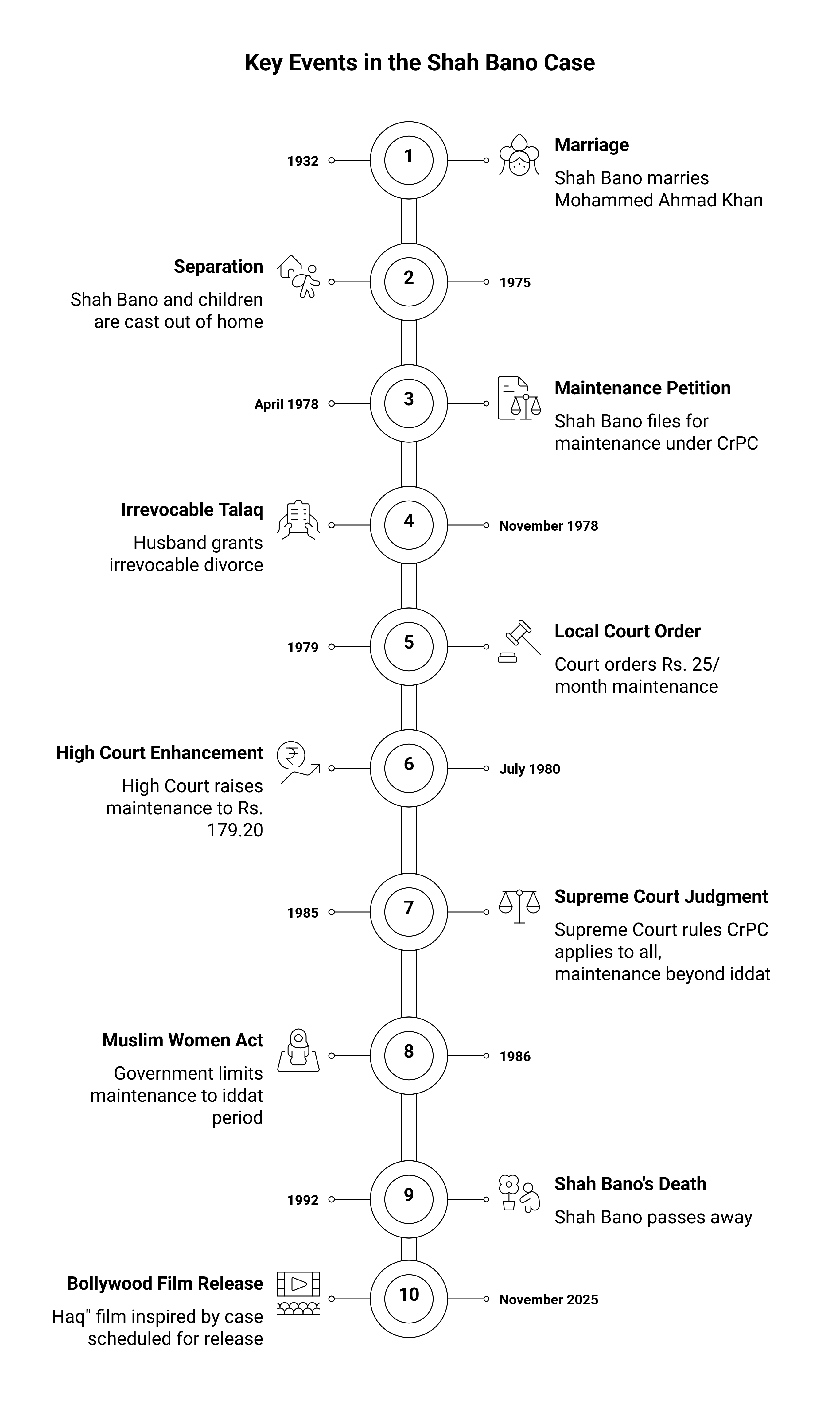
    • Origin: In 1978, Shah Bano Begum, a 62-year-old Muslim woman from Indore, was divorced by her husband, Mohammad Ahmad Khan, a lawyer, via triple talaq after 43 years of marriage.
    • Legal Action: She filed for maintenance under Section 125 of the CrPC (1973), a secular law ensuring financial support for dependents unable to maintain themselves.
    • Husband’s Argument: Claimed that under Muslim personal law, his obligation ended after the iddat period (~3 months) and that payment of mahr (dower) fulfilled his duty.
    • Lower Court Ruling: Ordered payment of ₹25/month; the Madhya Pradesh High Court raised it to ₹179.20. Khan appealed to the Supreme Court, triggering the landmark 1985 judgment.

    Supreme Court Verdict of April 23, 1985:

    • Bench & Ruling: A five-judge Constitution Bench led by CJI Y.V. Chandrachud dismissed the appeal, upholding the High Court’s decision.
    • Secular Applicability: Held that Section 125 CrPC applies to all religions, as its purpose is to prevent destitution, not to regulate personal law.
    • Maintenance Beyond Iddat: Affirmed that a divorced Muslim woman is entitled to maintenance beyond the iddat period if she cannot sustain herself.
    • Religious Harmony: Cited Quranic verses to show consistency between Islamic principles and maintenance under secular law.
    • Uniform Civil Code (UCC): Expressed concern that Article 44 remained a “dead letter,” urging steps toward a common civil code.

    Muslim Women (Protection of Rights on Divorce) Act, 1986:

    • Enactment: Passed after protests from Muslim organisations and AIMPLB, reversing the Shah Bano ruling.
    • Key Provision: Limited husband’s liability to maintenance during iddat, shifting later responsibility to relatives or Waqf Boards.
    • Judicial Interpretation:
      • Danial Latifi v. Union of India (2001) – Upheld the Act but read it progressively, requiring lump-sum payment within iddat for lifetime support.
      • Mohd. Abdul Samad v. State of Telangana (2024) – Reaffirmed that Muslim women may still claim relief under Section 125 CrPC, preserving the choice of remedy.

    Legacy and Significance:

    • Landmark Impact: Became a watershed case in India’s struggle between gender justice and religious identity.
    • Political Consequence: The 1986 Act was seen as appeasement politics, deepening the secularism debates.
    • Reform Catalyst: Revived the UCC discourse, influenced feminist legal reform, and reinforced constitutional morality.
    • Enduring Symbol: Continues to shape discussions on minority rights, women’s empowerment, and judicial activism in India’s plural legal framework.
    [UPSC 2020] Customs and traditions suppress reason, leading to obscurantism. Do you agree?


  • 20 years of Right to Information (RTI)

    Why in the News?

    RTI activists across India marked 20 years since the Right to Information Act, 2005, came into effect.

    About the Right to Information (RTI) Act, 2005:

    • Overview: Passed by Parliament in 2005, replacing the Freedom of Information Act, 2002.
    • Objective: Empower citizens to access information freely from public authorities to promote openness and good governance.
    • Scope: Applicable to Central, State, and Local Governments, public sector undertakings, and statutory bodies.
    • Key Provision: Under Section 22, the RTI Act overrides all other laws that may restrict access to information.
    • Constitutional Basis:
      • It is derived from Article 19(1)(a), the Right to Freedom of Speech and Expression.
      • The Supreme Court has recognized access to information as implicit in freedom of expression.
      • Backed by Article 32 and Article 226, citizens can seek redress for violations through the Supreme Court and High Courts.
      • RTI upholds constitutional principles of equality (Article 14) and personal liberty (Article 21) by ensuring informed citizen participation.
    • Timeframe for Response:
      • 30 days in general cases.
      • 48 hours when life or liberty is involved.
    • Exemptions from Disclosure:
      • Section 8(1): Exempts disclosure of information that could compromise sovereignty, national security, strategic or economic interests, or affect foreign relations.
      • Section 8(2): Allows disclosure if public interest outweighs potential harm to protected interests.
      • Proactive Disclosure: Every public authority must digitize records and proactively publish information to minimize formal RTI requests.
    • RTI (Amendment) Act, 2019:
      • The amendment removed fixed tenure (5 years) and salary parity with Election Commissioners.
      • It vested powers in the Central Government to determine terms of service, tenure, and allowances for CIC and ICs.
      • This was viewed as reducing the institutional autonomy of the RTI framework, raising concerns among transparency advocates.

    Institutional Framework:

    1. Central Information Commission (CIC)

    • Composition: Chief Information Commissioner (CIC) + up to 10 Information Commissioners (ICs).
    • Appointment: By the President on recommendation of a committee comprising the Prime Minister (Chairperson), Leader of Opposition (Lok Sabha), and a Union Cabinet Minister.
    • Tenure: As prescribed by the Central Government or until 65 years of age, whichever is earlier.
    • Functions:
      • Inquire into complaints and appeals under RTI.
      • Exercise civil court powers for summoning witnesses or documents.
      • Conduct suo motu inquiries in cases of systemic non-compliance.
    1. State Information Commissions (SICs)

    • Composition: State Chief Information Commissioner + up to 10 Information Commissioners.
    • Appointment: By the Governor, based on recommendations from a committee chaired by the Chief Minister, along with the Leader of Opposition and a Cabinet Minister.
    • Qualifications: Persons of eminence in public life, not affiliated with political parties or profit-making roles.
    • Functions: Parallel to CIC at the state level, ensuring local compliance with RTI obligations.
    [UPSC 2019] There is a view that the Officials Secrets Act is an obstacle to the implementation of RTI Act. Do you agree with the view? Discuss.

    [UPSC 2018] The Right to Information Act is not all about citizens’ empowerment alone, it essentially redefines the concept of accountability.” Discuss.


  • SC exempts pre-2022 Surrogacy Cases from Age Restrictions

    Why in the News?

    The Supreme Court has ruled that age limits prescribed under the Surrogacy (Regulation) Act, 2021 do not apply retrospectively to couples who had frozen their embryos and initiated the surrogacy process before January 25, 2022, the date when the law came into effect.

    Case Background:

    • Petitions: Filed by three couples who had undergone IVF and frozen embryos before Jan 25, 2022, when the Surrogacy Act came into effect.
    • Issue: They became ineligible under Section 4(iii)(c)(I) (age limits: women 23–50, men 26–55).
    • Argument: Since embryos were created pre-2022, the process was already initiated and could not be retrospectively invalidated.
    • Court’s View: Recognised embryo freezing as a lawful start to surrogacy; held that new age restrictions cannot retroactively disqualify such couples.

    Supreme Court’s Observations and Constitutional Findings:

    • No Retrospective Disqualification: The age restrictions introduced by the 2021 law cannot apply retrospectively to cases where medical procedures had already begun.
    • Equality in Conception Modes: Justice Nagarathna emphasised that couples conceiving through assisted reproductive technologies (ART) must enjoy the same constitutional protection as those conceiving naturally.
    • Article 21 & Reproductive Autonomy: The Court reaffirmed that the right to reproductive choice including IVF, ART, or surrogacy, forms part of personal liberty and privacy under Article 21.
    • Article 14 & Equality Before Law: Retrospective age-based exclusion was termed arbitrary and unreasonable, amounting to a violation of equality.
    • Parenting Competence Argument Rejected: The Court rejected the notion that older parents are inherently less capable, stating that state authorities cannot retrospectively judge parenting ability once medical procedures have been initiated lawfully.
    • Non-Retroactivity Principle: Reinforced the rule that unless a statute explicitly states otherwise, it operates prospectively.
    • Precedent Applied: Relied on Suchita Srivastava v. Chandigarh Administration (2009), where the Court recognised reproductive autonomy and bodily integrity as constitutionally protected rights.

    Back2Basics: Surrogacy (Regulation) Act, 2021

    • Objective: To regulate surrogacy, prevent commercial exploitation, and ensure ethical, altruistic surrogacy based solely on medical necessity.
    • Legislative Intent: To promote ethical medical practices, protect the rights of surrogate mothers and children, and curb commercialisation while respecting constitutional morality and reproductive dignity.
    • Applicability: Extends to all surrogacy cases involving Indian citizens and permanent residents, and works alongside the Assisted Reproductive Technology (Regulation) Act, 2021.
    • Key Provisions:
      • Type Permitted: Only altruistic surrogacy (no payment except medical expenses).
      • Eligibility for Couples: Married for at least five years; woman 23–50 yrs, man 26–55 yrs; no living biological, adopted, or surrogate child.
      • Single Women: Only widows or divorcees (35–45 yrs) are eligible; unmarried women excluded (under legal challenge).
      • Surrogate Requirements: Must be a close relative, married, with at least one biological child; age 25–35 years.
      • Certification: Requires Certificate of Essentiality, infertility proof, parentage order, and insurance for the surrogate.
      • Penalties: Commercial surrogacy banned; violation punishable by up to 10 years’ imprisonment and ₹10 lakh fine.
      • Regulatory Bodies: Establishment of National and State Surrogacy Boards for implementation and oversight.

    Issues Highlighted by the Supreme Court:

    • Absence of Transitional Provisions: The 2021 Act lacks a “grandfather clause” protecting couples already in process before its commencement.
    • Inconsistent Standards: The Court questioned why adoption laws have no upper age limit, while surrogacy does, creating unequal treatment among parents.
    • Gender Discrimination: Restricting surrogacy access to only married couples and excluding unmarried women was flagged as a potential Article 14 violation.
    • Fundamental Rights Impact: Retrospective restrictions infringe upon the right to equality and reproductive freedom under Articles 14 and 21.
    • State Overreach: The Court cautioned that the state’s intent to protect child welfare cannot override individual liberty or invalidate rights exercised under prior legal norms.

    Significance of the Judgment:

    • Reinforcement of Reproductive Rights: Confirms that assisted reproduction and surrogacy fall within the ambit of reproductive autonomy and personal liberty.
    • Protection Against Legal Injustice: Shields couples who initiated lawful medical procedures from retrospective disqualification.
    • Constitutional Precedent: Establishes that statutory changes cannot nullify pre-existing lawful rights, strengthening India’s jurisprudence on non-retroactivity.
    • Judicial Balance: Maintains a balance between ethical regulation of surrogacy and protection of individual autonomy.
    • Wider Applicability: Permits similarly placed couples to seek relief before respective High Courts, widening the ruling’s scope.
    • Affirmation of Constitutional Morality: The Court underscored that justice, equity, and good conscience must guide interpretation where legislation creates unintended inequities.
    [UPSC 2024] Under which of the following Articles of the Constitution of India, has the Supreme Court of India placed the Right to Privacy?

    (a) Article 15 (b) Article 16 (c) Article 19 (d) Article 21*


  • SC upholds Property Inheritance Rights for Gond Tribal Women

    Why in the News?

    The Supreme Court of India has affirmed that women of the Gond community, a Scheduled Tribe under Article 342, are entitled to inherit ancestral property, even where no explicit tribal custom confers this right.

    Supreme Court Verdict on Gond Women’s Inheritance Rights:

    • Background: Case concerned women of the Gond Scheduled Tribe seeking equal inheritance rights over their maternal grandfather’s ancestral property.
    • Lower Court Rulings: The trial court and Madhya Pradesh High Court dismissed the plea, holding that no tribal custom granted such rights and placing the burden of proof on the women.
    • Supreme Court Review: On 17 July 2025, a Bench of Justices Sanjay Karol and Joymalya Bagchi examined whether constitutional equality overrides unwritten tribal customs excluding women from succession.
    • Legal Context: Under Section 2(2) of the Hindu Succession Act (1956), Scheduled Tribes are excluded unless specifically notified—none apply to Gonds—so the dispute was governed by customary tribal law.

    Supreme Court’s Ruling:

    • Presumption of Equality: The Court reversed lower findings, holding that equality must be presumed unless a proven, valid custom denies it.
    • Burden of Proof: Stated that custom cannot be presumed; it must be ancient, certain, and reasonable, proven through credible evidence.
    • Gender Justice: Rejected patriarchal inferences drawn from Hindu traditions, asserting such predispositions have “no place” in the case.
    • Guiding Principle: In absence of valid custom, courts must decide per “justice, equity, and good conscience.”

    Constitutional Principles Applied:

    • Article 14: Ensures equality before law; male-only inheritance lacks rational basis.
    • Article 15(1):  Prohibits sex-based discrimination; used to strike down exclusion of women.
    • Article 38: Mandates elimination of inequality across social and gender lines.
    • Article 46:  Requires protection of Scheduled Tribes from exploitation and injustice.
    • Hindu Succession (Amendment) Act, 2005 cited for illustrating gender-equal intent, not direct applicability.

    Constitutional–Customary Balance:

    • Conflict: Between tribal autonomy under Fifth/Sixth Schedules and constitutional equality under Part III.
    • Precedent Shift: Unlike Madhu Kishwar v. State of Bihar (1996), which upheld male-only inheritance, the 2025 ruling held that when custom is unproven or discriminatory, Article 14 prevails.
    • Significance: Moves jurisprudence from deference to custom toward enforcement of constitutional morality, ensuring tribal women’s equal property rights.
    [UPSC 2023] Explain the constitutional perspectives of Gender Justice with the help of relevant Constitutional Provisions and case laws.

    [UPSC 2015] Discuss the possible factors that inhibit India from enacting for its citizens a uniform civil code as provided for in the Directive Principles of State Policy.