💥Join UPSC 2027,2028 Mentorship (July Batch) + XFactor Notes & Microthemes PDF

Subject: “Genetics,Biotechnology”

  • Next Generation Nanomedicine for Breast Cancer

    Why in the news?

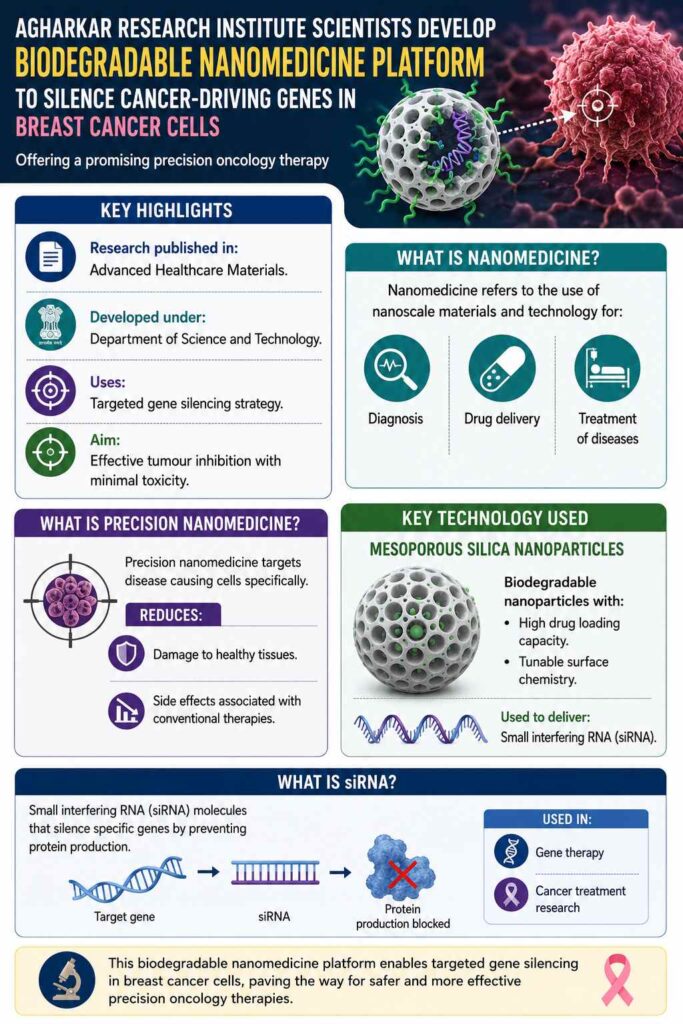
    Scientists from Agharkar Research Institute developed a biodegradable nanomedicine platform capable of silencing cancer driving genes in breast cancer cells, offering a promising precision oncology therapy.

    Key Highlights

    • Research published in: Advanced Healthcare Materials.
    • Developed under: Department of Science and Technology.
    • Uses: Targeted gene silencing strategy.
    • Aim: Effective tumour inhibition with minimal toxicity.

    What is Nanomedicine?

    Nanomedicine refers to the use of nanoscale materials and technology for:

    • Diagnosis
    • Drug delivery
    • Treatment of diseases.

    What is Precision Nanomedicine?

    • Precision nanomedicine: Targets disease causing cells specifically.
    • Reduces:
      • Damage to healthy tissues.
      • Side effects associated with conventional therapies.

    Key Technology Used

    Mesoporous Silica Nanoparticles

    • Biodegradable nanoparticles with:
      • High drug loading capacity.
      • Tunable surface chemistry.
    • Used to deliver: Small interfering RNA (siRNA).

    What is siRNA?

    • Small interfering RNA (siRNA): Molecules that silence specific genes by preventing protein production.
    • Used in:
      • Gene therapy
      • Cancer treatment research.

    [2015] With reference to the use of nanotechnology in health sector, which of the following statements is/are correct?
    1.Targeted drug delivery is made possible by nanotechnology
    2.Nanotechnology can largely contribute to gene therapy
    Select the correct answer using the code given below.

    [A] 1 only

    [B] 2 only

    [C] Both 1 and 2

    [D] Neither 1 nor 2

  • The genie of synthetic biology is out, and with it comes power and peril

    Why in the News?

    Advances in synthetic biology, genome sequencing, artificial intelligence, and genome synthesis are rapidly giving humans the ability not only to read DNA but also to design and create new biological systems. This marks a historic shift from understanding life to engineering life.

    What is Synthetic Biology?

    1. Definition: Synthetic biology is the application of engineering principles to biology to design, modify, or create organisms, cells, genes, or biological systems with desired functions.
    2. Objective: Moves beyond studying life to actively engineering biological systems.
    3. Approach: Combines genetics, molecular biology, biotechnology, computer science, artificial intelligence, and engineering.
    4. Applications: Drug development, vaccines, biofuels, industrial chemicals, climate-resilient crops, and environmental remediation.
    5. Significance: Enables scientists to redesign existing life forms or create biological systems that do not exist in nature.

    What is DNA?

    1. DNA (Deoxyribonucleic Acid): The hereditary molecule that stores genetic information in living organisms.
    2. Building Blocks: Consists of four nucleotide bases:
      1. Adenine (A)
      2. Thymine (T)
      3. Guanine (G)
      4. Cytosine (C)
    3. Function: Contains instructions for building and maintaining an organism.
    4. Location: Found in nearly every cell of living organisms.
    5. Importance: Acts as the biological code that determines traits, growth, development, and cellular functions.

    What is a Genome?

    1. Definition: A genome is the complete set of DNA present in an organism.
    2. Contents: Includes:
      1. Genes that code for proteins
      2. Regulatory DNA that controls gene activity
    3. Role: Serves as the complete biological blueprint of an organism.
    4. Human Genome: Contains about 22,000 protein-coding genes.
    5. Significance: Differences in genomes explain biological diversity among species.

    What is the Genomic Revolution?

    1. Definition: The rapid advancement in genome sequencing technologies that has dramatically increased the ability to read and analyse DNA.
    2. Trigger: Massive reduction in sequencing costs and time.
    3. Human Genome Project Comparison:
      1. Took over a decade
      2. Cost nearly $3 billion
      3. Involved thousands of scientists
    4. Today:
      1. Genome sequencing can be completed in hours
      2. Costs have fallen to a few hundred dollars
    5. Major Outcomes:
      1. Mapping evolutionary history
      2. Understanding diseases
      3. Identifying genetic adaptations
      4. Personalized medicine
      5. Genome engineering
      6. Synthetic biology
    6. Significance: The genomic revolution has transformed biology into a data-driven science and laid the foundation for synthetic biology.

    How Has Understanding DNA Transformed Humanity’s Ability to Engineer Life?

    1. DNA as the Language of Life: DNA stores genetic information through four nucleotides, A, T, G, and C, which determine biological structure and function.
    2. Genome as Biological Blueprint: Every cell contains a genome comprising thousands of genes and regulatory sequences.
    3. Protein Synthesis: Genes encode proteins that perform structural, regulatory, metabolic, and physiological functions.
    4. Regulatory Architecture: Complexity arises not merely from gene numbers but from when, where, and how genes are expressed.
    5. Transcription Factors: Specialized proteins switch genes on or off, creating diverse biological outcomes.
    6. Phenylketonuria Example: Understanding genetic disorders has enabled dietary interventions that allow affected individuals to live normal lives.

    Why Does Gene Number Alone Not Explain Biological Complexity?

    1. Limited Difference in Gene Count: Humans possess approximately 22,000 genes, compared with:
      1. Escherichia coli: ~4,300 genes
      2. Fruit fly: ~17,000 genes
      3. Mouse: ~22,000 genes
      4. Water flea (Daphnia): ~31,000 genes
    2. Regulation Over Quantity: Biological complexity depends largely on gene regulation rather than the absolute number of genes.
    3. Expression Dynamics: Variations in timing, location, intensity, and interaction of gene expression create complexity.
    4. Cellular Specialization: Identical genomes produce diverse cell types through differential gene expression.

    How Has the Genomic Revolution Expanded Human Knowledge About Life?

    1. Reconstruction of Evolutionary History
      1. Evolutionary Mapping: Genome sequencing reconstructs the tree of life and evolutionary relationships among organisms.
      2. Complement to Fossils: Genomic evidence fills gaps where fossil records are absent.
      3. Historical Precision: Provides unprecedented accuracy in tracing biological evolution over millions of years.
    2. Understanding Adaptation and Natural Selection
      1. Adaptive Evolution: Genetic variations reveal how organisms adapt to environmental conditions.
      2. Human Diabetes Example: Genes predisposing populations to Type-II diabetes may have evolved under conditions of fluctuating food availability but become maladaptive under modern abundance.
      3. Selection Processes: Genome studies reveal how mutations are preserved or eliminated through natural selection.
    3. Building Comprehensive Cellular Maps
      1. Cellular Atlases: Sequencing enables identification of:
        1. Gene expression patterns
        2. Protein localization
        3. Cellular functions
        4. Regulatory interactions
      2. Big Data Biology: Massive biological datasets are enabling integrated understanding of cellular systems.
      3. Systems Biology: Facilitates comprehensive models of life processes rather than isolated gene studies.

    How Is Artificial Intelligence Accelerating Synthetic Biology?

    1. Computational Design: AI enables analysis of large-scale biological and environmental data.
    2. Genome Engineering: Scientists can increasingly design sections of genomes or entire genomes digitally.
    3. Predictive Biology: AI supports prediction of biological outcomes before laboratory implementation.
    4. Design Optimization: Accelerates identification of desirable genetic traits and functions.
    5. Reduced Costs: Improves accessibility and efficiency of biological engineering.
    6. Current Limitation: Biological systems often resist simplistic in silico predictions, requiring experimental validation.

    What New Possibilities Does Synthetic Biology Create?

    1. Designer Cells
      1. Biomanufacturing: Engineered cells produce chemicals, drugs, fuels, and advanced materials. Example: Genetically modified yeast is used to manufacture insulin and other therapeutic proteins.
      2. Industrial Biotechnology: Supports sustainable production systems. Example: Engineered microbes are used in the production of bioethanol and biodegradable plastics.
      3. Novel Biological Products: Enables creation of compounds not found naturally. 
    2. Engineered Organisms
      1. Genome-Wide Engineering: Modification extends beyond individual genes to entire genomes.
      2. Agricultural Applications: Facilitates development of improved crops and livestock.
      3. Biomedical Applications: Supports advanced therapeutics and regenerative medicine.
    3. Creation of Synthetic Life
      1. Artificial Genomes: Scientists can synthesize complete genomes and insert them into living cells.
      2. Novel Organisms: Opens possibilities for entirely new biological entities.

    Why Was Craig Venter’s Experiment a Historic Turning Point?

    1. Synthetic Genome Creation: In 2010, J. Craig Venter and his team chemically synthesized a complete bacterial genome.
    2. Genome Transplantation: The synthetic genome was inserted into a bacterial cell whose native DNA had been removed.
    3. Digitally Created Life: The experiment represented the first major demonstration of a cell controlled by a synthetic genome.
    4. Biological Watermarking: Non-coding DNA regions contained encoded quotations from:
      1. James Joyce: “To live, to err, to fall, to triumph, to recreate life out of life.”
      2. Richard Feynman: “What I cannot create, I do not understand.”
      3. J. Robert Oppenheimer: “See things not as they are, but as they might be.”
    5. Future Potential: Genome synthesis may eventually allow creation of larger synthetic genomes and engineered organisms.

    How Does Bottom-Up Synthetic Biology Attempt to Recreate the Origin of Life?

    1. Bottom-Up Synthetic Biology: Seeks to construct living systems from scratch using non-living chemical components. Instead of modifying existing organisms, it attempts to recreate the earliest stages through which life may have emerged on Earth.
    2. Scientific Objective: Examines one of biology’s fundamental questions, how non-living molecules transformed into self-replicating living systems approximately 4 billion years ago.
    3. Protocell Construction: Researchers build simplified cell-like structures called protocells, which mimic some characteristics of primitive life forms but are not fully living organisms.
    4. Jack Szostak’s Research: Developed fatty-acid membrane structures that can spontaneously assemble, encapsulate RNA molecules, grow by incorporating surrounding molecules, and divide into smaller daughter structures.
    5. Origin of Life Studies: Such experiments help scientists understand how the first biological cells may have formed before the evolution of complex organisms.
    6. Future Possibilities: Success in creating self-replicating protocells could eventually enable the development of entirely new forms of artificial life designed for specific purposes.
    7. Example: Jack Szostak’s protocell experiments demonstrated that simple fatty-acid vesicles can spontaneously form membrane-bound compartments capable of enclosing RNA and undergoing growth and division, providing a possible model for the earliest stages of life on Earth.

    Why Does Synthetic Biology Create Unique Governance Challenges?

    1. Self-Replicating Systems: Unlike machines, living organisms can reproduce and evolve.
    2. Unpredictability: Biological systems exhibit emergent properties and complex interactions.
    3. Biosecurity Risks: Potential misuse for harmful biological applications.
    4. Ecological Risks: Release of engineered organisms may alter ecosystems.
    5. Ethical Concerns: Raises questions regarding ownership, modification, and creation of life.
    6. Dual-Use Nature: Technologies useful for medicine and industry may also pose security threats.

    How Should Society Balance Innovation and Regulation in Synthetic Biology?

    1. Scientific Freedom: Advances require open research and innovation.
    2. Risk-Based Regulation: Governance frameworks must evaluate risks proportional to applications.
    3. Global Coordination: Biological risks transcend national boundaries.
    4. Responsible Innovation: Ethical oversight should accompany technological development.
    5. Precautionary Principle: Requires anticipation of future risks before deployment.
    6. Adaptive Governance: Regulations must evolve alongside technological progress.

    Conclusion

    Synthetic biology marks a transition from decoding life to designing life. The convergence of genomics, artificial intelligence, and genome synthesis offers unprecedented opportunities in healthcare, agriculture, industry, and environmental sustainability. However, because biological systems can self-replicate and evolve, governance challenges are fundamentally different from those associated with conventional technologies. The future of synthetic biology will depend on balancing scientific innovation with robust ethical, biosafety, and biosecurity safeguards.

    PYQ Relevance

    [UPSC 2021] What are the research and developmental achievements in applied biotechnology? How will these achievements help to uplift the poorer sections of society?

    Linkage: The PYQ examines the transformative potential of biotechnology and its socio-economic applications. With the new advancements, a question on synthetic biology can be asked next. The article extends the biotechnology discourse from genetic modification to genome engineering, synthetic genomes, and artificial life.

  • In the context of genetic disorders, consider the following

    In the context of genetic disorders, consider the following :
    A woman suffers from colour blindness while her husband does not suffer from it. They have a son and a daughter. In this context, which one of the following statements is most probable) correct ?

  • At present, scientists can determine the arrangement or relative positions of genes or DNA sequences on a chromosome. How does this knowledge benefit us? 1. It is possible to know the pedigree of livestock. 2. It is possible to understand the causes of all human diseases. 3. It is possible to develop disease-resistant animal breeds.

    At present, scientists can determine the arrangement or relative positions of genes or DNA sequences on a chromosome. How does this knowledge benefit us? 1. It is possible to know the pedigree of livestock. 2. It is possible to understand the causes of all human diseases. 3. It is possible to develop disease-resistant animal breeds.

  • With reference to ‘stem cells’, frequently in the news, which of the following statements is/are correct? 1. Stem cells can be derived from mammals only. 2. Stem cells can be used for screening new drugs. 3. Stem cells can be used for medical therapies.

    With reference to ‘stem cells’, frequently in the news, which of the following statements is/are correct? 1. Stem cells can be derived from mammals only. 2. Stem cells can be used for screening new drugs. 3. Stem cells can be used for medical therapies.

  • Mycorrhizal biotechnology has been used in rehabilating degraded sites because mycorrhiza enables the plants to

    Mycorrhizal biotechnology has been used in rehabilating degraded sites because mycorrhiza enables the plants to
    (1). resist drought and increase absorptive area
    (2). tolerate extremes of pH
    (3). resist disease infestation
    Select the correct answer using the codes given below.

  • Recombinant DNA technology (Genetic Engineering) allows genes to be transferred

    Recombinant DNA technology (Genetic Engineering) allows genes to be transferred
    (1). across different species of plants
    (2). from animals to plants
    (3). from microorganisms to higher organisms
    Select the correct answer using the codes given below.

  • In the context of the developments in Bioinformatics, the term ‘transcriptome’, sometimes

    In the context of the developments in Bioinformatics, the term ‘transcriptome’, sometimes
    seen in the news, refers to

  • What is the application of Somatic Cell Nuclear Transfer Technology

    What is the application of Somatic Cell Nuclear Transfer Technology?

  • With reference to agriculture in India, how can the technique of `genome sequencing’, often seen in the news, be used in the immediate future

    With reference to agriculture in India, how can the technique of `genome sequencing’, often seen in the news, be used in the immediate future?
    1. Genome sequencing can be used to identify genetic markers far disease resistance and
    drought tolerance in various crop plants.
    2. This technique helps in reducing the time required to develop new varieties of crop
    plants.
    3. It can be used to decipher the host-pathogen relationships in crops.
    Select the correct- answer using the code given below: