💥Mains Ready By December. Smash Mains & Smash PYQ Admissions Open

Subject: Governance

Important aspects of Society

  • Supreme Court clarifies scope of police custody under Section 187(2) BNSS

    Why in the News?

    The Supreme Court held in The State of Andhra Pradesh vs Suda Suresh Veera Venkata Naga Raju that Section 187(2) of the Bharatiya Nagarik Suraksha Sanhita, 2023 enlarges the window during which police custody may be sought. The ruling has exposed the difference between the new code and the old regime, under which police custody was confined to the first 15 days of remand alone. Police custody is now available in parts, though in aggregate not exceeding 15 days, during the first 40 or 60 days of detention.

    What is Section 187(2) of the Bharatiya Nagarik Suraksha Sanhita, 2023?

    1. Governing provision: Section 187 of the Bharatiya Nagarik Suraksha Sanhita, 2023 (BNSS), the criminal procedure code that replaced the Code of Criminal Procedure, 1973, governs the detention of an accused when investigation cannot be completed in 24 hours.
    2. Enlarged window: Under Section 187(2), a magistrate may authorise detention not exceeding 15 days in the whole, or in parts, at any time during the initial 40 days or 60 days of a total detention period of 60 or 90 days.

    What is default bail?

    1. Definition: Where investigation is not completed within the stipulated period, the accused becomes entitled to release, widely known as default bail.
    2. Time limits under Section 187(3): Judicial detention may extend up to 90 days for offences punishable with death, life imprisonment or imprisonment of 10 years or more, and up to 60 days for any other offence.

    What is the current status of pre-trial custody rights in India?

    1. Twenty four hour rule: Section 58 of the BNSS provides that a person arrested without warrant cannot be detained beyond 24 hours without a magistrate’s authorisation under Section 187.
    2. Fifteen day cap on police custody: Police custody remains capped at 15 days in aggregate, but may now be spread across the early investigation period rather than the first 15 days alone.
    3. Right to counsel: Section 38 of the BNSS entitles an arrested person to meet an advocate of choice during interrogation, though not throughout interrogation.
    4. Recording safeguard: Audio visual recording of the actual interrogation and of any discovery or recovery satisfies the transparency requirement.

    Constitutional provisions related to arrest and detention:

    1. Article 22(1): Guarantees the right to be informed of grounds of arrest and to consult a legal practitioner of choice.
    2. Article 22(2): Requires production before the nearest magistrate within 24 hours of arrest.
    3. Article 21: Protects life and personal liberty, permitting deprivation only by a just, fair and reasonable procedure established by law.
    4. Article 20(3): Protects against self incrimination, relevant to the presence of counsel during interrogation.

    What did the Supreme Court hold?

    1. No absolute outer limit: A magistrate cannot place an absolute and non extendable outer limit on custody, since such a limit forecloses recourse to Section 187(2) of the BNSS.
    2. Purpose of the change: The enlarged window is intended to meet situations where fresh facts, discoveries or leads emerge during the course of investigation.
    3. Additional custody granted: The Court permitted 7 days of additional police custody so that the total police remand would not exceed 15 days.
    4. Facts of the case: In a custodial death case the victim’s body remained untraced, the original CCTV hard disks were yet to be discovered, and recoveries under the Bharatiya Sakshya Adhiniyam were imminent.

    How does the new remand window differ from the old code?

    1. Old Section 167 CrPC: Detention in police custody could not be granted beyond the initial 15 days in the whole under Section 167 of the Code of Criminal Procedure, 1973.
    2. Alteration within the window: Even under the old code, during the first 15 days a magistrate could alter custody from judicial to police and back.
    3. New flexibility: Under the BNSS police custody may be sought in parts across the first 40 or 60 days, keeping the aggregate at 15 days.

    What did the Court hold on the presence of an advocate?

    1. Not continuous: Section 38 does not contemplate the continuous, ongoing physical presence of an advocate for the entirety of each interrogation session.
    2. Line of sight: The advocate may remain present within the site of interrogation from where he can see the accused, but not throughout the questioning.
    3. Recording over escort videography: Instead of uninterrupted videography of the accused in transit, audio visual recording of the interrogation and of any recovery meets the requirement.

    What are the major debates surrounding the enlarged custody window?

    1. Liberty versus investigation: Spreading police custody across 40 or 60 days risks repeated custodial spells, weighed against the need to pursue late emerging leads.
    2. Magistrate’s discretion: The ruling limits a magistrate’s power to foreclose future custody, raising the question of how liberty is protected during the extended window.
    3. Counsel access: The line of sight standard for the advocate leaves open how effectively the right against coercion is protected during interrogation.

    Way Forward:

    1. Reasoned remand orders: Require magistrates to record specific reasons linking each spell of police custody to investigative need.
    2. Guard against repeat custody: Frame guidelines to prevent the enlarged window becoming a route to successive custodial spells.
    3. Effective counsel access: Clarify practical standards for an advocate’s presence to protect against coercion.
    4. Mandatory recording compliance: Ensure audio visual recording of interrogation and recovery is uniformly implemented and preserved.
    5. Judicial training: Orient magistrates on the new remand architecture to balance liberty with investigation.

    Conclusion:

    The Court has clarified that police custody under the BNSS is capped at 15 days in aggregate but may be sought in parts through the first 40 or 60 days of investigation, not the first 15 days alone. The ruling reflects the legislative intent to accommodate fresh discoveries during a probe. The interpretation now governs how magistrates authorise and structure police remand under the new code.

    Back2Basics:

    BNSS, BNS and BSA

    1. Bharatiya Nyaya Sanhita, 2023: Replaced the Indian Penal Code, 1860 as the substantive criminal law.
    2. Bharatiya Nagarik Suraksha Sanhita, 2023: Replaced the Code of Criminal Procedure, 1973 governing procedure, arrest, investigation and trial.
    3. Bharatiya Sakshya Adhiniyam, 2023: Replaced the Indian Evidence Act, 1872 governing admissibility of evidence.
    4. Effective date: The three codes came into force on 1 July 2024.
    5. Zero FIR and e-FIR: The BNSS recognises registration of a First Information Report irrespective of jurisdiction and enables electronic reporting.

    PYQ Relevance

    [UPSC 2026] Which of the following statements about a Zero First Information Report (Zero FIR) under the Bharatiya Nagarik Suraksha Sanhita (BNSS), 2023 is/are correct?

    1. A Zero FIR can be lodged at a police station, even though the place of commission of a cognizable/non-cognizable offence is outside the territorial jurisdiction of that police station. 2. The Officer-in-Charge of the police station where a Zero FIR has been lodged may, with the permission of the competent authority, initiate a preliminary enquiry. 3. Under Zero FIR, it is obligatory for the informant to furnish information electronically.

    (a) 1 and 2 (b) 2 and 3 (c) 1 and 3 (d) 1 only

    Answer: D

  • Foreign Contribution (Regulation) Amendment Bill, 2026 referred to 31-member JPC

    Why in the news?

    The Lok Sabha adopted a motion referring the Foreign Contribution (Regulation) Amendment Bill, 2026, to a Joint Parliamentary Committee (JPC) after sustained Opposition protest and coordinated appeals from Christian organisations. The referral has exposed a tension between the state’s claim to regulate foreign funded civil society and the property and hearing rights of the organisations that funding built. Minority run schools, colleges and hospitals sustained by money from abroad stand most exposed to the Bill’s asset takeover provisions.

    What is the Foreign Contribution (Regulation) Act, 2010?

    1. Governing statute: The Foreign Contribution (Regulation) Act, 2010 regulates the acceptance and use of foreign contributions and foreign hospitality by individuals and associations. It replaced the earlier Foreign Contribution (Regulation) Act, 1976.
    2. Registration mechanism: An organisation receiving foreign funds must register with the Ministry of Home Affairs and renew that registration every five years. Funds may be used only for the declared cultural, economic, educational, religious or social programme.

    What is a Joint Parliamentary Committee (JPC)?

    1. Ad hoc committee: A JPC is a temporary committee of members drawn from both Houses to examine a specific bill or matter in detail and report back. This one has 21 Lok Sabha members nominated by the Speaker and 10 Rajya Sabha members nominated by the Chairman, a total of 31 members.
    2. Reporting deadline: The committee must submit its report to the Lok Sabha by the last day of the first week of the coming Winter Session.

    What is the current status of the right to receive foreign contributions in India?

    1. Not a fundamental right: The Central government contends that the right to receive foreign contributions is not a fundamental right, and that access to foreign funds is a privilege the state may condition or withdraw.
    2. Renewal regime: About every registered body operates on a five year certificate, renewable on application, with the Ministry of Home Affairs holding discretion to refuse renewal on security grounds.
    3. Prior tightening: The 2020 amendments barred a registered body from transferring foreign funds to any other body, even one registered under the same Act, and cut the share of foreign funds usable for administrative expenses from one half to one fifth.
    4. Judicial check: The Kerala High Court on Tuesday set aside the Centre’s refusal to renew certificates of two NGOs, Save A Family Plan and Kerala Social Service Forum, holding that reasons must be specified in every order and that peaceful protest funding is not a national security threat.

    Constitutional provisions related to foreign funding regulation:

    1. Article 19(1)(c): Guarantees the right to form associations, which the regulation of their funding directly affects.
    2. Article 19(1)(a): Protects freedom of speech and expression, engaged where funding refusal follows an organisation’s support for protest.
    3. Article 14: Requires that any classification and any exercise of discretion in refusing renewal be non arbitrary and reasoned.
    4. Article 300A: Provides that no person shall be deprived of property save by authority of law, engaged by the automatic vesting of NGO assets in a designated authority.
    5. Entry 10, Union List: Places foreign affairs and matters bringing the Union into relation with foreign countries within Parliament’s exclusive competence, the basis for central regulation of foreign funds.

    What does the 2026 Bill change?

    1. Designated authority: The Bill creates a government designated authority to take over, manage or dispose of assets built from foreign funds when an organisation’s FCRA registration is suspended, cancelled or not renewed.
    2. Trigger on lapse: Registration can be lost not only by cancellation, but when renewal is refused, not applied for, or not granted before the old certificate expires.
    3. Automatic vesting: On that event the organisation’s foreign funds and everything built with them pass to the authority automatically, returning only if the body re registers within a period the government has yet to specify.
    4. Full takeover of part funded property: A building put up only partly with foreign money is taken over in full, and the organisation must separately apply to recover the share not paid for with foreign money.
    5. Limited appeal: An appeal to a district judge lies only against what the authority later does with the property, not against the refusal to renew, and the organisation has no right to be heard before that refusal.

    Why are minority religious institutions most alarmed?

    1. Scale of dependence: Christian organisations run thousands of schools, colleges and hospitals built and sustained with money from churches and congregations abroad, which the takeover provisions place at risk.
    2. Retrospective reach: A hospital built decades ago can be taken over today merely because a certificate has been allowed to lapse, contradicting the Home Minister’s assurance that the Bill will not apply retrospectively.
    3. Geographic spread of protest: Hundreds marched in Aizawl under a newly formed council of churches, organisations in Kerala objected, the Nagaland Chief Minister sought a parliamentary review, and the Tamil Nadu Assembly unanimously resolved for withdrawal.
    4. External pressure: A United States Congressman described the Bill as an attack on Christians and warned it could strain India United States relations, one trigger for the government’s rethink.
    5. Institutional welcome for referral: The Catholic Bishops’ Conference of India and the National Council of Churches in India welcomed the referral while asking that major and minor offences be distinguished before assets are taken.

    What are the major debates surrounding foreign funding regulation?

    1. Regulation versus autonomy: Church bodies concede that regulation of foreign funds is necessary and that action must follow against anti national activity, while resisting a design that punishes lapse of a certificate as harshly as proven wrongdoing.
    2. Discretion without reasons: Because the authority acts on the Centre’s instructions, the Centre can use opaque reasons to withdraw a licence, take over property, and then direct the body now holding it.
    3. Hearing and appeal gap: The absence of a pre decisional hearing and of any appeal against refusal to renew is the core fairness objection the JPC is asked to cure.
    4. Property proportionality: Full takeover of a building only partly financed by foreign money raises a proportionality question under the protection of property.

    Challenges to fair FCRA regulation:

    1. Reasoned order deficit: Refusals often rest on undisclosed intelligence inputs, leaving organisations unable to contest the specific ground, as the Kerala High Court flagged.
    2. Chilling effect on civil society: Uncertainty over renewal deters legitimate service delivery in health and education that depends on predictable foreign inflows.
    3. Asset valuation disputes: Separating the foreign funded share of a mixed asset invites prolonged litigation over apportionment and valuation.
    4. Federal friction: State Assemblies have resolved against the Bill, exposing a centre state fault line over regulation of institutions operating within States.
    5. Compliance burden on small NGOs: Frequent re registration and strict expense caps fall hardest on small organisations lacking dedicated legal and accounting capacity.
    6. Selective enforcement risk: Broad discretion creates room for targeting organisations by community or by their political positions rather than by conduct.

    Conclusion: The Bill’s central defect is that it lets the Centre seize the assets of a civil society body on the mere lapse of a certificate, without a hearing before refusal and without an appeal against it. The referral to a 31 member JPC defers passage rather than resolving the dispute. The committee must redraft the Bill to give organisations a hearing before renewal is refused and a right to appeal that refusal, with the report due by the first week of the Winter Session.

    Statutory Framework Governing Foreign Funding of NGOs:

    1. Foreign Contribution (Regulation) Act, 2010: The principal Act requiring registration and prior permission for receipt of foreign contributions.
    2. Foreign Contribution (Regulation) Amendment Act, 2020: Barred sub granting of foreign funds, cut the administrative expense cap to one fifth, and mandated a designated FCRA account at a specified State Bank of India branch.
    3. Foreign Contribution (Regulation) Rules, 2011: Prescribe the procedure for registration, renewal, reporting and use of foreign contributions.
    4. Foreign Contribution (Regulation) Amendment Bill, 2026: The pending Bill introducing the designated authority and automatic vesting of assets, now before the JPC.

    Back2Basics: FCRA registration

    1. Administering ministry: Ministry of Home Affairs, Foreigners Division.
    2. Eligibility: Associations with a definite cultural, economic, educational, religious or social programme, normally in existence for at least three years.
    3. Prohibited recipients: Election candidates, judges, government servants, members of legislatures, political parties and media organisations are barred from accepting foreign contributions.
    4. Validity and renewal: Registration is valid for five years and must be renewed through a fresh application before expiry.

    Way Forward:

    1. Pre decisional hearing: Mandate notice and an opportunity to be heard before any refusal to renew or cancellation.
    2. Appeal against refusal: Provide a statutory appeal against the refusal itself, not only against later dealing with the property.
    3. Proportionate asset treatment: Restrict any takeover to the demonstrably foreign funded share of an asset, with independent valuation.
    4. Reasoned orders: Require every refusal to state specific, disclosable reasons, subject to security redaction reviewed by the appellate authority.
    5. Distinguish offences: Separate technical lapses, such as delayed renewal, from substantive violations before invoking asset consequences.

    “[2015 GS2 12.5m] Examine critically the recent changes in the rules governing foreign funding of NGOs under the Foreign Contribution (Regulation) Act (FCRA), 1976.”

  • Parliament passes Tribunals Reforms Bill; National Tribunals Commission set up

    Why in the News?

    Parliament passed the Tribunals Reforms Bill, 2026, which establishes a National Tribunals Commission to oversee the selection and administration of tribunals. The Bill responds to a Supreme Court direction, yet it retains executive control over the commission’s appointments and finances. This exposes the tension between insulating tribunals from the ministries they review and preserving the government’s grip over the same bodies.

    What is the National Tribunals Commission (NTC)?

    1. Definition: The National Tribunals Commission (NTC) is a proposed statutory body to oversee the appointment, service conditions, and administration of tribunals under a common framework covering 16 tribunals.
    2. Composition: It is to be headed by a former Supreme Court judge or a former chief justice of a High Court, supported by two judicial members and two technical members.
    3. Selection method: Appointments to member tribunals are to be made through a search cum selection system run by the commission, supported by a dedicated NTC Secretariat.
    4. Origin: The Supreme Court first recommended an independent statutory commission of this kind in the Rojer Mathew judgment of 2019.

    Why were tribunals created in the first place?

    1. Speed and specialisation: Tribunals allow specialists to settle technical disputes faster than regular courts, in areas such as taxation, company law, securities, and the environment.
    2. Complementary role: They do not replace constitutional courts but supplement the judicial system with specialised adjudication.
    3. Economic stake: Timely resolution frees locked capital and restores investor confidence, linking ease of justice to ease of doing business.
    4. Constitutional basis: Articles 323A and 323B provide for administrative tribunals on service matters and tribunals on specified subjects respectively.

    How has tribunal jurisprudence developed?

    1. S.P. Sampath Kumar, 1987: Upheld tribunals but held that their decisions remain subject to review by constitutional courts.
    2. L. Chandra Kumar, 1997: Held that judicial review by High Courts under Article 226 is part of the basic structure and cannot be ousted by tribunals.
    3. Rojer Mathew, 2019: Recommended an independent statutory National Tribunals Commission and held that defining who is qualified to exercise judicial power is an essential legislative function that cannot be left to executive rulemaking.
    4. Madras Bar Association, 2025: Struck down provisions Parliament had reenacted, restored the earlier framework, and gave the government four months to establish the commission.
    5. Structural flaw addressed: Tribunals had historically been administered by the same ministries whose decisions they were meant to review.

    What are the other major changes the Bill introduces?

    1. Five year terms: Restores five year terms for tribunal members in place of shorter tenures the courts had rejected.
    2. Uniform service conditions: Introduces uniform service conditions across tribunals to end variation between ministries.
    3. National Tribunals Data Grid: Provides for a data grid to track pendency and disposal across tribunals.
    4. Pending appointments protected: Does not disturb appointments already in the pipeline.
    5. Rationalisation retained: Follows the earlier reduction of tribunals from 26 to 19 and then to 16.

    Where does the genuine tension in the Bill lie?

    1. Autonomy versus executive control: The commission is meant to insulate tribunals from executive control, yet the Centre still appoints its members and retains substantial influence over its finances and administration.
    2. Delegation to executive rules under Section 14: Qualifications, manner of selection, salaries, and service conditions of members are left to future executive rules, the very delegation the Rojer Mathew reasoning had resisted.
    3. Ministerial screening under Section 16: A ministry first screens a complaint against a member before it passes to the commission for inquiry.
    4. Consultation, not concurrence: The Centre consults the Chief Justice of India only for the chairperson and judicial members, retaining the decisive voice.
    5. Representation gap: Members flagged that very few tribunal members come from Scheduled Caste and Scheduled Tribe communities, with only one tribal judge recorded so far.

    What are the challenges to the tribunal system?

    1. Executive dependence: Funding, staffing, and infrastructure of many tribunals still flow from the parent ministry whose orders they review.
    2. Vacancies and pendency: Delayed appointments leave benches vacant and cases pending, defeating the promise of speedy justice.
    3. Inconsistent service conditions: Divergent tenures and salaries across tribunals weaken independence and deter qualified members.
    4. Access barriers: Concentration of benches in a few cities makes tribunals hard to reach for litigants from distant areas.
    5. Weak enforcement: Tribunal orders are sometimes not implemented, as seen in inter State water sharing disputes.

    Conclusion

    The Tribunals Reforms Bill, 2026, creates the long directed National Tribunals Commission and restores protections the Supreme Court had earlier upheld. The central weakness is that a body designed to insulate tribunals from executive control remains subject to executive appointment, removal, and finance. Genuine autonomy will require the government to surrender its power to appoint or remove members at will, a change the current text does not make.

    Back2Basics

    What is Judicial Review?

    1. About: Judicial review is the power of constitutional courts to examine the validity of legislative and executive action against the Constitution.
    2. Rationale: It protects fundamental rights and the separation of powers by preventing any organ from exceeding constitutional limits.
    3. Basic structure: In L. Chandra Kumar, the Supreme Court held that judicial review by the High Courts and the Supreme Court is part of the basic structure and cannot be excluded, including over tribunal decisions.

    Constitutional Framework Governing Tribunals

    1. Article 323A: Empowers Parliament to establish administrative tribunals for disputes over recruitment and service conditions of public servants.
    2. Article 323B: Empowers appropriate legislatures to set up tribunals for specified matters such as taxation, industrial and labour disputes, and elections.
    3. Article 226: Preserves the High Courts’ writ jurisdiction, which tribunals cannot oust.
    4. Article 227: Preserves the High Courts’ power of superintendence over tribunals within their territory.
    5. Article 136: Preserves the Supreme Court’s discretionary appellate jurisdiction over tribunal decisions.

    Way Forward

    1. Full commission autonomy: Vest appointment, removal, and finance of the commission in an independent process free of executive dominance.
    2. Statutory qualifications: Fix member qualifications and service conditions in the parent statute rather than delegated rules.
    3. Timely appointments: Ensure a search cum selection cycle that fills vacancies before benches fall idle.
    4. Inclusive representation: Widen the pool so that Scheduled Caste, Scheduled Tribe, and other under represented groups are considered for tribunal membership.
    5. Enforcement mechanism: Provide a clear route to enforce tribunal orders, including in inter State disputes.

    PYQ Relevance

    [UPSC 2025] Comment on the need for administrative tribunals as compared to the court system. Assess the impact of the recent tribal reforms through rationalisation of tribunals made in 2021.

    Linkage: The PYQ directly relates to the need, role and rationalisation of tribunals as an alternative to regular courts. The NTC debate highlights concerns of tribunal independence, executive control, vacancies and effective administration of justice.

  • Amid backlash, govt to refer FCRA Bill to JPC

    Why in the News

    The government agreed to move a resolution referring the Foreign Contribution (Regulation) Amendment Bill, 2026, to a Joint Parliamentary Committee after protests from the Opposition, State Assemblies, and Christian institutions. The referral exposes the core tension in the Bill: the State’s power to take over foreign funded assets when a registration lapses, set against the property and autonomy of charitable, educational, and religious institutions built partly on foreign donations.

    What is the Foreign Contribution (Regulation) Act, 2010 (FCRA)?

    1. Core function: The Foreign Contribution (Regulation) Act, 2010 (FCRA) regulates the acceptance and use of foreign contributions and foreign hospitality by individuals, associations, and companies to ensure such funds do not harm national interest.
    2. Registration regime: Any association receiving foreign funds must register with the Union Home Ministry or take prior permission, with registration renewable every five years.
    3. Restricted recipients: Election candidates, judges, government servants, legislators, and political parties are barred from receiving foreign contributions.
    4. Administering authority: The Act is administered by the Ministry of Home Affairs, not the Finance Ministry, which distinguishes it from foreign investment law.

    What is a Joint Parliamentary Committee (JPC)?

    1. Definition: A Joint Parliamentary Committee (JPC) is an ad hoc committee constituted to examine a specific Bill or matter in detail, with members drawn from both the Lok Sabha and the Rajya Sabha.
    2. Distinction from a Select Committee: A Select Committee is constituted by a single House and consists only of members of that House, while a JPC draws members from both Houses through motions adopted separately by each.
    3. Powers: A JPC can examine a Bill clause by clause, hear the government and stakeholders, seek evidence, and suggest amendments, though its recommendations are not binding.
    4. Precedent: Bills earlier sent to a JPC include the Waqf (Amendment) Bill, the Personal Data Protection Bill, and the One Nation One Election Bill.

    What are the major changes the Bill proposes on asset vesting?

    1. New Chapter IIIA: The Bill inserts a new chapter providing for the vesting of foreign contributions and assets created from them in a government Designated Authority in certain circumstances.
    2. Cessation of certificate under Section 14B: A certificate is deemed to have ceased if an organisation does not apply for renewal, its renewal is refused, or it is not renewed before expiry.
    3. Provisional vesting under Section 16A: On cessation, the organisation’s foreign contribution and assets created from it provisionally vest in the Designated Authority, which may take possession and manage the activities in public interest.
    4. Permanent vesting and disposal: If a fresh or restored certificate is not obtained within the prescribed period, assets permanently vest in the authority and may be transferred to a government body or sold, with proceeds credited to the Consolidated Fund of India.
    5. Whole asset coverage: An asset created partly from foreign contribution and partly from other sources vests in its entirety, with the organisation left to apply for return of a distinct or ascertainable domestic portion.

    Why do Church and civil society groups oppose the Bill?

    1. Penalising past investments: Church bodies and non governmental organisations fear that the vesting rules, read with the cessation concept, could reach assets of organisations whose registrations lapsed in the past.
    2. Retrospective reach under Section 16B: The contested Section 16B provided that assets already vested under the existing Section 15 would be deemed provisionally vested under the new regime from the date the amendment takes effect.
    3. Minority institutions at risk: The Tamil Nadu Assembly resolution warned the provisions could affect the autonomy and functioning of educational and social welfare institutions run by minority communities.
    4. Absence of judicial oversight: The Council of Churches in Mizoram objected that a designated authority would gain sweeping powers over land, buildings, and funds without judicial oversight.
    5. Federal concern: The Tamil Nadu resolution urged that any amendment preserve natural justice, proportionality, property rights, legitimate expectation, and federalism.

    Where does the genuine tension in the Bill lie?

    1. Regulating funds versus regulating recipients: Opposition members argue the Bill does not regulate the use of foreign contributions but instead regulates the organisations receiving them, shifting the target from misuse to the institution itself.
    2. Public interest versus property rights: The State frames vesting as plugging gaps in managing foreign funded assets when registration is cancelled, while institutions frame it as expropriation of property built over decades.
    3. Place of worship safeguard: For a place of worship, the authority must preserve its religious character while entrusting management to an eligible person, a safeguard critics see as insufficient against loss of control.
    4. A law outliving the government: Critics note that a law passed by Parliament will outlive the government of the day and carry far reaching consequences regardless of present assurances.

    What are the challenges to the FCRA framework

    1. Compliance burden: Frequent renewal cycles, bank account restrictions, and reporting requirements impose heavy administrative costs on small organisations.
    2. Chilling effect on civil society: Cancellation and suspension of registrations have reduced the funding available to advocacy and research bodies.
    3. Definitional vagueness: Terms such as activities prejudicial to national interest lack precise statutory definition, widening administrative discretion.
    4. Concentration of executive power: The Home Ministry combines the power to register, inspect, suspend, and cancel, with limited independent review.
    5. Federal friction: State governments and minority institutions argue they are not consulted before changes that affect welfare institutions within their jurisdiction.

    Conclusion

    The government has signalled willingness to refer the Foreign Contribution (Regulation) Amendment Bill, 2026, to a Joint Parliamentary Committee, while the Opposition continues to demand full withdrawal. The referral defers rather than resolves the central dispute over retrospective vesting and the fate of assets built from mixed foreign and domestic funds. The monsoon session is due to end on 13 August, and the JPC examination will determine whether the vesting provisions survive in their present form.

    Back2Basics:

    Statutory Framework Governing Foreign Funding of Associations

    1. FCRA, 2010: Primary statute governing acceptance and utilisation of foreign contribution by associations and individuals.
    2. Foreign Contribution (Regulation) Rules, 2011: Subordinate rules prescribing registration, renewal, reporting, and account maintenance procedures.
    3. FCRA (Amendment) Act, 2020: Barred transfer of foreign funds between registered entities, capped administrative expenses at 20 percent, and mandated a designated FCRA account at the State Bank of India main branch in New Delhi.
    4. Article 19(1)(c): Guarantees the right to form associations, the freedom that receipt of foreign funds engages.
    5. Section 25 of the Foreign Exchange Management Act, 1999: Distinguishes foreign investment routes from foreign contribution, which FCRA governs separately.

    FCRA Regulatory Framework

    1. Governing Act: Foreign Contribution (Regulation) Act, 2010, which replaced the earlier FCRA, 1976.
    2. Administering ministry: Ministry of Home Affairs, Foreigners Division.
    3. Jurisdiction: Covers all persons and associations in India receiving foreign contribution, including for definite cultural, economic, educational, religious, or social programmes.
    4. Registration validity: Five years, renewable, with prior permission route for one time or project specific receipts.
    5. Designated account: Foreign contribution must first be received in a single designated FCRA account at the State Bank of India, New Delhi main branch.

    Way Forward

    1. Statutory consultation: Undertake comprehensive consultation with State governments, minority institutions, and non governmental organisations before finalising vesting provisions.
    2. Judicial oversight: Provide for independent or judicial review before an asset permanently vests in the authority.
    3. Protect mixed assets: Frame a clear mechanism to segregate and return the domestically funded portion of institutions built from combined donations.
    4. Narrow retrospective reach: Confine the new regime to prospective lapses rather than registrations that ended before the amendment.
    5. Proportionate enforcement: Distinguish genuine diversion of funds from procedural lapses in renewal so that welfare institutions are not penalised for administrative delays.

    PYQ Relevance

    [UPSC 2015] Examine critically the recent changes in the rules governing foreign funding of NGOs under the Foreign Contribution (Regulation) Act (FCRA), 1976.

    Linkage: The PYQ directly relates to regulation of foreign funding and the functioning of NGOs under FCRA. The proposed Bill extends this debate to executive powers, asset vesting, civil society autonomy and property rights.

  • Find solutions to speed up work on Eklavya schools: House panel to Centre

    Why in the News

    The Parliamentary Standing Committee on Social Justice and Empowerment flagged delays in constructing and operationalising Eklavya Model Residential Schools (EMRS). Only 428 of 728 sanctioned schools have been completed, while 118 continue from government or rented buildings.

    What is EMRS?

    • EMRS: Eklavya Model Residential Schools.
    • Provides free residential education from Classes 6 to 12 to Scheduled Tribe (ST) students in tribal-majority and remote areas.
    • Nodal Ministry: Ministry of Tribal Affairs.
    • Managing body: National Education Society for Tribal Students (NESTS).
    • Aim: Improve educational access while preserving tribal cultural identity.

    What did the Panel Find?

    • 428/728 schools completed.
    • 249 under construction.
    • 51 at pre-construction stage.
    • 118 schools operate from temporary government/rented buildings.
    • Delays have caused construction cost escalation.
    • Panel suggested an independent monitoring agency and an alternative implementation mechanism.

    Scholarship Concerns

    • Scholarship funds are often released in the next academic year due to delays in State/Union Territory verification.
    • The Committee criticised the repeated explanation that States need more time for verification.
    • It also recommended reviewing the ₹8 lakh annual income ceiling for the free coaching scheme for Scheduled Castes (SCs) and Other Backward Classes (OBCs).
    • Government accepted 14 of 25 recommendations; the panel rejected responses on four issues.

    Why is Implementation Weak?

    1. Federal dependence: Central schemes depend on States for construction and verification.
    2. Weak monitoring: Delays accumulate without independent oversight.
    3. Cost escalation: Delays increase construction costs and budget requirements.
    4. Portal mismatch: Scholarship portals and State verification timelines do not align well.

    Constitutional Framework

    • Article 15(4): Enables special provisions for advancement of socially and educationally backward classes and STs.
    • Article 46: Directs the State to promote educational and economic interests of STs.
    • Article 275(1): Provides Central grants for tribal welfare and Scheduled Areas.
    • Article 342: Specifies Scheduled Tribes.
    • Fifth & Sixth Schedules: Provide special arrangements for administration of Scheduled and tribal areas.

    Back2Basics: EMRS

    • Full form: Eklavya Model Residential Schools.
    • Nodal Ministry: Ministry of Tribal Affairs.
    • Implementing body: NESTS, National Education Society for Tribal Students.
    • Classes: 6 to 12.
    • Target: ST students in tribal-majority and remote areas.
    • Purpose: Quality residential education with cultural preservation.

    Key Government Initiatives

    • Pre-Matric & Post-Matric Scholarships: Financial support for ST students.
    • National Fellowship and Scholarship for Higher Education of ST Students: Supports higher education.
    • PM-JANMAN: Pradhan Mantri Janjati Adivasi Nyaya Maha Abhiyan, focused on Particularly Vulnerable Tribal Groups (PVTGs).
    • Dharti Aaba Janjatiya Gram Utkarsh Abhiyan: Development of tribal villages.
    • Vanbandhu Kalyan Yojana: Umbrella framework for tribal development.
  • Amendments to FCRA to bring more transparency

    Why in the News

    India’s ambassador to the United States publicly defended the amendments to the Foreign Contribution (Regulation) Act after a US Congressman claimed the changes would let the Indian government take control of churches and charities. The envoy argued the amendments bring more transparency and follow national security practice adopted by other democracies.

    What is the Foreign Contribution (Regulation) Act?

    1. Definition: The Foreign Contribution (Regulation) Act (FCRA) is the law that governs the acceptance and use of foreign donations by non-governmental organisations (NGOs), civil society bodies, educational institutions, and religious organisations. It requires such bodies to register and channel foreign funds through a laid-down process.
    2. Objective: The stated purpose is to ensure foreign contributions do not compromise national interest or the integrity of public and political life.

    What do the 2026 amendments change?

    1. Vesting of assets already in law: When a registration is cancelled or surrendered, foreign contributions and the assets created from them already vest in a State Government authority under a provision in force since 2010.
    2. A designated safeguard authority: The 2026 Bill adds a designated authority to safeguard those assets rather than leaving them unprotected.
    3. A way back: If the organisation restores its registration, all assets and unused funds are returned in full.
    4. Protection for places of worship: Where a cancelled association created property connected to a place of worship, that property passes to another FCRA-registered association of the same faith to ensure continuity of worship.
    5. Faith-neutral application: The Act applies to all organisations regardless of religion, community, or ideology, and faith-based welfare, religious education, and maintenance of places of worship remain eligible for foreign funding.

    Why does the government say FCRA regulation is justified?

    1. Sovereign step: Regulating foreign financial flows in public and political spaces is presented as a sovereign act driven by national security concerns.
    2. Internal matter: Legislative decisions concerning India are treated as internal affairs decided by Parliament.
    3. Accepted global feature: The government frames such regulation as a standard feature of modern governance in many democracies.

    How do other countries regulate foreign funding?

    1. United States: The Foreign Agents Registration Act (FARA) has operated since 1938, requiring agents of foreign principals to register and disclose their activities.
    2. United States: The Foreign Account Tax Compliance Act (FATCA) has operated since 2010, mandating reporting of foreign-held financial accounts.
    3. Australia: Legislated foreign-influence transparency rules in 2018.
    4. Canada: Enacted its foreign-funding framework in 2024.
    5. United Kingdom: Its foreign-influence registration scheme came into force in July 2025.
    6. European Union: Is currently legislating a comparable framework.

    What is the scale of FCRA-regulated funding?

    1. NGO base: India has over three million NGOs, of which only 14,450 hold FCRA registration.
    2. Legislative timeline: India first enacted FCRA in 1976, followed by a new Act in 2010, with further amendments in 2016, 2018, and 2020.
    3. Use of funds: Registered associations routinely receive foreign funds for health, education, disaster relief, research, and humanitarian work.

    Conclusion

    The government’s position is that the 2026 FCRA Bill adds safeguards for the assets of cancelled associations, a route to restore them, and specific protection for places of worship, framed as a transparency and national-security measure rather than a takeover of religious bodies. The next step is passage of the 2026 Bill and the accompanying Rules, which the government describes as the continuation of a phased strengthening of the law since 1976.

    Regulation of Foreign Funding of NGOs in India (Foundational Context)

    1. About: Foreign funding of civil society is regulated so that donations from abroad do not influence India’s internal politics or security.
    2. Administering authority: FCRA is administered by the Ministry of Home Affairs, which grants, renews, and cancels registrations.
    3. Design feature: Registered bodies must receive all foreign contributions in a single designated bank account for monitoring.

    Laws and Rules Governing Foreign Contributions

    1. Foreign Contribution (Regulation) Act, 1976: The original law regulating the acceptance of foreign donations by associations.
    2. Foreign Contribution (Regulation) Act, 2010: Replaced the 1976 Act, tightened registration, and required renewal every five years; introduced vesting of assets of cancelled associations in a State authority.
    3. 2020 Amendment: Barred sub-granting of foreign funds, capped administrative expenses at 20 percent, and mandated an SBI New Delhi FCRA account.
    4. 2026 Bill and Rules: Add a designated authority to safeguard assets of cancelled registrations and protect property linked to places of worship.

    Back2Basics: FCRA regulatory framework

    1. Governing Act: Foreign Contribution (Regulation) Act, 2010, as amended.
    2. Administering ministry: Ministry of Home Affairs.
    3. Jurisdiction: Applies to associations, individuals, and companies receiving foreign contributions, excluding certain government bodies.
    4. Key requirement: Mandatory registration or prior permission, five-yearly renewal, and receipt of funds in a designated account.

    Challenges to the FCRA Regime

    1. Compliance burden: Frequent amendments and strict banking rules raise the administrative cost for small NGOs.
    2. Registration cancellations: Large-scale cancellations have disrupted health, education, and relief work dependent on foreign grants.
    3. Chilling effect: Uncertainty over renewals discourages legitimate civil society activity.
    4. Ambiguity in definitions: Broad terms such as activities against national interest allow wide discretion.
    5. International friction: Foreign governments and donors periodically object, creating diplomatic exposure.

    Way Forward

    1. Predictable timelines: Fix clear, time-bound decisions on registration, renewal, and restoration to reduce uncertainty.
    2. Proportionate compliance: Scale reporting requirements to the size of the organisation.
    3. Transparent grounds: Publish specific reasons for cancellation to allow effective appeal.
    4. Stakeholder consultation: Consult civil society and faith-based bodies before framing subordinate Rules.

    [2025, GS2, 10 marks] Civil Society Organizations are often perceived as being anti-State actors rather than non-State actors. Do you agree? Justify.”

  • Ten years later, looking back and ahead at GeM

    Why in the News

    The Government e-Marketplace (GeM) completed 10 years, connecting around 1.37 lakh government buyers with 25 lakh sellers/service providers and achieving nearly ₹20 lakh crore cumulative Gross Merchandise Value (GMV).

    What is GeM?

    • GeM: Government e-Marketplace.
    • Launched on 9 August 2016.
    • A digital platform for government procurement of goods and services.
    • Replaced the Directorate General of Supplies and Disposals (DGS&D).
    • Integrates product discovery, bidding, contract award and payment.

    How does GeM Improve Procurement?

    1. End-to-end digitisation: Covers the complete procurement cycle.
    2. Transparency: Creates an auditable digital trail.
    3. Reduced discretion: Limits face-to-face interaction and scope for favouritism.
    4. Single window: Simplifies registration and standardises procurement.
    5. Inclusion: Gives Micro and Small Enterprises (MSEs), start-ups and women-led firms direct access to government buyers.

    What Does the Data Show?

    • Cumulative GMV: About ₹20 lakh crore.
    • Buyers: 1.37 lakh.
    • Sellers/service providers: 25 lakh.
    • Categories: 10,644 product and 350 service categories.
    • MSEs: Around 60% of orders by volume and over 45% of GMV.
    • Measured benefit: IIT Delhi study estimated ₹86,571.69 crore in benefits over the last three financial years through price and process efficiencies.

    What Problems Does GeM Address?

    • Reduces corruption and procurement discretion.
    • Improves Ease of Doing Business (EoDB) for suppliers.
    • Expands opportunities for MSMEs and start-ups.
    • Enables faster procurement.
    • Promotes competitive prices and better use of public funds.
    • Supports domestic manufacturing and Atmanirbhar Bharat.

    What is Public Procurement?

    • Public procurement is the process through which government bodies purchase goods, works and services using public funds.
    • Core principles: Transparency, Fair competition, Non-discrimination, Value for money, and Accountability

    Challenges

    1. Quality assurance: Risk of substandard products in a large digital catalogue.
    2. MSME payment delays: Delayed payments affect working capital.
    3. Bid rigging: Cartelisation can undermine competition.
    4. Digital divide: Smaller sellers may lack connectivity or digital skills.
    5. Grievance redress: Delays in resolving quality, delivery and payment disputes.
    6. Cybersecurity: Concentration of procurement data increases cyber risks.

    Back2Basics: GeM

    • Full form: Government e-Marketplace.
    • Launch: 9 August 2016.
    • Nodal Ministry: Ministry of Commerce and Industry.
    • Predecessor: DGS&D, Directorate General of Supplies and Disposals.
    • Purpose: Transparent and efficient government procurement.
    • Users: Government buyers, sellers and service providers.
    • Focus: Particularly beneficial for MSMEs, start-ups and women entrepreneurs.

    Government Initiatives

    • Public Procurement (Preference to Make in India) Order, 2017: Preference for domestically manufactured goods.
    • Public Procurement Policy for MSEs, 2012: Procurement preference for Micro and Small Enterprises.
    • Vivad se Vishwas for MSMEs: Relief mechanism for eligible MSME contractual disputes.
    • TReDS: Trade Receivables Discounting System, helping MSMEs obtain liquidity against receivables.

    [2025, GS2, 10 marks] E-governance projects have a built-in bias towards technology and back-end integration than user-centric designs. Examine.”

  • Congress slams new rural jobs law amid fall in employment generation

    Why in the News

    Person-days under the Viksit Bharat Guarantee for Rozgar and Ajeevika Mission (Gramin) (VB-G RAM G) fell 49.94% year-on-year in July 2026, its first month of implementation, compared with Mahatma Gandhi National Rural Employment Guarantee Act (MGNREGA). The decline has raised concerns about moving from a demand-driven legal guarantee to a more centralised, technology-dependent model.

    What is the Viksit Bharat Guarantee for Rozgar and Ajeevika Mission (Gramin)?

    1. About: VB-G RAM G is the central rural employment and livelihood scheme that replaced MGNREGA. It is administered by the Union Rural Development Ministry.
    2. Design shift: Access is made increasingly dependent on technology and biometric authentication, and the scheme is centralised rather than run through gram panchayats.
    3. Key change: Critics state it removes the legal guarantee of employment that defined MGNREGA, converting an entitlement into a discretionary programme.

    What is a person-day and why is the July figure significant?

    1. Person-day: A person-day is a unit that measures the amount of work done by one person in a working day, the standard metric for employment generated under rural works schemes.
    2. The fall: Person-days generated in July 2026 were 49.94% lower than those generated under MGNREGA in July of the previous year, roughly halving recorded rural work in the first implementing month.

    Why has the Opposition attacked the new scheme?

    1. Loss of guaranteed work: The scrapping of MGNREGA stripped millions of families of their “right to work”, replaced by a scheme that wiped out around 50% of labourer employment in the first month.
    2. Centralisation: The scheme centralises delivery and imposes a heavy financial burden on State governments, weakening the earlier panchayat-led model.
    3. Technology gating: Making access dependent on technology and biometric authentication makes it harder for workers to claim their rights.
    4. Loss of local autonomy: MGNREGA had empowered gram panchayats and freed workers from dependence on the political whims of the government of the day.
    5. Pending dues: Rs 17,144 crore in pending MGNREGA funds to the States was flagged as unpaid.

    What wider distress does the data point to?

    1. Kharif shortfall: There is a 26.50% shortfall in sowing for the kharif crop, raising the demand for rural wage work at the very moment the scheme has contracted.
    2. Drought assistance gap: The Opposition questioned whether any assistance had been provided to drought-affected States.
    3. Funding pattern dispute: Even BJP-ruled States had demanded a review of the funding pattern of VB-G RAM G, indicating cross-party concern over State fiscal burden.

    Conclusion

    The near-halving of person-days in the first month captures the core risk of replacing a demand-driven legal guarantee with a centralised, technology-gated scheme, that the guarantee itself, not the branding, was what protected rural workers in distress. The data release coincides with a kharif sowing shortfall and State demands to review the funding pattern. The next test is whether the government revises the funding model and restores enrolment before the lean agricultural season deepens rural unemployment.

    What is a demand-driven employment guarantee?

    1. About: It is a legal framework under which the state must provide wage employment on demand to any eligible household, making work an enforceable entitlement rather than a target-based programme.
    2. Rationale: It exists to provide a rural safety net during agricultural distress and to set a wage floor, with the guarantee acting as automatic stabiliser when other work dries up.
    3. Distinguishing feature: Provision is triggered by the worker’s demand, not by a fixed budget or administrative ceiling, so contraction in person-days signals suppressed or unmet demand.

    Key Concerns Regarding Rural Employment Guarantee Schemes

    1. Wage payment delays: Chronic delays in wage disbursal erode the entitlement’s value and deter workers.
    2. Fund devolution to States: Centralised control and delayed release strain State finances and stall works.
    3. Technology exclusion: Biometric and app-based attendance systems exclude workers with poor connectivity or authentication failures.
    4. Suppressed demand: Administrative rationing and closed muster rolls understate genuine demand for work.

    Back2Basics: MGNREGA

    1. Full name: Mahatma Gandhi National Rural Employment Guarantee Act, 2005, a UPA-era law.
    2. Ministry: Union Ministry of Rural Development.
    3. Aim: Guaranteed at least 100 days of wage employment in a financial year to every rural household whose adult members volunteer to do unskilled manual work.
    4. Beneficiaries: Adult members of any rural household, without a poverty-line or caste restriction.
    5. Design features: Legal right to work, demand-driven provision, works planned and executed through gram panchayats, and an unemployment allowance if work is not provided in time.

    Government Initiatives / Schemes for Rural Livelihoods

    1. VB-G RAM G: The current central rural employment and livelihood mission that replaced MGNREGA.
    2. Deendayal Antyodaya Yojana – National Rural Livelihoods Mission (DAY-NRLM): Promotes self-help groups and self-employment for rural poor women.
    3. Pradhan Mantri Awaas Yojana – Gramin: Provides pucca housing to rural households.
    4. Deen Dayal Upadhyaya Grameen Kaushalya Yojana: Skill training and placement for rural youth.

    Challenges in Rural Employment Delivery

    1. Payment delays: Wage and material payment delays discourage participation and stall projects.
    2. State fiscal burden: A shift of cost-sharing to States constrains scheme rollout in weaker States.
    3. Technology-driven exclusion: Biometric attendance and app-based systems drop workers who cannot authenticate.
    4. Weak asset quality: Poor planning produces low-value, non-durable assets from works undertaken.
    5. Corruption and leakage: Ghost workers and inflated muster rolls divert funds from genuine beneficiaries.
    6. Suppressed demand recording: Under-registration of work demand hides the true extent of rural distress.

    Way Forward

    1. Restore the legal guarantee: Retain an enforceable right to work as the anchor of the scheme rather than a discretionary target.
    2. Timely fund release: Clear pending dues to States and set statutory timelines for wage payment.
    3. Inclusive technology: Provide offline fallbacks and grievance redress for biometric and connectivity failures.
    4. Countercyclical scaling: Expand allocation automatically in drought and low-sowing years to match rural distress.
    5. Panchayat empowerment: Keep planning and execution with gram panchayats to preserve local accountability.

    [2011] Among the following who are eligible to benefit from the “Mahatma Gandhi National Rural Employment Guarantee Act”?

    (a) Adult members of only the scheduled caste and scheduled tribe households

    (b) Adult members of below poverty line (BPL) households

    (c) Adult members of households of all backward communities

    (d) Adult members of any household

  • FCRA Amendment Bill, 2026 faces demand for JPC scrutiny

    Why in the News

    The Opposition, the Mizoram Chief Minister, and Christian bodies are pressing for the Foreign Contribution (Regulation) Amendment Bill, 2026 to be referred to a Joint Parliamentary Committee (JPC) before the coming session.

    What is the FCRA?

    1. Definition: The Foreign Contribution (Regulation) Act, 2010 (FCRA) governs the receipt and use of foreign funds by individuals, associations, and NGOs in India.
    2. Registration regime: Organisations need FCRA registration or prior permission to receive foreign donations, with periodic renewal.

    Why is the amendment contested?

    1. Compliance burden: Critics argue tighter conditions could choke funding for civil society and faith-based organisations.
    2. Federal and minority concern: State governments and church bodies see the changes as targeting specific organisations.
    3. Scrutiny demand: Referral to a JPC is sought to allow detailed clause-by-clause examination before passage.

    Requirement for JPC Referral

    A Bill can be referred to a Joint Parliamentary Committee (JPC) when:

    1. Either House proposes referral: The Lok Sabha or Rajya Sabha may move a motion to refer the Bill to a JPC.
    2. House approval: The motion must be approved by the concerned House.
    3. Agreement of both Houses: Since a JPC includes members from both Houses, the other House must also agree to the referral.
    4. Government or Opposition request: Referral can be proposed by the government or opposition, but Parliament decides.
    5. No constitutional compulsion: There is no mandatory constitutional requirement that a Bill must be sent to a JPC.

    Note: A Joint Parliamentary Committee (JPC) is not a constitutional body, as the Constitution of India does not explicitly provide for or mandate its creation. Instead, a JPC is an ad-hoc (temporary) parliamentary committee established by the Parliament of India under the Rules of Procedure of the houses for a specific purpose, duration, and mandate

    [2025, GS2, 10 marks] Civil Society Organizations are often perceived as being anti-State actors rather than non-State actors. Do you agree? Justify.”

    [2014] Which one of the following is the largest Committee of the Parliament?

    [A] The Committee on Public Accounts

    [B] The Committee on Estimates

    [C] The Committee on Public Undertakings

    [D] The Committee on Petitions.

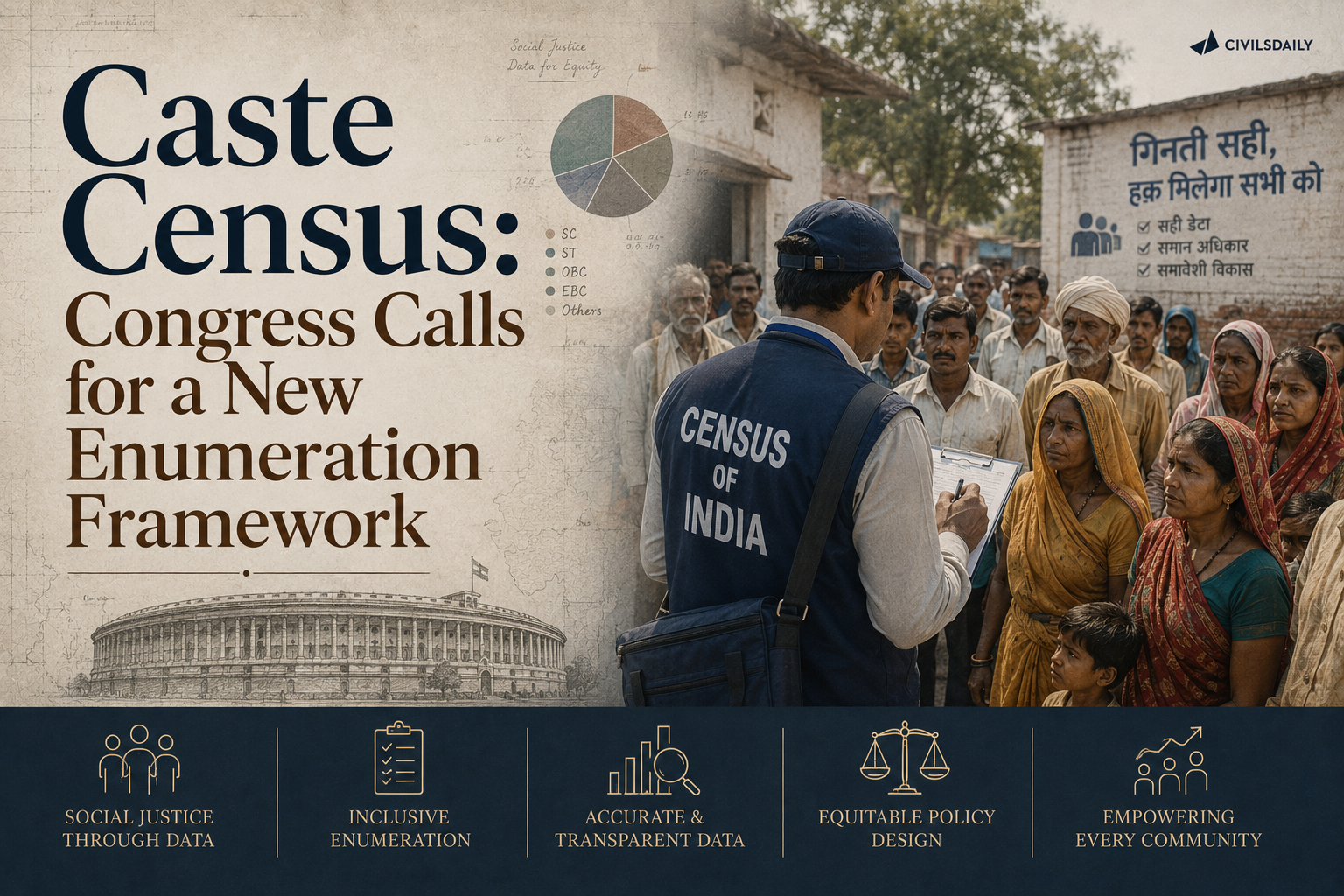
  • Ladakh to begin Census 2027 caste enumeration first

    Why in the News

    Ladakh is set to be the first to begin the Population Enumeration phase of Census 2027, from 17 August, with an open-ended caste column. It is the first full caste count in independent India’s Census.

    What is Population Enumeration?

    1. Definition: Population Enumeration is the second phase of the Census, when detailed data on every individual, including caste, is collected.
    2. First phase: It follows Houselisting, which records housing and household amenities.

    Why does caste enumeration matter?

    1. Policy base: Caste data underpins reservation, welfare targeting, and sub-categorisation debates that currently rely on 1931 caste figures.
    2. Open-ended column: An open caste field captures self-reported identity rather than a fixed dropdown, raising classification and comparability challenges.
    3. Security-sensitive geography: Ladakh’s enumeration near the China and Pakistan borders is being geo-tagged, adding a strategic dimension.

    Conclusion

    The caste column makes Census 2027 a landmark data exercise for social policy. The next milestone is the nationwide enumeration schedule.

    Matching Previous Year Question

    “No direct PYQ traced in the provided files. Closest microtheme: Census / Registrar General and Census Commissioner of India.”