💥Join UPSC 2027,2028 Mentorship (August Batch) + XFactor Notes & Microthemes PDF

Subject: History

  • Kolkata Tram

    Why in the News?

    West Bengal has announced the discontinuation of the iconic 150 year old Kolkata trams, India’s last functioning tram system.

    About Kolkata Tram

    • Introduced in 1873 in Calcutta (now Kolkata), the first trams were horse-drawn and operated along a 3.8 km route between Sealdah and Armenian Ghat Street.
    • In 1874, horse-drawn trams reached Bombay (now Mumbai), followed by their introduction in Nashik and Patna.
    • However, their dependency on horse labor made them unsustainable.

    Revival and Modernization of Kolkata’s Trams

    • Lord Ripon revived trams in Calcutta in 1880 by experimenting with steam locomotives.
    • While the steam-powered trams improved speed, they introduced issues like pollution, which discouraged other states from adopting this technology.
    • In 1895, Madras (now Chennai) launched the country’s first electric tramcars, reducing noise and pollution.
    • Following this, Calcutta also transitioned to electric-powered trams by 1902, with routes between Esplanade and Kidderpore, and Esplanade and Kalighat.

    Significance of Trams

    • Kolkata’s trams hold historical significance as India’s oldest running tram system, symbolizing the city’s colonial past and cultural identity.
    • They provide an environmentally friendly and affordable mode of transport, making them relevant even today.
    • As a symbol of resilience, Kolkata’s trams have survived while other cities phased them out.
    • They also serve as a unique tourist attraction, offering a nostalgic glimpse of the city.

    PYQ:

    [2020] Which of the following statements correctly explains the impact of Industrial Revolution on India during the first half of the nineteenth century?

    (a) Indian handicrafts were ruined.

    (b) Machines were introduced in the Indian textile industry in large numbers.

    (c) Railway line were laid in many parts of the country.

    (d) Heavy duties were imposed on the import of British manufactures.

  • Bhagat Singh (1907-1931)

    Why in the News?

    September 28th marks 117th birth anniversary of the legendary freedom fighter “Bhagat Singh”.

    Who was Bhagat Singh?

    Details
    Birth  September 28, 1907; Banga, Punjab (now in Pakistan)
    Family  Came from a family involved in anticolonial activities; his father Kishan Singh and uncle Ajit Singh were active freedom fighters.
    Affiliations • Hindustan Republican Association (1924)
    • Hindustan Socialist Republican Association (1928)
    • Naujawan Bharat Sabha (1926)
    Revolutionary Actions • Played a key role in the Lahore Conspiracy Case (1928) by avenging Lala Lajpat Rai’s death and mistakenly killing J.P. Saunders
    • Threw a bomb in the Central Legislative Assembly on April 8, 1929, with B.K. Dutt, to protest oppressive British laws.
    Ideologies and Principles • Advocated Marxist and socialist ideologies
    • Rejected religion in his essay Why I Am an Atheist
    • Emphasized rationalism, equality, and justice.
    Arrest and Trial
    • Arrested in 1929 for throwing a bomb in the Central Legislative Assembly; later rearrested for the Lahore Conspiracy Case (murder of J.P. Saunders).
    • Jinnah opposed a 1929 Bill allowing trials in absentia, delivering a strong speech in the Central Assembly.
    Execution
    • Hanged on March 23, 1931, along with Sukhdev and Rajguru, in Lahore for his revolutionary activities.
    • Nehru and Subhash Chandra Bose visited Bhagat Singh in prison.
    Literary Works
    • Bhagat Singh was fluent in Urdu, Punjabi, Hindi, and English, and familiar with Sanskrit.
    • His jail notebook referenced thinkers like Karl Marx, Thomas Jefferson, Mark Twain, and others, reflecting his intellectual diversity.
    • At 17, he wrote Vishwa Prem (Universal Love), advocating for universal brotherhood and equality.
    • He urged the oppressed classes to rebel against the social order and spoke about the philosophy of revolution in his writings, such as What is Revolution? (1929).
    • In his series What is Anarchism? he described organized religion and the state as forms of mental and physical slavery.
    • He wrote about the power of love in a 1929 letter to Sukhdev, emphasizing its role in personal and political strength.


    PYQ:

    [2020] Since the decade of the 1920s, the national movement acquired various ideological strands and thereby expanded its social base. Discuss.

  • Deendayal Upadhyaya’s Birth Anniversary

    Why in the News?

    September 25 marks the 108th birth anniversary of Pandit Deendayal Upadhyaya, one of the most influential thinkers of India’s right-wing movement.

    About Pandit Deendayal Upadhyaya (1916-1968)

    Details
    Born September 25, 1916 in Mathura, Uttar Pradesh

    Antyodaya Diwas is observed on this day since 2014.

    Affiliations Rashtriya Swayamsevak Sangh (RSS), Bharatiya Jana Sangh (BJS)
    Political Role • One of the key leaders of the Bharatiya Jana Sangh (BJS)
    • Served as President of BJS
    Key Contributions • Founder of the Integral Humanism philosophy
    • Introduced the concept of Antyodaya for the upliftment of the poorest
    • Promoted self-reliance (Swadeshi) and decentralization of power
    Doctrine of ‘Antyodaya’ Antyodaya means “upliftment of the last person in society.”
    • It focuses on improving the living conditions of the poorest and most marginalized sections of society.
    • Upadhyaya believed that true development can only be measured by the welfare of the weakest sections, promoting policies aimed at economic, social, and educational inclusion of these groups.
    Legacy Antyodaya Anna Yojana and Deendayal Upadhyaya Gram Jyoti Yojana inspired by his ideas

    • In 2015, NRLM was renamed Deendayal Antyodaya Yojana-NRLM.

    Death February 11, 1968, under mysterious circumstances in Mughalsarai, Uttar Pradesh
  • How does the selection works at Oscar Awards?  

    Why in the News?

    India has announced its official entry for the Best International Feature Film category at the 97th Academy (Oscar) Awards, set to take place early next year.

    About the Film Federation of India (FFI)

    • The FFI is the main body representing the interests of the Indian film industry, including producers, distributors, and exhibitors.
    • It was established in 1951.
    • The FFI’s primary goal is to promote and protect the Indian film industry, both in India and internationally.
    • It plays a key role in selecting India’s official entry for the Best International Feature Film category at the Oscar Awards.

    How does the FFI make the choice?

    • Submission Process: The FFI invites filmmakers to submit their films for consideration. To be eligible, the film must:
      • Be at least 40 minutes long.
      • Have more than 50% of its dialogue in a non-English language.
      • Have had a theatrical release of at least seven days between November 1, 2023, and September 30, 2024.
    • Jury Selection: The FFI appoints a 13-member jury made up of experienced individuals from the creative field, who evaluate the films and select India’s entry.
      • The jury chairperson is nominated by the FFI and oversees the selection process.
    • Screening and Voting: The jury watches all the submissions and conducts discussions before making a final decision via voting.

    Why has the FFI come under criticism?

    • All-Male Jury: The FFI’s current jury has drawn criticism for being composed entirely of men. This led to public discussions about the absence of women on the jury, especially since India’s official entry for the 97th Oscars focuses on women’s issues.
    • Arbitrary Process: FFI’s selection process can be arbitrary, and there have been calls for greater transparency and inclusiveness in choosing films for international awards like the Oscars.

    PYQ:

    [2014] What do understand by the concept “freedom of speech and expression”? Does it cover hate speech also? Why do the films in India stand on a slightly different plane from other forms of expression? Discuss.

  • Why Ambedkar and Gandhi disagreed on question of separate electorates for SC’s?

    Why in the News?

    On September 20, 1932, Mahatma Gandhi began a fast unto death in Yerawada Jail, Pune, to protest against the provision of separate electorates for Scheduled Castes.

    Gandhi vs Ambedkar on Caste

    • Gandhi’s Views on Caste: Initially orthodox, Gandhi supported social prohibitions like restrictions on inter-dining and inter-marriage but later rejected untouchability, referring to untouchables as “Harijans.” However, he did not reject the institution of caste itself, as it was tied to Hindu religious practices.
    • Ambedkar’s Radical Approach: Ambedkar believed that to truly abolish caste, one needed to attack the divine authority of the Hindu scriptures (shastras) that justified it. He argued that reforms short of rejecting the religious basis of caste were insufficient.
      • Ambedkar’s strategy was to focus on lower castes achieving political power to challenge their subjugation within the Hindu social order.

    Ambedkar’s Argument for Separate Electorates

    • Distinct Identity of Depressed Classes: Ambedkar argued that the Depressed Classes (Scheduled Castes) formed a distinct group, separate from the Hindus. Despite being part of Hindu society, they did not enjoy equal treatment and were subject to systemic oppression.
    • Political Machinery for Representation: Ambedkar advocated for separate electorates with a double vote system, where Scheduled Castes would vote for their own candidates as well as in the general electorate.
    • Protection from Majority Rule: Ambedkar warned that joint electorates would allow the Hindu majority to control the election of Dalit representatives, making it impossible for lower castes to effectively protect their interests against the tyranny of the majority.

    Why Gandhi Opposed Separate Electorates

    • Integration of Lower Castes: Gandhi opposed separate electorates because he believed they would marginalize lower castes further.
      • Instead of being restricted to a limited share of seats, Gandhi thought lower castes should aim for broader participation in political leadership.
    • Fear of Dividing Hindu Society: Gandhi feared that separate electorates would divide Hindu society, further weakening it.
      • He believed this division would help the British continue their “divide and rule” policy, undermining India’s struggle for independence.
    • Strategic Concerns: The introduction of separate electorates for Scheduled Castes, in addition to those for Muslims, would fragment the Hindu political base, reducing the power and influence of upper-caste Hindu leadership.

    Culmination of the Debate: The Poona Pact

    • Gandhi’s Fast: In 1932, Gandhi went on a fast unto death to oppose separate electorates, pressuring Ambedkar to concede. Ambedkar, despite his misgivings, agreed to the Poona Pact, which provided for reserved seats for Scheduled Castes but within a joint electorate.
    • Ambedkar’s Dissatisfaction: Ambedkar was never fully satisfied with the outcome, believing the joint electorate allowed upper-caste Hindus to nominate Dalit representatives, effectively controlling their political voice.

    Conclusion: The Gandhi-Ambedkar debate on caste culminated in the Poona Pact, with Gandhi opposing separate electorates to maintain Hindu unity, while Ambedkar sought political power for lower castes. Though Ambedkar agreed, he remained dissatisfied with the compromise.

    Mains PYQ:

    Q Mahatma Gandhi and Dr. B R Ambedkar, despite having divergent approaches and strategies, had a common goal of amelioration of the downtrodden. Elucidate. (UPSC IAS/2015)
  • Who was Mary Poonen Lukose?

    Why in the News?

    100 years ago, on September 23, 1924, Mary Poonen Lukose became the first woman to join a legislative council in an Indian princely state, entering the Travancore Legislative Council.

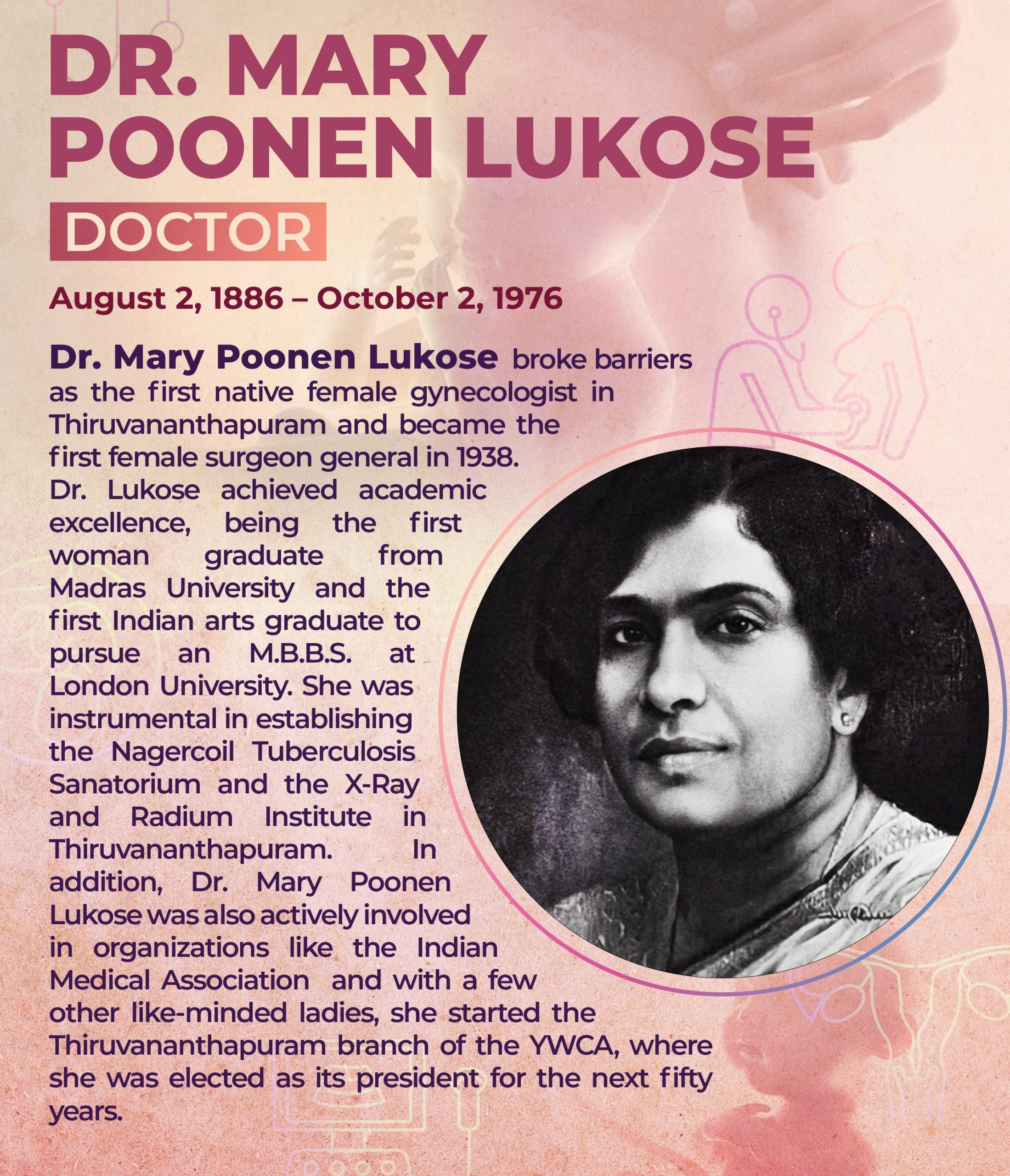
    Who Was Mary Poonen Lukose?

    • Born on August 2, 1886, in Kerala, she became the first woman from the state to earn a medical degree, specialising in gynaecology and obstetrics.
    • Her contributions:
      • She performed the first cesarean section in Kerala before 1920, often working under challenging conditions with minimal equipment.
      • She started a midwifery training program for local women, which led to safer home births, reducing risks for mothers and babies.
      • As a member of the Travancore Legislative Council, she influenced public health policy, using her expertise to benefit the community.

    Records set by Mary Poonen Lukose

    • First woman legislator in an Indian princely state: In 1924, she became the first woman member of the Travancore Legislative Council (a predecessor to Kerala’s Legislative Assembly).
    • First woman graduate from Madras University in 1909, despite facing barriers to studying science as a woman.
    • First woman Surgeon General of Travancore, and possibly the first woman Surgeon General in the world, in 1938.
      • First woman to head the health department in Travancore, in 1924.
    • Awarded the Padma Shri in 1975 for her contributions.

    PYQ:

    [2013] Defying the barriers of age, gender and religion, the Indian women became the torch bearer during the struggle for freedom in India. Discuss. (10 marks-200 words).

    [2011] With reference to Indian freedom struggle, Usha Mehta is well-known for

    (a) Running the secret Congress Radio in the wake of Quit India Movement
    (b) Participating in the Second Round Table Conference
    (c) Leading a contingent of Indian National Army
    (d) Assisting in the formation of Interim Government under Pandit Jawaharlal Nehru

  • 100 Years of Harappan Civilization

    Why in the News?

    It has been 100 years since the discovery of the Harappan Civilization, announced by John Marshall on September 20, 1924.

    Harappa: Remains of a Civilization

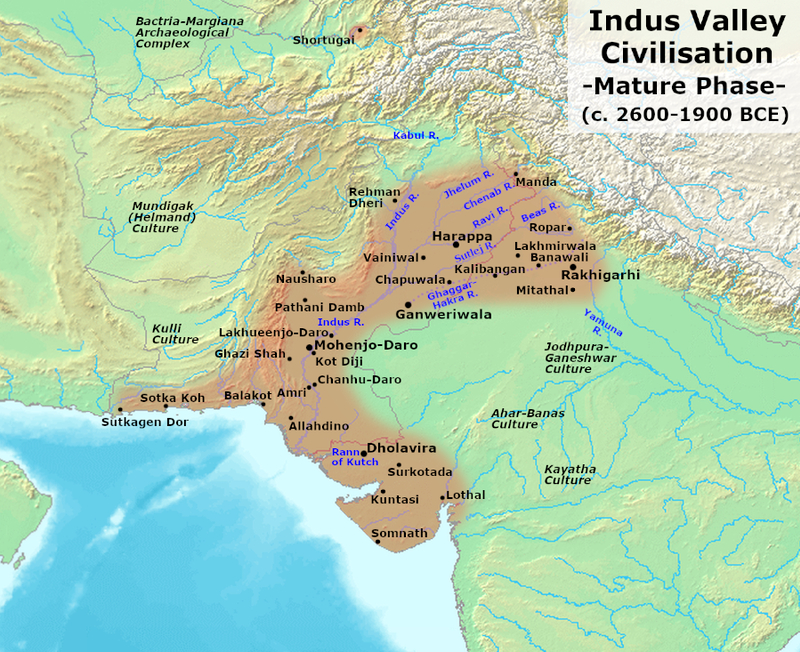
    • The Harappan Civilization, also known as the Indus Valley Civilization, flourished between 2600 BCE and 1900 BCE, with earlier settlements dating back to 3200 BCE.
    • The origins of this civilisation are traced back to Mehrgarh in Balochistan, which dates to 7000 BCE.
    • It is considered one of the three earliest civilizations, alongside Egypt and Mesopotamia.
    • The civilization covered over 1.5 million sq. km, stretching across modern-day India, Pakistan, and Afghanistan.
    • Remains of the civilization include:
      • Well-planned cities with a grid layout, intersecting streets, and fortified structures.
      • Advanced drainage systems with underground sewers and covered drains, showing a strong emphasis on hygiene.
      • Granaries, warehouses, and dockyards, indicating the presence of structured trade and food storage mechanisms.
      • The discovery of seals made of steatite, often engraved with animals and an un-deciphered script, suggesting a sophisticated administrative system.
      • Craftsmanship in pottery, bead-making, terracotta figurines, metal artefacts, and weaving.
      • Water management systems such as reservoirs, wells, and baths, indicating an advanced understanding of hydraulic engineering.

    The Discoverers:

    • Two ASI archaeologists were credited with the discovery:
      • Daya Ram Sahni excavated Harappa in 1921-22, discovering seals, pottery, and beads.
      • Rakhal Das Banerji began excavating Mohenjo-daro in 1922, finding similar items such as seals and copper objects.
    • John Marshall noticed the similarity between the objects found at Harappa and Mohenjo-daro, despite the sites being 640 km apart.

    About the Mohenjo-daro Site:

    • Mohenjo-daro is one of the largest cities of the Harappan Civilization, located in the Sindh province of Pakistan, discovered in 1922 by Rakhal Das Banerji.
    • The city represents one of the finest examples of ancient urban planning:
      • Great Bath: A large, centrally located structure thought to be used for ritual bathing or religious ceremonies. It is considered one of the earliest public water tanks in history.
      • Granaries: Massive storage facilities near the citadel suggest an organized system of storing food for the community.
      • Citadel and Lower Town: The city was divided into a raised citadel for the ruling elite and a lower town for common people. Both areas had well-planned streets and residential complexes.
      • Drainage Systems: Mohenjo-daro featured covered drainage systems with individual toilets connected to the drainage network, showcasing an impressive public sanitation system.
      • Residential Buildings: Homes were built from uniform mud bricks, with courtyards and bathrooms, and were often multi-storied. The use of standardised brick sizes (ratio 1:2:4) and cubic weights showed their high degree of organisation.
    • Artefacts found at Mohenjo-daro include:
      • Seals with animal motifs and the un-deciphered Harappan script, believed to have been used for administrative or trade purposes.
      • Pottery and tools made of bronze and copper.
      • Terracotta figurines, jewellery, and toys that reflect a highly developed artistic culture.
      • Weights and measures based on a uniform standard, indicating the use of a standardized economic system.
    • The city’s streets were aligned north-south and east-west, cutting at right angles, allowing for efficient transportation, including bullock carts.
    • Mohenjo-daro is believed to have had trade links with Mesopotamia, as suggested by artefacts with Mesopotamian connections.

    PYQ:

    [2013] Which of the following characterizes/characterize the people of Indus Valley Civilization?

    1. They possessed great palaces and temples.

    2. They worshipped both male and female deities.

    3. They employed horse-drawn chariots in warfare.

    Select the correct statement/statements using the codes given below.

    (a) 1 and 2 only

    (b) 2 only

    (c) 1, 2 and 3

    (d) None of the statements given above is correct

  • [pib] A poem on ‘National War Memorial’ and a chapter on ‘Veer Abdul Hameed’ included in NCERT

    Why in the News?

    A poem on National War Memorial and a chapter about Veer Abdul Hameed (PVC) introduced by the Ministries of Defence and Education has been included in the NCERT Class VI curriculum.

    About National War Memorial

    • The National War Memorial was unveiled on 25th February 2019 to honor Indian soldiers who sacrificed their lives in conflicts with Pakistan, China, 1961 Goa war and Operation Pawan.
    • The monument is designed in a C-hexagon layout, with names of the fallen soldiers inscribed on its walls.
    • It was designed by Yogesh Chandrasan of WeBe Design Lab.
    • Key features include the Amar Chakra (Circle of Immortality) with the ‘Eternal Flame’ symbolizing the nation’s commitment to remembering the soldiers.
    • The Veerta Chakra showcases six bronze murals depicting acts of bravery.
    • The Rakshak Chakra symbolizes protection with trees representing troops safeguarding the nation.
    • Tyag Chakra (Circle of Sacrifice) features concentric granite walls honoring the soldiers who have died since Independence.
    • The memorial also features busts of 21 soldiers who have received the Param Vir Chakra, India’s highest gallantry award.

    Who was Veer Abdul Hameed?

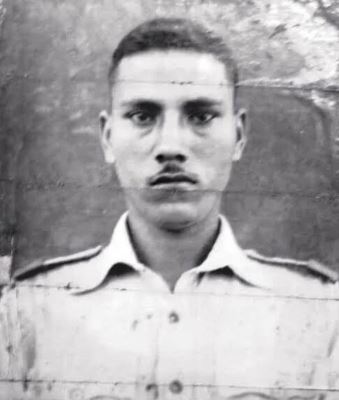
    • Abdul Hamid was a soldier in the 4th Grenadiers of the Indian Army.
    • He fought in the Battle of Asal Uttar during the 1965 India-Pakistan war, which took place near the India-Pakistan border in Punjab.
    • On 10th September 1965, he destroyed 3 Pakistani tanks and damaged a 4th near Chima village. He was killed during the battle.
    • For his exceptional bravery, he was posthumously awarded the Param Vir Chakra, India’s highest military honour.
    • A war memorial now stands at the site of his death, featuring a captured Pakistani Patton tank as a tribute to his courage.
  • Port Blair renamed as Sri Vijaya Puram

    Why in the News?

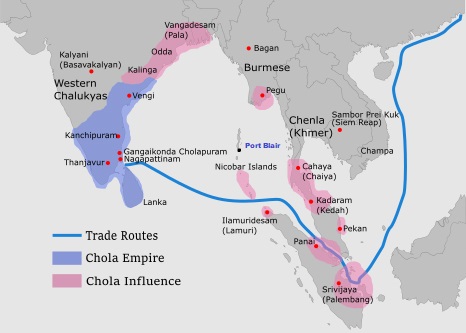
    Union Home Minister announced that Port Blair, the capital of the Andaman and Nicobar Islands, will be renamed Sri Vijaya Puram.

    On December 30, 2018, three islands in the Andaman and Nicobar archipelago were renamed by the Government of India to honor Netaji Subhas Chandra Bose and to commemorate India’s independence struggle:

    • Ross Island renamed as Netaji Subhas Chandra Bose Island
    • Neil Island renamed as Shaheed Dweep
    • Havelock Island renamed as Swaraj Dweep

    Historical Importance of Port Blair

    • The city was named after Lieutenant Archibald Blair, a British naval officer who served during the early 18th century.
    • The infamous Cellular Jail, known as Kaala Paani, was established in 1906.
    • Many prominent freedom fighters, including Veer Savarkar, were incarcerated here under oppressive circumstances.
    • It is also the place that hosted the first unfurling of our ‘Tiranga’ by Netaji Subhash Chandra Bose.

    Port Blair renamed as Sri Vijaya Puram

    Behind the new name ‘Sri Vijaya Puram’: Chola History

    • The Chola Empire, under Rajendra Chola I, used the Andaman Islands as a strategic naval base in the 11th century.
      • He launched a naval expedition to attack the Srivijaya Empire in present-day Indonesia.
    • His victory over Srivijaya resulted in the capture of the king Sangrama Vijayottunggavarman and looting valuable treasures, further cementing the Chola dominance.
    • The Thanjavur inscriptions (1050 CE) refer to the islands as Ma-Nakkavaram (great open land), later evolving into the name Nicobar Islands.

    PYQ:

    [2014] Which one of the following pairs of islands is separated from each other by the ‘Ten Degree Channel’?

    (a) Andaman and Nicobar

    (b) Nicobar and Sumatra

    (c) Maldives and Lakshadweep

    (d) Sumatra and Java

  • The Great Stupa of Sanchi

    Great Stupa of Sanchi

    Why in the News?

    External Affairs Minister S. Jaishankar visited the replica of the East Gate of Sanchi’s Great Stupa in Berlin.

    About the Great Stupa of Sanchi

    Details
    Establishment
    • Commissioned by Emperor Ashoka in the 3rd century BCE.
    • UNESCO World Heritage Site.
    Purpose Built to enshrine the relics of Buddha and symbolise the Buddhist faith.
    Construction
    • Overseen by Ashoka’s wife, Devi, from Vidisha.
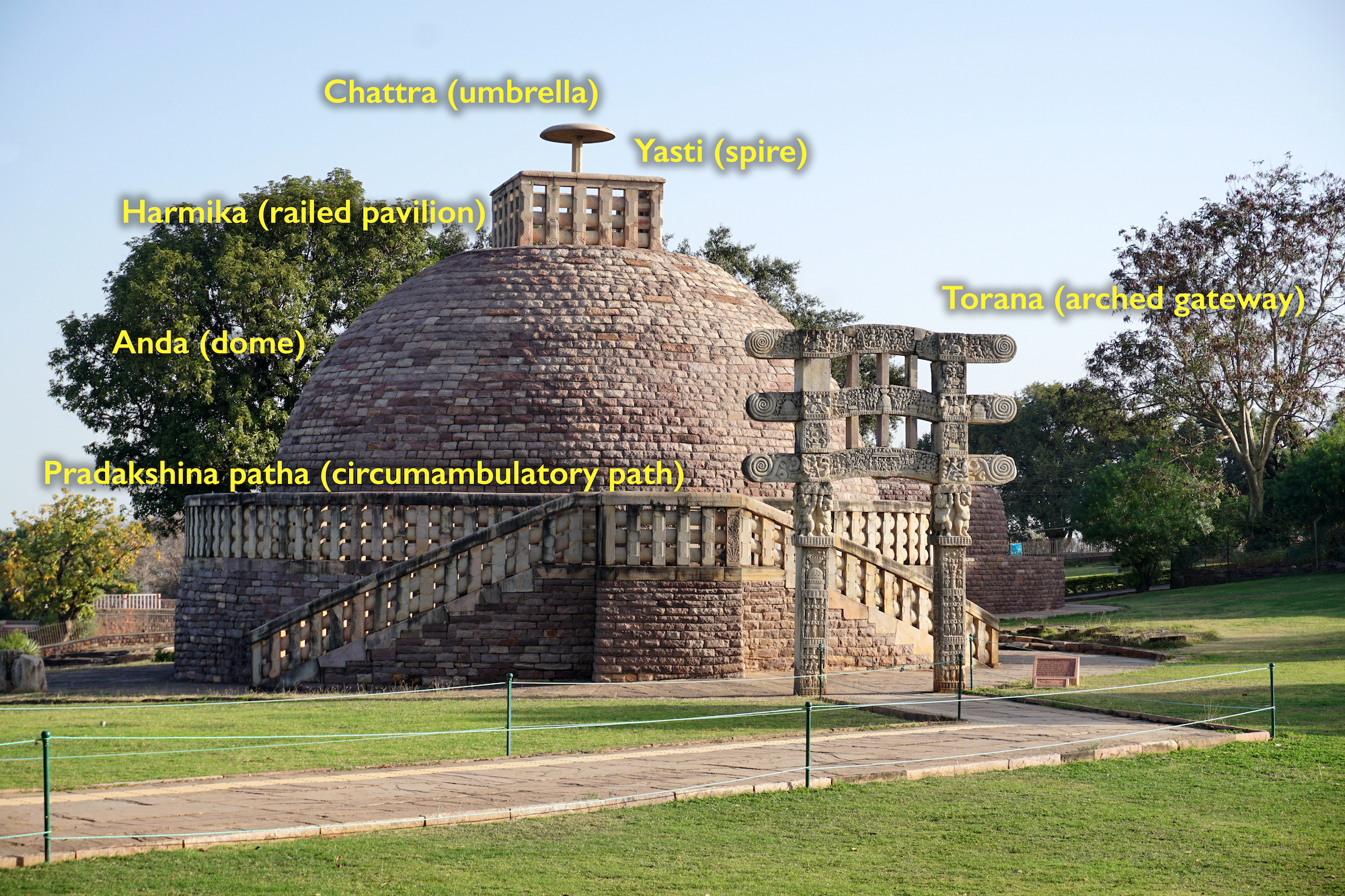
    • Stupa is a simple hemispherical structure crowned by a chhatra (parasol), symbolizing high rank.
    • Development of the Sanchi complex was supported by the mercantile community of Vidisha.
    Design
    • Follows a simple hemispherical dome structure.
    • Later, in the 1st century BCE, under the Satavahana dynasty, 4 ornamental gateways (toranas) were added in four cardinal directions.
    Toranas (Gateways) Each torana consists of 2 pillars supporting 3 architraves, adorned with bas-reliefs depicting scenes from Buddha’s life, Jataka tales, and Buddhist symbols.
    Artistic Features The toranas are famous for their intricate carvings, depicting elephants, winged lions, peacocks, and shalabhanjikas (fertility symbols).
    Symbolism Upper architrave shows seven Manushi Buddhas (previous Buddhas), the middle depicts the Great Departure of Prince Siddhartha, and the lower shows Ashoka’s visit to the Bodhi tree.
    Restoration Rediscovered in 1818 by British officer Henry Taylor and restored by John Marshall (ASI director) in the early 1900s with financial aid from the Begums of Bhopal.
    Replica of East Gate
    • A plaster cast of the East Gate was made in the 1860s by Henry Hardy Cole for the Victoria and Albert Museum.
    • A replica now stands in front of the Humboldt Forum Museum in Berlin.


    PYQ:

    [2013] Consider the following historical places:

    1. Ajanta Caves

    2. Lepakshi Temple

    3. Sanchi Stupa

    Which of the above places is / are also known for mural paintings?

    (a) 1 only

    (b) 1 and 2 only

    (c) 1, 2 and 3

    (d) None

    [2016] Early Buddhist Stupa-art, while depicting folk motifs and narratives successfully expounds Buddhist ideals. Elucidate.