Recently, followers of the two rival groups within the Namdhari religious sect clashed violently in Haryana.
About Namdhari Sect
Details
Founder
Satguru Ram Singh in 1857 (on Baisakhi)
Also known as Kuka Movement
Primary Beliefs
– Belief in a living human Guru; Also known as Kuka/Kukaism
– Guru Granth Sahib is considered the Supreme Gurbani
– Strict vegetarianism and teetotalism (alcohol is forbidden)
Key Practices
– Wearing white attire as a sign of mourning
– Rejection of caste distinctions
– Promotion of widow remarriage
– Non-violent resistance– Cow is the sacred animal
Headquarters
Bhaini Sahib, Ludhiana, Punjab
Global Presence
– Deras across Punjab and Haryana
– Presence in countries such as the UK, Canada, and Kenya
Role in Independence
– Early opposition to British rule
– Adoption of non-cooperation and boycott of British goods
– Victims of severe British reprisals
Notable Historical Event
Malerkotla Massacre (1872) – 66 Namdharis executed by the British
Leadership Succession
– After Ram Singh: His brother Satguru Hari Singh
– Later Successors: Satguru Partap Singh, Satguru Jagjit Singh
– Current leaders: Uday Singh and Dalip Singh (factional dispute)
PYQ:
[2013] Consider the following Bhakti Saints :
1. Dadu Dayal
2. Guru Nanak
3. Tyagaraja
Who among the above was/were preaching when the Lodi dynasty fell and Babur took over?
PYQ Relevance: Mains: Q Highlight the importance of the new objectives that got added to the vision of Indian Independence since the twenties of the last century. (UPSC IAS/2017) Q Why did the armies of the British East India Company – mostly comprising of Indian Soldiers – win consistently against the more numerous and better-equipped armies of the then-Indian rulers? Give reasons. (UPSC IAS/2022)
Note4Students:
Subject: GS I (Modern India)
Mains: Significance of Red Fort Trial
Mentor comments: The Red Fort trials, held in 1945-46, were a significant event in India’s struggle for independence. The British colonial government prosecuted key members of the Indian National Army (INA), including Shah Nawaz Khan, Prem Sahgal, and Gurbaksh Singh Dhillon, charging them with waging war against the King. Despite the government’s expectation of public disdain, the trials ignited widespread support for the INA, leading to national demonstrations. The defendants were ultimately found guilty but received lenient sentences, which further fueled the independence movement and contributed to the eventual end of British rule in India.
Why in the news?
Decades after the Red Fort trial, it is hoped that India’s leaders will once again find the wisdom to commit themselves to what unites us as a people.
About the Red Fort Trial:
The Red Fort Trial, also known as the Indian National Army (INA) trials, was a series of court-martials held by the British colonial government in India between November 1945 and May 1946. The trials were held at the Red Fort in Delhi, and they are among the most significant events in the final years leading up to India’s independence.
Background:
Indian National Army (INA): The INA was formed by Indian nationalists during World War II under the leadership of Subhas Chandra Bose. It was composed primarily of Indian prisoners of war who had been captured by the Japanese in Southeast Asia and was aligned with the Axis powers to fight against British rule in India.
The objective of the INA: The INA aimed to overthrow British rule in India through military means, and it played a key role in the campaigns in Burma and the Indian Northeast during the war.
British Reaction: After World War II ended, the British captured several INA soldiers and officers. The British decided to make an example of the INA by trying its officers for treason, murder, and other charges.
Protests that spread across India
Widespread National Support: Protests erupted in multiple cities, including Delhi, Calcutta, Madras, Lahore, Bombay, Patna, and Lucknow, with people from all religious and social backgrounds uniting to demand justice for the INA officers.
Role of Congress and Muslim League: Both the Indian National Congress and the Muslim League supported the INA officers, with leaders from both parties actively participating in and encouraging the protests, showcasing rare political unity against British colonial rule.
Slogans and Symbols of Unity: Protesters chanted slogans like “Laal Quila se aayi aawaaz, Sahgal, Dhillon, Shahnawaaz!” and “Hindu-Muslim Unity Zindabad!”, while the flags of both Congress and the Muslim League were prominently displayed, emphasizing the nationalistic fervour and unity.
Violent Clashes and Sacrifices: The protests were met with brutal police repression in several cities, particularly in Madras and Calcutta, where police firing led to significant casualties—five in Madras and 97 in Calcutta—highlighting the intense opposition to British rule and the high cost of the struggle for independence.
Why is it so significant?
National Unity Across Religious Lines: The trial involved three officers of the Indian National Army (INA)—a Hindu (Prem Kumar Sahgal), a Muslim (Shah Nawaz Khan), and a Sikh (Gurbaksh Singh Dhillon). This symbolized the inclusive and secular nature of India’s struggle for independence.
Mobilization of Public Sentiment: The INA officers were seen as heroes who had fought for India’s freedom, despite the controversial alliance with the Axis powers. Their prosecution by the British was widely perceived as unjust, leading to mass protests, strikes, and demonstrations.
Challenge to British Moral Authority: The trial highlighted the declining legitimacy of British rule in India. The British attempted to portray the INA officers as traitors, but the Indian public saw them as patriots fighting for their country’s freedom.
Catalyst for Independence Movement: The trial also demonstrated the effectiveness of public mobilization and protest in challenging colonial authority, inspiring further actions that ultimately led to India’s independence in 1947.
Conclusion: The Red Fort Trials, featuring INA officers, ignited widespread protests and highlighted national unity, challenging British legitimacy. They symbolized India’s resolve for independence, accelerating the end of colonial rule.
Former CM of West Bengal and leader Buddhadeb Bhattacharya passed away at 80.
Who was Buddhadeb Bhattacharya?
Bhattacharya was a politician who served as CM of West Bengal from 2000 to 2011.
He was known for his attempts to modernize and industrialize West Bengal while navigating the challenges of maintaining communist ideology.
In 2022, Bhattacharya was awarded Padma Bhushan by the Indian government, which he declined, citing his political principles.
Key Contributions:
Category
Details
Political Reforms
Attempted to reduce the influence of powerful trade unions in the state, particularly in the industrial sector, to attract investments and improve work culture.
Social-Cultural Reforms
Played a key role in establishing the Kolkata International Film Festival and promoted Bengali literature.
Authored several books and translated works of Gabriel Garcia Marquez and Vladimir Mayakovsky into Bengali, enriching the state’s cultural heritage.
Introduced measures to eliminate corruption in school recruitments by ensuring all hiring was conducted through transparent exams.
Initiated reforms to integrate mainstream subjects into madrassa education.
Economic Reforms
Led efforts to industrialize West Bengal by attracting investments in IT, steel, and special economic zones (SEZs), including the Tata Nano project in Singur.
Faced significant opposition and protests in Singur and Nandigram over land acquisition, which ultimately contributed to the political decline of the Left Front.
PYQ:
[2011] Karl Marx explained the process of class struggle with the help of which one of the following theories?
Lalit Kala Akademi, National Gallery of Modern Art
Objective
Enhance New Delhi’s cultural and aesthetic outlook
Key Themes
Nature tributes, Natyashastra, Gandhi ji, Toys of India, Hospitality, Ancient knowledge, Naad (Primeval Sound), Harmony of Life, Kalpataru (Divine Tree).
Artist Participation
Over 200 visual artists; significant participation from women artists
Artforms included
Phad paintings (Rajasthan), Thangka painting (Sikkim/Ladakh), Miniature painting (Himachal Pradesh), Gond art (Madhya Pradesh), Tanjore paintings (Tamil Nadu), Kalamkari (Andhra Pradesh), Alpona art (West Bengal), Cheriyal painting (Telangana), Pichhwai Painting (Rajasthan), Lanjia Saura (Odisha), Pattachitra (West Bengal), Bani Thani Painting (Rajasthan), Warli (Maharashtra), Pithora Art (Gujarat), Aipan (Uttarakhand), Kerala Murals (Kerala), Alpana art (Tripura).
PYQ:
[2018] The well-known painting “Bani Thani” belongs to the:
On July 31, 1940, Indian revolutionary leader Udham Singh was executed at the Pentonville prison in London for killing Michael O’Dwyer, the former lieutenant governor of Punjab.
Singh was born in Sunam in Punjab’s Sangrur district in 1899.
Political Activism
Became associated with the Ghadar Party while in the US, which was founded by Sohan Singh Bhakna in 1913 and headquartered in California.
Purpose and Actions
In 1934, Singh travelled to London to assassinate Michael O’Dwyer, the former Lieutenant Governor of Punjab during the 1919 Jallianwala Bagh massacre.
Reason for Targeting O’Dwyer
O’Dwyer had ordered Brigadier Reginald Dyer to Amritsar before the massacre, fearing a second Indian mutiny due to Hindu-Muslim unity and demonstrations.
Assassination of O’Dwyer
On March 13, 1940, Singh shot O’Dwyer at a meeting in Caxton Hall, London.
Arrest and Execution
Arrested immediately, held in Brixton prison, sentenced to death, and hanged on July 31, 1940, at Pentonville Prison.
Legacy and Recognition
Regarded as a hero for avenging the Jallianwala Bagh massacre.
Gandhi termed it an “act of insanity”.
He symbolized Hindu-Sikh-Muslim unity by adopting the name ‘RamMohamed Singh Azad’ during his trial.
Posthumous Honors
His remains were returned to India in 1974 and cremated in his village in Sunam.
His statue was installed at Jallianwala Bagh in 2018;
Udham Singh Nagar district in Uttarakhand is named after him.
PYQ:
[2014] The Ghadr (Ghadar) was a:
(a) Revolutionary association of Indians with headquarters at San Francisco.
(b) Nationalist organization operating from Singapore
(c) Militant organization with headquarters at Berlin
(d) Communist movement for India’s freedom with head-quarters at Tashkent
The 46th Session of the World Heritage Committee has concluded successfully.
It was the first timeIndia hosted this international assembly.
Capacity-building initiatives proposed by India
Indiapledged $1 million to the UNESCO World Heritage Centre to support capacity-building initiatives and conservation projects in developing countries.
India proposed to develop and implement training programsfor heritage professionals from around the world.
India proposed exchange programs for heritage professionals and researchers.
Leading Indian heritage institutions, such as the Archaeological Survey of India and the Indian National Trust for Art and Cultural Heritage (INTACH), will play a key role in implementing the initiatives.
About the World Heritage Young Professional Forum
The World Heritage Young Professionals Forum is an initiative by UNESCO to engage young professionals in the field of heritage conservation.
The first World Heritage Young Professionals Forum was organized in 1995.
The primary aim is to engage young professionals in heritage conservation and management through capacity building, networking, and awareness-raising.
Back2Basics: UNESCO World Heritage Sites
Description
UNESCO World Heritage Sites
Landmarks or areas selected by UNESCO for their cultural, historical, scientific, or other significant value, legally protected by international treaties.
Importance
World Heritage Sites represent collective and preservative interests of humanity, signifying remarkable accomplishments and intellectual history.
Selection Criteria
Sites must be already-classified landmarks, unique and significant culturally or physically, such as ancient ruins, historical structures, cities, monuments, etc.
Conservation
World Heritage Sites require practical conservation to protect them from risks like trespassing, uncontrolled access, or administrative negligence.
World Heritage Committee
Selects and monitors World Heritage Sites, manages the World Heritage Fund, and provides financial assistance. Composed of 21 states parties elected for a four-year term.
Membership
India is NOT a permanent member of the World Heritage Committee.
It has been selected for a term from 2021 to 2025.
PYQ:
[2014] Consider the following international agreements:
The International Treaty on Plant Genetic Resources for Food and Agriculture
The United Nations Convention to Combat Desertification
The World Heritage Convention
Which of the above has / have a bearing on the biodiversity?
The Charaideo Moidams, a unique 700-year-old mound-burial system of the Ahom dynasty from Assam, has been added to the UNESCO World Heritage List.
About Charaideo Moidams
The Charaideo moidams represents the late medieval(13th-19th century CE) mound burial tradition of the Tai Ahom community in Assam.
Charaideo, more than 400 km east of Guwahati, was the first capital of the Ahom dynasty founded by Chao Lung Sukaphaa in 1253.
The Ahoms preferred to place the deceased family members at Charaideo where the first king Sukapha was laid to rest.
The historical chronicles inform that wives, attendants, pet animals and huge quantity of valuables were buried with the departed kings.
After 18th century, the Ahom rulers adopted the Hindumethod of cremation and began entombing the cremated bones and ashes in a Maidam at Charaideo.
Out of 386 Maidams explored so far, 90 royal burials at Charaideo are the best preserved, representative of and the most complete examples of mound burial tradition of the Ahoms.
Architecture details:
Architecturally it comprises a massive underground vault with one or more chambers having domical superstructure.
It is covered by a heap of earthen mound and externally it appears a hemispherical mound.
At the top of the mound, a small open pavilion chow-chali is provided.
An octagonal dwarf wall encloses whole maidam.
Significance of this addition:
Moidams has become the 43rd property from India to be included in the UNESCO List.
India now stands at the 6th position globally for the most number of World Heritage Properties.
The Moidams are the first site from the North East to be recognized as a World Heritage Site in the cultural category.
Assam has 2 other World Heritage Sites in the natural category: Kaziranga National Park and Manas National Park, both upgraded to tiger reserves.
Who were the Ahoms?
The Ahom, also known as the Tai-Ahom, are an ethnic group from Assam and Arunachal Pradesh in India.
This ethnic group is made up of interbred descendants of the Tai people, who first came to Assam’s Brahmaputra valley in 1228, and indigenous people who later joined them.
The current Ahom people and culture are a mix of the ancient Tai people and culture, as well as indigenous Tibeto-Burman people and cultures that they assimilated in Assam.
Sukaphaa, the Tai group’s leader, and his 9000 supporters founded the Ahom empire (1228–1826 CE), which ruled over part of modern-day Assam’s Brahmaputra Valley until 1826.
It retained sovereignty for 600 years until annexed by British India in 1826 (Treaty of Yandaboo).
Lachit Borphukan (1622-1672) is the most celebrated ruler of Ahom Dynasty.
Back2Basics:UNESCOWorld Heritage Sites
Aspect
Details
Definition
Sites of outstanding cultural or natural value to humanity, are protected under the UNESCO Convention of 1972.
Classification
Cultural Heritage Sites: Historic buildings, archaeological sites, monumental sculptures/paintings.
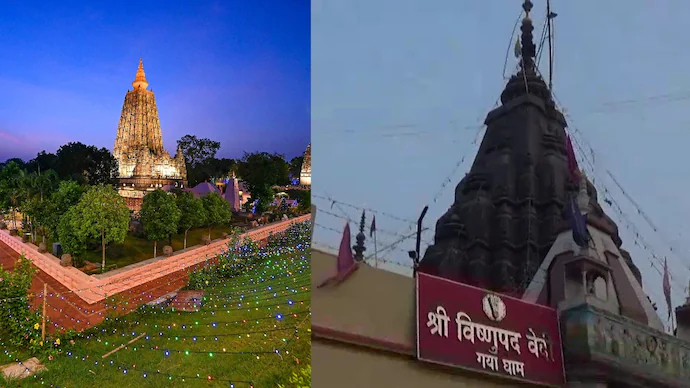
Finance Minister announced during her Union Budget speech that corridor projects will be built for the Vishnupad Temple at Gaya and the Mahabodhi Temple at Bodh Gaya in Bihar.
These will be modelled on the Kashi Vishwanath Temple Corridor, to transform them into world-class pilgrim and tourist destinations.
About the Vishnupad Temple at Gaya
Details
Dedicated to
Lord Vishnu
Significance
Contains a 40 cm long footprint of Lord Vishnu; considered sacred in Hinduism; attracts pilgrims for “Pind Daan” rituals.
Historical Importance
Believed to be over 1000 years old; associated with various legends and historical references in Hindu texts.
Architecture
Built in Shikhara style;
Features intricate carvings and silver-plated flagposts;
Constructed of grey granite blocks.
Built by
Queen Ahilyabai Holkar of Indore in 1787.
Festivals and Rituals
Major site for “Pind Daan” rituals during Pitru Paksha;
Attracts thousands of pilgrims during this period.
Mythology
The footprint is believed to be where Lord Vishnu placed his foot to subdue the demon Gayasur.
Associated River
Located on the banks of the Phalgu River, considered sacred for ritual offerings.
Access and Visitation
Accessible year-round; major pilgrimage site with facilities for devotees.
Recent Developments
Ongoing efforts for preservation and restoration; improved infrastructure for pilgrims.
About the Mahabodhi Temple Complex:
Details
Location
Bodh Gaya, Bihar;
Significance
Marks the location where Buddha attained enlightenment
UNESCO Status
World Heritage Site since 2002
Historical Importance
One of the four holy sites related to Buddha’s life (Enlightenment).
Other holy sites: Lumbini (Birth) in Nepal, Sarnath (First Sermon) in Uttar Pradesh, Kushinagar (Death) in Uttar Pradesh
Original Construction
Built by Mauryan Emperor Ashoka around 260 BCE
Reconstruction
Reconstructed in brick during the late Gupta period (5th or 6th centuries)
Archaeological Finds
Indicates site of veneration since the Mauryan period.
Vajrasana (Diamond Throne): Located within the temple, dated to the third century BCE
Main Temple Structure
Dates from the 6th century CE, incorporates parts from 2nd or 3rd century CE
Architectural Features
Two large shikhara towers, the largest over 55 meters high
Influenced Jain, Hindu, and Buddhist architecture globally
Materials
Made mostly of brick covered with stucco
Bodhi Tree
Direct descendant of the original tree under which Buddha attained enlightenment
Traditional Accounts
Describes 7 weeks Buddha spent meditating after enlightenment at various spots within the complex
Decline and Revival
Declined after Huna invasions and early Islamic invasions.
Revived under the Pala Empire (8th-12th century).
Declined again after 12th century CE invasions by Turk armies.
![[15th August 2024] The Hindu Op-ed: The trial that progressed rapidly towards Independence](https://www.civilsdaily.com/wp-content/uploads/2024/08/15-Aug-1568x882.jpg)