💥Join UPSC 2027,2028 Mentorship (August Batch) + XFactor Notes & Microthemes PDF

Subject: History

  • Why September 12 is observed as Saragarhi Day?

    Saragarhi

    Why in the News?

    127th Anniversary of the Battle of Saragarhi was observed on September 12.

    About the Battle of Saragarhi

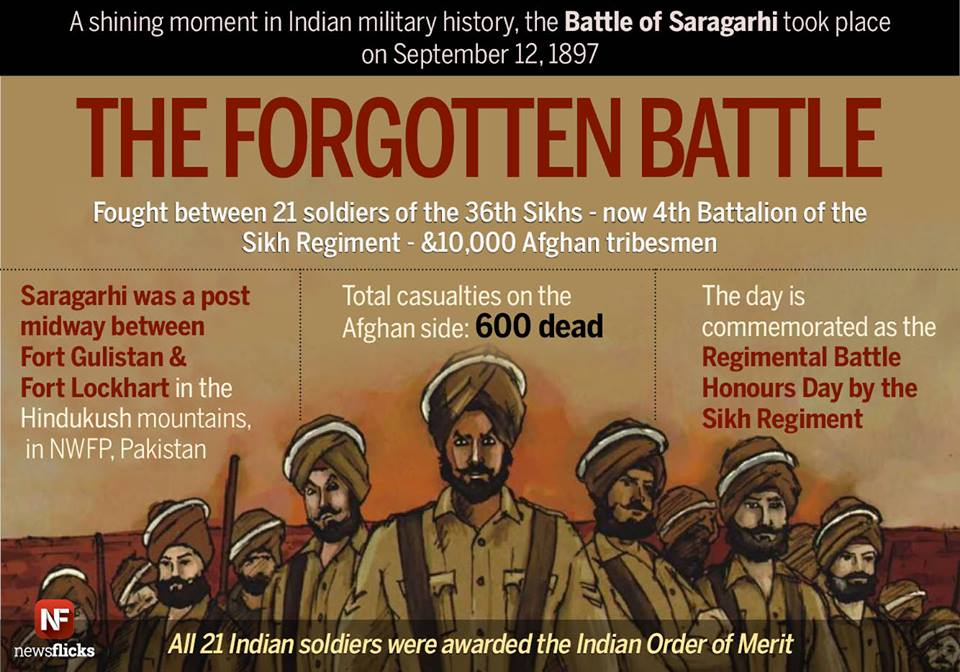
    • The Battle of Saragarhi occurred on September 12, 1897, between 21 Sikh soldiers of the then 36th Sikh Regiment and around 8,000 Afridi and Orakzai tribals.
    • The soldiers defended a communication post at Saragarhi, connecting Fort Lockhart and Fort Gulistan in the North West Frontier Province (now Pakistan).
    • Led by Havildar Ishar Singh, the Sikhs fought to the last man, marking one of the greatest last stands in military history.
    • Despite their bravery, the soldiers were eventually outnumbered and killed.
    • Their sacrifice gave the British time to strengthen positions at Fort Lockhart and Gulistan, halting enemy advances.

    Implication of the Battle

    • The Sikh soldiers showed extraordinary courage, fighting against overwhelming odds.
    • The 21 soldiers killed around 200 militants and injured 600, holding the enemy for seven hours.
    • The British Government posthumously awarded all 21 soldiers the Indian Order of Merit.
    • The battle highlighted the importance of discipline, leadership, and sacrifice, and underscored the role of Sikh regiments in the British Indian Army.

    PYQ:

    [2020] Wellesley established the Fort William College at Calcutta because:

    (a) He was asked by the Board of Directors at London to do so

    (b) He wanted to revive interest in oriental learning in India

    (c) He wanted to provide William Carey and his associates with employment

    (d) He wanted to train British civilians for administrative purpose in India

  • Who was Sakthan Thampuran (1751-1805)?

    On Saturday, September 7, Minister of State for Tourism and Thrissur MP Suresh Gopi has pledged to replace the statue of Sakthan Thampuran, which was damaged by a state transport bus in June, with a new bronze statue if the Kerala government fails to do so within 14 days.

    Why in the News?

    Ministry of Tourism has pledged to replace the Sakthan Thampuran statue that was knocked over by a state transport bus in Thrissur.

    Who was Sakthan Thampuran?

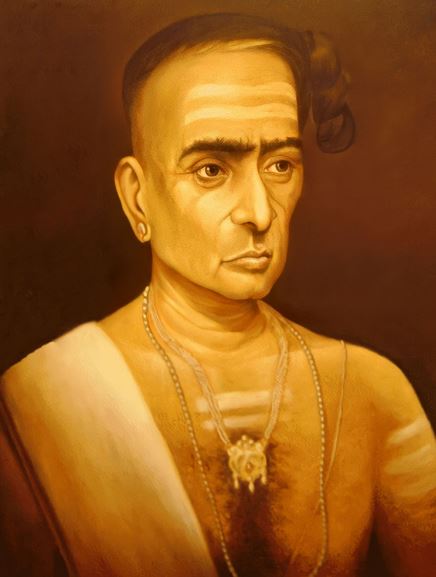
    • Sakthan Thampuran, born Raja Rama Varma IX in 1751, was a powerful ruler of the Cochin kingdom from 1790 to 1805.
      • He was raised by an aunt who nicknamed him Sakthan, meaning powerful, reflecting his strong personality and leadership.
    • The title Thampuran is derived from the Sanskrit word samrat, meaning emperor.
    • The Cochin kingdom, a part of the Late Chera Empire, spanned regions from Ponnani (Malappuram) to Thottappally (Alappuzha) in modern-day Kerala.
    • At age 18, in 1769, he became heir apparent, advising the king to maintain friendly relations with both the Dutch and the English, who were competing for control of trade in the region.
    • He orchestrated the Mysore invasion of Travancore, which eventually led to the Powney treaty.
    • This treaty freed the Cochin kingdom from its allegiance to Mysore and formalized its relations with the British East India Company.
    • He ended the institution of the Yogiatirippads, spiritual heads of key temples. He shifted temple management to the government, earning a reputation as a fearsome leader who rid his kingdom of crime.

    Sakthan and the Thrissur Pooram Festival

    • Sakthan relocated the capital of his kingdom from Thrippunithura to Thrissur.
      • He developed Thekkinkadu Maidanam and the surrounding Swaraj Round, which became the foundation for Thrissur’s infrastructure.
    • He invited merchants from all religions and British officials to settle in Thrissur, and personally managed the kingdom’s finances.
    • In 1797, he started the Thrissur Pooram as an alternative to Arattupuzha Pooram, uniting major temples in Thrissur to pay respects to Lord Shiva, the deity at Vadakkumnathan Temple.
      • It is held every year on the Pooram day – the day when the moon rises with the Pooram star in the Malayalam Calendar month of Medam.


    PYQ:

    [2021] With reference to Indian history, which of the following statements is/are correct?​

    1. The Nizamat of Arcot emerged out of Hyderabad State.​

    2. The Mysore Kingdom emerged out of Vijayanangara Empire.​

    3. Rohilkhand Kingdom was formed out of the territories occupied by Ahmad Shah Durrani.​

    Select the correct answer using the code given below:

    (a) 1 and 2 only​

    (b) 2 only​

    (c) 2 and 3 only​

    (d) 3 only ​

  • Ancient India Temple Music: Haveli Sangeet

    Why in the News?

    Haveli Sangeet is a unique form of classical music rooted in ancient temple traditions in India.

    About Haveli Sangeet:

    Details
    Origin Linked to the Pushti Margiya temples of the Vaishnava Tradition; rooted in ancient temple music traditions.
    Historical Background Revived during the Bhakti movement; declined during the medieval period due to socio-political changes.
    Founder Mahaprabhu Vallabhacharya, 16th century, founder of Pushti Marg and proponent of devotional worship (Bhakti).
    Key Elements Involves Raga (melody), Bhog (offering), and Shringar (adornment) as part of sewa (service) in temples.
    Musical Styles Includes Prabandh, Dhrupad, Dhamar, Khyal, Kirtana, and Bhajan; not limited to Dhrupad style alone.
    Languages Used Songs are performed in Brij Bhasha, Sanskrit, Punjabi, and Marwari.
    Significant Figures Vallabhacharya, Shri Vitthalnathji (Shri Gusaiji), Astachaps poets (e.g., Kumbhandas, Surdas), Pandit Jasraj.
    Role in Vaishnavism Serves as a vehicle for Kirtan Bhakti, focusing on collective singing and emotional devotion to Lord Krishna.


    PYQ:

    [2014] A community of people called Manganiyars is well-known for their:

    (a) Martial arts in North-East India

    (b) Musical tradition in North-West India

    (c) Classical vocal music in South India

    (d) Pietra dura tradition in Central India

  • World Heritage City of Jaipur

    Why in the News?

    The Walled City of Jaipur, a UNESCO World Heritage Site since 2019, is set for heritage conservation and development with a budget of ₹100 crore.

    About the World Heritage City of Jaipur:

    • Founded in 1727 by Maharaja Sawai Jai Singh II, Jaipur was designed as a commercial capital with a grid layout that reflects Vedic architectural principles. 
    • Unlike many other Indian cities built in hilly terrains, Jaipur was established on a plain, allowing for a systematic urban design characterized by wide streets and public squares known as chaupars.

    Architectural Significance

    • Jaipur’s urban planning is notable for its geometric structure, which integrates traditional Hindu concepts with modern Western influences.
    • The city is divided into nine blocks, with two reserved for state buildings and the remaining for public use. Known for its distinctive pink-colored buildings, which give it the nickname “Pink City.”
    • The architecture features uniform facades along the main streets. Key monuments include:
      • Hawa Mahal: A palace known for its intricate façade and numerous windows.
      • City Palace: A royal residence that blends Mughal and Rajput architecture.
      • Jantar Mantar: An astronomical observatory built by Jai Singh II.
      • Govind Dev Temple: A significant religious site reflecting the city’s cultural heritage.

    Jaipur’s (Pink City) Criteria for UNESCO Recognition

    • Criterion (ii): Exhibiting an important interchange of human values in architecture and urban planning.
    • Criterion (iv): Representing a significant example of a planned city that reflects the cultural traditions of its time.
    • Criterion (vi): Being directly associated with events or living traditions of universal significance, particularly in the context of its festivals and cultural practices.


    Other Important Places Contributing to World Heritage Status

    Amber Fort (Amer Fort)
    • A majestic fort known for its artistic Hindu and Mughal architectural style, located on a hill overlooking Maota Lake.
    • Famous for its intricate carvings, mirror work, and expansive courtyards.
    City Palace
    • A complex of palaces, courtyards, and museums in the heart of Jaipur, reflecting the rich cultural heritage of the region.
    • Combines Rajput and Mughal architectural styles, showcasing royal artifacts, costumes, and weapons.
    Hawa Mahal (Palace of Winds)
    • A five-story palace with 953 small windows (jharokhas), designed to allow royal women to observe street activities while remaining unseen.
    • An iconic example of Rajput architecture with intricate latticework and unique design.
    Jantar Mantar
    • An astronomical observatory with 19 large instruments, including the world’s largest stone sundial.
    • A separate UNESCO World Heritage Site, reflecting the scientific achievements of the 18th century.
    Nahargarh Fort
    • Built in 1734, located on the Aravalli Hills, offering panoramic views of Jaipur city.
    • Served as a retreat and defensive structure for the royal family, showcasing the military architecture of the period.
  • Study confirms the existence of a Dockyard at Lothal

    Why in the News?

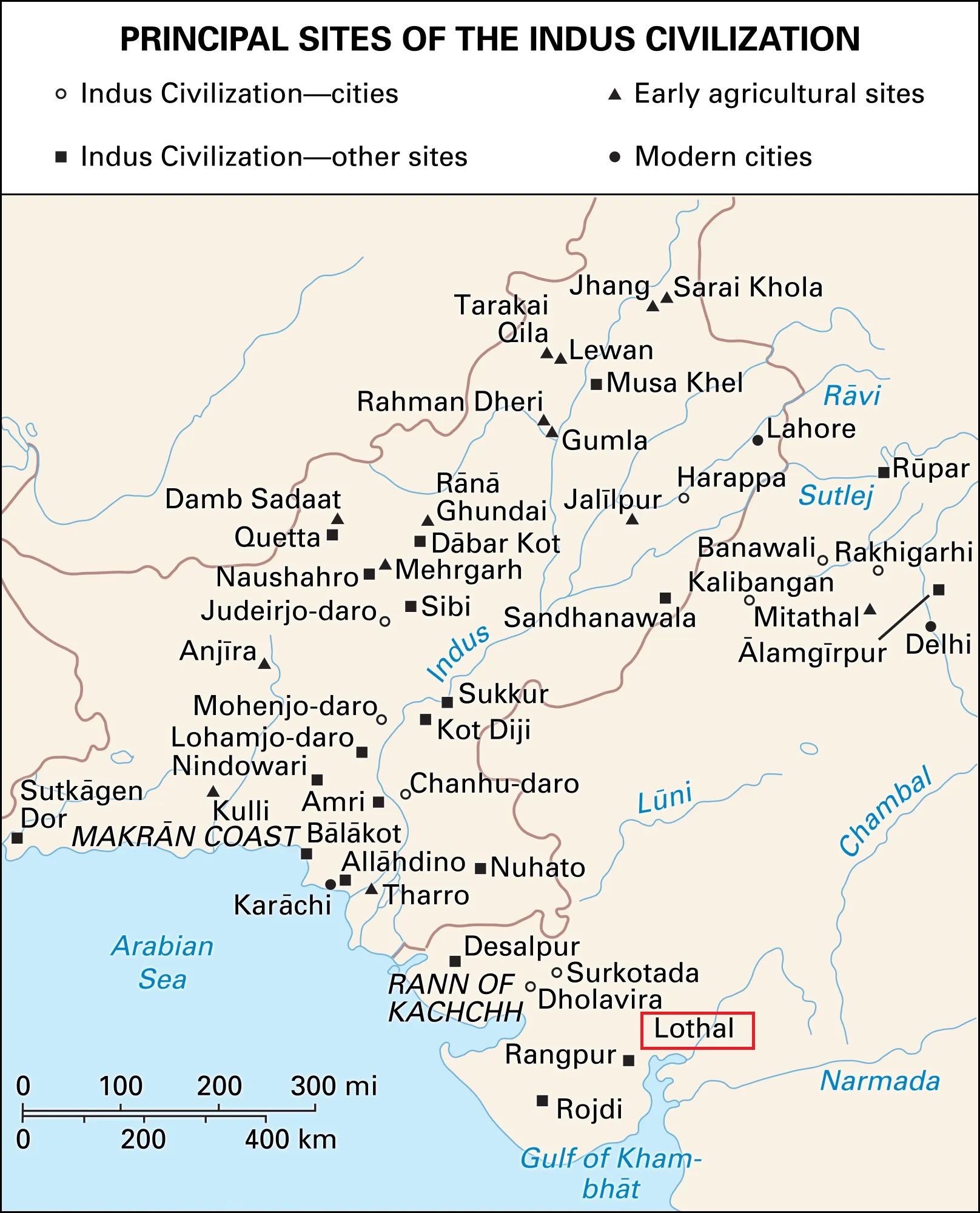
    A recent study by the Indian Institute of Technology-Gandhinagar (IITGn) has presented new evidence supporting the presence of a dockyard (222 x 37 metres) at Lothal, which was earlier debated.

    Evidence of Lothal’s Dockyard

    • The discovery of Lothal, located in the Bhal region of Gujarat during the 1950s, initiated debates among archaeologists about the existence of a dockyard.
    • The IITGn study reveals that the Sabarmati River once flowed close to Lothal during the Harappan period, contrasting its current course, which is 20 km away.
    • The study suggests a trade route linking Ahmedabad, through Lothal, Nal Sarovar, and the Little Rann, to Dholavira, another prominent Harappan site.
    • Satellite imagery and multi-sensor data analysis have uncovered the ancient channels of the Sabarmati River, confirming Lothal’s strategic location on a significant riverine route.
    • The study also suggests that traders might have arrived in Gujarat via the Gulf of Khambhat, collected materials from Ratanpura, and transported them to Mesopotamia (modern-day Iraq).

    About Lothal:

    Details
    Location Bhal region, Gujarat, India
    Historical Significance Built around 2200 BC; major trade centre for beads, gems, and ornaments
    Name Meaning “Lothal” means “the mound of the dead” in Gujarati (Similar to Mohenjodaro)
    Discovery Discovered by S.R. Rao; excavated from 1955 to 1960
    Port City Evidence Earliest known dock; connected to the ancient Sabarmati River
    Key Features Tidal dockyard, marine microfossils, and a basin for sailing boats
    Heritage Status Nominated for UNESCO World Heritage Site in 2014; only port-town of the Indus Valley Civilization


    PYQ:

    [2021] Which one of the following ancient towns is well-known for its elaborate system of water harvesting and management by building a series of dams and channelling water into connected reservoirs?

    (a) Dholavira

    (b) Kalibangan

    (c) Rakhigarhi

    (d) Ropar

  • What is the Munich Agreement and the role it played in starting World War II?   

    Why in the News?

    On September 1, 1939, German troops invaded Poland, sparking World War II. Britain and France declared war on Germany two days later, on September 3.

    The Sudeten crisis 

    • Background: The Sudeten crisis emerged from Hitler’s demand that the German-majority regions of Czechoslovakia, known as Sudetenland, be ceded to Germany. These regions, with a population of over three million German-speaking people, were part of Czechoslovakia after the dissolution of the Austro-Hungarian Empire post-World War I. Hitler aimed to incorporate Sudetenland into his vision of a “Greater Germany.”
    • German Occupation: Following the Munich Agreement, German troops occupied Sudetenland from October 1 to October 10, 1938. This occupation was part of Hitler’s broader plan for territorial expansion.

    About the Munich Agreement and changes after that 

    • Signatories: The Munich Agreement was signed on September 29-30, 1938, by Germany, France, Italy, and Great Britain. Czechoslovakia was not a party to the agreement but was pressured into accepting it by the signing powers.
    • Terms: The agreement allowed Germany to annex Sudetenland in exchange for a promise of peace. Great Britain’s Prime Minister Neville Chamberlain, who supported the agreement, famously declared it as “peace with honour” after returning from Munich.
    • Terms and Implementation:
      • Plebiscite: Some regions within Sudetenland were subject to a plebiscite for determining their fate.
      • Military Withdrawal: The Czechoslovak government was required to withdraw its military and police forces from Sudetenland and release Sudeten German prisoners within four weeks of the agreement.
    • Aftermath: Despite the Munich Agreement, Hitler violated the terms within six months by invading the rest of Czechoslovakia.
      • The Munich Agreement, intended to appease Hitler and maintain peace, ultimately failed and was seen as a significant misjudgment of dealing with expansionist totalitarian regimes.

    Conclusion: The Munich Agreement, meant to appease Hitler by ceding Sudetenland to Germany, failed disastrously. Within six months, Hitler violated the agreement by invading the rest of Czechoslovakia, highlighting the dangers of appeasing expansionist totalitarian regimes.

    Mains PYQ: 

    Q There arose a serious challenge to the Democratic State System between the two World Wars.” Evaluate the statement. (2021)
  • In news: Thanjavur Veena

    Why in the News?

    Thanjavur, Tamil Nadu, is renowned for making the Veena, the first musical instrument in India to receive a Geographical Indication (GI) tag.

    About Thanjavur Veena:

    Details
    Type Saraswati Veena (a classical stringed musical instrument)
    GI Tag Received in 2012.
    Crafting Materials Jackfruit wood, known for its resonance and tonal quality.
    Production Process – Wood is cut, carved, shaped, and assembled.
    – Takes 15-20 days to complete.
    – Involves three parts: resonator (kudam), neck (dandi), and tuning box.
    Other Types of Veena – Saraswati Veena (used in Carnatic classical music)
    – Rudra Veena and Vichitra Veena (used in Hindustani classical music)
    – Chitra Veena (used in Carnatic classical music)


    PYQ:

    [2021] With reference to India, the terms ‘Halbi, Ho and Kui’ pertain to​:

    (a) Dance forms of Northwest India​

    (b) Musical instruments​

    (c) Pre-historic cave paintings​

    (d) Tribal languages​

  • Major Dhyan Chand (1905-1979): India’s first sporting superstar

    Why in the News?

    National Sports Day is celebrated on August 29 in India to honor the memory of “Major Dhyan Chand”, widely regarded as the first superstar of Indian hockey and arguably India’s first sporting superstar.

    About Major Dhyan Chand:

    Details
    Birth Born on August 29, 1905, in Allahabad, India
    Olympic Achievements Led India to three Olympic gold medals in 1928 (Amsterdam), 1932 (Los Angeles), and 1936 (Berlin).
    Career Goals Scored 33 goals in 12 Olympic matches, nearly averaging a hat-trick per game.
    Signature Skill Renowned for his exceptional dribbling and ball control.
    Anecdotes
      • Famous for his stick work so effective that his hockey stick was checked for magnets;
    • Declined an offer from Adolf Hitler to change nationality after the 1936 Olympics.
    National Recognition
    • In honour of his contributions, August 29 is celebrated as National Sports Day in India.
    • Rajiv Gandhi Khel Ratna Award was renamed the Major Dhyan Chand Khel Ratna Award in 2021.
    • It is the highest sporting award given by the Ministry of Youth Affairs and Sports for the spectacular and most outstanding performance in the field of sports by a sportsperson over four years.
      • The award comes with a cash prize of Rs 25 lakh.
    • The Khel Ratna Award was instituted in 1991-1992 and the first recipient was Chess legend Viswanathan Anand.
      • Winners: Leander Paes, Sachin Tendulkar, Dhanraj Pillay, Pullela Gopichand, Abhinav Bindra, Anju Bobby George, Mary Kom and Rani Rampal in 2020.
    Legacy Major Dhyan Chand National Stadium in New Delhi is named after him, underscoring his impact on Indian sports infrastructure.
  • Classical Language Centres ask for autonomy

    Why in the News?

    Classical Language Centres in India are seeking more autonomy to improve their effectiveness and address operational challenges.

    Classical Language Centres in India

    • India has designated 6 languages as classical: Tamil, Sanskrit, Telugu, Kannada, Malayalam, and Odia.
    • Special centres have been established to promote these languages.
    • Only the Centre for Tamil functions autonomously.
    • The centres for Telugu, Kannada, Malayalam, and Odia operate under the Central Institute of Indian Languages (CIIL) in Mysuru.

    About Classical Languages in India

    Aspect Details
    Recognized Classical Languages Tamil (2004), Sanskrit (2005), Kannada (2008), Telugu (2008), Malayalam (2013), Odia (2014).
    Additional Languages for Preservation Pali, Persian, Prakrit, and Farsi (Persian) as per the National Education Policy-2020.
    Criteria for Classical Language Status High Antiquity: Recorded history of 1500-2000 years.
    Valuable Heritage: Possesses ancient literature and texts.
    Originality: Unique literary tradition, not borrowed from other languages.
    Distinctness: Language and literature distinct from modern forms.
    Promotion of Classical Languages International Awards: Two major awards for scholars in classical Indian languages.
    Centre of Excellence: For studies in classical languages.
    Professional Chairs: UGC requested to create chairs in Central Universities.
    The Eighth Schedule Lists 22 official languages, governed by Articles 344(1) and 351 of the Constitution. Includes Assamese, Bengali, Bodo, Dogri, Gujarati, Hindi, Kannada, Kashmiri, Konkani, Maithili, Malayalam, Manipuri, Marathi, Nepali, Odia, Punjabi, Sanskrit, Santali, Sindhi, Tamil, Telugu, and Urdu.
    Chronological Additions to the Eighth Schedule 1950: Initially included 14 languages.
    1967: Sindhi added (21st Constitutional Amendment).
    1992: Konkani, Manipuri (Meitei), Nepali added (71st Constitutional Amendment).
    2003: Bodo, Dogri, Maithili, Santali added (92nd Constitutional Amendment).
    2011: “Oriya” replaced with “Odia” (96th Constitutional Amendment).


    PYQ:

    [2015] Which one of the following was given classical language status recently?

    (a) Odia

    (b) Konkani

    (c) Bhojpuri

    (d) Assamese

  • [pib] Maharaja Bir Bikram Kishore Manikya Bahadur

    Why in the News?

    The Prime Minister has paid homage to the great Maharaja of Tripura Bir Bikram Kishore Manikya Bahadur on his birth anniversary.

    Who was Maharaja Bir Bikram Kishore Manikya Bahadur?

    Details
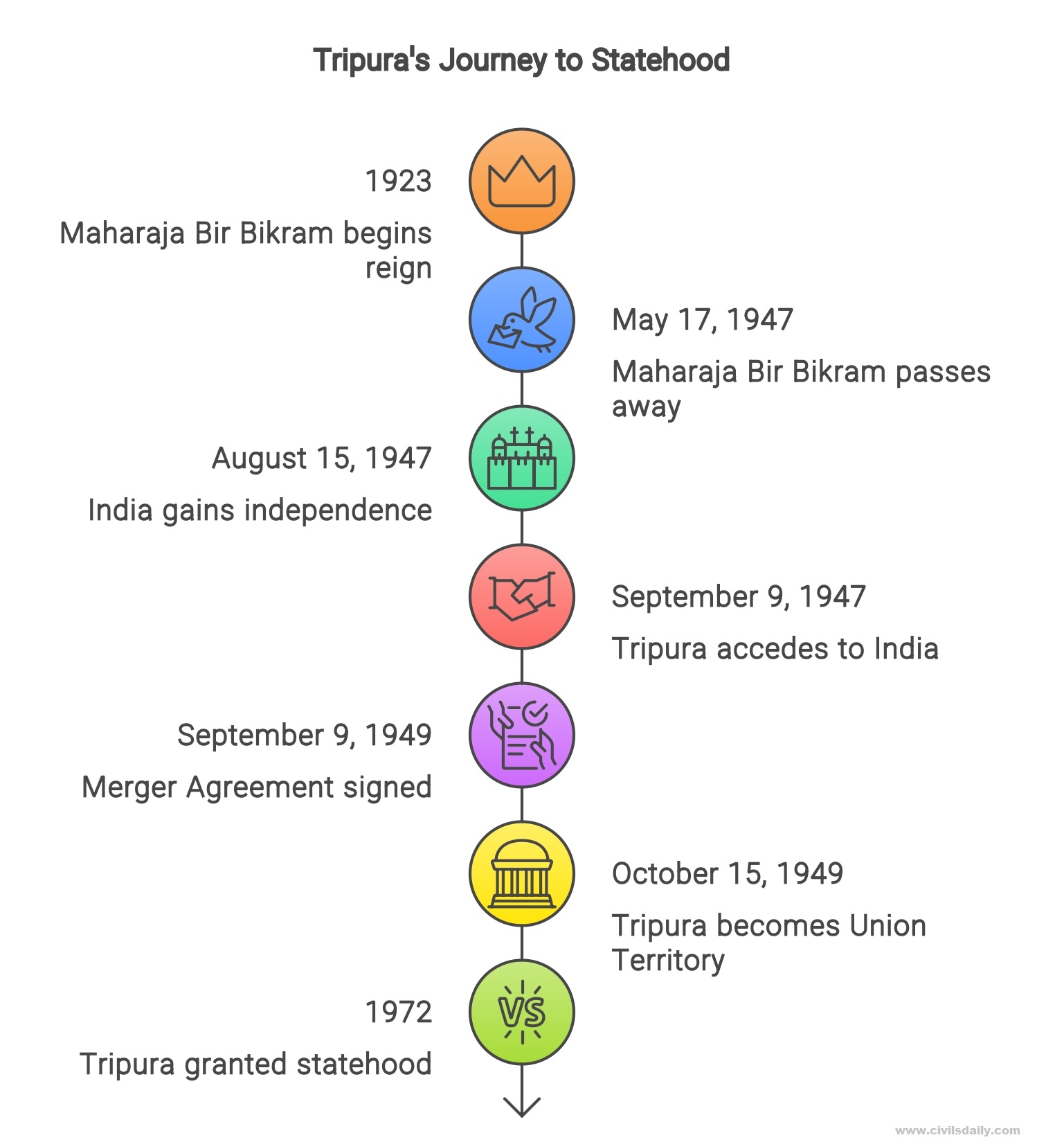
    Reign 1923 – 1947
    Birth August 19, 1908
    Contributions to Tripura – Modernized Tripura with infrastructure and educational reforms.
    – Planned and designed the city of Agartala, earning the title “Architect of Modern Tripura.”-He took initiatives to explore tea cultivation and established several tea estates in Tripura.
    Education and Infrastructure – Established schools, colleges, and hospitals.
    – He was instrumental in establishing the first airport in Tripura, the Maharaja Bir Bikram Airport, which greatly improved connectivity and facilitated economic growth
    Social Reforms Introduced land reforms, granted land rights to indigenous people, and worked to abolish untouchability.

    Maharaja Bir Bikram was a patron of the arts and culture, supporting various cultural activities and institutions.

    Military Role Supported the British during World War II.
    Legacy Died on May 17, 1947

    Remembered as a visionary ruler who played a crucial role in shaping modern Tripura.

    PYQ:

    [2022] The political and administrative reorganization of states and territories has been a continuous ongoing process since the mid-nineteenth century. Discuss with examples. (250 words, 15 marks)

    [2007] Which one of the following is the correct chronological order of the formation of the following states as full states of the Indian Union?

    (a) Sikkim, Arunachal Pradesh, Nagaland, Haryana

    (b) Nagaland , Haryana, Sikkim, Arunachal Pradesh

    (c) Sikkim, Haryana, Nagaland, Arunachal Pradesh

    (d) Nagaland, Arunachal Pradesh, Sikkim, Haryana