Within just three weeks of its launch, over 10 lakh senior citizens have enrolled for the Ayushman Vay Vandana Yojana.
Note: Pradhan Mantri Vaya Vandana Yojana (PM-VVY) is a pension scheme and insurance policy for senior citizens in India. One must not get confused with Ayushman-VVY.
AboutAyushman Vay Vandana Yojana:
Details
Features and Provisions
• Cashless health coverage up to ₹5 lakh per year for senior citizens aged 70and above. • Beneficiaries receive an Ayushman Vay Vandana Card, which grants them access to free treatment in empaneled hospitals across India.
• Coverage includes medical consultations, treatments, pre- and post-hospitalization expenses, and complex procedures such as angioplasty.
Structural Mandate
• Administered under the PM-JAY framework, ensuring structured implementation and integration with India’s health insurance network.
• Implemented across empaneled hospitals in both urban and rural areas, ensuring nationwide reach.
• Centralized digital system tracks treatments, patient details, and expenses for transparency and accountability.
• Specifically designed for senior citizens, addressing their unique healthcare needs.
Aims and Objectives
• Universal healthcare for senior citizens, ensuring access to essential medical treatments without financial strain.
• Seeks to reduce out-of-pocket expenditure for elderly citizens and their families.
• Encourages preventive care and early medical intervention to address age-related health conditions.
Eligibility Criteria
• Open to all Indian citizens aged 70 and above.
• There are NO income/ family size restrictions, making it accessible to all senior citizens, regardless of their economic status.
• Beneficiaries must be Indian citizens.
• Seniors need to register under PM-JAY to receive the AVV Card and avail of the benefits.
Q) Public health system has limitations in providing universal health coverage. Do you think that private sector can help in bridging the gap? What other viable alternatives do you suggest? (UPSC CSE 2015)
Q) The increase in life expectancy in the country has led to newer health challenges in the community. What are those challenges and what steps need to be taken to meet them? (UPSC CSE 2022)
India’s Public Health System needs to focus on preventing and controlling non-communicable diseases like hypertension, diabetes, cardiovascular diseases, stroke, and cancer. These diseases affect people of all income levels, but the poor and old aged population is the most vulnerable.
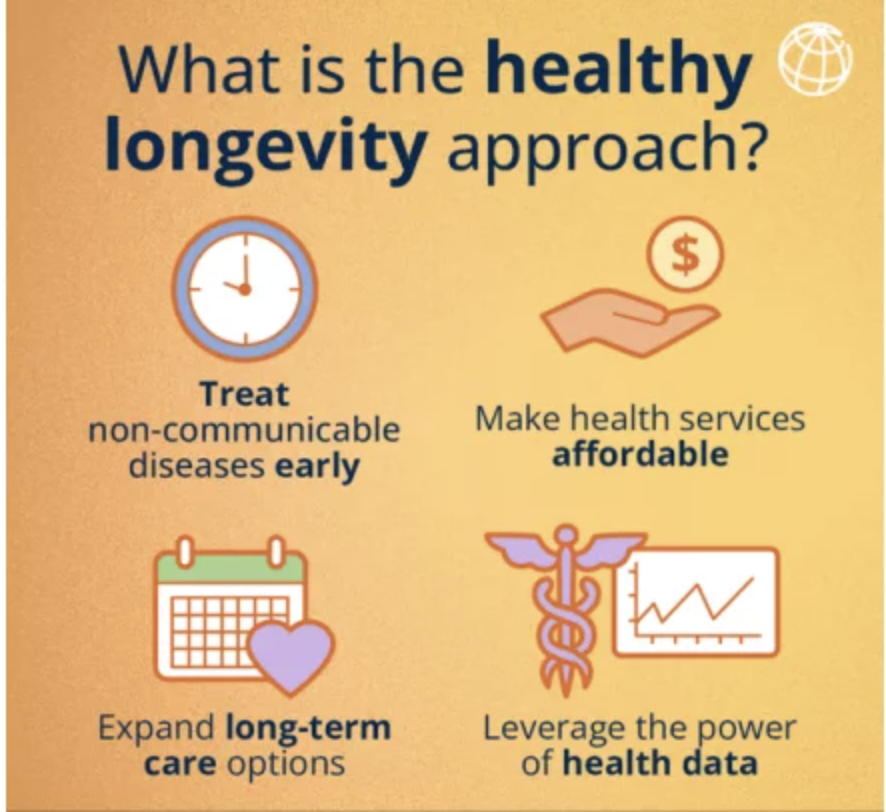
In this scenario, Health Longevity is an evidence-based approach to help countries define prioritized, costed interventions and policy changes to save and extend people’s lives. According to World Bank, investing in healthy longevity could save 150 million lives in low- and middle- income countries.
Today’s editorial emphasizes the issues related to the health sector in India especially with respect to Non-communicable diseases.
_
Let’s learn!
Why in the News?
The World Bank publishes an important and forward-thinking report on a key issue affecting people’s well-being. The report is Unlocking the Power of Healthy Longevity: Demographic Change, Non-communicable Diseases, and Human Capital, released in Washington D.C. in September 2024.
Key Findings of the Report:
● Aging and NCD Burden: Global aging is accelerating, with non-communicable diseases (NCDs) causing over 70% of deaths, especially in low- and middle-income countries. ● Potential Life Savings: Investing in healthy longevity could save 150 million lives and significantly improve productivity and economic growth by 2050. ● Life-Course Health Investments: Addressing health from maternal to elderly care, with a focus on NCD prevention, is essential for promoting healthier aging populations. ● Gender and Social Equity: Women, who often bear caregiving responsibilities and live longer with NCDs, require targeted health and social protections to ensure equity in aging.
Issues related to the Elderly Population in India:
Size of Elderly Population: India has the second-largest elderly population in the world, with approximately 140 million people aged 60 years and above.
Growth Rate: The elderly population is growing at a rate nearly three times higher than India’s overall population growth, indicating a significant demographic shift.
Aging Population Challenge: This rapidly aging population places considerable pressure on health services, social systems, and the economy.
What are the Disease Concerns in India?
Rise in Non-Communicable Diseases (NCDs): India is witnessing an increasing burden of NCDs, including heart disease, diabetes, cancer, and chronic respiratory diseases, which are now the leading causes of death.
Health Risks for the Elderly: As the elderly population grows, the prevalence of age-related diseases and NCDs is expected to surge, straining healthcare systems.
Impact on Public Health: The health challenges are compounded by the underdeveloped infrastructure for treating chronic diseases, particularly in rural areas.
Issues related to Hospital Expenses in India:
Rising Healthcare Costs: Medical expenses for elderly care, especially for chronic diseases and long-term care, are escalating. Private hospitals often charge exorbitantly, making healthcare unaffordable for many elderly individuals.
Inaccessibility of Healthcare: The elderly often face challenges in accessing healthcare facilities due to geographic and economic barriers, leading to delays in diagnosis and treatment.
Catastrophic Health Expenditure: Many elderly people, particularly in lower-income segments, face catastrophic health expenses that can push them into poverty. Even with government schemes, the out-of-pocket expenses remain high.
Steps taken by the Indian Government:
● National Programme for Health Care of the Elderly (NPHCE): This program aims to provide comprehensive healthcare services specifically tailored for older adults. ● National Social Assistance Programme (NSAP): Aimed at providing financial assistance to the elderly who are below the poverty line. ● Maintenance and Welfare of Senior Citizens Act, 2007: This act mandates maintenance and welfare provisions for senior citizens. ● Atal Vayo Abhyuday Yojana (AVYAY): A scheme focused on promoting the welfare of senior citizens through various support services. ● Elderline: A national helpline established to assist elderly individuals in accessing information and services related to their needs
Efficacy of Social Security Schemes:
Limited Coverage: India’s social security schemes, including pensions and health insurance, often do not adequately cover the elderly, especially those in lower income brackets or rural areas.
For example: Public health schemes like Ayushman Bharat aim to provide health insurance to underprivileged populations, but the coverage and access remain limited for the elderly.
Vulnerable Groups: The elderly in India, particularly those without formal employment or savings, remain highly vulnerable to financial distress from healthcare expenses and lack sufficient social security support.
Way forward:
Enhance and Expand Social Security Coverage: Strengthen existing social security schemes like Ayushman Bharat to ensure comprehensive health insurance and pension coverage for elderly populations, particularly in rural and low-income areas. This can help alleviate financial strain from healthcare costs.
Invest in Geriatric Healthcare Infrastructure: Improve healthcare facilities and services for the elderly, focusing on chronic disease management and accessible healthcare, especially in rural areas. This includes training healthcare workers in geriatric care and increasing the availability of affordable long-term care options.
The National Commission for Scheduled Tribeshas asked the Union Home Ministry and the states of Chhattisgarh, Maharashtra, Andhra Pradesh, and Odisha to submit a detailed report on the condition of Gotti Koya tribals.
Why did the NCST urge the Centre and States?
An estimated 50,000 Gotti Koya tribals were displaced due to Left-Wing Extremismand now live in 248 settlements across Odisha, Andhra Pradesh, Telangana, and Maharashtra.
Reports indicate that Telangana has reclaimed land from internally displaced persons (IDPs) in 75 settlements, impacting the tribals’ livelihoods and increasing their vulnerability.
About the Gotti Koya Tribe:
Details
Location
Multi-racial and multi-lingual communities found in the forests, plains, and valleys on both sides of the Godavari River in AP, Telangana, Chhattisgarh, and Odisha.
Migrated from Bastar, northern India.
Society and Culture
Koya language (Koyi) is a Dravidian language related to Gondi and influenced by Telugu.
Most speak Gondi or Telugu alongside Koyi.
Divided into five subdivisions (gotrams).
Patrilineal and patrilocal family structure, with a focus on monogamous, nuclear family.
Worship their own ethnic religion alongside Hindu gods, with Mother Earth being a significant deity.
Burial or cremation of the dead, with the erection of menhirs in memory.
Pastoralists and shifting cultivators (Podu), are now engaged in settled cultivation, animal husbandry, and seasonal forest collection.
Grow Jowar, Ragi, Bajra, and other millets.
Maintain community funds and grain banks for food security.
Festivals
Vijji Pandum (Seeds charming festival) and KondalaKolupu (Festival to appease hill deities).
Perform the Permakok (Bison horn dance) during festivals and marriages.
Sammakka Saralamma Jatra, held once every two years on the full moon day of Magha Masam (January/February) at Medaram village, Warangal district.
Challenges Faced
Many fled to Andhra Pradesh (now Telangana) in the mid-2000s due to violent conflicts between Maoist insurgents and Salwa Judum (Govt backed tribal militia).
Salwa Judum was later banned by the Supreme Court of India in 2011.
PYQ:
[2014] Every year, a month long ecologically important campaign/festival is held during which certain communities/tribes plant saplings of fruit-bearing trees. Which of the following are such communities/ tribes?
(a) Bhutia and Lepcha
(b) Gond and Korku
(c) Irula and Toda
(d) Sahariya and Agariya
The Chief Ministers of Andhra Pradesh and Tamil Nadu have recently voiced concerns over the low fertility rates in their states.
What is the current demographic situation, especially in the southern States?
Falling Fertility Rates: Southern states like Tamil Nadu, Andhra Pradesh, Telangana, and Kerala have fertility rates below the replacement level of 2.1.
For instance, Tamil Nadu and West Bengal recorded fertility rates of 1.4 (2019-21), and Andhra Pradesh, Telangana, and Kerala at 1.5.
Ageing Population: These states face an advanced demographic transition with an increasingly ageing population. The share of elderly in Kerala is expected to rise to 22.8% by 2036, in Tamil Nadu to 20.8%, and in Andhra Pradesh to 19%.
End of Demographic Dividend: With a rising old age dependency ratio — Kerala (26.1), Tamil Nadu (20.5), and Andhra Pradesh (18.5) in 2021 — the demographic window for leveraging a young workforce is closing or has already closed in these states.
What is the likely economic impact?
Rising Healthcare Costs: The elderly demographic is likely to increase healthcare costs. Southern states, comprising one-fifth of India’s population, accounted for 32% of out-of-pocket cardiovascular healthcare expenditure in 2017-18.
Reduced Economic Growth Potential: A declining working-age population means a lower potential to reap economic benefits from a young labor force. This demographic shift may impact productivity and economic growth.
Impact on Women’s Labor Force Participation: Pro-natalist policies to increase fertility may lead to a reduction in women’s participation in the labor force, hindering economic growth further.
What are the political implications?
Federal Representation Changes: With the 2026 delimitation, seats in Parliament are expected to be adjusted based on population. Southern states could lose representation due to slower population growth, with Tamil Nadu potentially losing nine seats, Kerala six, and Andhra Pradesh five, while northern states like Uttar Pradesh, Bihar, and Rajasthan may gain seats.
Resource Allocation: Slower-growing southern states contribute more tax revenue yet may receive a smaller share of resources from the central pool, as allocation formulas often consider population.
What are the solutions being considered? (Way forward)
Pro-natalist Incentives: Some southern leaders advocate incentivizing families to have more children. However, international experiences show limited success with pro-natalist incentives.
Gender Equity and Family Policies: Policies such as paid maternity/paternity leave, accessible childcare, and employment protections can support sustainable fertility rates without economically disadvantaging women.
Increasing Working Age and Migrant Inclusion: Extending working lifespans and better integrating economic migrants in social security and political representation can help mitigate the impact of an ageing population.
Balancing Migration Needs: Southern states, which attract many economic migrants, face challenges as these migrants are still counted in their home states, impacting political representation and resource distribution in the host states.
Mains PYQ:
Q Critically examine whether growing population is the cause of poverty OR poverty is the mains cause of population increase in India. (UPSC IAS/2015)
Amid the ongoing evolution of the “gig worker” concept, India recently witnessed a groundbreaking movement a nationwide digital strike organized by women gig workers this Deepavali.
What are the specific exploitative practices faced by gig workers?
Wage Theft and High Commissions: Many gig workers receive only a fraction of their earnings after substantial deductions for company commissions, which can range from 10% to 35% of their total income. This often leaves them with minimal take-home pay, insufficient to meet basic living expenses.
Forced Purchases and Costs: Workers are often required to buy product kits at full retail prices from their employers, which further erodes their earnings. This practice restricts their ability to purchase necessary supplies at more affordable wholesale rates.
Job Insecurity and Rating Systems: Gig workers are subjected to biased rating systems that can lead to job insecurity. If they refuse “auto-assigned” jobs or fail to meet performance metrics, they risk being blocked from the platform or terminated without recourse.
Lack of Social Security: Gig workers are excluded from essential benefits such as minimum wages, health protections, and social security rights, leaving them vulnerable in times of need.
How do platform dynamics contribute to labour exploitation?
Misclassification of Workers: Gig workers are often classified as independent contractors rather than employees, which denies them access to fundamental labour rights and protections. This legal loophole allows companies to evade responsibilities related to wages and benefits.
Algorithmic Control: Companies utilize complex algorithms to manage worker assignments and ratings, creating a system where workers are constantly monitored and evaluated based on performance metrics that may not accurately reflect their work quality.
Patriarchal Structures: The gig economy perpetuates existing patriarchal norms by relegating women to traditionally female roles such as beauticians and housekeepers, limiting their job options and negotiating power within the labour market.
What measures can address and combat labour exploitation in this sector? (Way forward)
Legal Recognition as Employees: Governments should legislate the recognition of gig workers as employees rather than independent contractors, thereby extending labour rights such as minimum wage laws and social security benefits.
Regulatory Frameworks: Establishing comprehensive labour laws specific to the gig economy would help protect workers’ rights. This includes mechanisms for grievance redressal, ensuring fair treatment and accountability from platform companies.
Collective Bargaining Rights: Supporting unionization efforts like those of the Gig and Platform Services Workers Union (GIPSWU) can empower workers to negotiate better wages and working conditions collectively. This grassroots organizing is crucial for achieving meaningful change in labour practices within the sector
Mains PYQ:
Q Examine the role of ‘Gig Economy’ in the process of empowerment of women in India. (UPSC IAS/2021)
Q) National Education Policy, 2020 conforms with the Sustainable Development Goal-4 (2030). It intends to restructure and reorient education system in India. Critically examine the statement. (UPSC CSE 2020)
Q) Besides the welfare schemes, India needs deft management of inflation and unemployment to serve the poor and the underprivileged sections of society. Discuss. (UPSC CSE 2022)
Q) The quality of higher education in India requires major improvement to make it internationally competitive. Do you think that the entry of foreign educational institutions would help improve the quality of technical and higher education in the country? Discuss. (UPSC CSE 2015)
Mentor’s Comment:The SDG India Index, developed by NITI Aayog, reports an overall score of 71 out of 100, up from 66 in the previous edition, indicating progress in areas such as quality education (SDG 4), where the score improved from 66 to 75. Despite progress, challenges remain, including disparities in educational quality across regions and inadequate infrastructure.
SDG 4.4 aims to substantially increase the number of youth and adults who have relevant skills, including technical and vocational skills, for employment, decent jobs, and entrepreneurship by 2030.
Additionally, SDG 8 also plays a significant role in this context, as it promotes sustained, inclusive, and sustainable economic growth, full and productive employment, and decent work for all.
In light of the increasing global demand for skilled professionals in Science, Technology, Engineering, and Mathematics (STEM), today’s editorial focuses on the urgent need for revitalizing educational frameworks to better prepare students for future challenges.
_
Let’s learn!
Why in the News?
The NITI Aayog reports highlight the need for increased investment in teacher training, digital resources, and facilities to enhance learning environments.
What is the significance of STEM Education?
•Economic Growth and Competitiveness: STEM education equips students with essential skills such as critical thinking, problem-solving, and creativity, which are crucial for success in technology-driven industries. A strong foundation in STEM fields enables India to compete globally and contribute to the global talent pool in science and technology.This is vital for India’s economic expansion, as a skilled workforce can drive innovation and attract investments. •Equity and Access: STEM education fosters a multidisciplinary approach, where students learn to apply scientific principles to develop innovative solutions for these challenges. Efforts to promote STEM education also focus on empowering women and marginalized groups, reducing gender disparities in these fields. •Curriculum Innovation: Integrating STEM into the curriculum encourages a shift from traditional rote learning to hands-on, project-based learning. Well-trained STEM educators are needed to implement these educational strategies effectively.
What are the key barriers to effective STEM education in current curricula?
School-Related Barriers: Many schools lack sufficient laboratory equipment and materials necessary for hands-on STEM learning, which limits practical experiences for students.
Secondly, high student-to-teacher ratios hinder personalized instruction and effective classroom management, making it difficult to engage all students in STEM subjects.
Teacher-Related Barriers: A shortage of qualified STEM teachers and inadequate professional development opportunities result in a lack of effective teaching methods in STEM education.
Student-Related Barriers: Students often show low levels of motivation towards STEM subjects, which can stem from a lack of relatable content or perceived difficulty. Some educators need to be made aware that focusing on STEM will detract from traditional academic subjects, leading to resistance.
Curriculum and Instructional Barriers: Current curricula are rigid and do not integrate interdisciplinary approaches, limiting students’ ability to make connections between different fields.
Technology-Related Barriers: In many areas, particularly rural regions, students do not have adequate access to technology that supports STEM learning, such as computers and internet connectivity
How can Educational Institutions adapt their teaching methodologies in STEM fields?
Project-Based Learning (PBL): PBL encourages students to work on projects that promote creativity, teamwork, and practical application of knowledge in real-world problems, as students take ownership of their learning from start to finish.
Problem-Based and Analytical Thinking (PBAT): In this approach, students are presented with complex problems that do not have straightforward solutions. They must analyze the situation, evaluate different perspectives, and devise solutions, thereby enhancing their critical thinking skills.
Encouraging Curiosity: This method allows students to ask questions and explore topics of interest through investigation and experimentation. It fosters a deeper understanding of STEM concepts and develops research skills, as students learn to seek out information independently.
Integration of Technology: Utilizing technology in the classroom—such as simulations, coding platforms, and digital collaboration tools—can enhance student engagement and provide access to a wider range of learning resources.
What role does industry collaboration play in enhancing STEM education?
Real-World Application of Knowledge: Industry partnerships help students see how STEM concepts apply to real-world challenges, making learning more relevant and engaging. This connection motivates students to pursue STEM subjects by illustrating their practical importance in various fields.
Access to Resources and Expertise: Partnerships with industry can supply schools with access to the latest technologies, enhanced research, and expert knowledge. This access ensures that students are learning with up-to-date tools and methodologies relevant to current market demands.
Authentic Assessment: Industry partners can provide valuable and experienced feedback on student projects and educational practices, helping educators refine their curricula to better meet industry standards and expectations.
They provide students with insights into various STEM careers through guest speakers, mentorship programs, skill development, and industrial visits.
Strengthening Industrial Community: They collaborate with local businesses foster community involvement in education, creating a supportive environment for students. These partnerships can also contribute to local economic development by preparing a skilled workforce
A collaborative Project by UNESCO and Huawei on “Revitalizing STEM education to equip next generations with STEM competency”
• Launched in March 2024, this initiative aims to enhance STEM education across Europe by focusing on several key areas: ○ To support innovative educational projects through a competitive selection process. For empowering girls and women in STEM fields, addressing gender disparities in these areas. ○ Initiates to integrate gender perspectives in Romania, support refugees in Germany, enhance earthquake engineering education in North Macedonia, and improve mathematics teaching in Malta. • It aims to improve teaching practices, promote STEM research, and create a Regional STEM Clearinghouse for knowledge sharing, all while aligning with the United Nations’ Sustainable Development Goals (SDGs).
Way Forward: By implementing these adaptive methodologies, educational institutions and Industries can create a dynamic learning environment that not only enhances students’ understanding of STEM subjects but also cultivates the critical thinking and innovative skills necessary for future success in these fields.
Q) What are the continued challenges for Women in India against time and space? (UPSC CSE 2019) Q) Is the National Commission for Women able to strategize and tackle the problems that women face at both public and private spheres? Give reasons in support of your answer. (UPSC CSE 2018) Q) Discuss the positive and negative effects of globalization on women in India? (UPSC CSE 2015)
Mentor’s Comment:Nearly 23% of women surveyed in eight countries reported experiencing online abuse or harassment multiple times, with the U.S. having the highest rate.
Women in power, such as U.S. politician Nikki Haley and Italian Prime Minister Giorgia Meloni, have encountered gender bias in technology and safety. Haley faced manipulated explicit images during her Republican primary campaign, while Meloni was targeted with deepfake content.
In Bangladesh, female politicians Rumin Farhana and Nipun Roy were victims of deepfake images circulating on social media ahead of the January 7, 2024, general election, which attracted millions of views. This situation raises critical questions about what actions content moderators are taking to address these issues?
Today’s editorial addresses the persistent issues of online harassment and abuse that disproportionately affect women. It criticizes the failure of major technology companies to create safe digital environments.
_
Let’s learn!
Why in the News?
Online abuse directed at women, including harassment, threats, and misogynistic comments has gained significant attention as more women share their experiences of unsafe digital environments, highlighting the urgent need for action.
Kamla Harris faced extensive online trolling, particularly from right-wing commentators.
These personal attacks targeted her background, character, and integrity, including a manipulated video shared by Elon Musk that falsely portrayed her making disparaging remarks about Joe Biden and herself.
How does online abuse uniquely affect women compared to men?
Widespread Online Harassment: Women in power, such as U.S. politician Nikki Haley and Italian PM Giorgia Meloni, have also encountered similar challenges. In Bangladesh, female politicians Rumin Farhana and Nipun Roy were victims of deepfake images ahead of general election, which attracted millions of views.
Impact of Big Tech’s Inaction: The failure of major tech companies to effectively manage degrading content places an undue burden on women.
The nature of online abuse varies significantly; while men often face misinformation regarding their roles, women are subjected to objectification, sexualized content, and body shaming.
Accountability Issues: Big Tech often evades accountability by claiming that their platforms merely reflect user behavior and cannot be closely monitored.
In short, they benefit from ‘safe harbor‘ protections that shield them from responsibility.
Psychological Impact: Research shows that nearly half of women report severe psychological consequences from online abuse, such as anxiety, depression, and panic attacks.
Many women alter their online behavior due to fear of harassment, leading to self-censorship (silencing effect).
CASE STUDY:
• Siri and Gender Bias: Siri’s responses to sexual harassment reflected gender biases inherent in its programming. Apple acknowledged the issue and began working on updates to improve Siri’s responses and reduce gender stereotyping in its interactions. • UNESCO Initiatives: UNESCO has been actively working on projects aimed at reducing gender bias in AI technologies. They promote diversity in AI development teams and encourage the implementation of gender-sensitive approaches in algorithm design.
What measures can be taken to mitigate gender bias in technology and improve safety?
Policy and Governance: Establish clear guidelines that address gender bias in technology development and online platforms. Promote diversity in tech leadership roles to ensure varied perspectives are included in decision-making processes.
Technology Design: Develop AI tools that can identify and flag abusive content directed at women, allowing for quicker intervention. Secondly, we need to involve women in the design and testing phases of technology to better understand their needs and experiences.
Education and Training: Implement training programs for developers and tech professionals on gender sensitivity and the impacts of bias. Need to enhance digital literacy among women to empower them to navigate technology safely and effectively.
Online Safety Measures: Improve reporting systems for online harassment, making them more accessible and responsive to women’s experiences. Encourage platforms to provide robust privacy settings that allow users to control their data and interactions more effectively.
The Thadou tribe, one of the oldest and largest non-Naga tribes in Manipur, has expressed support to implement the National Register of Citizens (NRC)in the state.
About the Thadou Community
Details
Overview
One of the oldest indigenous tribes in Manipur, recognized as a distinct community.
One of 29 officially recognized indigenous tribes in Manipur with rich cultural practices and folklore.
Historical Background
Recognized as the largest tribe in Manipur since the First Census of India (1881), with a distinct historical narrative from Kukis.
ST Recognition
Acknowledged as an independent Scheduled Tribe under the 1956 Presidential Order.
Population
As per the 2011 Census, the Thadou population stands at 2,15,913;
Identity
Asserts a distinct identity from the Kuki community, emphasizing unique language, culture, and history.
Language
Belongs to the Tibeto-Burman family, with a distinct dialect from other nearby tribes.
Geographic Distribution
Primarily located in Manipur; also present in Nagaland, Assam and Mizoram, inhabiting hilly regions.
Socioeconomic Status
Engaged in agriculture (particularly jhum cultivation) and knowledgeable about medicinal plants; faces challenges in infrastructure and education.
Religious Practices
Traditionally practiced animism; many have converted to Christianity, blending traditional and Christian customs.
Position Amid Ethnic Conflict
Affected by the ethnic conflict between Meitei and Kuki-Zo communities since May 3, 2023; asserts their distinct identity.
In the recent judgment of Society forEnlightenment and Voluntary Action v. Union of India, the SC has shifted the focus in child marriage cases from punishing criminal acts to addressing the “harm inflicted on the victim.”
What is the law on Child Marriage?
Prohibition of Child Marriage Act, 2006 (PCMA): Defines child marriage as one where the husband is under 21 years or the wife is under 18.
Such marriages are voidable: The underage person can choose to cancel the marriage, but until they do, it is still legally recognized.
State Variations: In Karnataka and Haryana, child marriages are void from the beginning, without the need for annulment.
Annulment vs. Divorce: Annulment treats the marriage as if it never took place, while divorce ends an existing marriage. To get an annulment under the PCMA, it only needs to be shown that one person was underage at the time.
Why are there concerns about using criminal action to tackle child marriage?
Although the marriage remains valid unless annulled, related activities are criminalized under PCMA, BNS, and POCSO, such as promoting or performing child marriages and sexual activity with a minor.
Criminal provisions can lead to charges against the girl’s family members (parents, husband, in-laws), leaving her without support and creating barriers to accessing sexual and reproductive healthcare.
Studies reveal criminal provisions are used more in self-initiated marriages than arranged ones, overlooking the complexities of these cases.
Some adolescents may choose marriage to escape abusive environments or forced marriage, often seeing it as a way to assert their agency in a restrictive society.
Why is the SC judgment significant?
Social and Economic Barriers: Women who leave child marriages often face significant social and economic penalties. The SC judgment proposes skill development, vocational training, economic stability programs, rehabilitation services, and victim compensation to support them.
Empowering Women in Child Marriages: Some women prefer to remain married but need support to advocate for themselves. The judgment calls for tools to help them make decisions about reproductive rights, employment, and education.
Sex Education for Adolescents: The judgment emphasizes sex education, equipping young people with skills and knowledge to navigate relationships and improve agency.
Holistic Approach: By moving away from solely criminal prosecution to focus on empowerment and support, the SC judgment provides a more comprehensive, agency-affirming response to child marriage.
Way forward:
Strengthen Support Systems: Develop targeted programs for skill training, financial assistance, and rehabilitation to help individuals exit child marriages, promoting economic stability and social reintegration.
Enhance Education and Awareness: Implement comprehensive sex education and awareness initiatives in communities to empower young individuals and discourage child marriage through informed decision-making and better access to reproductive rights.
Mains PYQ:
Q “Empowering women is the key to controlling the population growth.” Discuss. (UPSC IAS/2019)
Q Customs and traditions suppress reason leading to obscurantism. Do you agree? (UPSC IAS/2020)
Q) What are the continued challenges for Women in India against time and space? (UPSC CSE 2019) Q) Are we losing our local identity for the global identity? Discuss. (UPSC CSE 2019) Q) “Though women in post-independent India have excelled in various fields, the social attitude towards women and the feminist movement has been patriarchal.” Apart from women’s education and women empowerment schemes, what interventions can help change this milieu? (UPSC CSE 2021) Q) Explain why suicide among young women is increasing in Indian society. (UPSC CSE 2023)
Mentor’s Comment:
The tragic death of Anna Sebastian Perayil, a 26-year-old chartered accountant, underscores the human cost of a relentless work culture that often glorifies long hours and high productivity, leading to Mental health crises among young professionals.
The World Health Organization (WHO) states that 20% of Indians are expected to experience mental health disorders by the end of the year, with 5.6 crore suffering from depression and 3.8 crore from anxiety disorders
Most of the world’s largest multinationals are American, which shapes their work culture. Western work culture is not just about productivity; it’s deeply rooted in historical and religious contexts.
Today’s editorial addresses the alarming trend of adopting detrimental workplace practices from abroad, particularly from high-pressure environments in developed countries. It highlights the severe implications of such practices on mental health and overall employee well-being.
_
Let’s learn!
Why in the News?
The tragic death of a 26-year-old Chartered Accountant has brought attention to the severe pressures faced by employees in high-stress environments.
The Lancet found a 35% increase in mental health disorders in India, reflecting the growing crisis
What are the characteristics of toxic work cultures imported from Western countries?
Historical Insights: After the USSR fell, the U.S. gained significant influence over global affairs, and its economic practices became the standard for success.
The idea of “the American way” (long hours and high productivity/Capitalist perspective) became synonymous with corporate culture, influencing companies worldwide.
Karl Marx pointed out over a century ago, longer working days can lead to higher profits if labor costs are kept low.
German sociologist Max Weber explored that Protestantism changed its attitudes toward work in Northern Europe.
American Influence on Work Culture: The term ‘Multinational Corporations’ is misleading because, despite their global operations, these companies are often closely tied to their home countries.
Max Weber cited American thinker Benjamin Franklin to illustrate this connection, suggesting that the work culture in MNCs is deeply rooted in historical religious values (cultural glorification of hard work) rather than modern management theories.
What is the actual scenario?
• Data from the International Labour Organisation (ILO) shows that while hard work has helped the U.S. economy grow, it doesn’t guarantee the highest living standards. In 2023, the U.S. ranked 12th globally in terms of per capita income, falling behind countries like Austria, Belgium, and Denmark. • The U.S. has improved only slightly compared to Switzerland. Interestingly, workers in most other countries listed worked fewer hours than those in the U.S. This shows that achieving greater wealth while working less is possible.
How does this imported ‘Capitalist perspective’ affect Indian professionals and their work culture?
High-Pressure Work Environment: American companies often expect long hours, leading to stress and burnout among Indian workers. The expectations set by American firms often clash with Indian cultural norms.
Indian work culture traditionally values relationships and teamwork, the imported capitalist model tends to prioritize efficiency and individual performance.
Indian professionals may struggle with the more egalitarian approach of American firms, which encourages open communication.
Hierarchical Structures Vs. Equality: Indian workplaces are typically hierarchical, with a strong emphasis on respect for authority and seniority. In Indian organizations, decision-making is often top-down, whereas American firms favor collaborative approaches.
This difference can make it challenging for Indian professionals to adapt, as they may feel uncomfortable speaking up or challenging their superiors even when encouraged to do so.
Work-Life Balance Challenges: Long hours and blur boundaries like working late or during weekends, make it hard for the employees to relax or find the space between work and personal life.
Rising stress levels contribute to mental health problems, including anxiety and burnout.
Women face additional pressures in balancing work demands with traditional family roles.
What steps can organizations take to mitigate these effects?
Employee Wellbeing Programs: Create wellness initiatives that include flexible work hours, mental health days, and access to counseling. These programs help reduce stress and improve morale.
Promote Work-Life Balance: Encourage flexible schedules and remote work options. This helps employees manage personal and professional commitments, reducing burnout.
Foster Open Communication: Build a culture where employees can discuss their workloads and mental health openly. Regular check-ins can help managers support their teams effectively.
Train Managers: Provide training for managers to be supportive leaders. Good management practices can enhance employee satisfaction and create a positive work environment.