💥Join UPSC 2027,2028 Mentorship (August Batch) + XFactor Notes & Microthemes PDF

Subject: Institutional measures

  • National Cooperation Policy (NCP), 2025

    Why in the News?

    The National Cooperation Policy (NCP) 2025 recently unveiled by Union Home and Cooperation Minister Amit Shah has drawn criticisms from SKM (Samyukt Kisan Morcha).

    Also in news:

    • The Union Cabinet has also approved a ₹2,000 crore Central Sector Scheme to aid National Cooperative Development Corporation (NCDC) from 2025–26 to 2028–29.
    • NCDC was established in 1963 as a statutory Corporation under Ministry of Agriculture & Farmers Welfare (now functions under the Ministry of Cooperation since 2021).


    About Cooperatives in India:

    • What is it: A cooperative is a voluntary, autonomous association of individuals who unite to meet common economic, social, or cultural needs through a jointly-owned and democratically-controlled enterprise.
    • Key Principles:
      • One member, one vote: Equal say in governance, regardless of financial contribution.
      • Based on collective benefit, democratic control, and mutual aid.
    • Historical Evolution:
      • 1904 & 1912: Cooperative Acts laid the foundation for the cooperative movement in India.
      • Post-independence: Emphasis on rural credit, dairy, and agriculture cooperatives (e.g., Amul).
      • Key Institutions: NABARD (National Bank for Agriculture and Rural Development), NCDC (National Cooperative Development Corporation).
    • Constitutional & Legal Backing:
      • 97th Constitutional Amendment (2011):
        • Article 19(1)(c): Right to form cooperative societies.
        • Article 43B: Directive Principle promoting cooperative societies.
        • Part IXB (Articles 243ZH to 243ZT): Provides governance framework.
      • MSCS Act, 2002: Governs multi-state cooperatives (under Central Registrar).
      • State List (Entry 32): State legislatures regulate intra-state cooperatives.
    • Scale:
      • India has over 8.42 lakh cooperatives with 29 crore members (~27% of global total).
      • Leading states: Maharashtra, Gujarat, Telangana, MP, Karnataka.
      • Notable cooperatives: IFFCO, Amul — ranked among top 300 cooperatives globally.

    National Cooperation Policy (NCP) 2025:

    • Launch: Introduced by Union Minister Amit Shah on July 24, 2025.
    • Vision: “Sahakar se Samriddhi” — promoting prosperity through cooperatives.
    • Objective:
      • Establish a comprehensive national framework for cooperative growth (2025–2045).
      • Replace the 2002 policy and drive inclusive development through grassroots cooperatives.
    • Key Features:
      • 2 lakh new Primary Agricultural Credit Societies (PACS) in 5 years
      • Scheme convergence: e.g., PM Matsya Sampada Yojana, NPDD
      • Inclusive focus: Women, Dalits, Adivasis, youth
      • Sector expansion: Into 25+ areas—dairy, fisheries, exports, technology
      • Education: First cooperative university—Tribhuvan Sahkari University
      • Export support: Through National Cooperative Exports Limited (NCEL)
      • Digital thrust: Emphasis on digitisation and platform integration

    Issues with NCP, 2025:

    • Federalism Undermined
      • Entry 32: Cooperatives are a State Subject
      • SC Verdict (2021): Centre cannot regulate intra-state cooperatives
      • Criticism: Policy lacks ratification by half the states (Article 368(2))
    • Corporate Entry Fears
      • Emphasis on digital platforms may enable indirect corporatisation
      • Potential marginalisation of small farmers and FPOs
    • Weak Social Inclusion
      • Lacks focus on Minimum Support Price (MSP), surplus sharing
      • No robust support for producer cooperatives or fair wages
      • Inclusion of tribals, Dalits, women remains rhetorical
    [UPSC 2021] With reference to ‘Urban Cooperative banks’ in India, consider the following statements:

    1. They are supervised and regulated by local boards set up by the State Governments.

    2. They can issue equity shares and preference shares.

    3. They were brought under the purview of the Banking Regulation Act, 1949 through an Amendment in 1966.

    Which of the statements given above is/are correct?”

    Options: (a) 1 only (b) 2 and 3 only* (c) 1 and 3 only (d) 1, 2, and 3


  • [pib] PM Viksit Bharat Rozgar Yojana (PM-VBRY)

    Why in the News?

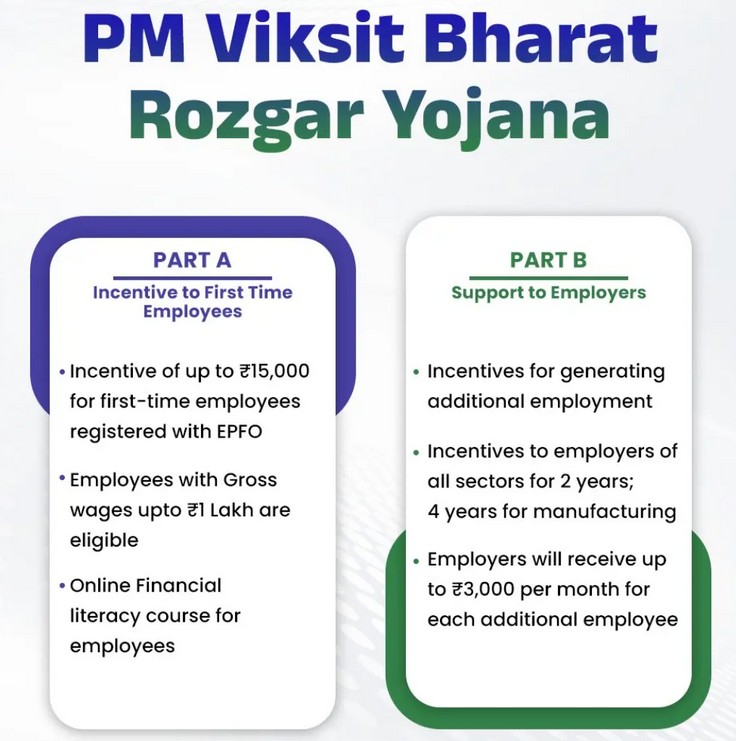
    The Employment Linked Incentive (ELI) Scheme has been officially launched as the PM Viksit Bharat Rozgar Yojana (PM-VBRY), effective from 1st August 2025.

    About PM Viksit Bharat Rozgar Yojana (PM-VBRY):

    • Objective: Promote formal employment and inclusive job creation.
    • Outlay: ₹99,446 crore (Aug 2025 – July 2027).
    • Aim:  3.5 crore new jobs, including 1.92 crore first-time entrants into the workforce.
    • Focus: Expanding EPFO coverage and supporting Viksit Bharat vision.
    • Sectoral Coverage: Open to all sectors, with special focus on manufacturing for long-term growth.

    PM Viksit Bharat Rozgar Yojana (PM-VBRY)

    Key Features:

    1. Incentives for Employees
      • Eligible: First-time EPFO-registered workers earning ≤ ₹1 lakh/month.
      • Benefit: 1-month EPF wage (max ₹15,000) in two parts — after 6 and 12 months.
      • Condition: Completion of a financial literacy programme; Part of the amount is locked in a savings scheme.
    1. Incentives for Employers
      • Applies to: New hires with salary ≤ ₹1 lakh/month.
      • Minimum hires: 2 (if firm <50 employees), 5 (if ≥50).
    • Incentive per employee/month:
      • ₹1,000 (wages ≤ ₹10,000)
      • ₹2,000 (₹10,001–₹20,000)
      • ₹3,000 (₹20,001–₹1 lakh)
    • Manufacturing sector: Extended benefits for 3rd & 4th years.
    1. Payment Mechanism
    • To employees: Direct Benefit Transfer via Aadhaar-based system.
    • To employers: Paid to PAN-linked bank accounts.
    [UPSC 2024] With reference to the Pradhan Mantri Shram Yogi Maan-dhan (PM-SYM) Yojana, consider the following statements:

    1. The entry age group for enrolment in the scheme is 21 to 40 years

    2. Age specific contribution shall be made by the beneficiary

    3. Each subscriber under the scheme shall receive a minimum pension of ₹ 3,000 per month after attaining the age of 60 years

    4. Family pension is applicable to the spouse and unmarried daughters

    Options: (a) 1 and 4 (b) 2 and 3* (c) 2 only (d) 1,2 and 4


  • [21st July 2025] The Hindu Op-ed: Temples of social justice 

    PYQ Relevance:

    [UPSC 2024] Despite comprehensive policies for equity and social justice, underprivileged sections are not yet getting the full benefits of affirmative action envisaged by the Constitution. Comment.

    Linkage:  The article explicitly states that “any argument against government control of temple affairs would be striking at the root of social justice”. This question directly addresses “social justice” and the upliftment of “underprivileged sections,” which is the core argument of the article “social justice model” enabled by the regulation of temple funds.


    Mentor’s Comment:  A political controversy in Tamil Nadu emerged over using temple funds to build colleges. The debate highlights a unique social justice model rooted in colonial-era laws, notably the Tamil Nadu Hindu Religious and Charitable Endowments Act, 1959, which legally permits such use of surplus funds. The issue reflects ongoing tensions between secular governance, social reform, and religious traditions.

    Today’s editorial analyses the Issues related to temple funds like to build colleges. This topic is important for GS Paper I (Indian Society) and  GS Paper II (Social Justice) in the UPSC mains exam.

    _

    Let’s learn!

    Why in the News?

    A political controversy recently erupted in Tamil Nadu over the use of temple funds for building colleges.

    What is the origin and evolution of state control over temples in Tamil Nadu?

    • Colonial Intervention and Legal Frameworks: The British colonial government began regulating temples through laws such as the Madras Regulation VII of 1817 and the Religious Endowments Act, 1863. These aimed at curbing mismanagement and ensuring proper use of temple revenues, though actual control was minimal.
    • Madras Hindu Religious and Charitable Endowments (HRCE) Act, 1927 & 1951: Post-independence, the Madras HRCE Act, 1951 granted the state direct control over temple administration. It replaced hereditary trustees with government-appointed officers, shifting from oversight to active state involvement in managing temple affairs.
    • Dravidian Politics and Reformist Push: The Self-Respect Movement and the rise of Dravidian parties (e.g., DMK) advocated for rationalism and secular administration of temples. This reinforced the idea of temples as public institutions, furthering state oversight in their functioning.

    Why is using temple funds for education legally and socially justified?

    • Legal Provision under State Law: The Tamil Nadu Hindu Religious and Charitable Endowments (HR&CE) Act, 1959 allows the use of temple surplus funds for public purposes like education, healthcare, and social welfare, provided the core religious functions are not affected. Eg: The government used temple funds to construct colleges in Tiruvannamalai and Krishnagiri, serving backward districts.
    • Social Justice and Inclusive Development: Tamil Nadu follows a Dravidian model that sees temples as public institutions capable of promoting equality, education, and empowerment, especially for marginalized communities. Eg: Building a college with temple funds in a remote area helps first-generation learners, aligning with constitutional goals of equity and social upliftment.
    • Historical and Cultural Precedent: In the pre-colonial and colonial era, temples often served as centres of learning and charity. Using their resources for education today revives that tradition in a modern, secular context. Eg: In the 19th century, temple lands supported gurukuls and feeding centres, a legacy extended now through modern institutions.

    How did the Self-Respect Movement shape temple governance?

    • Challenged Brahminical Control: The movement, led by Periyar E.V. Ramasamy, questioned hereditary priesthood and the dominance of Brahmins in temple administration, pushing for non-Brahmin inclusion in both ritual and managerial roles.
    • State Intervention in Temple Administration: It laid the ideological foundation for government regulation of temples through legislations like the HR&CE Act, bringing temples under state control to ensure transparency, social equity, and public accountability.
    • Promotion of Secular and Social Justice Values: The movement emphasized that temple wealth should serve the public good, such as education, healthcare, and social welfare, especially for the oppressed castes, transforming temples into instruments of social reform.

    What are the constitutional and legal bases for state intervention in religious institutions in India?

    • Article 25(2)(a) – Social Welfare and Reform: The Constitution permits the state to regulate or restrict any economic, financial, political, or secular activity associated with religion to promote social welfare and reform.
    • Article 26 – Regulates While Protecting Rights: While religious denominations have rights to manage their own affairs, the state can impose reasonable restrictions in the interest of public order, morality, and health.
    • Judicial Precedents and Statutory Laws: Courts have upheld state control over temples (e.g., in Shirur Mutt case) distinguishing between religious practices and secular administration. Laws like the Hindu Religious and Charitable Endowments (HR&CE) Act legally enable such oversight.

    Should religious institutions be allowed to function autonomously without state control? 

    • Argument in favour: 
      • Protection of Religious Freedom: Article 26 of the Indian Constitution grants religious denominations the right to manage their own affairs. Autonomy respects the pluralistic ethos of India and avoids state overreach in spiritual matters.
      • Cultural and Traditional Integrity: Many religious institutions have centuries-old customs and management systems. Autonom y helps preserve these indigenous practices without interference from changing political or administrative interests.
    • Argument against: 
      • Accountability and Transparency: Without state oversight, there is a higher risk of financial mismanagement, corruption, or exploitation of devotees. State regulation ensures proper audit and governance of temple funds and assets.
      • Public Interest and Welfare: Religious institutions often hold significant wealth and influence. State control can direct surplus resources towards social welfare, education, and infrastructure, promoting inclusive development beyond the religious community.

    Way forward: 

    • Balanced Autonomy with Regulation: Implement a co-governance model where religious institutions retain spiritual autonomy, while the state ensures financial transparency, protection of heritage, and equitable use of public funds.
    • Strengthen Legal Frameworks: Update existing laws to clearly define the limits of state intervention, ensure community representation in temple boards, and establish robust grievance redressal mechanisms.
  • The mental health of pilots is the elephant in the room 

    Why in the News?

    The issue of pilot mental health has come into focus following the Aircraft Accident Investigation Bureau’s preliminary report on the Air India Boeing 787 incident in Ahmedabad on June 12, 2025.

    What are the main mental health issues affecting pilots and flight safety?

    • Chronic Stress and Fatigue: Long working hours, night shifts, and frequent time zone changes disrupt sleep and increase fatigue, impairing concentration and reaction time. Eg: A 2020 study by the European Cockpit Association found that over 60% of pilots reported fatigue-related performance degradation during flights.
    • Sleep Deprivation (“Sleep to Order”): Pilots often have to sleep on demand in unfamiliar settings, leading to poor-quality rest and mental exhaustion. Eg: The crash of Colgan Air Flight 3407 (2009) was partly attributed to fatigue from irregular sleep patterns.
    • Depression and Suicidal Ideation: Isolation, stress, and lack of support can lead to depression, which often remains hidden due to stigma. Eg: The Germanwings Flight 9525 (2015) crash, where the co-pilot deliberately downed the plane, highlighted undiagnosed depression.
    • Financial and Career Pressure: Burdens like debt from pilot training and job insecurity can lead to anxiety and emotional distress. Eg: During the COVID-19 pandemic, mass layoffs and pay cuts caused increased psychological issues among airline staff globally.

    Why is mental health still taboo in aviation?

    • Fear of Disclosure and Stigma: Pilots avoid seeking help fearing license suspension or job loss, which worsens untreated conditions. Eg: A Harvard study (2016) found that 56% of pilots with depression symptoms had not sought treatment due to career fears.

    Who regulates airlines in India?

    • DGCA (Directorate General of Civil Aviation): Primary regulator of civil aviation in India. Oversees air safety, airworthiness, licensing, operations, and regulation of airlines.
    • Ministry of Civil Aviation: Responsible for overall policy formulation, promotion of civil aviation, and coordination with other ministries and international bodies.
    • Airports Authority of India (AAI): Manages airport infrastructure, air navigation services, and ensures airspace safety.
    • BCAS (Bureau of Civil Aviation Security): Regulates and ensures aviation security standards at airports and airlines.

    What are the steps taken by the Indian government? 

    DGCA Mental Health Guidelines (2021): The Directorate General of Civil Aviation (DGCA) issued formal guidelines requiring airlines to implement Peer Support Programmes (PSPs) and conduct confidential mental health assessments. Eg: Pilots can confidentially report stress or anxiety and receive support without fear of job loss.

    What global practices can India adopt for pilot mental health? (Way forward)

    • Peer Support Programs (PSPs): Establish confidential peer-led counselling services to encourage early intervention. Eg: Germany’s Lufthansa runs a Peer Support Program that offers confidential mental health assistance to pilots.
    • Non-punitive Medical Disclosure Policies: Allow pilots to self-report mental health issues without fear of losing their license, ensuring safe reintegrationafter treatment. Eg: The U.S. FAA’s HIMS program supports pilots with substance or mental health conditions to return to flying duties safely.
    • Mandatory Mental Health Training & Awareness: Introduce regular mental health education, anti-stigma campaigns, and stress management workshops for flight crew. Eg: Australia’s CASA mandates mental health modules in pilot training and encourages a wellness culture in aviation.

    Mains PYQ:

    [UPSC 2022] The increase in life expectancy in the country has led to newer health challenges in the community. What are those challenges and what steps need to be taken to meet them.

    Linkage: This question directly addresses “health challenges in the community” and “steps needed to meet them,” which aligns perfectly with the detailed discussion in the article “Pilot Mental Health: Addressing a Taboo Topic” regarding the often-overlooked and taboo subject of pilot mental health.

  • High Security Registration Plates (HSRPs)

    Why in the News?

    Maharashtra’s transport department has now made HSRP number plate mandatory with a final deadline set for 15 August.

    What is a High-Security Registration Plate (HSRP)?  

    • About: It is a standardised, tamper-proof vehicle number plate mandated for all vehicles in India.
    • Launch: It was officially introduced in 2001 under Rule 50 of the Central Motor Vehicle Rules (CMVR), 1989, and later made mandatory by the Supreme Court in 2012.
    • Composition: The plate is made of aluminium and includes several embedded security features to prevent counterfeiting and enhance traceability.
    • Key Features:
      • Each HSRP is fitted with a non-removable snap lock that prevents tampering or re-use.
      • The plate contains a laser-etched 10-digit unique identification number, linking it to the vehicle’s registration details.
      • A chromium-based hologram of the Ashoka Chakra is embedded to authenticate the plate and prevent duplication.
      • A retro-reflective film improves night-time visibility and supports automated detection systems.
      • A colour-coded third registration sticker is affixed to the vehicle’s windshield displaying key information like engine number, chassis number, and registration number.
      • The plate is embedded with RFID (Radio Frequency Identification) technology, allowing authorities to digitally track the vehicle for enforcement and traffic management purposes.

    Compliance and Enforcement in India:

    • HSRPs are mandatory for all vehicles registered after April 1, 2019, as per Ministry of Road Transport and Highways (MoRTH) guidelines.
    • Vehicles registered before April 1, 2019 must retrofitted with HSRPs by deadlines set by respective state governments.
    • The Supreme Court and Ministry of Road Transport have directed states to enforce HSRP installation strictly to enhance road safety and curb vehicle-related crimes.
    • In case of non-compliance, vehicle owners are liable for a fine of ₹1,000 under Rule 50 of CMVR and Section 177 of the Motor Vehicles Act, 1988.
    • Transport departments across states, including Maharashtra, are conducting daily enforcement drives, issuing challans and directing retrofitting at authorised centres.
    • Several states have authorised zone-wise vendors to streamline installation, and vehicle owners must pre-book appointments online for HSRP fitting.
  • Child Adoption in India

    Why in the News?

    In a major step toward digital adoption reform, Central Adoption Resource Authority (CARA) has confirmed that digitally certified adoption orders sent by e-mail are now legally valid under current rules.

    Child Adoption in India: Legal Framework and Process

    • Adoption in India is governed by multiple laws, depending on the religion and category of the child:
      1. Hindu Adoption and Maintenance Act (HAMA), 1956: Applies to Hindus, Jains, Sikhs, and Buddhists.
      2. Juvenile Justice (Care and Protection of Children) Act, 2015: Applies to all religions and governs adoption of orphans, abandoned, and surrendered children.
      3. Guardians and Wards Act, 1890: Applies to Muslims, Christians, Jews, Parsis (allows guardianship, not full adoption).
    • Who can be adopted:
      • Children declared legally free by a Child Welfare Committee (CWC).
      • Children of relatives (uncle, aunt, or grandparent).
      • Stepchildren surrendered by biological parents.
    • Who can adopt:
      • Indian citizens, NRIs, OCIs, and certain foreign nationals (under strict guidelines).
      • Must be mentally, physically, and financially stable with no life-threatening conditions.
      • Married couples: Stable relationship of at least two years; combined age ≤ 110 years.
      • Single women can adopt any child; single men cannot adopt girls.
      • Minimum age gap of 25 years between the adoptive parent and the child.
      • Couples with three or more children are generally not eligible unless adopting children with special needs.
    • Adoption Process:
      • Online registration on CARA’s CARINGS portal; Submission of documents and Home Study Report.
      • Counseling sessions by licensed agencies.
      • Matching of child and parents; Acceptance and foster care phase.
      • Legal adoption order issued by the District Magistrate (post-2021 amendment).
      • Two-year follow-up by the adoption agency.

    Role of Central Adoption Resource Authority (CARA):

    • CARA is India’s statutory body under the Ministry of Women and Child Development, and functions as the central regulatory authority for all adoptions:
    • Established in 1990, CARA became a statutory body in 2015 under Section 68 of the JJ Act.
    • It is the only legally empowered authority for in-country and inter-country adoption of Indian children.
    • India’s Hague Convention central authority, responsible for overseeing foreign adoptions (India ratified the convention in 2003).

    Key Functions of CARA:

    CARA plays a pivotal role in the adoption ecosystem through the following functions:

    • Regulation and Oversight
      • Monitors all adoptions—domestic and inter-country—through licensed agencies.
      • Ensures adoptions are in compliance with laws and child rights standards.
    • Platform and Technology: It operates the CARINGS portal (Child Adoption Resource Information and Guidance System) for:
      • Registration of prospective adoptive parents.
      • Tracking adoption progress.
      • Referrals and matching children with parents.
    • Inter-Agency Coordination: It coordinates with:
      • State Adoption Resource Agencies (SARAs)
      • District Child Protection Units (DCPUs)
      • Specialised Adoption Agencies (SAAs)
      • Authorized Foreign Adoption Agencies (AFAAs)
    • Legal and Policy Role
      • Issues No Objection Certificates (NOC) and Conformity Certificates for inter-country adoptions.
      • Drafts and revises Adoption Regulations (latest version: 2022).
      • Issues clarifications and advisories, e.g., recognition of digitally certified adoption orders.
    • Promotion of In-country Adoptions
      • Encourages domestic adoption over inter-country adoption, especially for orphans and abandoned children.
      • Launches awareness campaigns to reduce illegal adoptions and child trafficking.
    • Post-Adoption Monitoring
      • Ensures the well-being of adopted children through follow-up reports for two years.
      • Promotes integration of children into adoptive families through counseling and support.
    • Policy Innovation and Reforms
      • Oversees foster-to-adoption transitions (notably in Jammu & Kashmir).
      • Expanding agency networks—245 new agencies added (2024–25).
      • New modules for step-parent and relative adoptions.
    [UPSC 2016] Examine the main provisions of the National Child Policy and throw light on the status of its implementation.


  • Water Management – Institutional Reforms, Conservation Efforts, etc.

    Importance for the exams

    • Mains – Understand the problems with the existing water management institutions. How a new institutional framework tries to address these, its criticism.
    • Prelims – All the bodies involved, their structure, composition – CWC, CGWB and the proposed NWC.

    In News

    Mihir Shah Committee recommendations on institutional reforms are being considered by the govt. The Committee proposes setting up of a new National Water Commission(NWC) whose focus will be protection, conservation and preservation of water. It will subsume the present bodies – Central Ground Water Board (CGWB) and Central Water Commission (CWC).
    These reforms are necessary for the effective implementation of the two proposed laws whose drafts have been released by the Ministry of Water Resources.

    Present Framework

    Water Management is carried out by 2 bodies
    1. CGWB is responsible for framing policies and guidelines related to the exploitation of ground water .
    2. CWC deals with water in irrigation projects and reservoirs.
    Work of river conservation and planning is divided among two Ministries, the Ministry of Water Resources and the Ministry of Environment. Glaciers and snow cover are dealt with by the Ministry of Earth Sciences from the point of view of climate change research.

    Issues with the present framework

    1. These bodies were setup in an era when India faced completely different set of challenges. CWC was mostly concerned with the creation of irrigation capacity to ensure food security. Likewise, CGWB was concerned with availability of drinking water at the cost of groundwater exploitation. They are not equipped to meet the challenges of today.
    2. In the current setup, they work independently in an isolated manner with very little coordination leading to over extraction of groundwater and drying up of peninsular rivers.
    3. According to a CWC note, 11 different Departments or Ministries handle the subject of water in different ways.
     

    Aim and working of NWC

    1. NWC will unify these 2 bodies and ensure all water-related activities are in sync with each other. Will views surface water and ground water in an integrated and holistic manner.
    2. River basin as a unit of planning – Given the integral link between aquifers, groundwater and river flows, it is important that planning for water management is done at the level of the river basin itself.
    3. It will stress on a multidisciplinary approach towards water usage and conservation by consulting professionals from across the domain
    4. Will follow a participatory approach where Local communities will have a decisive role in the allocation and use of water in their areas.
    5. Industries to declare water footprint.

    Composition

    1. Chief National Water Commissioner as its head.
    2. Full time commissioners representing hydrology, hydrogeology, hydrometeorology, river ecology, ecological economics, agronomy (with focus on soil and water) and participatory resource planning and management.
    3. 8 divisions –  Irrigation Reform, River Rejuvenation, Participatory Groundwater Management, Urban and Industrial Water, Water Security (including droughts, floods and climate change) and Water Quality

    Criticism

    1. The proposed reforms were already being taken up by CGWB and CWC and now they fear will be lost. The recommendations state that they will be merged within the 8 divisions.
    2. No way to tell if it will be an effective tool to resolve inter-state issues.

    RSTV

    Old Water Policy 2012
  • Medical Education Governance in India

    The MCI has been in the news for the wrong reasons as the Parliamentary Standing Committee on Health in its 92nd report came down heavily on various aspects of the functioning of MCI. British medical Journal also had suggested radical revamp of the MCI. This articles focuses on the medical education governance in India.

    source

    Let’s understand the issues under the following heads:

    • Context
    • Background
    • Weaknesses Highlighted by Parliamentary panel
    • What are the major reforms needed in MCI?
    • Measures needed to overhaul and revamp MCI
    • Mandate of Lodha committee
    • Way forward

    Context:

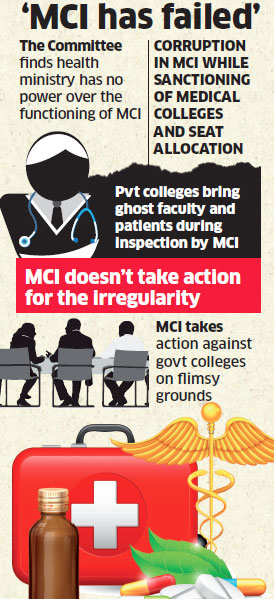
    • MCI has been criticised for being a ‘biased’ organisation, acting ‘against larger public health goals’ and an ‘exclusive club’ of medical doctors from corporate hospitals and private practice. The British Medical Journal (BMJ) and the Parliamentary Standing Committee in their recent report have called for a ‘radical prescription’ to reform the Medical Council of India (MCI) in order to eliminate corruption and lack of ethics in healthcare.
    • SC appointed a three-member committee headed by former Chief Justice of India R M Lodha to oversee MCI.

    Background

    • The MCI was established under the Indian Medical Council Act 1933 and given responsibility for maintaining standards of medical education, providing ethical oversight, maintaining the medical register, and, through amendments in 1993, sanctioning medical colleges has failed to deliver quality and integrity in the health services across India.
    • The Medical Council of India (MCI) is a statutory body entrusted with the responsibility of establishing and maintaining high standards of medical education in India.

    Weaknesses Highlighted by Parliamentary panel

    In its scathing report, the standing committee felt that the MCI has repeatedly failed on all its mandates over the years. The committee noted the following as some of the prominent failures of MCI.

    • Failure to create a curriculum that produces doctors suited to working in Indian context especially in the rural health services and poor urban areas. The committee felt that this has created disconnect between medical education system and health system.
    • Failure to maintain uniform standards of medical education, both at the undergraduate and post-graduate levels.
    • Devaluation of merit in admission, particularly in private medical institutions due to prevalence of capitation fees, which make medical education available only to the rich and not necessarily to the most deserving.
    • Non-involvement of the MCI in any standardized summative evaluation of the medical graduates and post-graduates.
    • Failure to put in place a robust quality assurance mechanism.
    • Very little oversight of PG medical education leading to huge variation in standards.
    • Failure to create a transparent system of medical college inspections and grant of recognition or de-recognition.
    • Failure to oversee and guide the Continuing Medical Education in the country, leaving this important task in the hands of the commercial private industry.
    • Failure to instill respect for a professional code of ethics in the medical professionals and take disciplinary action against doctors found violating the code of Ethics.

    What are the major reforms needed in MCI?

    1. There is a need to restructure the MCI. It should not be an elected body dominated by vested interest but should represent all stakeholders through nomination. The MCI, as presently elected, neither represents professional excellence nor its ethos. The current composition of the Council reflects that more than half of the members are either from 21 corporate hospitals or in private practice.
    2. The MCI currently sets standards for recognition, inspects and licenses medical colleges; overseas Registration and Ethical Conduct of Doctors. It now proposes to undertake accreditation as well. Such concentration of powers creates a serious conflict of interest and provides a fertile ground for misuse of authority. So there is a need to create a transparent system of licensing of medical colleges.
    3. There should be bifurcation of the functions of MCI and recommends that different structures be created for discharging different functions.
    4. There is a need to revisit ICT tools and revisit minimum standards which are required under the act to establish medical colleges.
    5. A code of ethics which is in line with the international standards needs to be developed for the medical professionals to reduce the corrupt practices.
    6. It needs to see a balance between the number of seats available for medical courses at undergraduate and postgraduate level.

    Measures needed to overhaul and revamp MCI

    1. The Parliamentary committee made a number of recommendations to overhaul the system. Some of the important recommendations of the committee are the following,
    2. Doctor – Population ratio in India is 1:1674 as against the WHO norm of 1:1000, hence the government should immediately spell out policy stance in great detail to augment the capacity of production of doctors including specialists and super-specialists at the scale and speed required to meet India’s health needs.
    3. The regulatory framework of medical education and practice should be comprised of professionals of the highest standards of repute and integrity, appointed through a rigorous and independent selection process.
    4. Urgent measures have to be taken to restructure the composition of MCI to encourage diversity so that it does not become an exclusive club of doctors.
    5. Physical infrastructure requirement should be pruned down in such a way that it should have just about 30 to 40 percent standing value in the total assessment of a medical college.
    6. Support to convert district hospitals into medical colleges. If a district hospital is converted into a medical college, it will not only be equipped with specialists of all disciplines, providing the healthcare services across the whole spectrum but will also produce some doctors in its area of operation and will thus help reduce geographical mal-distribution of doctors.
    7. The PG entrance exam should be held immediately after the final MBBS examination so that the graduate doctor could concentrate on practical skills during his internship.
    8. Ethics should be made one of the cornerstones of the syllabus of medical education.
    9. Introduction of Common Medical Entrance Test (CMET) should be done across the nation barring those States who wish to remain outside the ambit of the CMET. A common exit test should be introduced for MBBS doctors.

    Mandate of the Lodha committee

    1. Lodha Committee would have complete authority to oversee all statutory functions under the MCI Act.
    2. All policy decisions of the MCI will need approvals from the Committee. It will also be free to issue remedial directions.
    3. The Committee will function for 1 year, unless a suitable mechanism is brought in earlier by it.
    4. Initially the panel will function for a year, unless suitable mechanism is brought in place earlier which will substitute the said committee.

    Way forward

    • The abysmal doctor-patient ratios in India’s rural areas and poorer districts, the sanctioning of new medical colleges without ensuring trained medical faculty, the failure to produce adequate specialist doctors, and corruption in the conduct of inspections and in granting sanctions to medical colleges have wrecked the MCI’s credibility.So, there is a need to bring back the integrity which MCI has lost over the years.
    • Whether Lodha Committee manages to inculcate the changes needed in MCI or ends up being one of the numerous other attempts at cleaning up the medical education scene remains to be seen.

    References:

  • Liquor Policy of States

    Kerala’s Liquor Policy: What’s wrong with it?

    Recently, the Supreme Court upheld the ‘Liquor-Free Kerala’ policy restricting the serving of liquor to five-star hotels in the State. The apex court ruled that the State governments be given a free hand to curtail or ban public consumption of alcohol to protect public health and nutrition.

    Before we go into details, let’s see the time-line of Kerala’s Excise Policy

    2007 – Kerala govt. started tightening its excise policy to make liquor less-freely available in the state, in the interest of public health. It started a policy where only those hotels that were accorded 3-star or more by Union Govt.’s Ministry of Culture will be given new bar licenses.

    2011 – It further tightened the policy by denying licenses to any hotels that were accorded less than 4-star by Union Govt.’s Ministry of Culture. However, those hotels with existing licenses were accorded amnesty, i.e. they were allowed renewal of licenses even if the hotel’s rating was less than 4-star.

    2014 – Only hotels classed as 5-star and above by Union Govt.’s Ministry of Culture, will be allowed to serve liquor.


    What is Liquor-Free Kerala policy?

    The policy seeks to prohibit the sale and service of alcohol in all public places, except bars and restaurants in five-star hotels. To be precise, only five star hotels are now allowed to serve hard liquor. <Something, which is often confused>

    • Other categories of hotels could supply only beer and wine.
    • Govt-run liquor shops are to be phased out at a rate of 10% a year over the next decade.
    • Toddy is exempt from the ban and the drink has long been part of Kerala’s culture.

    Foreign tourists could be satisfied by beer and wine, while the domestic tourism sector will be the most affected as tourists from other states prefer hard liquor.


    What is the need for bringing such a policy?

    • Kerala accounts for 14% of the country’s liquor consumption.
    • Even, the apex court said that it is well established that consumption of liquor is bad for health of humankind.
    • Alcoholism critically impact the household budgets of the poor & may lead to domestic violence.

    DPSP also requires state to endeavour for prohibition of intoxicating drinks and drugs, due to the well-known ill-effects on standards of living and public health.


    How this ban could impact Kerala’s economy?

    • Kerala earns about $ 3.8 billion/year from tourism, which is likely to be hit by the liquor ban. The state govt. has hiked excise duty on beer to 5% and that on liquor to 8% to offset revenue losses.
    • The job opportunities in the tourism sector will also be get affected because of this policy, as the industry provides one out of four jobs in the state.

    Why there is so much criticism against prohibition?

    • Actually, the policy of prohibition does not encourage the people to quit the habit.
    • It leads to underground trade and creates a market for spurious liquor.
    • As a policy, prohibition has met with little success anywhere in India, due to corruption within enforcement agencies.
    • Even when it has helped bring down overall consumption, prohibition has led to loss of lives in hooch tragedies.

    What is the argument for exempting five-star hotels & why is it criticized?

    • The State govt. has argued that it is in the interest of tourism.
    • However, the Supreme Court’s decision to exempt five-star hotel seems unreasonable and arbitrary.
    • The judgment strikes at the root of non-discriminatory treatment under the constitution.

    Let’s analyse the court verdict vis-a-vis fundamental rights?

    The case is known as The Kerala Bar Hotels Association vs State of Kerala.

    The bar associations have argued that the liquor policy violates Art 19(1)(g) and Art 14.

    Article 19(1)(g) – To practice any profession, or to carry on any occupation, trade or business.

    • However, the liberty to freely carry on any trade or business is subject to reasonable restrictions that may be imposed by state in the interest of general public.
    • This argument fails, since Art 47 requires state to make an endeavour towards improving public health, including to bring about prohibition of the consumption of liquor.

    Art 14 – The State shall not deny to any person equality before the law or the equal protection of the laws within the territory of India.

    • The new excise policy had made an unreasonable classification by separately categorizing hotel of 5-star or more and permitting these hotels to serve liquor in public.
    • Therefore, the policy violates Art 14 of constitution by treating persons on an equal standing unequally.

    What could be the better policy alternative?

    Experts argue that a better idea would be to engage non-state actors to step up the campaign for abstention.

    Suggest some better policy alternatives or share some successful case-studies to curb the consumption of liquor.


    Published with inputs from Pushpendra