💥Join UPSC 2027,2028 Mentorship (August Batch) + XFactor Notes & Microthemes PDF

Subject: Institutional measures

  • Pension Reforms

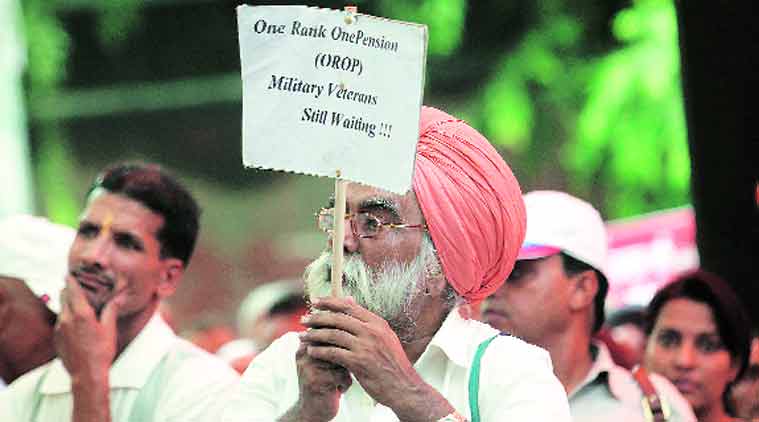
    Everything That You Need to Know on OROP


    • It is a pension scheme for the armed forces personnel which was in existence till 1973.
    • This scheme provided same pension for same rank and for the same length of service irrespective of the date of retirement which was the basis for determining the pension and benefits of the Indian Armed Forces till 1973.
    • OROP was terminated by the government in 1973.

    Which government was in power at that time and who was the PM of India?

    Then came the Koshiyari committee – 

    Bhagat Singh Koshiyari headed a committee which comprised 10 members (an all party parliamentary panel). It was formed in 2011.

    What were the recommendations of the committee?

    1. OROP should be implemented in the defence forces at the earliest and a separate commission should be formed to take decisions on pay allowances, pension, family pension etc. in respect of the defence personnel should be taken into the account by that committee.
    2. The committee recommended to absorb the Armed Forces personnel after their military engagement into other services of government which is a custom in countries like U.S. and China.

    What would be the financial Implications?

    1. Early estimates were around 3000crores for OROP.( by Ministry of Defence)
    2. Revised estimates vary between 8000 to 9000 crores.
    3. According to the Koshiyari committee the estimates for implementation of OROP were around 12000 crores.

    Is OROP expensive for the government?

    1. OROP is affordable by the government as it is a small fraction of the military pension budget.
    2. It includes about 4,00,000 defence civilians.
    3. Defence civilians, which includes the entire civilian bureaucracy in the ministry of defence ,retire at  the age of 60 are mostly based permanently in Delhi and they are not covered by OROP.
    4. It is alleged that they oppose the OROP due to their exclusion from the scheme.

    Government of India on OROP

    1. The government does not subscribe to the definition of Koshiyari committee, but states that there is a need for a new definition of OROP which should be acceptable to all the other ‘stakeholders’.
    2. The stakeholders were neither defined nor identified by the government.
    3. The government stand on the OROP prompted widespread dismay, disappointment and outrage amongst Armed Forces pensioners.
    4. The ministry of defence recommended the proposal for implementation after the approval of the Defence minister.
    5. Now it is with the of the Finance ministry which should make a call on the scheme.
  • BCCI Reforms – Lodha Committee, etc.

    Lodha Committee Report: Restoring the glory of the game

    To put an end to excesses and imbalances, corruption and red tape, all of which have harmed the game, the Lodha committee has examined reforms in the working of the Board of Control for Cricket in India (BCCI) to make its functioning transparent.


    What is the Lodha committee?

    The Lodha committee was formed in January, 2015 by the Supreme Court after the Mudgal committee report on IPL.

    In its earlier report in July 2015, the Lodha committee delivered its judgement by banning Meiyappan and Kundra for life and suspending the owners of Chennai Super Kings and Rajasthan Royals for 2 years.

    Let’s analyse the report under various dimensions

    The Lodha Committee has suggested sweeping reforms in the structuring and governance of cricket in the country.


    Structural Reforms: A major overhaul

    • The committee recommended that a 9-member apex council replace the 14-member BCCI working committee.
    • Each of these office-bearers has a three-year term and can contest for a maximum three terms.
    • The Lodha Committee also calls for dividing the governance into two parts: cricketing and non-cricketing.

    The non-cricketing management will be handled by 6 professional managers headed by a CEO, and the cricket matters like selection, coaching and performance evaluation should be left to the players

    Organisation & Office-bearers: Restrictions imposed

    • Each of these office-bearers has a 3-year term and can contest for a maximum three terms.
    • There will be a mandatory cooling off period after each term. Therefore, no office-bearer can hold office consecutively in a row.
    • No BCCI office-bearer can be Minister or government servant.

    State Cricket Associations: One Vote/State

    The Committee recommended that one association should represent an entire state and only one vote per state.

    Indian Premier League: Maintain distance

    • It recommends separate governing bodies for the IPL and BCCI.
    • There should be a 15-day gap between IPL season and national calender.

    Betting: Legalize it

    • It made a strong recommendation to lawmakers to legalise betting in cricket for all except cricket players, officials and administrators.
    • The players and others banned officials should disclose their assets to BCCI in a measure to ensure that they do not bet.

    Betting is a $ 400 billion phenomenon practised across the globe and lawmakers in India should enact laws to legalise it.

    Fixing: Criminalize it

    The committee said that match-and spot-fixing should be made a criminal offence.

    Conflict of Interest & Corruption

    • One individual hold only one post in cricket administration. The office-bearers would have to choose between positions in respective state associations and the parent body.
    • A former High Court judge should be appointed as ethics officer by the BCCI to administer issues relating to conflict of interest, misdemeanour and corruption.
    • A former Supreme Court judge should be appointed ombudsman to resolve internal disputes.

    Transparency: Bringing RTI to BCCI

    It recommended that the Legislature must seriously consider bringing BCCI within the purview of the RTI Act

    Securing player’s interest

    • It recommended the setting up of a Players’ Association to safeguard the interests of the cricketers.
    • The report said players that are the driving force of the game, but they had been reduced to the status of employees and subordinates of those governing the game.
    • The idea is to give players voice, use their expertise and skills for the development and betterment of the game

    Women Cricket: Often ignored by BCCI

    The Women’s Cricket Committee to be formed to exclusively pay attention to this much ignored department, along with Women’s Selection Committee.

    The proposed measures could radically alter the way the BCCI functions as well as vastly improve its public image and impart much-needed credibility.


    Published with inputs from Pushpendra 
  • Electoral Reforms In India

    Time and again, many electoral reforms have been proposed by various committees, Law Commission and ECI itself. A discussion on these crops up during every election. We’ve tried to comprehensively list the proposed reforms under various sub-headings. A brute-force memorization of all this information is not required. Go through this list so that you have a background while reading news items on Electoral Reforms and ECI.
    I.Amendment to the Constitution of India
    1. Constitutional protection for all members of the Commission.
    2. Budget of the Commission to be ‘charged’ on the CFI.
    3. Independent Secretariat for the Commission.
    II.Electoral Roll Matters
    While Army personnel are allowed to vote, Navy and Airforce are not.
    There are no provisions for overseas electors to vote despite being eligible to do so. Amendments proposed provide the option of proxy voting or postal ballot voting.
    At present, the Electoral Rolls prepared by the Election Commission are not used by the State Election Commissions leading to duplication of effort and errors costing both in terms of time and money. Common Electoral Rolls to be used in local elections was a recommendation endorsed by the Law Commission.
    III.Election Management Issues
    At present, filing false declarations about the background of the candidate attracts penalty under Section 125A of The Representation of the People Act, 1951. The offence is punishable by up to 6 months, or with fine, or with both.
    The Commission has proposed that the punishment under section 125A should be increased to 2 years’ imprisonment without the alternative clause of  fine, and also that the offence should be included in the list of offences listed in sub-section (1) of section 8 which would attract disqualification on conviction irrespective of the term if sentence. The Commission also proposed that furnishing of false affidavit or suspension of material information in the affidavit should also be specified as ground for challenging the election under section 100 (1) of The Representation of the People Act, 1951.
    In S. Subramaniam Balaji vs Govt. Of T.Nadu & Ors, the SC observed that “although, the law is obvious that the promises in the election manifesto cannot be construed as ‘corrupt practice’ under section 123 of The Representation of the People Act, the reality cannot be ruled out that distribution of freebies of any kind, undoubtedly, influences all people. It shakes the root of free and fair elections to a large degree. In this regard the EC has proposed an amendment to RPA, 1951 allowing Adjournment of poll or countermanding of elections on ground of bribery.
    IV.Election Officials and Logistics
    Use of Totalizer Machines
    EVM totalizer can count votes of multiple Electronic Voting Machines (EVMs) simultaneously. This way the results of votes in a group of EVMs can be taken without ascertaining the result in individual EVM corresponding to polling booth.
    As per the present provisions in The Conduct of Elections Rules, 1961, votes in the EVMs are to be counted polling station wise, which leads to situations where voting pattern in various localities/pockets become known to everyone. There is a view that this can result in victimization and/or discrimination and intimidation of electors of particular localities. This issue can be addressed by use of totalizer that can be used for taking out the results of voting in a group of 14 EVMs without revealing the votes in individual EVMs.
    V.Nomination of Candidates
    Contesting the elections from 2 seats  – At present as per RPA 1951, a person is allowed to contest from 2 seats. However it is imperative that he has to vacate one of the two seats should he win both. This leads to holding by-elections which causes inconvenience to voters and financial expenditure. The amendment to RPA 1951 calls for removal of this provision of contesting from 2 seats.
    VI.De- Criminalization of politics
    2. Misuse of religion for electoral gain
    3. Making bribery in elections a cognizable offence
    VII.Reforms relating to Political Parties
    1. De-registration of political parties
    2. Tax Relief for Political Parties
    3. Compulsory Maintenance of Accounts by Political Parties
    4. Accounting and Auditing Report of Political Parties
    5. Form 24A under Rule 85B of The Conduct of Elections Rules, 1961
    6. Prohibition on Anonymous Donations
    7. Sale of Coupons
    8. Maintenance of separate bank accounts by each contesting candidate for poll expenses
    9. Cap on Expenditure by Political Party on a Candidate for election campaign
    10. Ceiling of campaign expenditure by political parties
    11. Limit the Number of Star Campaigners
    12. Time period for maintaining books of account under section 77 of The Representation of the People Act, 1951
    VIII.Election campaign and advertisements
    1. Ban on exit polls and opinion polls
    2. Ban on Government Sponsored Advertisement before elections
    3. Section 126 of The Representation of the People Act, 1951
    4. Paid news in connection with elections
    5. Section 125A of The Representation of the People Act, 1951
    IX.Election Expenses and Election Petitions
    1. Ceiling on Election Expenditure to legislature from Local Authorities’, Graduates’ and Teachers’ Constituencies
    2. Election expenditure in case of adjournment of poll under section 52 of The Representation of the People Act, 1951
    3. Appointment of additional judges in the High Courts
    PDF for proposed electoral reforms –  PROPOSED ELECTORAL REFORMS