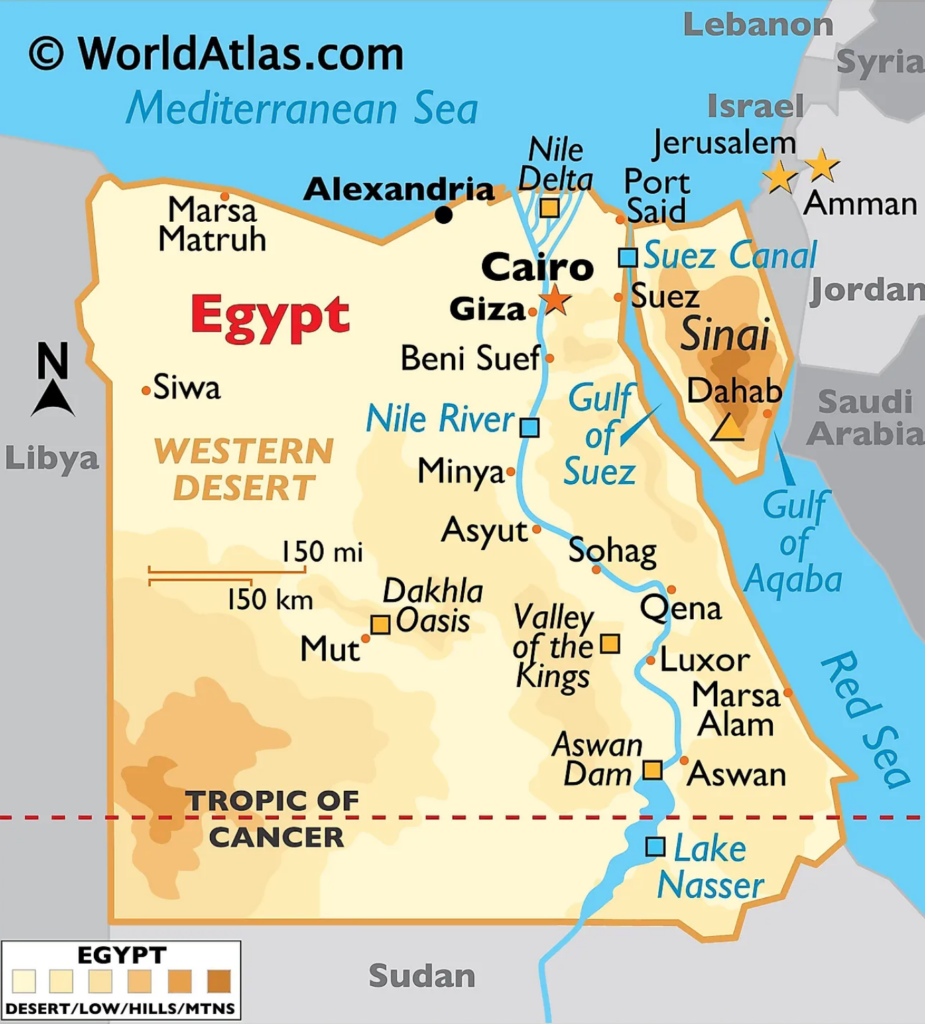
India and Egypt held the 11th Joint Defence Committee (JDC) meeting in Cairo (April 2026)
Aim: Strengthen bilateral defence ties
Key Highlights
1. Defence Cooperation Plan (2026–27)
Expansion of:
Military engagements
Joint training exercises
Defence exchanges
Increased frequency of:
Bilateral military exercises
2. Maritime Security Cooperation
Focus on: Indian Ocean security and Freedom of navigation
Role of: Information Fusion Centre – Indian Ocean Region
First: Navy-to-Navy staff talks held
3. Defence Industry Collaboration
Emphasis on: Co-development and Co-production
India’s defence sector:
Production > $20 billion
Exports ~ $4 billion
4. Air Force Cooperation
Interaction with: Egyptian Air Force leadership
Aim: Strengthen air defence ties
5. Institutional Mechanism
Joint Defence Committee:
Regular dialogue platform
Based on:
2022 MoU on defence cooperation
2023 Strategic Partnership
Strategic Importance
Egypt’s Geostrategic Position Controls: Suez Canal
Key link between: Europe, Asia, Africa
Ensures: Safe sea lanes and Trade security
Promotes:
Indigenous defence exports
Strategic partnerships
Cooperation supports: Stability in West Asia and Africa
[2024] Consider the following statements: Statement-I Sumed pipeline is a strategic route for Persian Gulf oil and Natural gas shipments to Europe. Statement-II: Sumed pipeline connects the Red Sea with the Mediterranean Sea. Which one of the following is correct in respect of the above statements? [A] Both Statement-I and Statement-II are correct and Statement-II explains Statement-I [B] Both Statement-I and Statement-II are correct, but Statement-II does not explain Statement-I [C] Statement-I is correct, but Statement-II is incorrect [D] Statement-I is incorrect, but Statement-II is correct
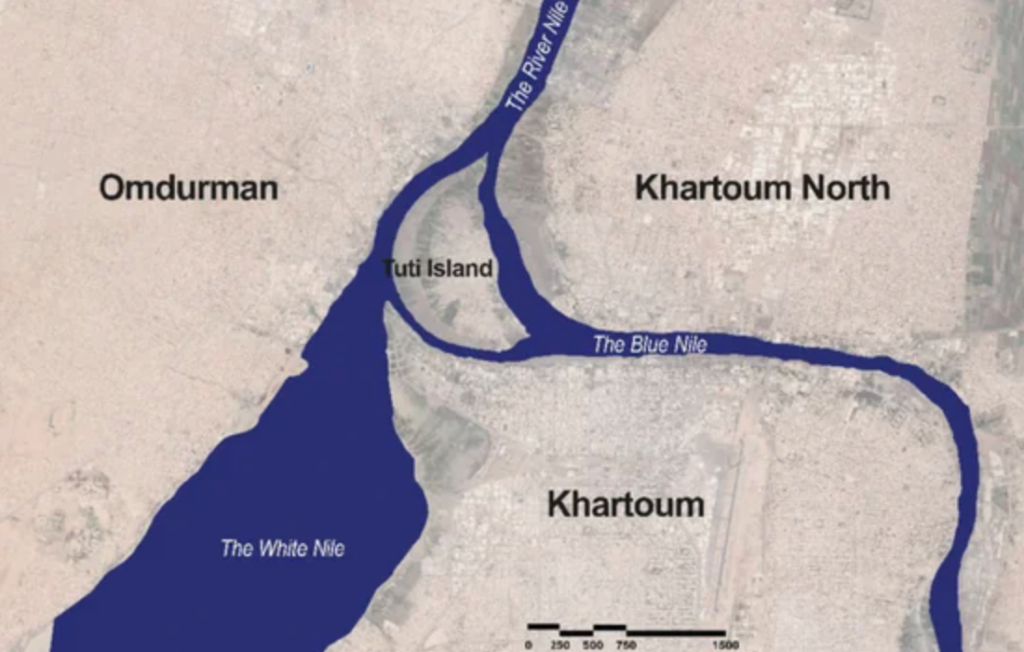
Tuti Island has drawn attention as residents return after a prolonged siege during the Sudan conflict 2023.
Location & Geography
Located in Khartoum
Lies at the confluence of:
White Nile (from Uganda region)
Blue Nile (from Ethiopia)
Forms the River Nile, flowing north to Egypt
Key Features
Crescent-shaped river island
Historically: Agricultural hub supplying fresh produce to Khartoum
Old settlement: Mosque dating back to 1480
Sudan Conflict Context
War between: Sudanese Army and Rapid Support Forces
Timeline
Conflict began: April 2023
Tuti Island siege: June 2023 to March 2025
[2024] Consider the following pairs: Country: Reason for being in the news 1. Argentina: Worst economic crisis 2. Sudan : War between the country’s regular army and paramilitary forces 3. Turkey : Rescinded its membership of NATO How many of the pairs given above are correctly matched? [A] Only one pair [B] Only two pairs [C] All three pairs [D] None of the pairs
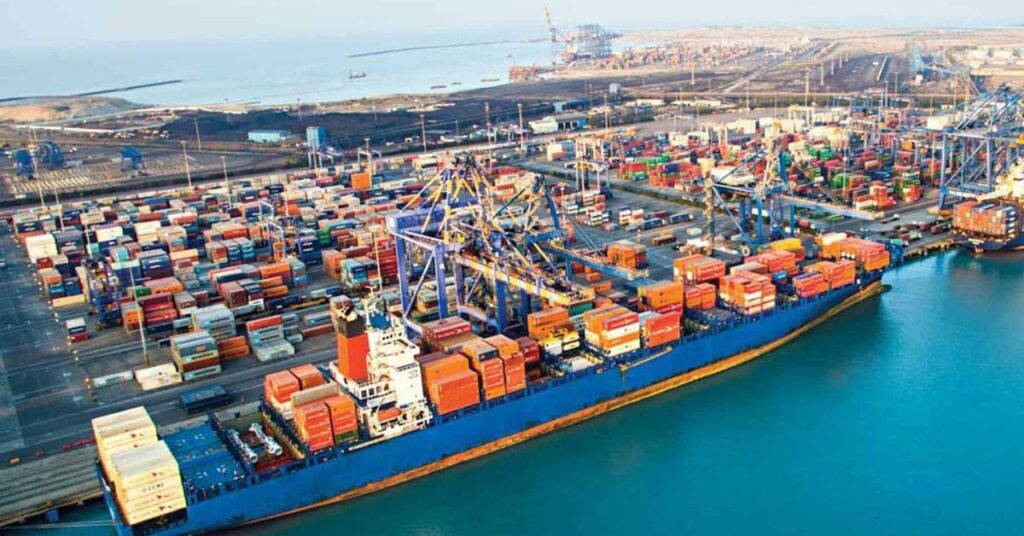
Tamil Nadu (3): Cuddalore, Nagapattinam, Thoothukudi
Andhra Pradesh (2): Kakinada, Krishnapatnam
Odisha (2): Paradip, Dhamra
Immigration Check Posts (ICPs)
Total ICPs in India: 114 (air, sea, land, rail, river routes)
ICPs at seaports: 37
E-Visa Entry Points
Entry allowed through: 32 airports and 33 seaports
About E-Visa
Features
Available to citizens of: 207 countries
Not available for: China, Pakistan, Yemen, Iran
Categories
Tourist, Business, Medical & Medical Attendant, Student, Family, Transit, Miscellaneous, and Production/Investment
Validity
Ranges from: 1 month to 5 years
Difference Between E Visa and Visa on Arrival
E-Visas require an online application and approval before travel, while VoA is obtained upon reaching the destination.
E-visas (like those from India Visa Online) offer more certainty and faster processing, whereas a VoA involves higher risks of delays and potential denial at the border.
Related Development (India-China)
Tourist visas for Chinese nationals resumed after 5 years
Relaxations:
Buddhist pilgrims
Families of diplomats
Direct flights (Delhi–Beijing) resumed
[2023] Consider the following pairs : Port—–Well known as 1.Kamarajar Port—-First major port in India registered as a company 2.Mundra Port—–Largest privately owned port in India 3.Visakhapatnam—-Largest container port in India How many of the above pairs are correctly matched? [A] Only one pair [B] Only two pairs [C] All three pairs [D] None of the pairs
PYQ Relevance[UPSC 2019] What is India’s plan to have its own space station and how will it benefit our space programme?Linkage: The PYQ tests understanding of space governance, future space economy, and strategic autonomy, which directly connects to debates on lunar resource exploitation. It links to global commons vs national interests, as lunar governance (Artemis Accords vs multilateralism) will shape future space missions and infrastructure like space stations.
Mentor’s Comment
The debate on lunar governance has intensified due to the rapid operationalisation of the U.S.-led Artemis programme and associated Artemis Accords, which for the first time enable private extraction and ownership of lunar resources. This marks a sharp departure from earlier norms under the Outer Space Treaty (1967) that treated outer space as the “province of all humankind.” The issue gains urgency as scarce lunar resources, especially water ice at the south pole, are becoming strategically valuable for future missions.
How does current geopolitical conduct undermine credibility in space governance?
Selective adherence to law: Demonstrates inconsistency in upholding international norms; e.g., continued military actions despite scrutiny by the International Court of Justice (ICJ).
Institutional bypassing: Weakens dispute resolution mechanisms; e.g., blockage of appointments to the WTO Appellate Body since 2019.
Due process concerns: Highlights erosion of legal safeguards; e.g., deportation policies criticised by the U.S. Supreme Court.
Humanitarian violations: Undermines moral authority; e.g., findings by International Commission of Jurists and Red Cross on violations in conflict zones.
What are the legal implications of the Artemis Accords on lunar resources?
The Artemis Accords, launched in 2020 and signed by over 60 nations as of April 2026, represent a significant evolution in international space law regarding lunar resources. They establish a principled framework aimed at operationalizing the 1967 Outer Space Treaty (OST) for commercial lunar exploration, primarily focusing on the extraction and utilization of resources.
Resource ownership rights: Enables private possession and sale of extracted resources; backed by U.S. domestic law (2015).
Commercial Extraction: The Accords explicitly affirm that the extraction and utilization of space resources, such as water ice or regolith, does not inherently constitute “national appropriation” under Article II of the OST.
Legal Standing: This allows signatories to authorize their private sector to possess, use, and sell extracted lunar resources, bridging the gap between scientific exploration and commercial mining.
Backed by U.S. Law: This stance aligns with the U.S. Commercial Space Launch Competitiveness Act of 2015, which already granted American citizens rights to own, transport, and sell space resources.
Norm-setting mechanism: Establishes bilateral agreements outside UN framework; risks fragmentation of global norms.
Soft Law Approach: The Accords are non-legally binding political commitments (“soft law”) but function as mandatory requirements for participation in NASA’s Artemis program.
Counter to 1979 Moon Agreement: The Accords ignore the 1979 Moon Agreement’s requirement for an international regime to govern resource exploitation, opting instead for a “first-come, first-served” approach to mining.
Interpretation bias: Expands meaning of “use” under Outer Space Treaty to include commercial extraction.
Redefining “Use”: The Accords interpret the OST’s allowance of the “use” of space to include commercial extraction of resources, whereas historically, this was seen as limited to scientific or operational utilization.
Legal precedent: Creates de facto customary norms without universal consent.
Subsequent Practice: The U.S. and its partners seek to establish “subsequent practice” under the Vienna Convention on the Law of Treaties, which could elevate these principles into customary international law through repeated actions.
Do “safety zones” risk creating exclusionary regimes on the Moon?
Yes, safety zones on the Moon pose a significant risk of creating exclusionary regimes. While designed to prevent harmful interference, safety zones can function as a de facto means of controlling, accessing, and exploiting high-value lunar areas (such as resource-rich polar craters) without requiring formal territorial claims.
Safety zones provision: Prevents harmful interference around operational sites.
De facto territoriality: Enables early movers to control high-value regions without formal sovereignty claims.
Operational Control: These zones enable actors to restrict access, creating a, de facto sovereignty by controlling entry to scientific and economic sites.
Legal Ambiguity: The “due regard” principle of the OST is used to justify these zones. But the lack of a standardized size or definition allows actors to create, large exclusion zones that inhibit the free movement of others.
Resource concentration: Targets scarce locations like lunar south pole water ice.
High-Value Sites: The most strategic locations, water-rich peaks of light and deep, icy craters, are limited. A safety zone around one of these sites can essentially monopolize that resource.
Inequitable access: Limits entry of latecomers, especially developing countries.
Rise of Contested Territory: As nations plan permanent bases, the competition for these, “safe” zones could turn them into, contested, contentious territory, rather than areas for scientific collaboration.
Why is multilateral governance necessary for lunar resources?
Global commons principle: Treats Moon as shared heritage of humanity.
Equitable distribution: Ensures fair access to resources across nations.
Conflict prevention: Reduces risk of geopolitical rivalry in space.
Institutional legitimacy: Strengthens UN-based frameworks like Committee on Peaceful Uses of Outer Space (COPUOS).
What role can the Moon Agreement (1979) play in future governance?
The Moon Agreement (1979), formally the Agreement Governing the Activities of States on the Moon and Other Celestial Bodies, provides a, yet largely underutilized, legal framework for the future of space governance, particularly regarding natural resource exploitation and environmental protection. Although limited by low ratification from major space-faring nations, its principles remain relevant in shaping debates on equitable space use.
International regime framework: The Agreement mandates the establishment of an international regime to govern the exploitation of lunar resources “as such exploitation is about to become feasible”.
This provides a mechanism for establishing rules before a free-for-all scenario occurs, ensuring orderly and safe development.
Collective benefit principle: Ensures benefits are shared globally.
The Agreement designates the Moon and its resources as the “common heritage of mankind” (Article 11). This shifts the focus from competitive exploitation to an equitable sharing of benefits derived from resources, with special consideration for developing nations.
Regulatory gap filling: It fills crucial gaps in the 1967 Outer Space Treaty (OST) regarding the exploitation of celestial resources.
While the OST prohibits national appropriation, it is ambiguous regarding resource extraction. The Moon Agreement clarifies this by establishing a framework for resource management.
The main challenge is its poor adoption, with only 17 or 18 states (as of 2023-2024) party to it, and none being major spacefaring powers (USA, Russia, China).
The rise of non-binding “soft law,” such as the U.S.-led Artemis Accords, demonstrates a shift away from the binding multilateralism of the Moon Agreement towards commercial-friendly frameworks.
Is the emerging space order shifting towards unilateralism?
Power asymmetry: Dominance of technologically advanced nations.
Intensifying Rivalry: The space domain is becoming a primary theater for U.S.-China strategic competition, with Russia also looking to develop asymmetric counterspace capabilities.
Sovereign Constellations: China is expanding its state-directed industrial model through sovereign constellations like GuoWang and Qianfan, aiming to challenge U.S. dominance.
Private sector involvement: Expands corporate influence in governance.
Dominance of Commercial Players: Commercial entities, particularly SpaceX, dominate the launch cadence, commercial, and constellation deployment markets, creating a “monopoly” that pushes other nations to seek sovereign alternatives.
In-Space Operations: The role of private companies is growing, with initiatives like India’s IN-SPACe enabling private sector participation in satellite launches and data analytics.
Minilateralism/Bilateralism: Due to UN gridlock, countries are shifting to agile, “small table” negotiations and minilateral groupings like the QUAD to achieve faster, more flexible results.
Strategic Competition: U.S.-China Rivalry in Space
Weaponized Interdependence: Space is viewed as an “operational battlespace” where critical commercial infrastructure can be used as a bargaining tool.
Nationalization of Space Policy: Nations are increasingly integrating their space programs with national security interests, moving from exploration to defensive-offensive capabilities.
Sovereign Launch Focus: U.S. allies (e.g., Australia, Canada, Spain, Germany) are aggressively funding domestic rocket startups to avoid dependency on American commercial providers, signaling a rise in sovereign-centric space policies.
Conclusion
Unilateral frameworks risk transforming lunar governance into a power-driven regime. A treaty-based multilateral approach remains essential to ensure equity, sustainability, and legitimacy in managing extraterrestrial resources.
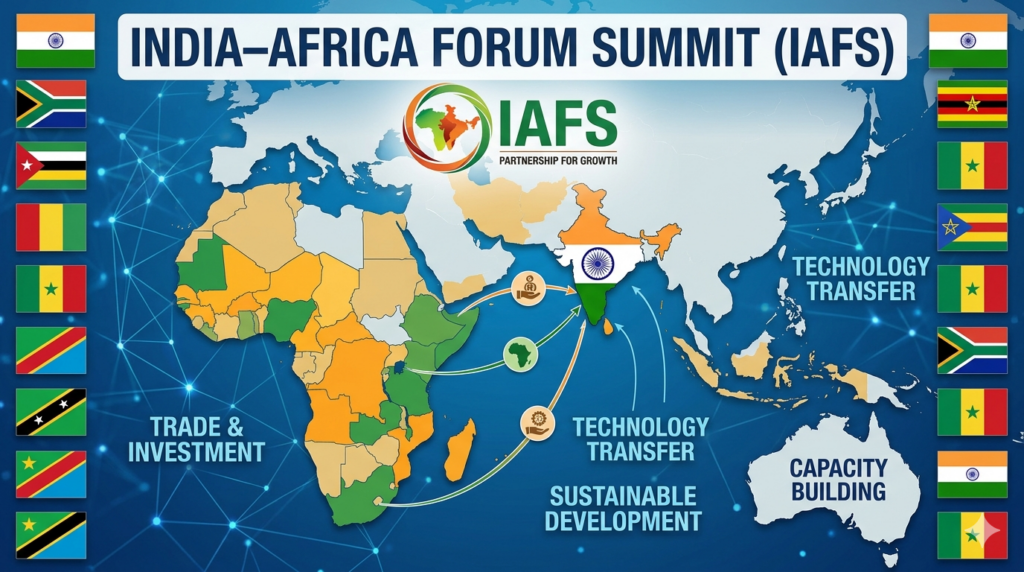
India will host the Fourth India–Africa Forum Summit (IAFS) 2026 after a gap of more than a decade (last held in 2015).
What is IAFS
A platform for cooperation between India and African countries
Brings together: India and Members of the African Union
Timeline
1st IAFS → 2008 (New Delhi)
2nd IAFS → 2011 (Addis Ababa)
3rd IAFS → 2015 (New Delhi)
4th IAFS → 2026 (New Delhi, upcoming)May 28 to May 31, 2026, in New Delhi, India.
Key Focus Areas (2026)
1. Development Cooperation
Infrastructure projects
Capacity building initiatives
2. Education & Skills
Example: IIT Madras campus in Zanzibar
3. Diplomatic Expansion
India has: Opened 16 new missions since 2018
Presence now in: 45 African countries
4. Defence Cooperation
Training and security collaboration
5. Trade & Investment
Shift from: Line of Credit (LoC) to Foreign Direct Investment (FDI)
[2016] Consider the following statements: 1 The India-Africa Summit Held in 2015 2 was the third such Summit Was actually initiated by Jawaharlal Nehru in 1951 Which of the statements given above is/are correct? a) 1 only b) 2 only c) Both 1 and 2 d) Neither 1 nor 2
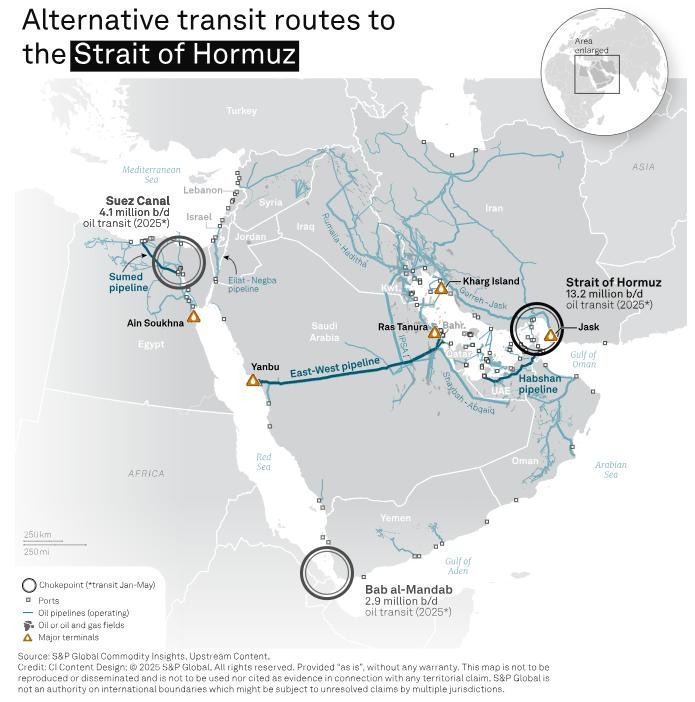
The ongoing West Asia conflict has exposed the vulnerability of the Strait of Hormuz, prompting Gulf countries to build alternative energy routes.
Strait of Hormuz
Located between: Iran and Oman
Connects: Persian Gulf to Arabian Sea
Handles: About 20% of global oil and LNG trade
What Happened
Conflict led to: Severe disruption of shipping
Demonstrated: Iran’s ability to block the chokepoint
Triggered: Global energy concerns
Why It Matters
1. Global Energy Security
Disruption affects: Oil supply and LNG supply
Leads to: Price spikes
2. Strategic Vulnerability
Overdependence on a single chokepoint
Risk to global supply chains
Gulf Countries’ Response
1. Pipeline Expansion
Aim: Bypass Hormuz
Reduce maritime dependence
2. Port Diversification
Increase exports via the Red Sea, Gulf of Oman, and Mediterranean routes
3. Regional Cooperation
Even rival countries: Collaborating for energy security
Key Pipelines (Important)
Operational
Saudi East–West Pipeline: From Persian Gulf to Red Sea (Yanbu)
Abu Dhabi Crude Oil Pipeline (ADCOP): From Habshan to Fujairah (bypasses Hormuz)
Potential / Revival Projects
Iraq–Turkey Pipeline (Kirkuk–Ceyhan)
Basra–Aqaba Pipeline (Iraq–Jordan)
Iraqi Pipeline through Saudi Arabia (IPSA)
Trans-Arabian Pipeline
[2024] Consider the following statements: Statement-I Sumed pipeline is a strategic route for Persian Gulf oil and Natural gas shipments to Europe. Statement-II: Sumed pipeline connects the Red Sea with the Mediterranean Sea. Which one of the following is correct in respect of the above statements? [A] Both Statement-I and Statement-II are correct and Statement-II explains Statement-I [B] Both Statement-I and Statement-II are correct, but Statement-II does not explain Statement-I [C] Statement-I is correct, but Statement-II is incorrect [D] Statement-I is incorrect, but Statement-II is correct [2018] Consider the following pairs : Towns sometimes mentioned in news Country 1. Aleppo: Syria 2. Kirkuk: Yemen 3. Mosul: Palestine 4. Mazar-i-sharif: Afghanistan Which of the pairs given above are correctly matched? [A] 1 and 2 [B] 1 and 4 [C] 2 and3 [D] 3 and 4
India extended OCI card eligibility to the 6th generation of the Indian-origin community in Sri Lanka.
Announced during the visit of C. P. Radhakrishnan.
What is OCI (Overseas Citizen of India)
A form of long-term visa status for persons of Indian origin
Not full citizenship, but provides:
Multiple-entry lifelong visa
Exemption from police reporting
Parity with NRIs in certain fields
Key Update
Earlier eligibility: Up to 4th generation
Now extended to: 5th and 6th generation (Sri Lanka specific)
Based on documents issued by Sri Lankan authorities
How “Generation” is counted
It is counted family-wise (lineage):
1st generation → Person born in India (original ancestor)
2nd generation → Child of that person
3rd generation → Grandchild
4th generation → Great-grandchild
5th generation → Next generation after that
6th generation → Further descendant
Significance
1. Diaspora Outreach
Benefits: Indian-origin Tamil community (~7% of Sri Lanka population)
Strengthens cultural and historical ties
2. India–Sri Lanka Relations
Reinforces: Neighbourhood First Policy
Builds goodwill and trust
3. Strategic Diplomacy
India positioning as: First responder in region
Seen in: 2022 Sri Lankan economic crisis support
[2021] With reference to India, consider the following statements: 1. There is only one citizenship and one domicile. 2. A Citizen by birth only can become the Head of State. 3. A foreigner once granted the citizenship cannot be deprived of it under any circumstance. Which of the statements given above is/are correct? [A] 1 only [B] 2 only [C] 1 and 3 [D] 2 and 3
A seemingly routine blockade of a shipping strait triggered widespread industrial unrest across major manufacturing hubs like Manesar, Noida, and Ghaziabad, exposing deep-rooted worker dissatisfaction. The scale is significant: over 2,500 km away, a global disruption translated into local wage protests, highlighting the fragile linkage between global supply shocks and domestic labour distress. The data reveals a persistent and rising trend of wage complaints, peaking at 4,240 cases in 2023-24, indicating systemic failure in wage enforcement despite legal frameworks.
How did a global disruption trigger local labour unrest?
Global Supply Shock: Blockade of a key shipping strait disrupted supply chains, raising input costs.
Local Impact: Workers in industrial hubs faced real wage erosion, triggering protests.
Supply Chain Disruptions: Delays in raw material availability affected production cycles and wage payments.
Global-Local Linkage: External shocks translated into domestic inflation, intensifying labour distress.
Why is wage non-payment a persistent structural issue?
Rising Complaints: Wage-related complaints increased from 2,859 (2020-21) to 4,240 (2023-24).
Legal Weak Enforcement: Only 132 challans (2023-24) issued despite high complaints.
Partial Redressal: Full salary paid in only 2,451 cases (2023-24), indicating gaps in enforcement.
Informalisation and Lack of Evidence: Approximately 92% of India’s labour force is unorganised. Many workers lack formal contracts or digital payment records, making it difficult to prove wage theft in quasi-judicial forums.
Economic Pressures on Employers: Shocks such as the COVID-19 pandemic and GST transition disproportionately affected MSMEs, who are the primary employers of unskilled labor.
Institutional Capacity Issues: Labour departments face limitations in inspection and grievance redressal.
How has inflation worsened worker vulnerability?
Wage-Inflation Gap: Wage growth at 3.9% (2025) vs inflation at 5.4% (2023-24).
This wage-inflation mismatch means that even if a worker receives a nominal raise, their ability to afford the same basket of goods has actually declined.
Declining Real Income: Workers’ purchasing power reduced significantly. Recent analysis indicates that when adjusted for inflation, wages for regular salaried workers in India have essentially remained stagnant since 2019.
Essential Costs Surge: LPG price rise disproportionately impacted urban informal workers. For urban informal workers, the sharp rise in rents and transport costs further tightens this consumption stress.
Consumption Stress: Higher spending on essentials, reduced savings and financial security.
Why is the informal sector at the centre of unrest?
Dominant Workforce: Large share employed in unincorporated, non-agricultural enterprises.
Wage Stagnation Amid Inflation: Annual nominal wage growth for informal workers fell to 3.9% in 2025, a sharp decline from 13% in the 2023-24 period. This slow growth fails to keep pace with the rising costs of essentials like housing, food, and LPG.
Job Losses: Employment fell to 74.5 lakh (2025) from 1.1 crore (2024).
Massive Job Volatility: While the sector added 1.1 crore jobs in 2024, job creation slowed by 32% in 2025, adding only 74.5 lakh positions. Unincorporated manufacturing, in particular, saw a contraction of 4.7% in mid-2025.
Structural Disconnect (The “Dwarfism” Paradox): Approximately 86% of informal enterprises are “Own Account Enterprises” (one-person operations) that lack access to formal credit and technology. This keeps them in a cycle of low productivity and high vulnerability to shocks like trade disputes or policy shifts.
Lack of Social Security: Absence of formal contracts and benefits increases vulnerability.
Precarious Employment: High job insecurity and irregular income patterns fuel dissatisfaction.
What role did policy expectations and misinformation play?
WhatsApp Forwards: Claims of rising minimum wages created expectations.
Viral messages regarding a rumored ₹20,000 flat minimum wage under the new Labour Codes triggered widespread expectations and subsequent anger when they didn’t materialize.
Delayed Implementation: Wage hikes under Labour Codes not immediately realized.
Expectation-Reality Gap: Triggered frustration among workers.
Information Asymmetry: Lack of clear official communication created confusion.
Policy Credibility Issues: Delay in execution reduced trust in government announcements.
How have working conditions aggravated the crisis beyond wages?
Working conditions have turned the wage crisis into a broader human rights issue by treating labor as an expendable resource. When workers are forced to work longer for no extra pay in unsafe environments, the “real cost” of their labor increases while their “real income” vanishes.
Excess Working Hours: Workers report 10-12 hours/day vs official 8 hours.
The Overtime Pay “Ghost”: Despite clear mandates in the Factories Act for double wages for overtime, enforcement is nearly non-existent. In 2023-24, the discrepancy between reported extra hours and actual payroll records highlights a massive “hidden” wage theft.
Safety Concerns: Lack of workplace safety and basic facilities highlighted.
Workplace Exploitation: Reports of ill-treatment and denial of dignity at workplace.
Regulatory Blind Spots: Labour inspections have largely shifted toward “self-certification” or “web-based random inspections.” This reduced physical oversight allows employers in small-scale factories and services to bypass safety and hour regulations with minimal risk of being caught.
Why did protests spread geographically and sectorally?
The “Demonstration Effect”: A massive 35% minimum wage hike in Haryana (April 2026) acted as a catalyst. Workers in neighbouring Noida (Uttar Pradesh), earning nearly ₹4,000-₹6,000 less for similar industrial work, mobilized to demand parity, leading to city-wide unrest.
Spillover Effect: Protests that began in major hubs like Manesar quickly moved to Faridabad, Noida, Ghaziabad, and Panipat. This was fueled by workers observing successful wage notifications in adjacent districts or states, creating a chain reaction across the National Capital Region (NCR) and beyond.
Union Unity: The Bharat Bandh (February 12, 2026) saw an estimated 300 million participants across 600 districts. This was led by a joint forum of 10 Central Trade Unions and the Samyukt Kisan Morcha (SKM), linking industrial labor issues with agrarian distress.
Multi-Sector Involvement: In Noida, the movement transitioned from a purely industrial strike to a broader labor rights movement when domestic workers joined factory laborers to protest extreme income inequality and lack of dignity at the workplace
Common Grievances: Wage insecurity, inflation pressure, poor conditions.
Network Mobilisation: Worker networks and unions facilitated rapid spread.
Regional Pattern: Similar protests observed earlier in Bawal, Bihar, and Panipat.
Conclusion
Labour unrest reflects structural imbalances in wage growth, enforcement, and working conditions. Addressing these requires synchronized policy action on wages, inflation, and labour rights.
PYQ Relevance
[UPSC 2024] Discuss the merits and demerits of the four ‘Labour Codes’ in the context of labour market reforms in India. What has been the progress so far in this regard?”
Linkage: The PYQ tests labour reforms, wage regulation, and enforcement gaps in India’s labour market (GS-3 Economy). It is directly linked to the article’s issues of delayed Labour Code implementation, wage insecurity, and rising industrial unrest.
India responded to investigations by the United States Trade Representative under Section 301 on forced labour and excess capacity.
Key Points
Section 301: US law to investigate unfair trade practices and impose tariffs.
India on Forced Labour: India has ratified International Labour Organization conventions:
Forced Labour Convention, 1930
Abolition of Forced Labour Convention, 1957
India on Excess Capacity: Economy is largely domestic demand driven
Export to GDP ratio about 12 percent
Trade Surplus Argument: Trade surplus is a normal outcome of global trade
Based on comparative advantage
US Concerns: Overcapacity affecting US jobs and industries
India’s Counter
India accounts for only about 3.1 percent of US imports
Limited role in US trade deficit
[2018] International Labour Organization’s Conventions 138 and 182 are related to: (a) Child labour (b) Adaptation of agriculture practices to global climate change (c) Regulation of food prices and food security (d) Gender parity at the workplace