💥Mains Ready By December. Smash Mains & Smash PYQ Admissions Open

Subject: International Stories of Key Importance

  • [op-ed snap] What Brexit means for the EU and its partners

    Context

    On January 31, 2020, the United Kingdom left the European Union, the EU project will be taken forward by the 27 member states.

    A structured exit

    • Minimum disruption:  This is largely thanks to the Withdrawal Agreement that was negotiated with the U.K., which enabled “an orderly Brexit”.
      • One that, at least for now, minimises disruption for our citizens, businesses, public administrations, as well as for our international partners.
    • An arrangement of the transition period: Under this agreement, the EU and the U.K. agreed on a transition period, until the end of 2020 at least.
      • During which the U.K. will continue to participate in the EU’s Customs Union and in the Single Market, and to apply EU law, even if it is no longer a Member State.
      • During this period, the U.K. will also continue to abide by the international agreements of the EU, as we made clear in a note verbale to our international partners.

    Building a new partnership between the EU and the UK

    • Degree of continuity: With the transition period in place, there is a degree of continuity. This was not easy given the magnitude of the task.
      • By leaving the Union, the U.K. automatically, mechanically, legally, leaves hundreds of international agreements concluded by or on behalf of the Union.
    • Building new partnership: That work will start in a few weeks as soon as the EU 27 Member States have approved the negotiating mandate proposed by the European Commission, setting out our terms and ambitions for achieving the closest possible partnership with a country which will remain EU’s ally, partner and friend.
    • Links and shared values: The EU and the U.K. are bound by history, by geography, culture, shared values and principles and a strong belief in rules-based multilateralism. Our future partnership will reflect these links and shared beliefs.
    • Working on topics beyond trade: Both sides want to go well beyond trade and keep working together on security and defence, areas where the U.K. has experiences and assets that are best used as part of a common effort.
    • Cooperation on the wide topics: In a world of big challenges and change, of turmoil and transition, we must consult each other and cooperate, bilaterally and in key regional and global fora, such as the United Nations, the World Trade Organization, the North Atlantic Treaty Organization or the G20.
    • Collective responses to handle global challenges: Today’s global challenges- from climate change to cybercrime, terrorism or inequality — require collective responses.
      • The more the U.K. is able to work in lockstep with the EU and together with partners around the world, the greater would be chances of addressing these challenges effectively.

    Way forward

    • Continuing project forward as 27: At the very core of the EU project is the idea that it is stronger together; that pooling resources and initiatives is the best way of achieving common goals. Brexit does not change this, and efforts must be taken to continue this project forward as 27.
    • Note for the partners: EU’s partners can be sure that EU will stay true to an ambitious, outward-looking agenda-be it on trade and investment, on climate action and digital, on connectivity, on security and counter-terrorism, on human rights and democracy, or on defence and foreign policy.
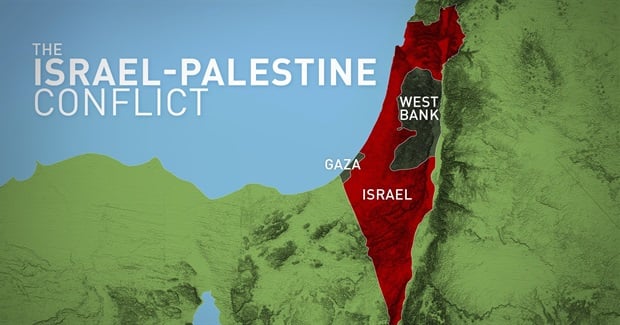
     

  • Explained: West Asia Peace Plan

    With West Asia Peace plan US plans to revive the stalled two-state talks between the Israelis and the Palestinians. Israeli PM Benjamin Netanyahu, who had earlier spoken against the two-state solution, has accepted the Trump plan.

    West Asia Peace Plan

    The West Asia peace plan unveiled by U.S. President Trump seeks to give the Israelis what they have long wanted — an expansive state with Jerusalem as its “undivided capital” and tight security control over a future Palestinian state.

    What’s the plan about?

    • The Trump plan seeks to address most of the contentious issues in the conflict such as the border of Israel, status of Palestinian refugees, Jewish settlements on the West Bank, land swap between Israel and Palestine, Israel’s security concerns and the status of the city of Jerusalem.
    • However US have proposed to almost all of these issues favour the Israeli positions.
    • For example, Israel would be allowed to annex the Jewish settlements on the West Bank as well as the Jordan Valley.
    • The Palestinian refugees, who were forced out from their homes during the 1948 Arab-Israeli war that followed the declaration of the state of Israel in the historic Palestine, would not be allowed to return.
    • They could move to the future Palestinian state, be integrated into the host countries or settled in other regional countries.

    Jerusalem: The undivided Capital

    • Jerusalem, perhaps the most contentious issue, would be “the undivided capital” of Israel, with Palestine gaining its capital in the east of the city — beyond the security border Israel has already built.
    • In return, Israel would freeze further settlement activities on the West Bank for four years — the time for negotiations.

    Land Swap

    • According to the Oslo Accords, the West Bank was divided into three areas and only one of them is under the direct control of the Palestinian Authority.
    • The plan proposes some land swap for the Israeli annexation of the West Bank Jewish settlements.
    • It seeks to enlarge Gaza and connect the strip with the West Bank through a tunnel.
    • The Arab towns in the southeast of Israel, which are close to Gaza, could become part of a future Palestinian state.

    Curb on Hamas

    • During this period, the Palestinian Authority should dismiss its current complaints at the International Criminal Court against Israel and refrain itself from taking further actions.
    • It should also crack down on “terrorist” groups such as Hamas and the Islamic Jihad.

    Investment Plans

    • US has also proposed $50 billion in investment over 10 years should Palestine accept the proposals.
    • In the final settlement, Palestine would get control over more land than what it currently controls.

    Implications for Palestine

    • The Palestine position is backed by most of the world powers is the formation of an independent, sovereign Palestinian state based on the 1967 border.
    • It means the whole of the West Bank and the Gaza Strip with East Jerusalem as its capital including the Old City that houses Haram esh-Sharif, also known as Temple Mount, a holy site for both Muslims and Jews.
    • Issues like the right of return of the Palestinian refugees are to be settled in final negotiations.
    • But US has effectively rejected the Palestinian claims outright and asked them to make more compromises.
    • He seeks to give Jerusalem and about 30% of the West Bank to the Israelis and has denied the right of return of the Palestinian refugees.
    • And for this, the Palestinians should take action against militant groups, stop supporting Palestinian families of those jailed or killed by Israel and refrain itself from questioning the occupation in international fora.
  • Oslo Peace Accord


    Palestinian officials threatened to withdraw from key provisions of the Oslo Accords, which define relations with Israel, if U.S. President Donald Trump announces his Middle East peace plan next week.

    The Oslo Peace Accord

    • The Oslo Accords were a landmark moment in the pursuit of peace in the Middle East.
    • Actually a set of two separate agreements signed by the government of Israel and the leadership of the Palestine Liberation Organization (PLO)—the militant organization established in 1964 to create a Palestinian state.
    • The negotiations between Israel and the PLO that ultimately led to the Oslo Accords began, in secret, in Oslo, Norway, in 1993.
    • The Oslo Accords were ratified in Washington, D.C., in 1993 (Oslo I) and in Taba, Egypt, in 1995 (Oslo II).
    • Sometimes called Oslo II, the interim agreement set out the scope of Palestinian autonomy in the West Bank and Gaza.
    • The interim pact was only supposed to last five years while a permanent agreement was finalised but it has tacitly been rolled over for more than two decades.

    A final nail in the coffin

    • World powers have long agreed that Jerusalem’s fate should be settled through negotiations between Israel and the Palestinians.
    • The Palestinians see east Jerusalem as the capital of their future state and believe Trump’s plan buries the two-state solution that has been for decades the cornerstone of international Middle East diplomacy.
  • ICJ ruling on Rohingyas


    • The International Court of Justice (ICJ) ruled that Myanmar must take effective measures to protect its Rohingya Muslims, including protecting evidence relating to allegations of genocide.
    • It is important to note that these directions are “provisional measures” until the ICJ can finally decide if Myanmar has been committing genocide against the Rohingya. The final verdict could take years.

    What is the case against Myanmar?

    • Last year, the Republic of the Gambia moved the ICJ against Myanmar over alleged violations of the Convention on the Prevention and Punishment of the Crime of Genocide.
    • The Gambia urged the ICJ to direct Myanmar to stop the genocide, ensure that persons committing genocide are punished, and allow the “safe and dignified return of forcibly displaced Rohingya”.
    • The Gambia and Myanmar are parties to the Genocide Convention that allows a party to move the ICJ for violations.
    • Disputes between the Contracting Parties are settled according to Article 9 of the Genocide Convention.

    How did Myanmar respond?

    • Myanmar asked the ICJ to remove the case from its list, citing lack of jurisdiction of the court.
    • Myanmar alleged that the proceedings before the court were instituted by the Gambia, not on its own behalf, but rather as a “proxy” and “on behalf of” the Organisation of Islamic Cooperation (OIC).
    • Gambia is a member of the OIC, which includes 53 Muslim-majority nations.
    • Myanmar cited the Gambia’s reliance on OIC documents to allege genocide and said the Gambia did not point to specific violations of the Genocide Convention.
    • The court refused to accept Myanmar’s argument and said the fact that the Gambia “may have sought and obtained the support of other States or international organizations in its endeavour” does not take away from its right to bring a case against Myanmar.

    Does the ICJ ruling indict Myanmar?

    • Although a ruling against Myanmar dents its image internationally, the order of provisional measures does not translate into a finding against Myanmar.
    • While granting provisional measures, the court is not required to ascertain whether Myanmar violated the Genocide Convention.
    • The court found that it is sufficient at this stage “to establish prima facie the existence of a dispute between the Parties relating to the interpretation, application or fulfillment of the Genocide Convention”.
    • Myanmar leader Aung San Suu Kyi’s personal appearance before the ICJ to lead the defence of the military, however, shows the great stakes her country had in the case.

    Effects of non-compliance for Myanmar

    • For its part, Myanmar has denied that its military or paramilitary has participated in genocide of Rohingya and it is unlikely to alter its position.
    • Provisional measures are essentially a restraining order against a state when a case is pending and can be seen as, at most, a censure.
    • Provisional orders cannot be challenged and are binding upon the state.
    • However, limitations in enforcing decisions of the ICJ are widely acknowledged by law experts.

    What are these limitations?

    • As per Article 94 of the Charter of the United Nations, all member states are required to comply with decisions of the ICJ.
    • However, any action by a state can be secured only through consent of the state in international law.
    • When a state fails to comply, the Security Council has the power to impose sanctions against it and ensure compliance when international security and peace are at stake.
    • So far, the Security Council has never taken a coercive measure against any country to get an ICJ ruling implemented.
    • Even with the stepping in of the Security Council, there are several hurdles in enforcement of ICJ decisions.
    • Any one of the five permanent members of the Security Council with veto powers can block the enforcement of an ICJ decision against itself or its ally.
  • Henley Passport Index 2020

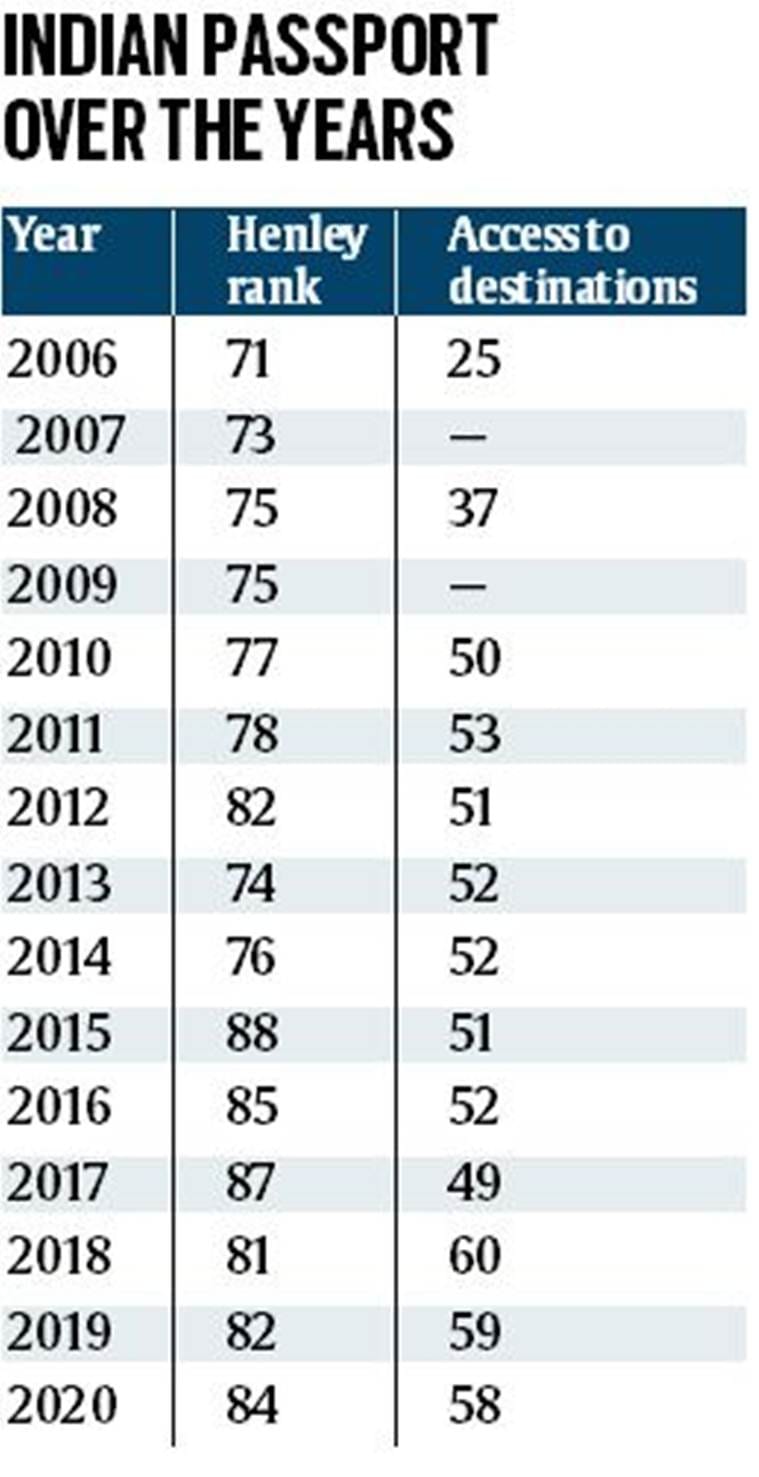
    The Indian passport is closer to the bottom, ranked 84th in the world, according to the 2020 edition of the Henley Passport Index.

    Henley Passport Index

    • According to Henley & Partners publishes the ranking and the Index of the world’s passports “according to the number of destinations their holders can access without a prior visa”.
    • The ranking is based on data from the International Air Transport Association (IATA), a trade association of some 290 airlines, including all major carriers.
    • The index includes 199 different passports and 227 different travel destinations.
    • The data are updated in real time as and when visa policy changes come into effect.

    India’s performance

    • Since the index began in 2006, the Indian passport has ranked in a band of 71st to 88th. (The number of passports ranked has, however, varied from year to year.)
    • The Indian passport’s 2020 ranking of 84th translates into visa-free access to 58 destinations, including 33 which give Indians visas on arrival.
    • It ranked higher in both 2019 (82, with visa-free access to 59 destinations) and 2018 (81, with visa-free access to 60 destinations).
    • Twenty of the 58 visa-free access destinations in the 2020 list are in Africa, and 11 each in Asia and the Caribbean.
    • Serbia is the only European country to which Indian passport holders can travel visa-free. There is no major or developed country to which Indian passport holders have visa-free access.

    Global performance

    • The top 10 most powerful passports this year are ranked in this order: Japan, Singapore, South Korea, Germany, Italy, Finland, Spain, Luxembourg and Denmark.
    • Japan has been topping the Index for three straight years; according to the 2020 index, its citizens are able to access 191 destinations without having to obtain a visa in advance.
    • Afghanistan at rank 107 is the weakest.
    • Singapore, in second place (same as in 2019), has a visa-free/visa-on-arrival score of 190.
    • Germany is No. 3 (same position as in 2019), with access to 189 destinations; it shares this position with South Korea, which dropped from the second place it held a year ago.
    • The US and the UK have been falling consistently over successive Indices.
  • [op-ed snap] Iran’s tightrope

    Context

    In the aftermath of recent events, Iran needs a new compact to deal with the domestic crisis and also a framework to deal with the US.

    The threat of “regime change” in Iran

    • The US policy-The temptation for a policy of “regime change” in Iran has never disappeared from the US policy towards Iran.
      • The policy is based on the hope that mounting external pressure and deepening internal dissent will combine to produce a “regime collapse” in Tehran.
      • US President has often insisted that he is not seeking to overthrow the clerical regime in Tehran led by Ayatollah Ali Khamenei.
      • The Us demands were an end to the nuclear and missile programmes, stop supporting terror in the region and end the interference in the internal affairs of its Arab neighbours.
    • Iran’s success in fending off these threats: Iran has been successful so far in fending off these external and internal challenges.
      • Iran has put down repeated mass uprisings and neutered attempts from within the elite to reform the system.

    De-escalation of the tension after the war-like situation

    • Fear of escalation: The widespread assessment after the killing of Soleimani was that Iran would inevitably escalate the confrontation.
      • Tehran set up a token retaliation for domestic political consumption and quickly called for de-escalation.
    • The message of peace from the US: Trump also told the Iranian leaders that America “is ready to embrace peace with all who seek it”.

    The shooting of a passenger jet and the aftermath 

    • The shooting of the jet:
      • The Ukrainian passenger jet was shot-down near Tehran killing all 176 passengers and crew on-board.
      • It included 82 Iranian nationals and many Canadian citizens of Iranian origin
    • After initial denial, Tehran was forced to accept responsibility for shooting down the plane.
    • The aftermath of the shooting of the plane
      • Protests: Soon after the confession, protests broke out against the government.
      • Demand for accountability: Iranians are angry at the attempt of the government to cover up initially and are demanding full accountability.

    The general discontent of the people against the government

    • The latest round of protests must be seen as a continuation of those that have raged since the end of 2017.
    • Reasons for the discontent: Economic grievances, frustration with widespread corruption, demands for liberalising the restrictions on women and political opposition to the regime are the reasons.
    • Discontent against external adventures: There was also strong criticism of the government’s costly external adventures in the Middle East amidst the deteriorating economic conditions.
      • There is little love for the Revolutionary Guards, the principal face of state oppression.
    • External pressure: As the regime cracks down on the protests against the airliner shooting, the external pressures against Iran are only likely to mount.

    Available option and their dangers

    • As sanctions squeeze the Iranian economy, the costs of regional overreach become apparent, and internal protests become persistent, Khamenei has few good options.
    • The option of the new political compact: Offering a new political compact to the people of Iran or a new framework to deal with the Arab neighbours and the US would seem reasonable goals.
      • But they involve considerable risk for the regime.
    • The option of pragmatism: All revolutionary regimes come to a point when they need to replace ideological fervour with pragmatism.
      • But the change from ideological fervour to pragmatism is also the time of the greatest vulnerability for the regime.

    Conclusion

    India as a friend of Iran will surely begin to debate if privately, the implications of the deepening regime crisis in Iran.

  • UAE’s new 5-year visa scheme

    The United Arab Emirates (UAE) has announced a five-year multiple-entry visa scheme for all nationalities, in a move that is geared towards promoting tourism in the country.

    What is UAE’s new visa scheme?

    • According to the Dubai-based Gulf News, prior to this, tourists could get single or multiple-entry visas for a duration of 30 or 90 days.
    • In the new five-year multiple-entry system, visa holders may be allowed to stay for six months at a stretch.
    • The details of the scheme are yet to be announced. The country’s Federal Authority for Identity and Citizenship will be implementing the decision.
    • Travellers from Africa, some South American countries, Arab states outside the Gulf, and European states from outside the European Union and the former Soviet Union previously needed visas.
    • The UAE currently receives more 2.1 crore tourists annually, and has recently increased its pace of rolling out policies to boost its trade and tourism sectors.

    Other reforms

    • In July 2019, the UAE allowed women employed in the country to sponsor work permits for their husbands, fathers, and adult children, and reduced the fees for obtaining work permits by 50 per cent to 94 per cent for 145 services and transactions.
    • In the same month, the Emirate of Dubai said it would accept the Indian rupee (INR) for transactions at duty-free stores.
  • [op-ed snap]The U.S. is weakened by Soleimani’s killing

    Context

    Targeted killing of powerful Iranian Major-General could have done more bad than good for the U.S.

    Series of events after the assassination

    • The Iraqi parliament voted to expel the U.S. troops stationed in Iraq and deny them access to its airspace, land or water.
    • Pro-Iranian groups could attack across the region where thousands of U.S. troops and official personnel are stationed.
    • Soleimani’s assassination has awakened the deep strain of Iranian patriotism.
    • And Iran is not alone.
    • In Beirut, Hezbollah leader Hassan Nasrallah called Soleimani the “glue that held the Resistance Axis together”.
    • The U.S threat of striking “52 Iranian sites” did not win the U.S. any support on the international stage.
    • Even the Europeans, otherwise steadfast with the U.S. in these sorts of adventures, hesitated.
    • Arab League’s Secretary-General Ahmed Aboul Gheit expressed concern over the situation and asked for calm.
    • This is the same man who had, only a few weeks ago, accused Iran of sowing chaos in the region.
    • It is likely that China and Russia will table a resolution at the UN that calls for calm as well as criticises the U.S.
    • This will certainly be vetoed by the U.S.

    Desperate and irrational policy

    • Till now the U.S. has not been able to extricate itself from its illegal war against Iraq.
    • That war provided a massive advantage to Iran not only in Iraq but also across the region.
    • This is what terrified two of the U.S.’s allies, Israel and Saudi Arabia, both of whom pressured Washington to increase its threats against Iran.
    • S. create the conditions for the rise of the worst kind of violence in Iraq, and later Syria
    • It also weakened the strategic position of its allies.
    • No attempt by the U.S. to regain its authority has worked.
    • The U.S. policy against Iran and Iraq appear desperate and irrational.

    Conclusion

    • The U.S recklessness has isolated it further and deepened anxieties amongst its increasingly isolated regional allies, Israel and Saudi Arabia.
  • What is Jus Cogens?

    The US has threatened to target few historical sites if Iran retaliates to attack US in revenge. This is a breach of JUS COGENS as targeting cultural sites amounts to a a war crime.

    Jus Cogens

    • The jus cogens rules have been sanctioned by the Vienna Conventions on the Law of Treaties of 1969 and 1986. According to both Conventions, a treaty is void if it breaches jus cogens rules.
    • Jus Cogens or ius cogens, meaning “compelling law” in Latin, are rules in international law that are peremptory or authoritative, and from which states cannot deviate.
    • These norms cannot be offset by a separate treaty between parties intending to do so, since they hold fundamental values.
    • Today, most states and international organisations accept the principle of jus cogens, which dates back to Roman times.

    What does the convention say?

    • Article 53 of the 1969 Convention says: “A treaty is void if, at the time of its conclusion, it conflicts with a peremptory norm of general international law.
    • For the purposes of the present Convention, a peremptory norm of general international law is a norm accepted and recognized by the international community of States as a whole as a norm.
    • From this no derogation is permitted and which can be modified only by a subsequent norm of general international law having the same character.
    • Article 64 says- If a new peremptory norm of general international law emerges, any existing treaty which is in conflict with that norm becomes void and terminates.
    • Besides treaties, unilateral declarations also have to abide by these norms.

    What is included in jus cogens?

    • So far, an exhaustive list of jus cogens rules does not exist.
    • However, the prohibition of slavery, genocide, racial discrimination, torture, and the right to self-determination are recognised norms.
    • The prohibition against apartheid is also recognised as a jus cogens rule, from which no derogation is allowed, since apartheid is against the basic principles of the UN.

    What is the problem with targeting cultural heritage?

    • Following the unparalleled destruction of cultural heritage in World War II, the nations of the world adopted at The Hague in 1954, The Convention for the Protection of Cultural Property in the Event of Armed Conflict.
    • It was the first international treaty focussed exclusively on the protection of cultural heritage during war and armed conflict.
    • The Convention defined cultural property as “movable or immovable property of great importance to the cultural heritage of every people, such as monuments of architecture, art or history, whether religious or secular; archaeological sites….”, etc.
    • There are currently 133 signatories to Convention, including countries that have acceded to and ratified the treaty.
    • Both the United States and Iran (as well as India) signed the Convention on May 14, 1954, and it entered into force on August 7, 1956.
    • The Rome Statute of 1998, the founding treaty of the International Criminal Court, describes as a “war crime” any intentional attack against a historical monument, or a building dedicated to religion, education, art, or science.
  • [op-ed of the day]Spotting an opportunity in changing fundamentals

    “Phase one” of the trade deal between the U.S. and China notwithstanding, the ongoing dispute between the U.S. and China and other changing scenarios could turn out opportunities in various forms for India.

    Oil prices windfall

    • Slack demand and increased production by the U.S., had lowered oil prices which was good news for India.
    • It could also help India address its current account deficit.
    • But oil prices have surged more than 4% following the killing of Iranian general by the U.S.
    • An outbreak of hostilities could send the oil prices soaring.
    • India’s energy import from the U.S. is likely to touch $10 bn by 2019-20.
    • While China is increasing its stake in Saudi Aramco- one of the largest oil production company in the world.
    • China is also increasing its ties with the other oil producers which gives China the opportunity to increase its naval presence in the Indian Ocean increasing the Strait of Hormuz.

    On trade front

    • According to the State Bank of India report-Ecowrap, India has scarcely benefited from the trade war.
    • Of the $35bn decline in China’s export to the U.S. $21bn was diverted to the other countries and the rest $14bn was made good by the U.S. producers.
    • India contributed only $755-million of this diversion.
    • The U.S. tariff made some other players-Mexico, Taiwan, Vietnam even more competitive.
    • China is facing pork shortage but India exports pork indirectly through Vietnam, increasing its cost and reducing market share.
    • China’s thrust on the AI, robotics, autonomous vehicles, and space technology has raised the U.S. suspicion, raising the prospects of high-tech war.
    • The big three Chines high-tech companies, Baidu, Alibaba, and Tencent together invested $5bn in India.
    • India could use this opportunity to insist China open its market for the IT sector and other tech exports.
    • India has allowed all the players including Huawei to participate in the 5G trials but the outcomes are far from over.
    • With all that said, the U.S.-China tensions drive supply chains out of China, with the right policies as Vietnam has done, India could emerge as an alternative destination.
    • Restriction by the U.S. on  China could lead to difficulties in reducing emissions and mitigate climate change in China.
    • Restrictions on technology export often lead to an increase in domestic research.
    • So, China could succeed in developing all the technologies that are denied to it by the U.S. under the restrictions.
    • With the protests in Hong Kong showing no signs of abating, India may have to cater to refugees of Indian origin if things turn uglier.

    Key regional issues

    • The situation in the South China Sea is in favour of China as it already has occupied several of them.
    • Though India is a member of “Quad” dialogue on border issues, it has no role in negotiating the “Code of Conduct” with the ASEAN.
    • On the connectivity issues, the U.S. position is helpful for India. Recently the U.S. criticised China-Pakistan Economic Corridor.
    • India is not a member of the Indo-Pacific Business Forum created by the U.S., Japan, and Australia.
    • India is also not a member of Blue Dot network created by the U.S., Japan, and Australia.
    • In future India might have to reconcile its regional connectivity issues with BRI projects that have mushroomed in the region.
    • On the ideological fronts, China is so emboldened by its economic success that it seeks to challenge the liberal democratic model and offers an alternative based on its own system.
    • India might have to contend with the greater Chinese presence in the Asia-Pacific theatre.

    Conclusion

    India’s relations with the U.S. and Chinas growing influence in economic as well as all the other sphere represents multiple challenges for India and are likely to grow in the future.