💥Mains Ready By December. Smash Mains & Smash PYQ Admissions Open

Subject: International Stories of Key Importance

  • Fighting COVID-19 together for a shared future

    Context

    The Chinese government has mobilised the whole nation with confidence, unity, a science-based approach and targeted response.

    Aspects that were focused by China to deal with COVID-19

    • Formulated timely strategies for epidemic prevention and control.
    • Strengthened a unified command and response in Wuhan and Hubei.
    • Coordinated the prevention and control work in other regions.
    • Strengthened scientific research, emergency medical and daily necessity supplies.
    • Effectively maintained social stability.
    • Strengthened public education.
    • Actively engaged in international cooperation.

    Mutual support between India and China

    • China and India have maintained close communication and cooperation on epidemic prevention and control. In a letter to President Xi, India’s Prime Minister has expressed support for China.
    • China appreciates the medical supplies provided by India and have helped facilitate the safe return of Indian nationals in Hubei.
    • The global footprint of COVID-19: China has been closely following the global footprint of COVID-19.

    Cooperation on a global level for disease control:

    • Chines govt. will stay in close communication with WHO.
    • Share its epidemic control experience with other countries.
    • Seek closer international cooperation on medicine and vaccine development.
    • Provide assistance to the best of its capabilities to countries and regions that are affected by the spread of the virus in keeping with its role as a responsible major
    • The Chinese reach-out: China has provided various kinds of assistance including testing reagents, remote assistance and medical supplies to countries with a severe outbreak.
    • Sharing of experience and protocol for treatment: China have shared diagnosis and treatment experience and protocols with many countries including India.
      • China is ready to maintain communication with India, share experience in a timely manner, render assistance and make joint efforts to overcome the epidemic.

    Impact and recovery of China

    • Robust economy: The impact on the Chinese economy will be short-lived and generally manageable. China has a resilient economy with robust domestic demand and a strong industrial base. We will definitely sustain the good momentum of economic and social development and meet the goal of achieving moderate prosperity in our society and eradicating extreme poverty in China.
    • Strengthen coordination and communication: China will also strengthen coordination and communication with economic and trading partners and give priority to the resumption of production and supply of leading enterprises and key sectors that have a major impact on the stability of global supply chains.
      • The fundamentals of China’s economy will remain strong in the long run, and China will remain an important engine for global economic growth.

    Conclusion

    The history of civilisation is also one of a history of fighting diseases and a great journey of ceaseless global integration. To prevail over a disease that threatens all, unity and cooperation is the most powerful weapon.



  • Fail-safe exit for America, but a worry for India

    Context

    The recently negotiated peace deal between the United States and the Taliban is unlikely to bring peace to Afghanistan, is geopolitically disadvantageous for India, and has serious implications for our national security.

    Power dynamics of the US-Taliban deal

    • An honourable exit for India: The terms of the deal, the manner in which it was negotiated as well as the geopolitical context in which it was stitched up indicate that it was more about providing an honourable exit route for the U.S.
    • Violence after concluding the deal: Within 24 hours of the much-publicised deal, violence and major disagreements about the deal began erupting in Afghanistan.
    • Why there are the prospects of instability in Afghanistan: Given that the Taliban negotiated from a position of strength, the Trump administration from weakness and little political will, and that the Ashraf Ghani administration in Afghanistan was by and large a clueless bystander in all of this, means that the country is perhaps on the verge of yet another long-drawn-out and internecine battle.

    The changed Taliban

    • Taliban of the 1990s: When the Taliban came to power in the mid-1990s in Kabul, it had few backers in the world.
      • Nor was it seen as a useful commodity by the great powers or the states in the region, except for Pakistan, Saudi Arabia, and the United Arab Emirates.
    • United pushback from the rest of the world: The international community was almost united in offering a normative pushback against the violent outfit.
      • As a result, the Taliban was at best reluctantly tolerated until it messed up towards the end of its regime in Kabul.
    • The pressure of Northern Alliance: The Northern Alliance, supported by countries such as Russia and India, kept up its military pressure against the Taliban while it was in power.
    • How today’s Taliban is different from the past: The situation today, at least for the moment, is perhaps the exact opposite of what was the case then.
      • Lessons learned to deal with the international system: The Taliban today is also more worldly-wise and might have learned, during its exile, to deal with the international system and play the game of balance of power.
      • Not necessarily the puppet: More so, it may not necessarily be a puppet of the Pakistani deep state once it returns to power.

    International acceptance of the Taliban

    • Lending the legitimacy to Taliban: Given the war fatigue and the geopolitical stakes in Afghanistan, most of the key players in the region and otherwise have been in negotiations with the Taliban one way or another, and for one reason or another, lending the terror group certain legitimacy in the process.
    • Why countries want good relations with the Taliban: Anyone desirous of a stake in Afghanistan or does not want its domestic turmoil to spill over into their country would want to keep the Taliban in good humour.
      • Suitable withdrawal of the US: There is another reason why the Taliban has many suitors — because of the U.S. withdrawal by and large suits everyone, be it China, Pakistan, Iran, or Russia.
      • The US bigger challenge: Suddenly, the Taliban appears to have been forgiven for its sordid past and unforgivable sins because for most of these countries, the U.S. is the bigger challenge than the Taliban.

    Why India’s strategy is diplomatically flawed?

    • Only state at losing end: The only state that seems to be on the losing end, unfortunately, of this unfolding game of chess and patience in Afghanistan is India.
      • Why the earlier Taliban was anti-India? The earlier Taliban regime was anti-India, it was also because India had militarily supported the Northern Alliance that kept up the military pressure against the Taliban.
      • Today’s Taliban does not share the same animus for India.
    • Need for Change in India’s approach: India, could have rejigged its approach to the Taliban this time around. However, it put all its eggs in the Ashraf Ghani basket, even on the eve of the signing of the peace deal in Doha.
    • Not a diplomatic strategy by India: India also, for most intents and objectives, adopted a puritanical approach to the Taliban.
      • There are 2 reason India is neither reaching out to the Taliban nor exploiting the fissures within it-
      • Because it did not want to irk the elected government in Kabul and-
      • It adopts a moralistic approach to dealing with extremist groups in general — not a smart diplomatic strategy.
    • Self-defeating position: This moralistic attitude, also a diplomatically lazy one, I would say, that be it Pakistan or Afghanistan, India would only talk to the legitimate government in that country, is a self-defeating position.
      • The world is not that perfect, nor state all that uniform, created in the shape and image of the Westphalian forefather.
      • Smart statecraft, therefore, is dealing with what you have and making the best of it.

    What would be the result of India’s strategy?

    • Impact on relations with Afghanistan: India’s relations with Afghanistan will take a hit in the immediate aftermath of the deal.
      • Limited ability to influence the outcomes: With China, India’s strategic adversary, deeply involved in the geopolitics and geo-economics of the region, including in Afghanistan, India’s traditional ability to influence the region’s political and security outcomes will be severely limited.
      • This will be further exacerbated by the withdrawal of the U.S., India’s closest friend, from the region.
      • India’s relation with the other players in the region: Other regional actors in Afghanistan are also less friendly towards India than ever before: Iran feels let down by India given how the latter has behaved towards it at the behest of the Americans.
      • Relation with Russia: For Russia, India is only one of the many friends in the region — the exclusivity of Russia-India relations is a thing of the past — and Pakistan would consider targeting India a fair game.
    • Counter Strategy: Unless New Delhi carefully envisages a counter-strategy, these factors will increasingly push India into a geopolitical tough spot in the region.
      • Need to focus on the region: India should worry us that our political class is focused on domestic politics while the region is becoming ever more uncertain and evidently unfavourable to us.

    Taliban and Kashmir Angle of the deal

    • Negligible physical impact but the possibility of psychological impact: While the direct physical impact of the Taliban’s return to power in Afghanistan on Kashmir will be negligible, this will not be without serious implications for the unfolding situation in Kashmir’s restive regions.
      • Psychological impact: The most important impact is going to be psychological.
      • Interpretation of the event: Disenchanted Kashmiri youngsters, and there are a lot of them, will interpret the events in Afghanistan as follows: “If the mighty superpower USA could be defeated by the Taliban in Afghanistan with help from the Pakistan army, defeating Indian forces in Kashmir won’t be impossible after all.”
      • This enthusiasm is completely misplaced, but that is not the point.
      • That the Kashmiri youth might pick up guns drawing inspiration from the situation in Afghanistan is indeed the point.
    • Increase in Pakistan’s utility: The U.S.-Taliban deal cannot survive without Pakistan’s assistance towards ensuring its success, and the U.S. and its allies recognise that. Such recognition of Pakistan’s utility provides the country with ability, as and when it wishes to, to up the ante in Kashmir.
    • The geopolitical significance of Pok and Aksai Chin claim: India’s official statement which describes Afghanistan as a “contiguous neighbour” — meaning that India considers Pakistan-occupied Kashmir (PoK) a part of its sovereign territory — will make Pakistan and China sit up and take notice.
      • Claim making reconciliation more difficult: India also made a similar claim about Aksai Chin in the wake of its August decision on Kashmir. Erstwhile rhetorical claims on PoK and Aksai Chin have suddenly assumed a lot more geopolitical significance today making conciliatory approaches to conflict resolution ever more difficult.

    Conclusion

    Given that a new Taliban-led dispensation in Afghanistan will be far more accepted by the international community than the last time around also means increased acceptability for such regimes in general, either out of necessity or as a function of geopolitical calculations. That the Taliban mass-murdered its opponents into statehood in the 21st century and that this might provide potential inspiration to other outfits in the region and outside should indeed worry us.


  • Freedom in the World 2020


    India has become one of the world’s least free democracies, according to a global survey.

    Freedom in the World Report

    • It is a yearly survey and report by the U.S. based non-governmental organization Freedom House.
    • It measures the degree of civil liberties and political rights in every nation and significant related and disputed territories around the world.
    • The report derives its methodology from the Universal Declaration of Human Rights, adopted by the UN General Assembly in 1948.
    • It covers 195 countries, awarding scores based on political rights indicators such as the electoral process, political pluralism and participation and government functioning, as well as civil liberties indicators related to freedom of expression and belief associational and organisational rights, the rule of law and personal autonomy and individual rights.

    Highlights of the report


    Deteriorating freedom in India

    • The report ranks India at the 83rd position, along with Timor-Leste and Senegal.
    • This is near the bottom of the pile among the countries categorised as “Free”.
    • India’s score fell by four points to 71, the worst decline among the world’s 25 largest democracies this year.
    • India scored 34 out of 40 points in the political rights category, but only 37 out of 60 in the civil liberties category, for a total score of 71, a drop from last year’s score of 75.
    • The report treats “Indian Kashmir” as a separate territory, which saw its total score drop precipitously from 49 to 28 this year, moving it from a status of “Partly Free” to “Not Free”.

    Reason for the downfall

    • The annulment of autonomy and the subsequent shutdown of Kashmir, the NRC and the CAA, as well as the crackdown on mass protests, have been listed as the main signs of declining freedom in the report.
    • These three actions have shaken the rule of law in India and threatened the secular and inclusive nature of its political system said the report.
    • The report slammed the internet blackout in Kashmir terming it the longest shutdown ever imposed by democracy.
    • It said freedom of expression was under threat in India, with journalists, academics and others facing harassment and intimidation when addressing politically sensitive topics.
    • It warned that the Indian government’s alarming departures from democratic norms under present govt. could blur the values-based distinction between Beijing and New Delhi.
  • Pieces of peace

    Context

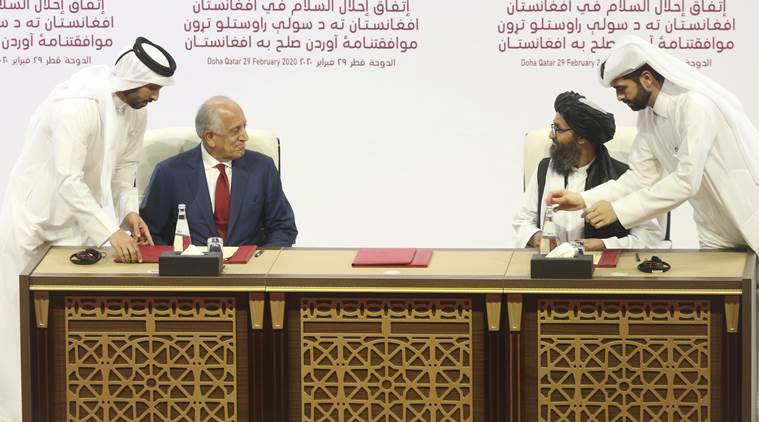
    “Agreement for Bringing Peace to Afghanistan” between the US and Taliban signed on February 29 in Doha, is just another piece in the overall strategy of the US for Afghanistan.

    Pakistan’s support to the Taliban and unchanged Afghan policy of the US

    • Continuation of the same hard-nosed policy: While rolling out the Afghan policy in August 2017, it was emphasised by the current US dispensation that it was making amends to the Afghan strategy of the previous dispensation.
      • In reality, it has been a continuation of the same hard-nosed line.
    • How Pakistan supported the Taliban? The US and allies had got a rude shock when it dawned on them that between 2001 and 2008, the Taliban had used training and recuperation centres in Pakistan to regain domination over most parts of Afghanistan.
      • Benefiting from the Coalition Support Fund: Pakistan had actively aided the Taliban and al Qaeda (AQ), while continuing to benefit from handsome Coalition Support Funds and a seat at the “high table”.
      • Support of the Pakistan Army: All failures were blamed on inadequate numbers of International Security Assistance Force (ISAF) and Afghan National Security Forces (ANSF), which were ill-equipped to challenge the Taliban, backed by a professional Pakistan Army.
      • Misdiagnosed cause: The Obama administration diagnosed that lack of governance, corruption and fragmented polity were other key factors.

    What was the comprehensive Afghanistan Strategy?

    • COIN doctrine and “troop surge”: A comprehensive Afghanistan strategy review led to replicating its “troop surge” strategy, which was believed to have succeeded in Iraq, leading to total withdrawal of US troops (December 2011).
      • At the heart of the troop surge was the Counterinsurgency (COIN) doctrine of the US Field Manual.
    • COIN plus CT: The military strategy in Afghanistan was split into COIN plus CT (Counter Terrorism) objectives.
      • The Taliban movement was treated as an insurgency.
      • What was involved in COIN: The COIN efforts entailed protecting population centres and highways, building numbers and capability of the ANSF to take on insurgents, with emphasis on good governance and support for reconstruction.
      • It also included reconciliation and reintegration of lower to mid-level willing Taliban.
      • The UN designations of Taliban and AQ were separated to pave the way for “peace talks” with Taliban commanders who were tired of fighting.
    • What this strategy achieved? The US-led ISAF troop surge helped create time and space to build and strengthen the ANSF over three times and succeeded in pushing the Taliban back to outlying areas.
      • Even today these territorial gains have not been reversed, except in some areas.
      • As the ANSF gained strength and depth, the US led-ISAF mission became a NATO led-Resolute Support mission.
    • How changing geopolitical circumstances increased challenges? The CT effort yielded rich dividends for the US and allies, in the Af-Pak region and even beyond.
      • The rise of ISIS: From the build-up of ISIS in 2014 to the loss of its Caliphate in 2019 and recently to the killing of General Solemani, the CT challenges of the US and allies in the Af-Pak region and periphery have become graver than ever.
      • These elements had a bearing on the Afghan strategy rolled out in August 2017.
      • Good progress was made in building up the ANSF, with a strong focus on three key elements — Special Forces, Air Force, and Afghan Intelligence (NDS).

    The US withdrawal

    • Objectives of the withdrawal: Emphasising that “consequences of a rapid exit were predictable and unacceptable”, it outlined two key objectives —
      • Preventing a resurgence of safe havens that threatened the security of Afghanistan and the US interests in Afghanistan and Pakistan.
      • Preventing terrorists from getting nukes or nuclear material which could be used against the US or elsewhere.
    • What is the recalibrated strategy: The “recalibrated” strategy envisaged following-
      • Time-bound but condition-based withdrawal.
      • Support for the Ghani government.
      • ANSF to take on the Taliban.
      • Talks with the Taliban and for Pakistan to demonstrate commitment on dismantling safe havens that threatened US objectives.
      • Overall, the strategy remained the same, except for the withdrawal of the US from a role in nation-building.
    • What are the results of the strategy? There has been a greater emphasis on the strengthening of ANSF.
      • The regular assessments by the US show an increasing role and success of the Afghan Special Forces.
      • The Air Force and the NDS in playing the lead in keeping the Taliban from running over capitals.
      • By and large, the ANSF have been successful in maintaining the balance and the Taliban-control has not slipped to 2009 levels.
      • In the meantime, US forces have dropped to 10 per cent of the peak (in 2011).
      • With the re-election of President Ghani, it is assured that the US line of thinking will prevail over the Afghan government.
      • Role of Pakistan in the process: On its part, Pakistan has demonstrated its intent by delivering top-rung Taliban, including Mullah Baradar in its custody since 2010, and Anas Haqqani released as part of the process, for the talks.
      • Even if there is no comprehensive ceasefire or full withdrawal ever, Pakistan is unlikely to be blamed.

    What Pakistan achieved from the peace process?

    • Return of Afghan refugee: Pakistan has been rewarded in more ways than one. It managed to return lakhs of Afghans.
    • Fencing on the eastern border of Afghanistan: It builds a fence along the eastern parts of Afghanistan to prevent cross-border attacks.
    • Targeting the key TTP leaders: Pakistan got the US and Afghan forces to target key TTP leaders, starting with TTP chief Mullah Fazlullah in June 2018.
      • Since January this year, three top TTP leaders have been killed in Kabul and Kunar.
      • This has also helped build the Pakistan narrative that Afghan soil is being used to target Pakistan.
    • Changing the international narrative in its favour: Even though it is facing “calibrated” heat on FATF sanctions, Pakistan has managed to change the international narrative in its favour.
      • The 24th report (July 2019) of the UNSC monitoring committee has stated, “Al Qaeda continues to cooperate closely with LeT and the Haqqani Network”, but there is no reference to LeT or Haqqani in the 25th report (January 2020).
      • This report has also asserted that ISIL-K has established informal contact with other terrorist groups, including Jamaat-ul-Ahrar, TTP and Lashkar e-Islam.
      • Meanwhile, these groups regularly attack Pakistani posts along the Afghan border.
      • All key anti-Pakistan groups are now being categorised as ISIL-K supporters, even though Pakistan has run the so-called Daesh networks in eastern Afghanistan for years.
      • The UNSC reports also highlight the positive role of Taliban in targeting ISIL-K.

    Conclusion

    • The election in the US has bearing on the process: In an election year, the US needs to show that it is not fighting someone else’s battles and is making “sincere efforts” at peace-making.
      • The “Agreement” demonstrates sincerity.
      • At the same time, the US has to continue steering the Afghan strategy to keep terror networks in check.
      • The peace process has already created a comfort-loving, globe-trotting leadership in the top echelons of the Taliban, who would continue to talk, even if the current Agreement falters.
    • Pakistan is again sitting on the high table: As the LeT and Haqqani networks go missing from UN reports and JeM chief Masood Azhar and pro-Pak TTP leader Ehasanullah Ehsan go conveniently “missing” from Pakistan soil, the pressure on Pakistan has eased.
      • The new non-state entities backed by Pakistan, such as the AQIS and ISKP/IS-Kashmir/IS-Hind will become more visible.
      • The rank and file of LeT, JeM, HUJI etc can easily be transferred to these new entities, while many more can be recruited under new banners.
      • Online propaganda of these entities, including in Indian languages, is already visible and likely to escalate.


  • Explained: US-Taliban Pact


    • The US and Taliban signed an agreement for “Bringing Peace to Afghanistan”, which will enable the US and NATO to withdraw troops in the next 14 months.
    • The pact is between the “Islamic Emirate of Afghanistan which is not recognized by the United States as a state and is known as the Taliban” and the US.
    • The four-page pact was signed between Zalmay Khalilzad, US Special Representative for Afghanistan Reconciliation, and Mullah Abdul Ghani Baradar, political head of the Taliban.

    Key elements of the deal

    Troops Withdrawal

    • The US will draw down to 8,600 troops in 135 days and the NATO or coalition troop numbers will also be brought down, proportionately and simultaneously.
    • And all troops will be out within 14 months — “all” would include “non-diplomatic civilian personnel” (could be interpreted to mean “intelligence” personnel).

    Taliban Commitment

    • The main counter-terrorism commitment by the Taliban is that “It will not allow any of its members, other individuals or groups, including al-Qaeda, to use the soil of Afghanistan to threaten the security of the US and its allies”.
    • While Miller said the reference to al-Qaeda is important, the pact is silent on other terrorist groups — such as anti-India groups Lashkar-e-Toiba or Jaish-e-Mohammed.
    • Again, India, not being an US ally, is not covered under this pact.

    Sanctions Removal

    • UN sanctions on Taliban leaders to be removed by three months (by May 29) and US sanctions by August 27.
    • The sanctions will be out before much progress is expected in the intra-Afghan dialogue.

    Prisoner’s release

    • This is a possible trouble spot because the US-Taliban agreement and the joint declaration differ, and it is not clear whether the Ashraf Ghani-led government is on board with this big up-front concession to Taliban.
    • The joint declaration says the US will facilitate discussion with Taliban representatives on confidence building measures, to include determining the feasibility of releasing significant numbers of prisoners on both sides.
    • While there are no numbers or deadlines in the joint declaration, the US-Taliban pact says up to 5,000 imprisoned Taliban and up to 1,000 prisoners from “the other side” held by Taliban “will be released” by March.
    • The intra-Afghan negotiations are supposed to start in Oslo.

    Ceasefire

    • This is identified as another potential “trouble spot”.
    • The agreement states ceasefire will be simply “an item on the agenda” when intra-Afghan talks start, and indicate actual ceasefire will come with the “completion” of an Afghan political agreement.

    Implications of the Deal

    An adieu to democracy in Afghanistan

    • The Taliban have got what they wanted: troops withdrawal, removal of sanctions, release of prisoners.
    • This has also strengthened Pakistan, Taliban’s benefactor, and the Pakistan Army and the ISI’s influence appears to be on the rise.
    • It has made it unambiguous that it wants an Islamic regime.
    • The Afghan government has been completely sidelined during the talks between the US and Taliban.
    • The future for the people of Afghanistan is uncertain and will depend on how Taliban honours its commitments and whether it goes back to the mediaeval practices of its 1996-2001 regimes.

    Implications for India

    • India has been backing the Ghani-led government and was among very few countries to congratulate Ghani on his victory.
    • India’s proximity to Ghani also drew from their shared view of cross-border terrorism emanating from Pakistan.
    • There has not been formal contact with top Taliban leaders, the Indian mission has a fair amount of access to the Pashtun community throughout Afghanistan through community development projects of about $3 billion.
    • Due to So, although Pakistan military and its ally Taliban have become dominant players in Kabul’s power circles, South Block insiders insist that it is not all that grim for New Delhi.
    • these high-impact projects, diplomats feel India has gained goodwill among ordinary Afghans, the majority of whom are Pashtuns and some may be aligned with the Taliban as well.

    Way Forward

    • The joint declaration is a symbolic commitment to the Afghanistan government that the US is not abandoning it.
    • Much will depend on whether the US and the Taliban are able to keep their ends of the bargain, and every step forward will be negotiated, and how the Afghan government and the political spectrum are involved.
    • Like in 1989, 1992, 1996, and in 2001, Pakistan has the opportunity to play a constructive role. It frittered away the opportunities in the past.

    Back2Basics

    India and the Taliban

    • India and the Taliban have had a bitter past.
    • New Delhi nurses bitter memories from the IC-814 hijack in 1999, when it had to release terrorists — including Masood Azhar who founded Jaish-e-Mohammed that went on to carry out terror attacks as such on Parliament, Pathankot and in Pulwama.
    • Quite predictably, Mullah Baradar did not name India among the countries that supported the peace process, but specially thanked Pakistan for the “support, work and assistance” provided.
    • The Taliban perceived India as a hostile country, as India had supported the anti-Taliban force Northern Alliance in the 1990s.
    • India never gave diplomatic and official recognition to the Taliban when it was in power during 1996-2001.
    • But its foreign policy establishment has shied away from engaging with the Taliban directly.
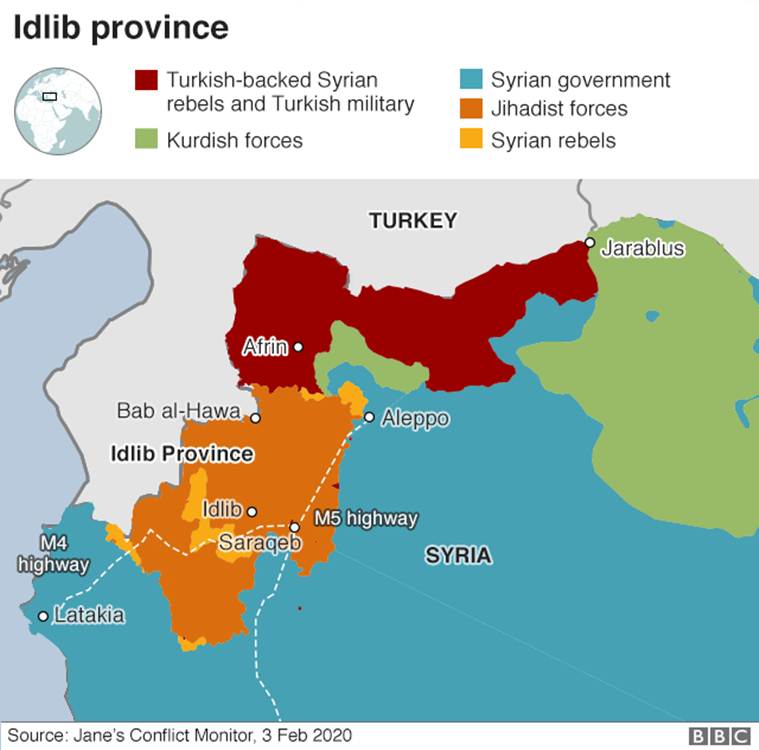
  • Location in news: Idlib Province


    The nine-year-old war in Syria is currently raging in the northwestern province of Idlib, with rapidly escalating tensions between government forces of President Bashar al-Assad and the Turkish military.

    Background

    • President’s Assad’s forces are backed by Russia, who are clashing with thousands of Turkish troops south of its border with Syria.
    • Turkey has closed the border and is trying to seal itself from waves of displaced refugees as Assad presses forth with a brutal campaign to take back Idlib.

    Why is Idlib important?

    • Assad has been pushing to recapture Idlib, which, along with parts of neighbouring Hama, Latakia and Aleppo, are the last remaining strongholds of the rebel opposition and other groups that have been attempting to overthrow Assad since 2011.
    • At one point, the opposition held large parts of Syria under its control, but that changed after Assad, with Russian military support, slowly regained control over most of the country.
    • In 2015, Idlib province was overtaken by opposition forces.
    • Now, Syrian government forces are attempting to capture the strategic M4 and M5 national highways that connect Idlib, Aleppo and Damascus, the capital of the country.
    • Idlib skirts the two national highways and lies between Aleppo in the north and Damascus in the south.
    • It’s proximity to the Turkish border makes Idlib strategically important to the Syrian government.

    Who controls Idlib now?

    • Since the province fell to opposition forces, there is no one group that controls Idlib, but rather, several separate factions.
    • International watchdogs say that the dominant faction in Idlib is the Hayat Tahrir al-Sham (HTS), a UN-designated terrorist organization set up in 2017, with links to al-Qaeda.
    • Also operating in Idlib is the Turkey-backed Syrian National Army, an armed opposition group. Included in the mix are the remnants of the Islamic State.
    • Watch groups say that other factions in Idlib strongly oppose the presence of IS fighters in the province.

    Why is Idlib important for Turkey?

    • Idlib’s proximity to the Turkish border makes it not only important for the Syrian government, but also a cause of concern for Turkey.
    • Since the war started in Syria, thousands of displaced Syrians have sought refuge in Turkey over the years.
    • According to the latest known figures, Turkey presently hosts some 3.6 million refugees and is feeling the socio-economic and political strain of their presence in the country.
    • More conflict in Idlib would only serve to displace more people, pushing them towards the Turkish border.
    • Turkey has been witnessing a surge in hostility among its citizens towards refugees and a fresh wave of refugees will only exacerbate the situation.
  • Explained: The EU data strategy

    The European Commission has recently released a “European strategy for data… to ensure the human-centric development of Artificial Intelligence” and a white paper on artificial intelligence.

    EU data strategy

    • The new documents present a timeline for various projects, legislative frameworks, and initiatives by the European Union, and represent its recognition that it is slipping behind American and Chinese innovation.
    • The strategy lays out “why the EU should act now”.
    • The blueprint hopes to strengthen Europe’s local technology market by creating a “data single market” by 2030 to allow the free flow of data within the EU.
    • To aid a “data-agile economy”, the Commission hopes to implement an “enabling legislative framework for the governance of common European data spaces” by the latter half of the year.
    • By the beginning of 2021, the Commission will make high-value public sector data available free through Application Programming Interfaces (APIs) — a pathway for two different applications to speak to each other.
    • Between 2021 and 2027, the Commission will invest in a High Impact Project to jump-start data infrastructure. Several other initiatives are laid out, including a cloud services marketplace.

    Why such strategy?

    • The EU has the potential to be successful in the data-agile economy. It has the technology, the know-how and a highly skilled workforce.
    • However, competitors such as China and the US are already innovating quickly and projecting their concepts of data access and use across the globe, the strategy states.
    • With American and Chinese companies taking the lead on technological innovation, Europe is keen to up its own competitiveness.

    What does the EU move mean for legislation?

    • Europe has been a frontrunner when it comes to technology regulation.
    • Its General Data Protection Regulation (GDPR) released in 2018 was a game-changer across the industry. In the recent strategy, the GDPR is seen as giving the “solid framework for digital trust.”
    • Parliamentarians are discussing India’s current Personal Data Protection (PDP) Bill in a Joint Select Committee.
    • The recent draft of the PDP introduced a clause on non-personal data, mandating entities to hand over such data to the government on command.
    • This was not included in the draft proposed by the Justice B N Sri Krishna Committee in October 2018.
    • Some of the movement around the PDP Bill comes from a desire to strengthen India’s own data economy, similar to the EU’s desire.

    Has India done anything similar?

    • The Union Cabinet approved the National Data Sharing and Accessibility Policy (NDSAP) in 2012.
    • As part of the initiative, the government worked with the US government to release data.gov.in, a site of government data for public use.
    • The Economic Survey of 2018 envisioned a similar use of non-personal data.
    • Just as the EU’s strategy discusses “data for public good”, the chapter titled “Data ‘Of the People, By the People, For the People’” advocated that the government step in to sectors that private players ignore, marking the first time India’s Economic Survey has isolated “data” as a strategic focus.
    • Other data integration efforts have been announced or implemented by NITI Aayog (the National Data & Analytics Platform), the Smart Cities Mission (India Urban Data Exchange), and the Ministry of Rural Development (DISHA dashboard).
    • In 2018, the National Informatics Centre worked with PwC and other vendors to create a Centre of Excellence for Data Analytics aimed at providing data analysis help to government departments.
  • Bangladesh fares better

    Content

    In the last decade, on a range of social development indicators, Bangladesh has fared better than India. So it is highly unlikely that Bangladeshis would want to leave their cherished homeland for India.

    Comparison with Bangladesh on the development indicators

    • Growth rate: This year Bangladesh’s economic growth rate has surpassed India.
    • Social development indicators: In the last decade, on a range of social development indicators, from infant mortality to immunisation, Bangladesh has fared better.
    • India lagging behind the neighbours in quality of life: Undoubtedly, since economic liberalisation, Indians have grown much richer than Bangladeshis, but in terms of quality of life our neighbour largely outshines us.
      • India trails across several (not all) composite indices from the latest Global Hunger Index to the Gender Development Index.
      • Even on the 2019 World Happiness Index, Bangladeshis score better.
      • While, technically, on the Human Development Index, Bangladesh scores marginally less, this is largely because the index merges income and non-income parameters.

    How India’s neighbour forged ahead in social development?

    • Dissolving the inequality and bridging the social and gender distances: In the case of Bangladesh, the most prominent factor has been-
      • Removing inequality: The country’s ability to dissolve inequalities through sustained investment in public services and-
      • Bridging the social distance: The bridging of social and gender distances.
    • Development in Healthcare: Till the Eighties, Indians lived longer than most South Asians.
      • But now, despite being poorer, an average Bangladeshi female child at birth can expect to live for four years more.
      • Fewer Bangladeshi children also die before their fifth birthday.
      • Community clinics: The formula for this success has been relatively simple. Since 2009, the government has constructed well-stocked “community clinics” in every third village.
      • Home delivery of medicines: For four decades, committed cadres of government health workers have delivered medicines and family planning to women in the comfort of their homes.
    • Achievement in Education: On the education front, even though India has a demographic dividend, Bangladesh has achieved a marginal advantage in youth literacy.
      • Further, across income quintiles, Bangladeshi girls have higher educational attainments than boys.
      • Free textbooks: The government provides free textbooks in the government, non-government (NGO) and madrassa-run schools promptly at the start of the academic year, without the chronic delays which plague India.
      • The greater proportion of expenditure on educations: Economist Jean Drèze has aptly described India as amongst the world champions in social underspending. In contrast, Bangladesh despite being a poorer neighbour since the Nineties has spent a greater proportion of government expenditure on education and healthcare.
      • The fruits of these sustained investments have reaped rich dividends.
    • Nutrition: On the nutrition front too, Bangladesh fares better.
      • Thirty-three per cent of Bangladeshi children are underweight compared to India’s 36 per cent as per the demographic health surveys.
      • Similarly, a greater proportion of Indian children are also stunted.
      • Further, the inequality between wealth quintiles is starker in India.
      • A few years ago, the Bangladeshi government, with the help of NGOs, hired a unique cadre of “Pushti Apas” (nutrition sisters) who went door-to-door in their social endeavours.
      • Unlike the Indian Poshan Abhiyan’s focus on vegetarian foods, they did not shy away from teaching mothers to feed growing infants a balanced diet with mashed fish, meat and eggs.
    • Sanitation: Even at the turn of the millennium, at least 80 per cent of Bangladeshi homes had toilets, even if rudimentary.
      • By 2016, 96 per cent of households and 80 per cent of schools in had proper sanitation.
      • Apart from the typical Islamic emphasis on hygiene, local governments not only provide cement rings for free to poor families but they also regularly spread messages through community group discussions, mosques, mass media and schools.
      • Local entrepreneurs have also ensured that with the innovation of plastic pans, the cheapest toilets cost less than Chinese mobile phones.
    • Women empowerment: Bangladeshi women are also increasingly assertive.
      • The 2006 World Bank Survey on Gender Norms found a growing trend of “educational hypogamy”.
      • In sharp contrast to India’s decline, Bangladeshi women also have higher labour force participation.

    Contrast

    • In comparison, India is grappling with the worst unemployment levels in 45 years and sinking economic growth rates. Government ministers should pull up their own socks, instead. Berating our neighbours with the false bogey of illegal immigrants, in light of the Citizenship Amendment Act, is nothing but an unjustifiable distraction. Instead, it would be far wiser for the Indian government to humbly learn the recipe of South Asian success to improve the lives of citizens from the impressive “Shonar Bangla”.
  • The battle in Beijing

    Context

    The coronavirus epidemic poses a challenge to China’s place in global affairs, its political leadership.

    The possible implications of coronavirus crisis

    • The Chines leadership might not be able to escape the blame: If the epidemic turns into a pandemic, as some analysts bet, China’s all-powerful leader Xi Jinping might not be able to escape the blame.
      • And will likely come under considerable political pressure.
    • It could also turn into a systemic threat: Some also speculate that the backlash against the government’s mishandling of the crisis could turn into a systemic threat against the dominance of the Chinese Communist Party.
    • Speculations as perennial hope among China’s critics: Sceptics, however, dismiss above speculation as merely reflecting the perennial hope among Beijing’s harshest critics who can’t wait to see a China without the CCP.
      • Realist’s stand: Realists point to the massive mobilisation of state power by President Xi in limiting the spread of the virus.

    Handling of the crisis by China

    • Initial faltering response: To be sure, there were major failures in the initial faltering response to the crisis.
      • Cover-up attempts from the lower level: The attempts at the lower levels to cover-up or underplays the crisis and the inadequate appreciation at the higher levels of the potential consequences are common to all large bureaucracies. The party-state in China is not an exception.
    • Praise for handling the crisis: China’s handling of the crisis had drawn much respect, grudging or otherwise, from the international community.
      • Whether it is the lockdown of Hubei province and its capital Wuhan, from where the virus began to spread.
      • Or in deploying thousands of doctors and health workers in the province and building massive hospitals for treating the infected.
    • Possibility of some political impact: Yet, there is no question that a crisis of this magnitude -will have some political impact.
      • The party-state is certainly having some difficulty in containing the public outrage against the initial failures.
    • Efforts to shield top leadership from blame: The CCP, however, is bound to shield the supreme leader from any damaging criticism and in fact, celebrate a triumph in containing the spread through a determined effort.
      • Responsibility will be affixed on provincial officials in Hubei and a purge of some kind may have already begun.

    Addressing the economic consequences of the crisis

    • International dimension: Nearly two decades after the SARS epidemic -China is now a much larger economy and its interdependence with the world has only deepened.
      • This interdependence, in turn, lends a strong international dimension to China’s crisis.
    • Optimist’s hope of future uptick: Optimists hope that a sharp drop in economic activity in the current quarter will be followed by a steep uptick in growth in the next when the virus is contained and normalcy returns.
    • Pessimist’s fear of economic disruption: Pessimists suggest that the economic disruption — in terms of the impact on internal and external trade and the breakdown of the global supply chains- could have lasting effects.
      • Reinforcing the disruption: Some suspect that the disruption could reinforce the slowdown driven by a number of other internal and external factors including the trade war with the US.

    China’s response to the rest of the world

    • Channelling of resentment against the West: Some in the West hope that a prolonged economic crisis might turn the people against the CCP. For now, though, Beijing is channelling the resentment against the West.
    • Terming evacuation as an over-reaction: Beijing has criticised the advisories from various countries against travel to China and the cancellation of flights as over-reaction.
      • Lukewarm response to evacuation efforts: China has also been lukewarm to efforts of various countries to evacuate their citizens from Wuhan and Hubei.
      • India evacuated students: India has managed to convince Beijing to let India airlift its students from Wuhan.
      • Pakistan has declared that it will not evacuate its students as a gesture of political solidarity with China in a time of crisis.
      • South Asian neighbour’s response: Many of India’s other South Asian neighbours are torn between the reluctance to offend Chinese sentiment and the mounting domestic pressures to bring students back.
      • Cooperation with the US: While being critical of the US travel restrictions against China, Beijing has certainly been open to cooperation with the US in dealing with the crisis.
    • India’s offer to help other countries in evacuation: The external affairs minister Subrahmanyam Jaishankar said last week that India has been willing to bring back students from all the neighbouring countries.
      • Balancing between Delhi and Beijing: The logic of balancing between Delhi and Beijing has prevented most of the smaller neighbours from requesting Indian assistance.
      • The Maldives has been the only exception.
    • The response of the East and Southeast Asia: Beyond South Asia, many countries in East and Southeast Asia have been hesitant to be seen as rushing to cut themselves from China.
      • What is making these countries hesitant: Deep economic interdependence and massive flows of Chinese tourists led to much dithering among the East Asian countries in their early responses to the crisis.

    Conclusion

    India must explore all potential cooperative engagement with Beijing as well as its other international partners on pandemics-an important but the under-addressed challenge for national, regional and international security.

  • [op-ed snap] Navy to the rescue

    Context

    Earlier this week, India sent an amphibious warship, INS Airavat, to Madagascar in the Indian Ocean Region (IOR) to help in rescue efforts after the island nation was hit by a cyclone.

    Humanitarian operations- Key component of peacetime strategy

    • A key component in IOR: In recent years, humanitarian operations have emerged as a key component of the Indian Navy’s peacetime strategy in the IOR.
      • In March 2019, the Navy deployed four warships for relief operations when Mozambique was hit by Cyclone Idai.
      • Indian naval teams played a stellar role in search and rescue operations and even set up medical camps.
      • A few months later, the Navy sent two warships to Japan to assist in rescue efforts following Typhoon Hagibis.
      • A year earlier, Indian vessels had delivered urgent medical assistance to Sulawesi, Indonesia, after it was struck by a high-intensity earthquake.
      • Operation Samudra Maitri was launched after a telephonic conversation between Prime Minister Narendra Modi and Indonesian President Joko Widodo, with naval planners mobilising assets and relief material in quick time.
    • India’s vision for IOR: The Navy’s new humanitarian approach, many says, is a maritime manifestation of India’s vision for the IOR, christened SAGAR (Security And Growth for All in the Region).
      • Lesson’s from tsunami: The Navy’s turn towards human-centred maritime security isn’t recent. It was in the aftermath of the 2004 tsunami that naval commanders first recognised the importance of large-scale relief and rescue missions in the IOR.
      • For over a decade, considerable resource and energy have been spent developing specialist capability and skills for naval humanitarian operations.

    India- A regional security provider

    • What is changing in India’s stance: What’s new today is New Delhi’s resolve to burnish its ‘regional security provider’ credentials.
      • The Navy has reached out to countries across the Indo-Pacific region, with greater deployment of assets, personnel and specialist equipment, showcasing an ability to undertake complex and diverse missions.
    • The highpoint for India: The highpoint of the Navy’s ‘benign’ efforts was the evacuation of over 1,500 Indian expatriates and 1,300 foreign nationals from Yemen in 2015 amid fighting for control of Aden.
      • Three years later, Indian naval ships were in Yemen again, to evacuate 38 Indians stranded in the cyclone-hit Socotra Island.

    How the new role could help India?

    • India’s desire to be the linchpin of security: The Navy’s humanitarian impulse stems from a desire to be a linchpin of security in the IOR.
      • The concept of the first responder: At the core of the evolving operations philosophy is the concept of ‘the first responder’, with the capability and willingness to provide assistance.
      • Extension of the sphere of influence: The above approach has the potential to create an extended sphere of Indian influence in the IOR.
      • Projection of soft power: Naval leaders recognise that benign missions help project Indian soft power and extend New Delhi’s influence in the littorals.
      • Creating goodwill: Prompt response during a humanitarian crisis helps generate political goodwill in the neighbourhood.

    Cause for caution with maritime presence

    • The issue with prolonged presence: While low-end naval assets in humanitarian mode create strategic equity for India, the prolonged presence of front-line warships in foreign waters has the potential to make partners anxious.
    • Shaping perception over naval presence: Naval power, experts underline, must be deployed discreetly, shaping perceptions in subtle ways.
      • Need to hide the underlying intent: The key is to not let the underlying intent of a mission appear geopolitical.
      • To ensure that motives aren’t misunderstood, and the assistance provided is efficient and cost-effective, it is best to use dedicated disaster-relief platforms.
    • India lacking inventory hospital ship: However, unlike the U.S. and China that have in their inventory hospital ships fully equipped for medical assistance, India deploys regular warships and survey ships converted for medical aid.
      • India’s improvised platforms do not match the U.S. Navy’s medical ship USNS Mercy or the People’s Liberation Army Navy’s Peace Ark.

    Need for greater coordination

    • The Navy’s expanding array of humanitarian missions reveals a need for greater coordination with the Indo-Pacific navies
      • In particular the U.S. Navy, the Royal Australian Navy and the Japanese Self-Defense Forces- which possess significant experience and assets to mitigate humanitarian threats.

    Conclusion

    As natural disasters in the IOR become more frequent and intense, India’s regional security role is likely to grow exponentially. At the forefront of disaster scenarios, the Indian Navy and Coast Guard would find themselves undertaking demanding missions. Humanitarian operations could serve as a springboard for a larger cooperative endeavour in the maritime commons.