💥Mains Ready By December. Smash Mains & Smash PYQ Admissions Open

Subject: Emerging Technologies

  • Maitri II Research Station in Antarctica

    Why in the News?

    The Finance Ministry has approved the establishment of Maitri II, India’s newest Antarctic research station, to be built in eastern Antarctica by January 2029.

    About Maitri II Research Station:

    • Objective: Advance research in climatology, glaciology, seismology, biology, and atmospheric sciences while maintaining eco-compliance.
    • Overview: India’s upcoming 4th Antarctic base, to be completed by January 2029 near Schirmacher Oasis, eastern Antarctica, replacing the aging Maitri (1989) which will operate as a summer camp.
    • Implementing Agency: Executed by National Centre for Polar and Ocean Research (NCPOR), Goa under the Ministry of Earth Sciences (MoES); estimated cost ₹2,000 crore.
    • Design & Technology: Features AI-enabled systems, automated sensors, solar and wind power, and upgraded modular accommodation with strict environmental standards.
    • Construction Phases: Prefabrication in India → shipment via Cape Town → transport to Indian Barrier (120 km from Maitri) → on-site assembly during Antarctic summer.

    Back2Basics: India’s Polar Programmes

    • Antarctica Programme: Began in 1981; coordinated by NCPOR.
      • Dakshin Gangotri (1983) – first base, now decommissioned.
      • Maitri (1989) – inland station near Lake Priyadarshini.
      • Bharati (2012) – modern coastal station 3,000 km east.
      • Maitri II (2029) – to be India’s largest and greenest base.
      • Research covers ice-core climate records, marine ecosystems, space weather, and climate modelling.
    • Arctic Programme (2007): Also led by NCPOR; permanent station Himadri at Ny-Ålesund (Svalbard, Norway) studies Arctic warming, polar-monsoon linkages, biodiversity; India holds Observer Status in the Arctic Council (since 2013).

    Key Laws & Treaties governing Polar Expeditions:

    • India Antarctica Act 2022: Implements the Antarctica Treaty (1959); creates Central Committee on Antarctica Governance; bans mining, nuclear activity, non-native species; introduces permit system and Antarctica Fund; severe penalties (up to 20 years).
    • Antarctica Treaty (1959): 54 members (India joined 1983); ensures peaceful scientific use, bans territorial claims and military activity, upholds environmental cooperation.
    • Madrid Protocol (1991): Declares Antarctica a “natural reserve for peace and science”; forbids mineral extraction; mandates Environmental Impact Assessments (EIA).
    • Convention on the Conservation of Antarctic Marine Living Resources (CCAMLR, 1982): Conserves Antarctic marine biodiversity, regulates fishing and resource use to maintain ecosystem balance.
    [UPSC 2015] The term ‘IndARC’, sometimes seen in the news, is the name of Options: (a) an indigenously developed radar system inducted into Indian Defence

    (b) India’s satellite to provide services to the countries of Indian Ocean Rim

    (c) a scientific establishment set up by India in Antartic region

    (d) India’s underwater observatory to scientifically study the Arctic region *


  • AgriEnIcs Programme

    Why in the News?

    The Ministry of Electronics and Information Technology announced the transfer of technology for agricultural and environmental solutions developed under the Agricultural and Environmental Electronics (AgriEnIcs) Programme.

    What is AgriEnIcs Programme?

    • Overview: A national initiative of the Ministry of Electronics & Information Technology (MeitY) integrating electronics, IT, and digital technologies into agriculture and environmental management.
    • Objective: To promote research, development, deployment, and commercialization of advanced tools for precision agriculture and sustainable resource monitoring.
    • Nature of Programme: Serves as a national R&D and technology translation platform connecting academia, industry, and government for innovation-driven solutions.
    • Implementing Agency: Led by the Centre for Development of Advanced Computing (C-DAC), Kolkata as nodal agency, with participation from IITs, ICAR institutes, and private entities.
    • Development: All technologies designed and tested in India for affordability and rural scalability.
    • Strategic Vision: Strengthens India’s push toward AI- and IoT-enabled agri-systems, aligning with Atmanirbhar Bharat and Digital India.

    Key Features:

    • Integrated Tech Approach: Combines AI, IoT, machine vision, and sensor networks for intelligent agricultural and environmental systems.
    • Collaborative Framework: Operates through partnerships among MeitY, C-DAC, academic, and industrial institutions to speed up technology transfer.
    • Multi-Domain Focus: Addresses dairy health monitoring, crop quality estimation, odour detection, and waste-management automation.
    • AI & ML Applications: Enables predictive diagnostics, real-time data analytics, and automated decision support in farm operations.
    • Sensor-Based Systems: Deploys wearable sensors, vision devices, and automated analyzers for livestock, grain, and environment monitoring.
    • Scalable Architecture: Interoperable with AgriStack, Ayush Grid, and other government data platforms for nationwide expansion.
  • Indian Army inducts ‘Saksham’ Counter-Unmanned Aerial System (CUAS) Grid

    Why in the News?

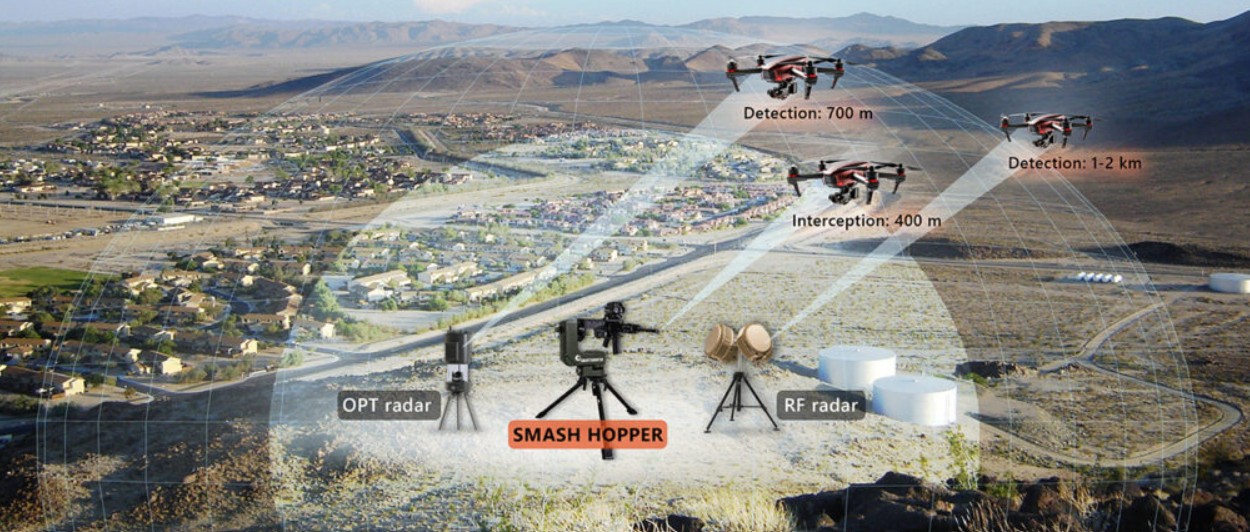
    The Indian Army has initiated procurement of ‘Saksham’, an indigenously developed Counter-Unmanned Aerial System (CUAS) Grid, to enhance airspace security and counter emerging aerial threats.

    Indian Army inducts ‘Saksham’ Counter-Unmanned Aerial System (CUAS) Grid
    Visual Representation

    About Saksham Counter-Unmanned Aerial System (CUAS) Grid:

    • Overview: Indigenous counter-drone system developed by the Indian Army with BEL, Ghaziabad, to detect, track, identify, and neutralise unmanned aerial threats.
    • Purpose: Secures the Tactical Battlefield Space (TBS) or Air Littoral—airspace up to 3,000 m (10,000 ft) against low-altitude drones.
    • Origin: Conceived after Operation Sindoor, which revealed gaps in air defence.
    • Acronym: SAKSHAM – Situational Awareness for Kinetic Soft & Hard Kill Assets Management; a Command-and-Control (C2) platform integrating sensors, weapons, and AI analytics to create a Recognised UAS Picture (RUASP).
    • Procurement: Approved under Fast Track Procurement (FTP); aligns with Atmanirbhar Bharat and the Army’s Decade of Transformation (2023–2032).

    Key Features:

    • Detection & Tracking: Continuous surveillance via radar, radio-frequency, and electro-optical/infrared (EO/IR) sensors.
    • AI-Enabled Prediction: Uses AI to forecast hostile activity and suggest counter-responses.
    • Sensor–Weapon Fusion: Integrates jammers, directed-energy systems, and kinetic interceptors for unified action.
    • Automated Command Support: Provides real-time decision aids for threat prioritisation.
    • 3-D Airspace Visualisation: Displays dynamic views of friendly and hostile assets.
    • Network Integration: Runs on the Army Data Network (ADN) and links with Akashteer Air Defence Control for unified airspace management.
    • Mobility & Modularity: Compact, scalable, and rapidly deployable across terrains.
    • Indigenous Focus: Fully designed and produced in India, demonstrating advanced self-reliant defence capability.
    [UPSC 2025] With reference to Unmanned Aerial Vehicles (UAVs), consider the following statements:

    I. All types of UAVs can do vertical landing. II. All types of UAVs can do automated hovering. III. All types of UAVs can use battery only as a source of power supply.

    Which of the statements given above are correct?

    (a) Only one (b) Only two (c) All the three (d) None*


  • The Nobel laurates’ work has redefined the immune system itself

    Introduction

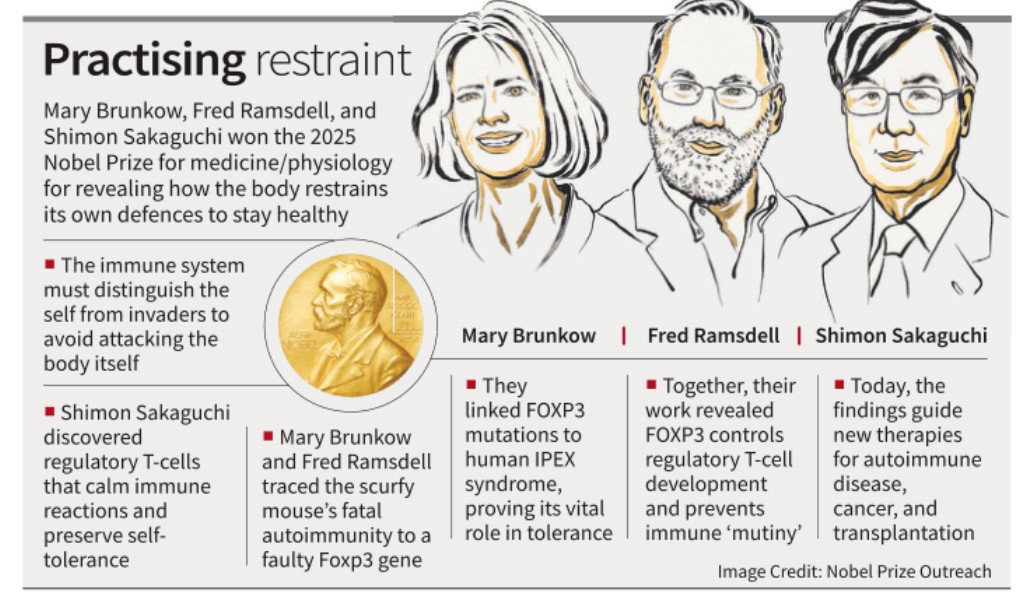
    For decades, the immune system was viewed as a binary apparatus either attacking foreign invaders or remaining silent toward the body’s own cells. This year’s Nobel laureates, Mary Brunkow, Fred Ramsdell, and Shimon Sakaguchi, dismantled that simplistic view by uncovering the critical role of regulatory T-cells (Tregs) and the FOXP3 gene in maintaining self-tolerance. Their findings fundamentally redefined how scientists perceive immune regulation and opened the path for precision immunotherapy — one of modern medicine’s most promising frontiers.

    The Science of Self-Tolerance: Why It’s in the News

    The Nobel Committee’s recognition of research on regulatory T-cells (Tregs) and FOXP3 marks a watershed moment in immunology. For the first time, the prize acknowledges discoveries that explain how the immune system prevents itself from attacking the body. The work explains why autoimmune disorders like Type 1 diabetes, rheumatoid arthritis, and lupus occur when this “self-check” mechanism fails. It also connects molecular immunology to emerging therapies for cancer and transplantation. This is a landmark shift from viewing immunity as mere “defence” to seeing it as a balance of activation and restraint, a concept that has redefined global biomedical research.

    nobel

    How the Nobel-winning Discovery Unfolded

    1. Early Understanding: In the 1990s, immunologists believed that self-reactive T-cells were deleted during their maturation. However, this could not explain why some autoreactive T-cells still existed in healthy people.
    2. Sakaguchi’s Breakthrough (1995): Identified a subset of CD4⁺ T-cells whose removal in mice led to multiple autoimmune disorders. Restoring them prevented disease — proving they act as regulators of immune overreaction.
    3. Discovery of FOXP3 Gene: Brunkow and Ramsdell, working in an industry lab (Celltech Chiroscience), traced severe autoimmune disease in male “scurfy” mice to a gene mutation on the X chromosome. They named it FOXP3.
    4. Human Correlation: Soon, mutations in FOXP3 were linked to lethal autoimmune syndromes in boys, confirming its pivotal role in human immune regulation.

    How These Discoveries Transformed Immunology

    • Redefining the Immune System: The immune system is now seen not as an on/off mechanism but as a dynamic ecosystem that balances activation (attack) with restraint (tolerance).
    • New Therapeutic Frontiers:
      1. Autoimmune Diseases: Efforts are underway to expand or stabilise Tregs to curb harmful immune activation without broad immunosuppression.
      2. Transplant Medicine: Infusion of engineered Tregs improves graft acceptance and reduces rejection rates.
      3. Cancer Research: Selective depletion or reprogramming of tumour-associated Tregs enhances anti-tumour immunity without triggering autoimmunity.

    From Lab to Life: The Translational Challenge

    1. Incremental Progress: Immunologists warn against overestimating breakthroughs. The immune system has multiple overlapping control layers, making clinical translation slow.
    2. High Cost Barrier: Cell-based therapies remain expensive, leading to inequitable access between high- and low-income populations.
    3. Ethical and Policy Dilemmas: Who gets access first? How do we regulate genetic manipulation or Treg engineering? These questions highlight the intersection of science, ethics, and public policy.

    Private Sector and Scientific Innovation

    1. Industrial Discovery: The fact that Brunkow and Ramsdell made their discoveries in an industry setting (Celltech Chiroscience) underscores the potential of private-sector-led innovation in fundamental science.
    2. Public–Private Synergy: It reinforces how collaborations between academic research and biotech industry can accelerate discovery and application, a model India can emulate in its biotechnology policy framework.

    Broader Implications for India and Global Health

    1. Indian Relevance: India’s growing burden of autoimmune diseases (such as lupus, celiac, and thyroiditis) highlights the need for indigenous immunogenetic research.
    2. Policy Perspective: Translating such research into affordable therapies aligns with National Biotechnology Development Strategy and Ayushman Bharat’s preventive healthcare goals.
    3. Global Impact: These discoveries open a new era of personalised immunotherapy, integrating molecular biology, bioethics, and equitable access.

    Conclusion

    The 2025 Nobel Prize reminds the world that progress in science often lies not in creating new weapons against disease but in understanding balance, the balance within nature and within ourselves. The discovery of Tregs and FOXP3 has rewritten textbooks, inspired therapies, and expanded our conception of what “self” and “immunity” truly mean. For policymakers and scientists alike, it represents the future, a fusion of molecular precision, ethical responsibility, and social justice.

    PYQ Relevance

    [UPSC 2021] The Nobel Prize in Physics of 2014 was jointly awarded to Akasaki, Amano and Nakamura for the invention of Blue LEDs in the 1990s. How has this invention impacted the everyday life of human beings?

    Linkage: Both the 2014 Nobel for Blue LEDs and the 2025 Nobel for Treg–FOXP3 discovery represent paradigm shifts where scientific breakthroughs moved from lab theory to real-world transformation — the former revolutionised energy efficiency, while the latter is redefining human health and immune regulation.

  • India’s Dhvani Hypersonic Missile

    Why in the News?

    The DRDO is preparing for the maiden test of the “Dhvani” hypersonic missile.

    About the Dhvani Missile and Its Features

    • Overview: The Dhvani hypersonic missile is being developed by India’s Defence Research and Development Organisation (DRDO) as part of its advanced hypersonic weapons programme.
    • Type: It is designed as a Hypersonic Glide Vehicle (HGV) — a next-generation missile system capable of travelling at hypersonic speeds (beyond Mach 5 or over 7,400 km/h) while performing sharp maneuvers at high altitudes.
    • Range and Speed:
      • Expected operational range: 6,000–10,000 km, potentially doubling the reach of India’s Agni-V ICBM.
      • Speed: Exceeds Mach 5, making interception nearly impossible with current missile defence systems.
    • Flight Mechanism:
      • Launched to extreme altitudes before entering a glide phase in the atmosphere at hypersonic speeds.
      • The glide vehicle can change direction mid-course, allowing unpredictable trajectories that evade radar and anti-missile systems.
    • Design and Engineering:
      • Length: ~9 metres; Width: ~2.5 metres.
      • Blended Wing-Body Configuration: Enhances lift and stability while reducing aerodynamic drag.
      • Thermal Protection System: Uses ultra-high-temperature ceramic composites capable of withstanding 2,000–3,000°C during re-entry.
      • Stealth Features: Angled surfaces and smooth contours minimise radar cross-section, making it virtually undetectable to enemy radars.
    • Development Heritage:
      • Builds upon DRDO’s success with the Hypersonic Technology Demonstrator Vehicle (HSTDV), which validated India’s scramjet propulsion and heat-resistant materials.
      • Represents the transition from technology demonstrator to operational weapon system, signalling India’s arrival in the hypersonic era.

    Comparison with Global Hypersonic Systems:

    System Name Type Speed (Mach) Operational Status
    Russia Avangard HGV 20+ Deployed
    China DF-ZF HGV 10 Deployed
    United States Dark Eagle / HACM Hypersonic Glide / Cruise 8–10 In testing
    India Dhvani (HGV) Hypersonic Glide Vehicle 5–6+ Pre-test stage (2025)

    Strategic Significance for India:

    • Global Standing: Positions India alongside the U.S., Russia, and China in the exclusive club of hypersonic powers, showcasing its advanced defence R&D capacity.
    • Regional Deterrence: Creates a technological and strategic edge over Pakistan and provides a credible counterbalance to China’s hypersonic arsenal.
    • Survivability and Precision: The missile’s speed, stealth, and maneuverability make interception nearly impossible while enabling pinpoint strikes on both land and sea targets.
    • Indigenous Achievement: Developed entirely through Indian expertise, aligning with the Atmanirbhar Bharat vision in critical defence technologies.
    • Force Multiplier: Strengthens India’s nuclear deterrent and strategic triad, ensuring readiness for long-range precision and deterrence missions.
    [UPSC 2014] Which reference to Agni-IV Missile, which of the following statements is/are correct?

    1. It is a surface-to-surface missile.

    2. It is fuelled by liquid propellant only.

    3. It can deliver one-tonne nuclear warheads about 7500 km away.

    Select the correct answer using the code given below:

    (a) 1 only  (b) 2 and 3 only  (c) 1 and 3 only  (d) 1, 2 and 3


  • What are Small Modular Reactors (SMRs)?

    Why in the News?

    Major Indian private sector corporations expressed formal interest in setting up Small Modular Reactor (SMR)-based nuclear projects as part of the ‘Bharat Small Modular Reactors (BSMR)’ programme.

    What is the Bharat Small Modular Reactors (BSMR) Programme?

    • Overview: India’s flagship nuclear programme, led by the Bhabha Atomic Research Centre (BARC) and the Nuclear Power Corporation of India Limited (NPCIL) under the Department of Atomic Energy (DAE).
    • Reactor Models:
      • BSMR-200 – 200 MWe Pressurized Water Reactor with passive safety.
      • BSR-220 – PHWR-based small reactor.
      • SMR-55 – 55 MWe PWR for captive or remote use.
    • Implementation: NPCIL retains ownership and operational control, while private companies fund and use generated power for captive needs. About 16 potential sites identified across Gujarat, Madhya Pradesh, Odisha, Andhra Pradesh, Jharkhand, and Chhattisgarh.
    • Policy & Financing: ₹20,000 crore allocated under the Nuclear Energy Mission for Viksit Bharat (2025-26) to operationalise five SMRs by 2033.
    • Private sector interest: Includes Reliance Industries, Tata Power, Adani Power, JSW Energy, Hindalco, and Jindal Steel & Power.
    • Reforms & Impact: Amendments to the Atomic Energy Act (1962) and Civil Liability for Nuclear Damage Act (2010) are proposed to facilitate investment and technology sharing.

    About Small Modular Reactors (SMRs):

    • Concept: SMRs are advanced nuclear reactors generating up to 300 Megawatt electric (MWe) each — about one-third the size of conventional reactors. They are “modular”, meaning major components are factory-fabricated, transported, and assembled on-site, cutting cost and construction time.
    • Working Principle: Operate on nuclear fission (splitting Uranium-235 atoms) to produce heat that converts water into steam for turbines. Most use the Pressurized Water Reactor (PWR) design with passive safety systems that cool the reactor without human intervention.
    • Distinct Features:
      • Compact and Scalable – suitable for remote or repurposed sites.
      • Factory-built – ensures quality and quicker rollout.
      • Safer Design – smaller radioactive inventory, underground containment.
      • Flexible Use – can supply electricity, industrial heat, desalination, or hydrogen.
    • Global Examples:
      • Akademik Lomonosov (Russia) – world’s first floating SMR (70 MWe, 2020).
      • HTR-PM (China) – high-temperature gas-cooled SMR (2023).
      • Key developers: Rolls-Royce (UK), NuScale (US), GE-Hitachi, Westinghouse (AP-300).
    [UPSC 2012] To meet its rapidly growing energy demand, some opine that India should pursue research and development on thorium as the future fuel of nuclear energy. In this context, what advantage does thorium hold over uranium?

    1. Thorium is far more abundant in nature than uranium. 2. On the basis of per unit mass of mined mineral, thorium can generate more energy compared to natural uranium. 3. Thorium produces less harmful waste compared to uranium.

    Which of the statements given above is/are correct?

    Options: (a) 1 only (b) 2 and 3 only (c) 1 and 3 only (d) 1, 2 and 3 *


  • [29th September 2025] The Hindu Op-ed: An Engel’s pause in an AI-shaped world

    PYQ Relevance

    [UPSC 2023] Introduce the concept of Artificial Intelligence (AI). How does AI help clinical diagnosis? Do you perceive any threat to privacy of the individual in the use of AI in the healthcare?

    Linkage: This question reflects the exact dilemma discussed in the Engels’ pause analogy—AI promises higher productivity (e.g., clinical diagnosis, efficiency) but without governance, the welfare gains (privacy, equitable access, trust) may lag, creating social costs.

    Mentor’s Comment

    The rise of Artificial Intelligence (AI) is hailed as the new Industrial Revolution, but as Geoffrey Hinton warns, it could also deepen inequality by making a few rich while leaving the majority poorer. This paradox, reminiscent of Friedrich Engels’ 19th-century observation, raises a pressing question for policymakers: Are we entering a modern “Engels’ pause” where productivity soars but living standards stagnate? For UPSC aspirants, this debate is central to GS 1 (industrial revolution parallels), GS 2 (governance), GS 3 (technology, economy), and GS 4 (ethics of equity in innovation).

    Introduction

    The concept of an Engels’ pause, coined by economist Robert Allen, describes a historical paradox in 19th-century Britain: industrial output grew rapidly, yet wages stagnated, food prices soared, and inequality widened. The benefits of industrialization reached the majority only after decades, with reforms and institutional adjustments.

    Today, AI as a general-purpose technology (GPT)—akin to steam power, electricity, or the internet—brings unprecedented productivity potential but also risks replicating this paradox. With Nobel Laureate Geoffrey Hinton warning of AI enriching a few at the expense of many, and evidence of uneven benefits emerging globally, the Engels’ pause metaphor becomes a crucial analytical lens.

    Why in the News?

    Artificial Intelligence is reshaping global economies, but early signs suggest a disconnect between productivity gains and broad-based prosperity. A recent Stanford study showed younger workers are more vulnerable to AI displacement, while an Indian IT giant laid off 12,000 employees in its AI pivot. Meanwhile, a MIT study revealed that 95% of AI pilots are failing to deliver visible gains due to weak complementary capabilities. In the Philippines, call centres recorded 30–50% productivity jumps with AI copilots, yet wages stagnated and workloads intensified. PwC forecasts AI could add $15.7 trillion to global GDP by 2030, but gains are concentrated in a few countries and firms. These developments highlight the possibility of an AI-induced Engels’ pause, making it a critical debate for global governance.

    Are We Facing a Modern Engels’ Pause?

    1. Historical Parallels: Like 19th-century Britain, current AI-driven growth risks benefiting capital over labour, delaying welfare gains for the majority.
    2. Vulnerable Workers: Stanford research shows younger workers are most exposed to AI disruptions.
    3. Sectoral Displacement: IT, healthcare, education, and even government (e.g., Albania’s AI Minister) are witnessing job/task reconfigurations.

    What Are the Markers of an AI Engels’ Pause?

    1. Stagnant Wages despite Productivity Gains: Philippines call centres show higher efficiency but little improvement in wages.
    2. Rising Costs of Complements: Cloud computing, retraining, coding bootcamps, and cybersecurity raise the “price of staying relevant”.
    3. Unequal Distribution of Gains: PwC’s $15.7 trillion AI GDP addition is concentrated in the U.S., China, and a few tech firms. IMF (2024) warns 40% of global jobs are AI-exposed, with advanced economies at greater risk of skilled substitution.
    4. Intensified Inequality: Research on India shows stronger IPR regimes widened wage inequality during tech races.

    How Can Governance Break the Pause?

    1. Skilling and Transition Models: Singapore’s SkillsFuture programme and MBZUAI (world’s first AI university) highlight proactive reskilling.
    2. Redistribution Tools: Robot taxes and Universal Basic Income (UBI) pilots in the UK and EU aim to channel AI rents toward social welfare.
    3. AI Infrastructure as Public Good: Compute and data should be democratized; initiatives like K2Think.ai (UAE) and Apertus (Switzerland) are steps in building open, public AI models.

    Why This Time Might Be Different

    1. Stronger Welfare Systems: Unlike 19th-century Britain, today’s democracies have safety nets and global institutions.
    2. Rapid Diffusion of Technology: Smartphones reached billions within a decade; AI could follow a similar trajectory.
    3. Potential Social Benefits: AI could lower costs in healthcare, education, and energy if deployed equitably.

    Conclusion

    The Engels’ pause analogy underscores a profound warning: productivity gains do not automatically translate into welfare improvements. AI governance, skilling programmes, redistribution mechanisms, and public-good infrastructure will determine whether AI becomes a human welfare revolution rather than just a productivity revolution. Political will, not just technological breakthroughs, will decide if this pause is short-lived or prolonged.

    Value Addition

    Scholarly References and Thinkers

    1. Robert C. Allen (2009): Coined Engels’ Pause in economic history; wages stagnated despite industrial productivity growth in 19th-century Britain.
    2. Nicholas Crafts (2021): Noted that GPTs like AI need institutional reforms and complementary innovations before welfare spreads.
    3. Bojan Jovanovic & Rousseau (2005): Documented “technology shocks” in U.S. economy → initial dislocation before long-term growth.
    4. Geoffrey Hinton (2024, FT Interview): Warned AI may “make a few rich and the rest poorer.”
    5. Agrawal, Gans & Goldfarb (2018): Defined AI as lowering the cost of prediction.

    Key Reports and Data Points

    1. PwC Report (2018): AI could add $15.7 trillion to global GDP by 2030; 70% of gains concentrated in U.S. and China.
    2. IMF Report (2024): 40% of global jobs are AI-exposed; higher risk of high-skilled substitution in advanced economies.
    3. MIT Study (2023): Found that 95% of AI pilot projects failed to show visible gains due to lack of complementary capabilities.
    4. Stanford Study (2023): “Canaries in the Coal Mine” → younger workers are most vulnerable to AI disruption.
    5. OECD AI Principles (2019): Global governance framework emphasising fairness, transparency, accountability.

    International Best Practices / Programs

    1. Singapore – SkillsFuture (2015): Provides continuous education credits for workers to reskill; considered a global model.
    2. UAE – Mohamed bin Zayed University of AI (MBZUAI, 2019): World’s first dedicated AI university.
    3. European Union – AI Act (2021 Draft): Risk-based framework regulating AI applications.
    4. United Kingdom – UBI Experiments: Pilots to test redistribution of tech-driven wealth.
    5. Albania – First AI Minister (2024): Institutional adoption of AI governance in public administration.

    Indian Context and Initiatives

    1. NITI Aayog’s National Strategy on AI (2018): “AI for All” approach—priority areas: healthcare, education, agriculture, mobility.
    2. Digital India Programme: Expanding digital infrastructure to enable AI adoption.
    3. National Programme on AI (2019): Envisioned as a Center of Excellence ecosystem for skilling, research, and governance.
    4. NASSCOM FutureSkills Prime: Public–private initiative to reskill 2 million professionals in emerging tech, including AI.
    5. IndiaAI Portal (2023): Central knowledge hub for AI use cases and policy discussions.

    Key Concepts for Thematic Depth

    1. General-Purpose Technology (GPT): Technologies with cross-sectoral transformative impact (steam, electricity, internet, AI).
    2. Complementary Innovations: Need for institutional reforms, new tasks, and human capital for GPT diffusion.
    3. Job Polarisation: Middle-skill jobs displaced → low-skill and high-skill jobs expand; seen in OECD labour markets.
    4. Robot Tax (Bill Gates’ Proposal): Idea of taxing automation to fund welfare.
    5. Universal Basic Income (UBI): Redistribution mechanism to tackle inequality in tech-driven economies.

    Comparative Historical Perspective

    1. Industrial Revolution (19th c. Britain): Productivity rose but welfare stagnated → Engels’ Pause.
    2. Gilded Age (U.S.): Huge inequality, labour unrest; later corrected via welfare state reforms.
    3. Digital Revolution (1990s): Internet adoption uneven; productivity surge lagged behind wages initially.

    Ethical and Governance Dimensions

    1. Equity and Justice (GS4): AI could worsen inequality unless governed inclusively.
    2. Privacy: Particularly sensitive in healthcare (HIPAA in U.S.; India’s Digital Personal Data Protection Act, 2023).
    3. Transparency: AI “black box” models challenge accountability.
    4. Democratic Deficit: AI development is corporate-heavy; needs citizen-centric governance.
  • Intermediate Range Agni-Prime Missile

    Why in the News?

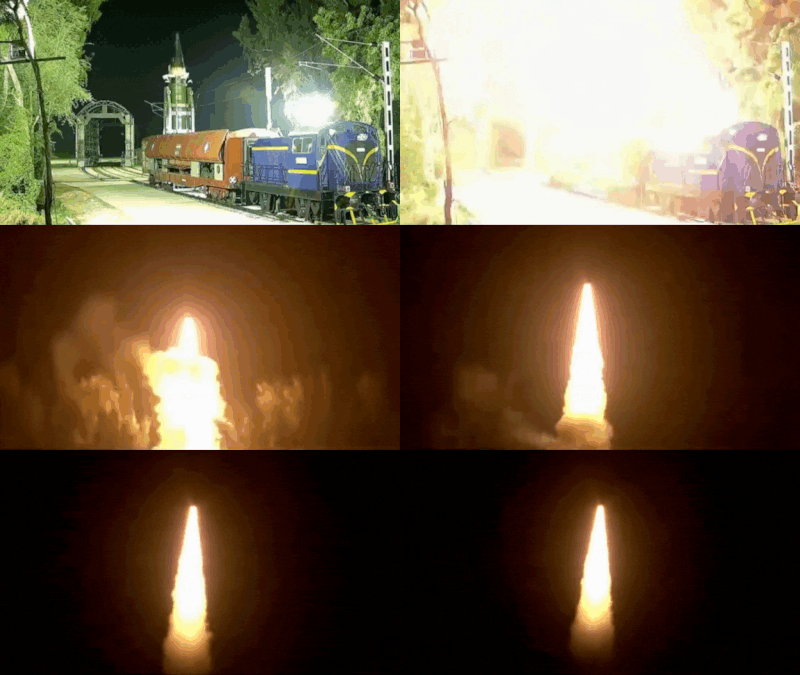
    The Defence Research and Development Organisation (DRDO) and the Strategic Forces Command (SFC) successfully test-fired the Agni-Prime missile from a rail-based mobile launcher, marking India’s first such operational test.

    About Agni-Prime Missile:

    • About: 6th missile in the Agni family, developed under the Integrated Guided Missile Development Programme (IGMDP).
    • Design: Two-stage, solid-propellant, canisterised surface-to-surface ballistic missile.
    • Range and Payload: 1,000–2,000 km; covering both China and Pakistan; Payload: Up to 1.5 tonnes (1,500–3,000 kg).
    • Navigation: Dual redundant guidance system; Maneuverable Re-entry Vehicle (MaRV) with delta fins to evade missile defence systems.
    • Deployment: Already inducted in road-mobile canisterised version; now tested with rail-based mobile launcher.

    Global Context: Rail-Based Missile Technology:

    With Agni-P rail launch, joins this select strategic group.

    • Soviet Union: Operated RT-23 Molodets Intercontinental Ballistic Missile (ICBM) on rail; dismantled after START Treaty.
    • Russia: Planned Barguzin rail-mobile ICBM system, shelved to focus on hypersonics.
    • United States: Explored rail-mobile Minuteman and Peacekeeper ICBMs, cancelled post-Cold War.
    • China: Tested rail-mobile DF-41 ICBM in 2016.
    • North Korea: Tested rail-based Short-Range Ballistic Missile system in 2021.

    Significance of Rail-Based Launch:

    • Mobility & Concealment: Railcars move across the network, hide in tunnels, evade satellite detection.
    • Survivability: Unlike silos, less vulnerable to pre-emptive strikes.
    • Rapid Response: Enables quick deployment and shorter reaction time.
    • Strategic Deterrence: Boosts credible second-strike nuclear capability.
    • Technological Showcase: Demonstrates India’s maturity in missile systems.

    Back2Basics: Integrated Guided Missile Development Programme (IGMDP)

    • Launch: Conceived in 1983 by Dr. A.P.J. Abdul Kalam to achieve self-reliance in missile technology.
    • Completion: 2012.
    • Missile Family (P-A-T-N-A):
      • Prithvi – Short-range ballistic missile.
      • Agni – Ballistic missiles of multiple ranges (Agni I–V, Agni-P).
      • Trishul – Short-range surface-to-air missile.
      • Nag – 3rd generation anti-tank guided missile.
      • Akash – Medium-range surface-to-air missile.

    Agni Series and its Development:

    • Origins: Began in 1983 under the IGMDP led by Dr. Kalam.
    • Evolution: Started as technology demonstrators for re-entry vehicles; later developed into full-fledged strategic missiles.
    • Variants:
      • Agni-I: 700–1,200 km range, inducted 2007.
      • Agni-II: 2,000–3,000 km range, inducted 2010.
      • Agni-III: 3,500 km range, highly accurate, tested 2007.
      • Agni-IV: 4,000 km range, advanced avionics, tested 2011.
      • Agni-V: 5,000+ km range, ICBM, MIRV capable.
      • Agni Prime (Agni-P): 1,000–2,000 km, lighter, tested 2021.
      • Agni-VI: Under development, 6,000–10,000 km, MIRV + submarine launch capable.
    • Significance: Backbone of India’s nuclear triad, enhancing deterrence against regional and global adversaries.


    [UPSC 2023] Consider the following statements:

    1. Ballistic missiles are jet-propelled at subsonic speeds throughout their fights, while cruise missiles are rocket-powered only in the initial phase of flight.

    2. Agni-V is a medium-range supersonic cruise missile, while BrahMos is a solid-fuelled intercontinental ballistic missile.

    Which of the statements given above is/are correct?

    (a) 1 only (b) 2 only (c) Both 1 and 2 (d) Neither 1 nor 2*


  • Roadmap for India’s Fusion Power Plan

    Why in the News?

    Researchers at the Institute for Plasma Research (IPR), Gandhinagar have released a roadmap for India’s fusion programme, envisioning the Steady-State Superconducting Tokamak-Bharat (SST-Bharat) as the country’s first fusion electricity generator.

    Back2Basics: ITER and India’s Contribution in ITER

    • ITER (International Thermonuclear Experimental Reactor): It is the world’s largest nuclear fusion project, based in France, involving 35 nations.
      • What is Nuclear Fusion: It is the process where light atomic nuclei, like hydrogen, combine to form a heavier nucleus, releasing a tremendous amount of energy, as seen in the Sun and stars.
    • Aim: Demonstrate safe, carbon-free fusion energy by achieving Q = 10 (500 MW output from 50 MW input).
    • Uses Tokamak design, heating plasma to 150 million °C with superconducting magnets.
    • India joined as a full partner in 2005, contributing 9% of ITER hardware (~₹17,500 crore).
    • Major Indian contributions:
      • Partnership: Member since 2005, contributes 9% of hardware (~₹17,500 crore) with full IP rights.
      • Cryostat (3,800 tonnes, world’s largest vacuum vessel) – fabricated by L&T in Gujarat.
      • Superconducting magnets, cryogenic systems, RF heating systems, diagnostics, and shielding modules.
      • R&D on lithium-lead breeder blankets for tritium self-sufficiency in fusion reactors.
    • ITER serves as a training ground for Indian scientists, engineers, and industry, strengthening the country’s precision engineering and high-tech capabilities.

    Roadmap for India’s Fusion Power Plan:

    • Vision: Outlined by the Institute for Plasma Research (IPR), Gandhinagar, aligned with India’s Net Zero 2070 goal.
    • Strategy: Transition from fusion–fission hybrids (SST-Bharat) to a full fusion demonstration reactor (INDRA) by 2060.
    • Phased Targets:
      • 2025–2035: ITER participation, validation of deuterium-tritium (D–T) fueling, superconducting magnets, and plasma control.
      • 2035–2060: Build INDRA (500 MWe, Q > 20), continuous operation >6 months, tritium breeding ratio >1.1.
      • Post-2060: Commercial-scale fusion plants, target 50 GW fusion capacity by 2100, offsetting ~750 MT CO₂ annually.
    • Hybrid Approach: Fusion neutrons to drive thorium-based subcritical assemblies until pure fusion matures.
    • Innovations: Digital twins of tokamaks, AI-assisted plasma confinement, and radiation-resistant materials.
    • Global Context: UK STEP targets 2040, US startups 2030s, China’s EAST plasma records; India aims for 2060 cautiously.

    About Steady-State Superconducting Tokamak-Bharat (SST-Bharat):

    • Design: Planned as India’s first fusion electricity generator, a fusion–fission hybrid.
    • Output: 130 MW total; 100 MW from fission, 30 MW from fusion.
    • Target: Q-Value = 5 (fusion output/input ratio), vs ITER’s goal of Q = 10.
    • Cost: Estimated at ₹25,000 crore.
    • Features: Superconducting magnets, advanced plasma control, hybrid breeding design to generate fuel and reduce waste.
    • Legacy: Builds on SST-1 tokamak, which achieved 650 ms confinement (designed for up to 16 min).
    • Goal: Pave way for INDRA (250 MW, Q = 20) by 2060.
    [UPSC 2016] India is an important member of the ‘International Thermonuclear Experimental Reactor’. If this experiment succeeds, what is the immediate advantage for India?

    Options: (a) It can use thorium in place of uranium for power generation

    (b) It attain a global role in satellite-navigation

    (c) It can drastically improve the efficiency of its fission reactors in power generation

    (d) It can build fusion reactors for power generation*

    [UPSC 2025] The fusion energy programme in India has steadily evolved over the past few decades. Mention India’s contributions to the international fusion energy project International Thermonuclear Experimental Reactor (ITER). What will be the implications of the success of this project for the future of global energy?


  • Optical Computing and AI with Light

    Why in the News?

    Finnish researchers showed that nonlinear optical fibres can perform AI tasks efficiently, advancing optical computing.

    About Optical Computing:

    • Overview: A computer that uses light (photons) instead of electricity (electrons) to process data.
    • Why Important: Light is faster, makes less heat, and carries more data at once.
    • Technology Used: Runs through optical fibres, the same cables that carry internet data.
    • Main Challenge: Hard to control how light behaves, especially when it gets very strong and non-linear (changes colour, merges, or spreads).

    Recent Breakthrough:

    • Research:
      • Turned images into light pulses.
      • Sent them through optical fibre where the light changed.
      • These changes acted like a hidden computing layer.
      • The system read the light at the other end to classify the images.
    • Results: Reached 91–93% accuracy, close to normal AI computers.

    How can it help AI working?

    • Energy-efficient AI hardware: Can make faster and greener AI systems in the future.
    • Tech needs: New tools like photonic chips and optical neural networks before large-scale use.
    [UPSC 2022] Which one of the following is the context in which the term “qubit” is mentioned?

    (a) Cloud Services (b) Quantum Computing* (c) Visible Light Communication Technologies (d) Wireless Communication Technologies