💥Mains Ready By December. Smash Mains & Smash PYQ Admissions Open

Subject: Emerging Technologies

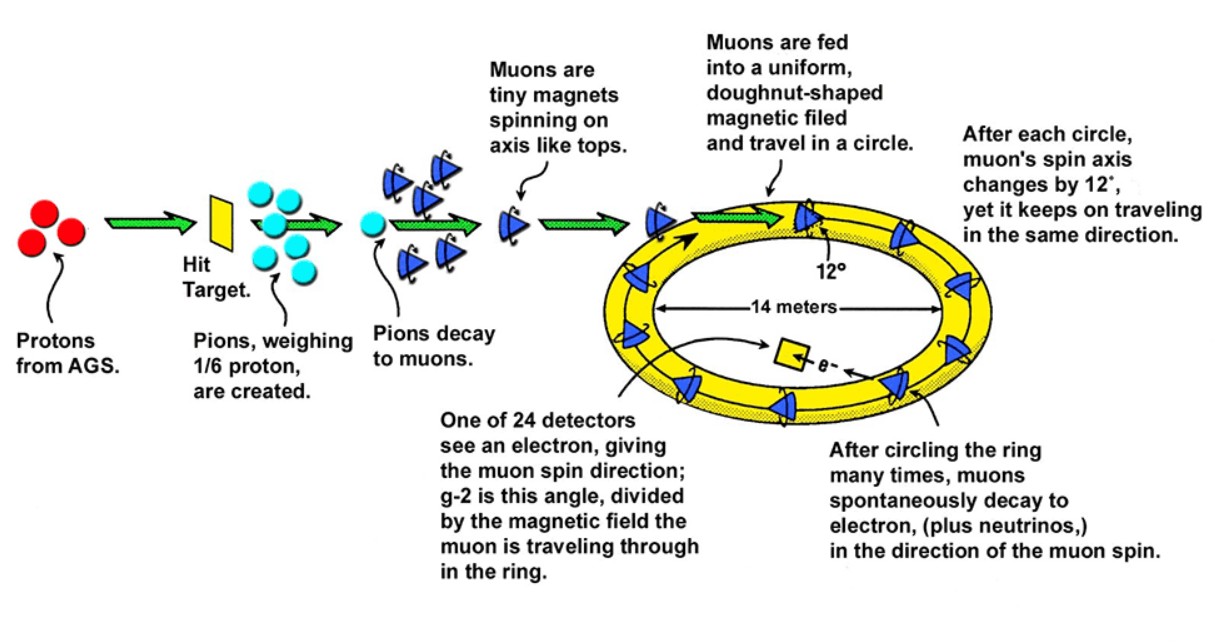
  • Muon g-2 Experiment

    Why in the News?

    Scientists at Fermilab in the USA have made an ultra-precise measurement of the muon’s magnetic behaviour, a finding that could hint at new physics beyond current laws.

    Muon g-2 Experiment

    Understanding Muon and G-2:

    • Overview: A muon is a subatomic particle like an electron but about 200 times heavier.
    • Behaviour: It has spin, making it act like a tiny magnet.
    • g-Factor: The magnet’s strength is measured by the g-factor. In simple theory, g = 2, but quantum effects make it slightly different — this difference is called g-2 (g minus 2).
    • Physics Relevance: Measuring g-2 can reveal unknown forces or particles beyond the Standard Model.

    The Fermilab Breakthrough:

    • Precision Record: Fermilab (USA) measured muon’s g-2 to an accuracy of 0.127 parts per million — comparable to detecting a 4-gram change on a 4-tonne elephant.
    • Method: Muons were sent into a large magnetic ring, measuring the gap between spin rate and orbital rate.
    • Results: Matches earlier experiments; disagreement with theory depends on calculation method used.
    • Next Steps: Japan’s upcoming experiment will independently test results.

    Significance:

    • Potential New Physics: If the gap is real, it may signal undiscovered forces or particles.
    • Refining Theory: If not, calculations will improve, sharpening known physics.
    • Broader Impact: Advances precision science and deepens global understanding of fundamental physics.
    • Lesson: Ultra-precise measurements can uncover hidden truths about nature.
    [UPSC 2013] The efforts to detect the existence of Higgs boson particle have become frequent news in the recent past. What is/are the importance/importances of discovering this particle?

    1. It will enable us to under-stand as to why elementary particles have mass.

    2. It will enable us in the near future to develop the technology of transferring matter from one point to another without traversing the physical space between them.

    3. It will enable us to create better fuels for nuclear fission.

    Select the correct answer using the codes given below.

    Options: (a) 1 only* (b) 2 and 3 only (c) 1 and 3 only (d) 1, 2 and 3


  • [pib] MSS+ Technology in Road Construction

    Why in the News?

    The CSIR–Central Road Research Institute, New Delhi, has developed MSS+ (Modified Mix Seal Surfacing Plus) technology for eco-friendly, durable, and low-cost road surfacing.

    About MSS+ Technology:

    • Developer: Council of Scientific & Industrial Research – Central Road Research Institute (CSIR–CRRI), New Delhi.
    • Year of Development: 2021 (in collaboration with J.M.V.D. Industries).
    • Pilot Project: First road in Uttar Pradesh built near Lucknow in 2022; Used for 202 km of roads under Pradhan Mantri Gram Sadak Yojana (PMGSY) in 2025.
    • Composition: Crushed natural aggregate, customised modified bitumen emulsion, mineral admixture.
    • Preparation: Mix made at ambient temperature, eliminating heating of aggregate or bitumen.
    • Laying: 25–30 mm thickness using conventional asphalt pavers.

    Benefits Offered:

    • Eco-Friendly: No thermal process → significantly reduces carbon emissions.
    • Durable: Provides strong wearing course, enhanced skid resistance, and prevents water infiltration.
    • Cost-Effective: Reduced energy requirement lowers construction costs.
    • All-Weather Use: Can be laid in varied weather conditions due to ambient temperature application.
    [UPSC 2020] In rural road construction, the use of which of the following is preferred for ensuring environmental sustainability or to reduce carbon footprint?

    1. Copper slag 2. Cold mix asphalt technology 3. Geotextiles 4. Hot mix asphalt technology 5. Portland cement

    Select the correct answer using the code given below:

    Options: (a) 1, 2 and 3 only * (b) 2, 3 and 4 only (c) 4 and 5 only (d) 1 and 5 only


  • How is AI reshaping India’s infotech sector?

    PYQ Relevance:

    [UPSC 2023] Introduce the concept of Artificial Intelligence (AI). How does Al help clinical diagnosis? Do you perceive any threat to privacy of the individual in the use of Al in healthcare?

    Linkage: Artificial Intelligence (AI) simulates human intelligence to perform tasks like analysis, prediction, and decision-making, and in healthcare, it aids clinical diagnosis through rapid image interpretation, predictive analytics, and early disease detection. Linking to India’s evolving IT sector, AI’s role in data management and compliance can ensure safe healthcare adoption, but risks such as data breaches, misuse of personal health records, and algorithmic bias highlight the need for strong privacy safeguards and ethical standards.

    Introduction:

    The Indian IT industry, valued at $280 billion and employing over 5.8 million people, has been the backbone of India’s digital economy for decades. However, the rise of AI is reshaping business models, altering talent requirements, and compelling firms to rethink their role in the global technology ecosystem. Far from being a simple “job killer,” AI is redefining the industry’s competitive advantage.

    Why is the IT Industry in Restructuring Mode?

    1. Beyond the “AI kills jobs” narrative:
      1. The shake-up is not merely about replacing human workers with AI, but about re-engineering processes for efficiency and scale.
      2. AI is driving transformation across the entire software lifecycle — from coding to testing and maintenance.
    2. The TCS trigger:
      1. TCS’s freeze on experienced hires and planned removal of 12,000 employees has been interpreted as a signal to markets, clients, and employees:
      2. Markets: Cost optimisation and forward-looking adaptation.
      3. Clients: AI-powered efficiency.
      4. Employees: Need for continuous upskilling.

    Why is AI Gaining Momentum Now?

    • Cost-optimisation as a driver:
      1. AI-led productivity boosts (30%+) are critical in a cost-sensitive, investor-driven market.
      2. Examples: AI-powered coding assistants, intelligent debuggers, automated testing.
    • Investment surge:
      1. In 2025, $1 trillion+ expected global spending on AI infrastructure, training, and applications.

    Impact on Jobs and Skills

    1. Job contraction in some areas:
      1. Automation, low-code platforms, and AI reduce the need for large teams in certain roles.
      2. Example: U.S. firms openly using workforce attrition to streamline operations.
    2. Skills that remain resilient:
      1. Core coding in C++ (OS, gaming, security systems), robotics, embedded systems.
      2. High-value areas: product management, UI/UX, tech architecture.
    3. Traits that will rule: math skills, imagination, problem-solving.

    Opportunity for India’s IT Sector

    • Addressing global AI adoption barriers:
      1. Legacy systems, poor data quality, and compliance requirements are major bottlenecks abroad.
      2. Indian firms can: Modernise systems, Organise and clean data and Build compliant AI solutions (aligning with laws like EU’s AI Act).
    • Moving from “back office” to “AI innovation partners”:
      1. Future advantage lies with small, lean AI-native teams solving complex domain-specific problems (healthcare, defence, fintech, sustainability, education).

    From Scale to Specialisation:

    1. The traditional “IT park with thousands of coders” model is declining.
    2. A 50-member AI-focused team can outperform a 5,000-member legacy services team.
    3. Requires cultural shift in Indian IT firms from scale efficiency to innovation agility.

    Conclusion:

    AI is not the end of India’s IT story, but a call for reinvention. By leveraging its talent pool, improving innovation culture, and addressing global AI adoption barriers, India can position itself not just as a participant but as a shaper of the AI era. The challenge lies in embracing the shift from large-scale coding work to lean, high-value, AI-driven problem solving.

    Value Addition:

    Thinkers & Scholars on AI: 

    Andrej Karpathy

    • Background: Former Director of AI at Tesla, known for his work on deep learning and computer vision.
    • View: Describes the shift to Software 2.0 and 3.0, where AI models themselves become the primary source code, reducing the advantage of large coding teams.
    • Relevance: Highlights why India’s IT sector must shift from scale-based operations to innovation-focused, AI-native solutions.

    V. Balakrishnan

    • Background: Chairman, Exfinity Ventures; former CFO at Infosys.
    • View: AI is becoming the fabric of enterprise operations, shaping everything from customer service to boardroom decision-making; Indian IT firms can become enablers of global AI adoption.
    • Relevance: Emphasises India’s opportunity in data cleaning, system modernisation, and AI compliance.

    Extra Mile:

    AI Capitalism – Concept: It refers to an economic and social order where artificial intelligence technologies become a core driver of capital accumulation, market power, and social influence. In this system, AI is not just a tool but a means of consolidating wealth and control in the hands of a few global tech giants, venture capital firms, and AI infrastructure providers.

    Scholars and Thinkers

    1. Shoshana Zuboff (The Age of Surveillance Capitalism) – Warns that AI capitalism commodifies human behaviour through constant data extraction.
    2. Nick Srnicek (Platform Capitalism) – Argues AI platforms centralise power and reshape markets in ways that undermine competition.
    3. Kate Crawford (Atlas of AI) – Highlights the environmental, political, and ethical costs of AI capitalism.


    Mapping Micro-themes:

    GS PAPER II Governance in technology adoption, regulation, Tech policy & regulation, India as a global technology partner:

    • Regulatory dimension: Global AI governance (EU AI Act) influencing Indian compliance services.
    • Geopolitical angle: India’s role as a trusted AI partner amid U.S.-China tech tensions.
    GS PAPER III Economic growth, employment (AI & automation impact on employment ), AI innovation ecosystem (Innovation-driven economy), Start-up ecosystem in AI

    • Economic implications: Job losses in low-skilled IT roles vs. high-skilled job creation in AI.
    GS PAPER IV Ethical AI (fairness, transparency, bias mitigation)

    Examples:

    • TCS workforce restructuring as a market signal
    • EU AI Act influencing compliance-driven service demand
    • AI-native teams in healthcare and defence as future growth hubs


    Practice Mains Question

    1. Discuss how Artificial Intelligence is reshaping India’s information technology sector. In your answer, highlight both the challenges and opportunities this transition presents. (250 words)
  • Yashoda AI Literacy Program

    Why in the News?

    The National Commission for Women (NCW) has launched “Yashoda AI”, an AI literacy program to empower women with skills in cybersecurity, digital privacy, and safe online practices, promoting digital inclusion across India.

    About Yashoda AI:

    • Launch: Introduced in May 2025 as an Artificial Intelligence Literacy Program for women.
    • Organisers: Joint initiative by the NCW and Future Shift Labs.
    • Objective: To train women in cybersecurity, digital privacy, and safe online practices.
    • Focus Areas: Covers AI-driven crimes, digital safety, and practical risk mitigation strategies.
    • Reach: Over 2,500 women trained to date.
    • Beneficiaries: Includes Self-Help Group members, local representatives (Sarpanchs, Pradhans, Mayors, Members of Legislative Assemblies), and frontline workers like Accredited Social Health Activists (ASHA workers).

    Back2Basics: National Commission for Women

    • Status: Statutory body established in 1992 under the NCW Act, 1990.
    • Composition: Consists of a Chairperson, 5 Members, and a Member-Secretary—appointed by the Central Government.
    • Term: All members serve for a term of 3 years.
    • Powers: Holds civil court powers during inquiries:
      • Can summon individuals and enforce attendance
      • Examine witnesses under oath
      • Demand records and receive affidavits
      • Issue commissions for examination of witnesses or documents


    [UPSC 2017] What is the purpose of Vidyanjali Yojana’?

    1. To enable the famous foreign campuses in India.

    2. To increase the quality of education provided in government schools by taking help from the private sector and the community.

    3. To encourage voluntary monetary contributions from private individuals and organizations so as to improve the infrastructure facilities for primary and secondary schools.

    Select the correct answer using the code given below:

    Options: (a) 2 only * (b) 3 only (c) 1 and 2 only (d) 2 and 3 only


  • Blockchain-verified Quantum Randomness for Secure Communication

    Why in the News?

    A recent breakthrough demonstrated use of quantum science, blockchain, and cryptography to create truly random and secure numbers used in encryption for secure communication.

    About the Technology:

    • Encryption: Converts readable data into unreadable code using a “key”; only someone with the correct key can decrypt the message.
    • Importance of Randomness: Secure encryption depends on unpredictable keys—predictable keys can be guessed or hacked.
    • Issue with Computers: Most keys are generated using pseudo-random algorithms, which appear random but are predictable if the method is known.

    About the Breakthrough Lava Lamp Method:

    • Setup: 100 lava lamps placed on a wall at Cloudflare’s San Francisco office; a camera takes periodic photos of the moving blobs.
    • Process: Each photo is converted into numerical data, creating a random seed to generate encryption keys.
    • Why Lava Lamps? The heat-driven movement of wax blobs is unpredictable and creates unique images.
    • Limitations: Movements follow physics, so not truly random. Also, the algorithm that converts images is deterministic—reproducible if known.

    Quantum Random Number Generation Protocol:

    • Why Quantum Physics: Subatomic particles like photons behave randomly; for example, a photon’s polarization is unknown until measured.
    • How It Works: Scientists used lasers to generate entangled photons and measured them millions of times to produce random results.
    • Data Conversion: The raw data (in binary) was biased, so a randomness extractor was used to generate a clean 512-bit unbiased number using a second random seed.
    • Blockchain Role: Each step was recorded on blockchain for transparency, with digital fingerprints (hashes) to ensure data integrity.
    • Team Involvement: National Institute of Standards and Technology (NIST), University of Colorado, and DRAND each handled separate parts to ensure decentralization and trust.
    • Public Use: The final random numbers are shared via CURBy, a public distribution service.
    • Significance: Though still emerging, this method shows strong potential for future ultra-secure encryption systems.
    [UPSC 2025] Consider the following statements:

    I. It is expected that Majorana 1 chip will enable quantum computing. II. Majorana 1 chip has been introduced by Amazon Web Services (AWS). III. Deep learning is a subset of machine learning.

    Which of the statements given above are correct?

    Options: (a) I and only I (b) II and III only (c) I and III only* (d) I, II and III


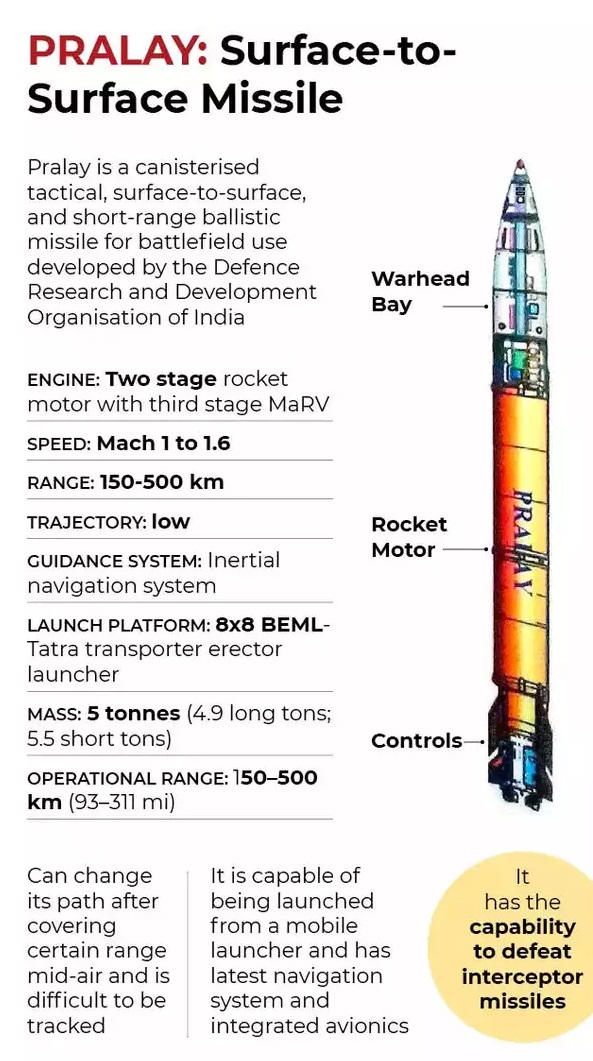
  • Pralay Missile 

    Why in the News?

    The Defence Research and Development Organisation (DRDO) successfully conducted two consecutive test flights of the Pralay missile from the Dr. A.P.J. Abdul Kalam Island off Odisha’s coast.

    Pralay Missile 

    About Pralay Missile:

    • Developer: Defence Research and Development Organisation (DRDO), led by Research Centre Imarat (RCI) with Indian industry support.
    • Purpose: Tactical surface-to-surface missile for precision strikes along sensitive borders like the Line of Actual Control (LAC) and Line of Control (LoC).
    • Role: Enhances India’s conventional deterrence in short-range battlefield operations.
    • Targets: Designed to destroy high-value assets—radars, command centers, airstrips, and military infrastructure.

    Key Features:

    • Type: Quasi-ballistic surface-to-surface missile
    • Range: 150–500 km
    • Payload: 500–1,000 kg (conventional warheads)
    • Propulsion: Solid-propellant rocket motor
    • Launcher: Mobile platform for rapid deployment
    • Guidance: Advanced inertial navigation with <10 m Circular Error Probable (CEP)
    • Terminal Speed: Up to Mach 6.1
    • Maneuverability: Capable of mid-air trajectory changes to evade interception
    [UPSC 2023]  Consider the following statements:

    1. Ballistic missiles are jet-propelled at subsonic speeds throughout their fights, while cruise missiles are rocket-powered only in the initial phase of flight. 2. Agni-V is a medium-range supersonic cruise missile, while BrahMos is a solid-fuelled intercontinental ballistic missile.

    Which of the statements given above is/are correct?

    Options: (a) 1 only (b) 2 only (c) Both 1 and 2 (d) Neither 1 nor 2*


  • Bamboo-Polymer Composite as alternative to Plastics

    Why in the News?

    IIT Guwahati researchers have created a strong, eco-friendly material using bamboo and biodegradable plastic to replace regular plastic in car interiors and other uses.

    About the Bamboo-Polymer Composite:

    • Origin: Made using Bambusa tulda, a fast-growing bamboo from Northeast India.
    • Composition: Reinforced with bio-based and petroleum-based epoxies for strength.
    • Objective: Reduce dependence on synthetic plastics in industrial sectors.
    • Process: Bamboo fibres undergo alkali treatment to bond well with polymers.
    • Evaluation: Tested across 17 parameters—tensile strength, water resistance, cost, etc.

    Key Features and Benefits:

    • High Strength: Suitable for load-bearing automotive components.
    • Thermal Stability: Can withstand high interior vehicle temperatures.
    • Low Moisture Absorption: Ideal for humid environments.
    • Eco-Friendly: Biodegradable, lowers environmental impact.
    • Cost-Effective: ₹4300 per kg—commercially viable.
    • Best Variant: Bamboo + bio-based epoxy FormuLite chosen through performance scoring.

    Applications:

    • Automotive: Dashboards, door panels, seat backs.
    • Electronics & Packaging: Lightweight, durable material.
    • Aerospace: Used for sustainable composite components.
    • Construction: Green alternative for interiors and fixtures.
    [UPSC 2021] Consider the following statements:

    1. Carbon fibres are used in the manufacture of the components used in automobiles and aircrafts.

    2. Carbon fibres once used cannot be recycled.

    Which of the statements given above is/are correct?”

    Options: (a) 1 only* (b) 2 only (c) Both 1 and 2 (d) Neither 1 nor 2


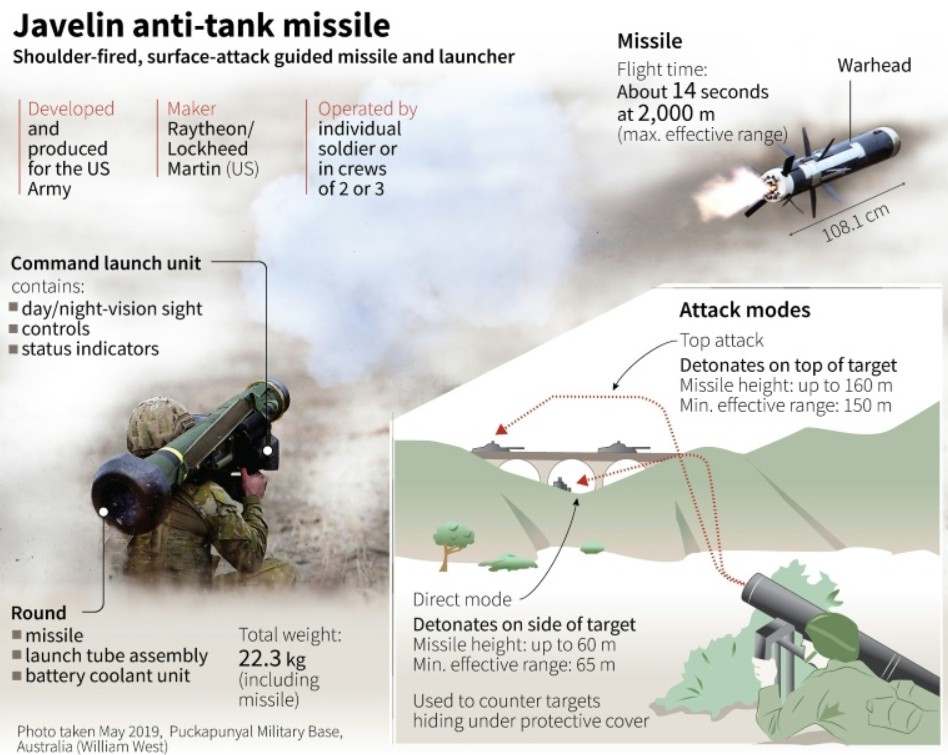
  • Javelin Anti-Tank Guided Missiles (ATGMs)

    Why in the News?

    India has formally submitted a Letter of Request (LoR) to the United States seeking the co-production of Javelin anti-tank guided missiles (ATGMs) under the ‘Make in India’ initiative.

    Javelin Anti-Tank Guided Missiles (ATGMs)

    About the Javelin Missile:

    • About: American-made man-portable anti-tank guided missile (ATGM).
    • Developers: Jointly developed by Raytheon and Lockheed Martin.
    • Purpose:
      • Defeats heavily armoured vehicles such as main battle tanks.
      • Effective against bunkers, fortifications, and helicopters.
    • Operational Since: Entered service with the U.S. military in 1996.

    Key Features:

    • Range:
      • Standard effective range: 2.5 km.
      • Advanced variants: Can reach up to 4 km.
    • Weight: Approximately 5.11 kg.
    • Technology:
      • Employs a “fire-and-forget” system.
      • No need for operator guidance after launch.
    • Target Engagement Modes:
      • Direct attack mode: For conventional engagement.
      • Top-attack mode: Hits the weaker top armour of tanks.
    • Mobility & Safety:
      • Soldiers can relocate or reload immediately after launch.
      • Uses infrared guidance allowing quick post-launch cover.
    [UPSC 2018] What is “Terminal High Altitude Area Defense (THAAD)”, sometimes seen in the news?

    Options: (a) An Israeli radar system (b) India’s indigenous anti-missile programme (c) An American anti-missile system* (d) A defence collaboration between Japan and South Korea


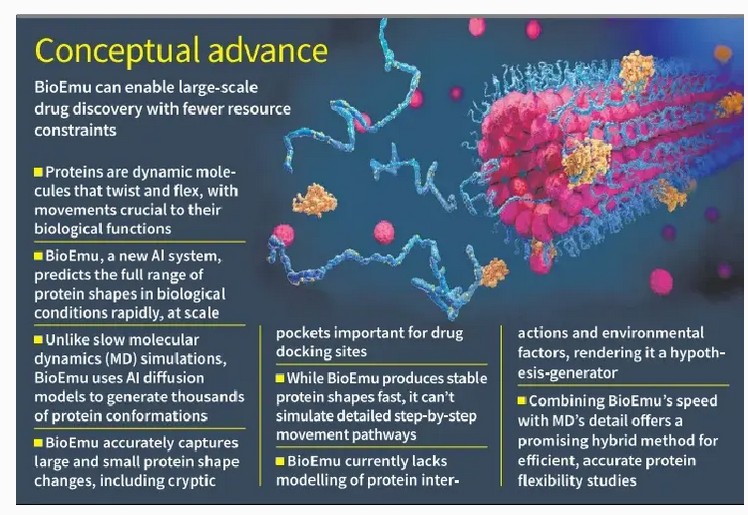
  • BioEmu AI tool for Protein Flexibility Modelling

    Why in the News?

    In a breakthrough, scientists have developed BioEmu—an AI tool that predicts the full range of protein shapes, offering faster and scalable insights into protein dynamics.

    BioEmu AI tool for Protein Flexibility Modelling

    What is BioEmu?

    • Overview: It is a deep learning tool that predicts the equilibrium ensemble of a protein — meaning all the different shapes a protein can naturally take.
    • It works like diffusion models, starting with random/noisy inputs and learning to rebuild protein shapes.
    • Training: It was trained on-
      • AlphaFold structures (millions of predicted proteins)
      • Molecular dynamics (MD) simulation data (200 ms)
      • 500,000 mutant sequences from lab experiments
    • Speed: Once trained, BioEmu can quickly create thousands of 3D protein structures on a single GPU in just minutes to hours.

    Key Features of BioEmu:

    • Flexibility Capture: Shows how proteins change shape, fold/unfold, or form hidden binding pockets.
    • Accuracy:
      • Detects 83% of large and 70–81% of small shape changes.
      • Predicts open/closed forms of enzymes like adenylate kinase.
    • Mutation Analysis: Helps see how mutations affect protein structure and stability.
    • Fast & Scalable: Much faster than traditional MD simulations; works on thousands of proteins using less computing power.
    • Snapshots Only: Gives static 3D shapes, not full motion timelines.
    • Limitations: Can’t handle membrane proteins, drug molecules, or multi-chain complexes.

    Why is BioEmu Important?

    • Improves Protein Modelling: Adds to what AlphaFold does by showing how proteins move, not just what they look like.
    • Helps Drug Discovery: Finds hidden drug binding sites — speeding up the search for new medicines.
    • More Accessible: Works on basic hardware, making advanced protein modelling available to more researchers.
    • Combines with Other Tools: Can be used with molecular dynamics for deeper study.
    • Future of Research: Encourages students and scientists to learn a mix of AI, biology, and physics.
    [UPSC 2020] Which of the following statements are correct regarding the general difference between plant and animal cells?

    1. Plant cells have cellulose cell walls whilst animal cells do not.

    2. Plant cells do not have plasma membrane unlike animal cells which do.

    3. Mature plant cell has one large vacuole vacuoles.

    Select the correct answer using the code given below:

    Options: (a) 1 and 2 only, (b) 2 and 3 only, (c) 1 and 3 only * (d) 1, 2 and 3


  • Piezo- Photocatalytic Water Filter

    Why in the News?

    Indian scientists from INST Mohali, IIT-Dharwad, and IIT-Kharagpur have developed a low-cost, reusable water filter that removes toxic industrial dyes using a process called piezo-photocatalysis.

    About the Light-Induced Water Filter:

    • Material Used: Built using 3D-printed polylactic acid (PLA) sheets (a biodegradable plastic); Sheets coated with bismuth ferrite (BFO) nanoparticles.
    • Working: It works in two ways. Together, this is called piezo-photocatalysis.
      • Photocatalysis: Uses sunlight to break dye molecules.
      • Piezoelectric effect: Uses vibrations (ultrasound) to work even in the dark.
    • Reusable: Can be used 5 times with only 3% loss in performance.
    • Lab tests showed:
      • 99% Congo Red removal
      • 74% Methylene Blue removal (in 90 minutes)

    Significance:

    • Eco-Friendly Solution: Removes harmful dyes without harmful chemicals or electricity.
    • Cost-Effective: Cheaper and safer than ozone or chemical-intensive treatments.
    • Green Energy Use: Operates using sunlight and mechanical vibrations—no external power needed.
    • Policy Alignment: Supports Namami Gange, Jal Nigam, and Aatmanirbhar Bharat missions.
    • Scalability: Ideal for deployment near textile treatment plants as a sustainable technology.
    [UPSC 2023] With reference to the role of biofilters in the Recirculating Aquaculture System, consider the following statements:

    1. Biofilters provide waste treatment by removing uneaten fish feed

    2.Biofilters convert ammonia present in fish waste to nitrate

    3.Biofilters increase phosphorus as nutrient for fish in water

    How many of the statements given above are correct?

    Options: (a) Only one (b) Only two* (c) All three (d) None