💥Mains Ready By December. Smash Mains & Smash PYQ Admissions Open

Subject: Emerging Technologies

  • [31st October 2025] The Hindu Op-ed: AI’s rewriting the rule of education

    PYQ Relevance

    [UPSC 2023] Introduce the concept of Artificial Intelligence (AI). How does AI help clinical diagnosis? Do you perceive any threat to privacy of the individual in the use of AI in the healthcare?

    Linkage: The PYQ highlights AI’s role in improving efficiency while raising privacy concerns. This theme directly relates to ethical and responsible use of AI in education.

    Mentor’s Comment

    India’s education system is witnessing a paradigm shift. The government’s decision to integrate Artificial Intelligence (AI) into school curricula from as early as Class 3 (2026-27) marks a decisive break from conventional learning. It signals not just a content shift, but a pedagogical revolution, from rote learning to personalised, data-driven education. The move holds immense promise but also raises profound questions on inclusivity, teacher readiness, and ethical adaptation.

    Introduction

    India’s AI-enabled education initiative, aligned with the National Education Policy (NEP) 2020, seeks to embed AI learning across the entire K-12 spectrum. The objective is to build a tech-savvy, future-ready workforce capable of thriving in a knowledge-driven global economy. However, as India gears up for this transformation, the focus extends beyond hardware and software, it includes teacher capacity-building, curriculum redesign, and equitable access to technology.

    Why in the News

    India will become one of the first major education systems globally to introduce AI at the school level. This move marks a sharp contrast to traditional “one-size-fits-all” models, where uniform pedagogy dominated classrooms.

    The Ministry of Education’s pilot programs have already trained over 10,000 teachers since 2019, in collaboration with Intel, IBM, and premier national institutes. Yet, the scale of reform, covering over 9 million educators, poses a massive challenge. AI’s integration represents not only an educational reform but also a socio-economic turning point, redefining teacher roles, learning processes, and workforce readiness.

    How is AI Transforming Teaching and Learning?

    1. Personalised Learning: AI-powered platforms analyse student behaviour, learning speed, and comprehension to design custom lessons, ensuring each learner’s unique needs are addressed.
    2. Enhanced Engagement: Adaptive systems use gamified interfaces and feedback loops to sustain learner attention and motivation.
    3. Human-AI Synergy: AI acts as an assistant, not a replacement, to educators, allowing teachers to focus on empathy, creativity, and conceptual depth.
    4. Real-Time Feedback: Automated assessment tools provide instant analytics on student performance, aiding teachers in timely interventions.

    How Are Teachers Being Equipped for AI Education?

    1. Teacher Upskilling: Over 10,000 educators trained under pilot projects since 2019 by MoE in collaboration with Intel and IBM.
    2. Curriculum Integration: AI modules embedded within existing NEP frameworks from kindergarten to Class 12.
    3. Pedagogical Shift: Teachers transition from content delivery to concept facilitation, focusing on AI-driven planning, analytics, and adaptive mentoring.
    4. Challenge of Scale: India’s 9 million teachers require reskilling; success depends on effective outreach and digital readiness.

    What Are the Opportunities and Disruptions Ahead?

    1. Employment Generation: AI adoption projected to create four million new jobs by 2030, with rising demand for digital adaptability.
    2. Skill Realignment: Emphasis on critical thinking, empathy, and creativity, complementing AI’s automation capabilities.
    3. Workforce Transition: AI-enabled education aims to prepare students for jobs that do not yet exist, requiring continuous learning.
    4. Economic Implication: According to NITI Aayog, AI could add up to two million jobs in India’s tech sector in the next decade

    Does AI Ensure Inclusivity and Accessibility

    1. Breaking Barriers: AI tools help overcome language, disability, and learning challenges, enabling wider access.
    2. Customised Content: AI-powered language processing supports non-native speakers and visually impaired learners.
    3. Digital Divide Concern: Equal access to AI resources remains uneven, demanding policy interventions for infrastructure parity.
    4. Diversity Support: In a multilingual India, AI can act as a bridge between learners of different socio-linguistic backgrounds.

    Could AI Become the Great Equaliser in Education?

    1. Equitable Opportunities: AI democratises learning by offering universal access to quality resources.
    2. Smart Governance: Data-driven insights help design evidence-based educational policies.
    3. Social Equity Impact: Reduces dependence on geography or school infrastructure, aligning with SDG 4 (Quality Education).
    4. Ethical Imperatives: Algorithmic fairness, data protection, and bias elimination remain essential for sustainable AI deployment.

    Conclusion

    AI’s integration into education represents a transformative leap rather than a linear reform. The focus must remain on teacher empowerment, inclusive infrastructure, and ethical governance to ensure the AI revolution benefits all. India’s model, if executed successfully, could emerge as a global benchmark for equitable, adaptive learning in the 21st century.
  • Governance, cybersecurity move to centrestage in AI conversations

    Introduction and Why in the News

    Artificial Intelligence, once hailed purely as an efficiency enhancer, is now at the centre of ethical, cybersecurity, and accountability debates. The AI@Work roundtable in Mumbai, moderated by industry and data leaders, highlighted that as organisations adopt AI to accelerate operations, they are simultaneously confronting unprecedented risks. These risks arise from data breaches and AI unpredictability to physical and digital intrusions. Globally, the scale of the threat is stark: over 36,000 AI-driven cyber incidents have been detected recently, revealing vulnerabilities that demand robust governance mechanisms. The focus is shifting from innovation for profit to AI for responsible, transparent, and accountable governance.

    How is AI reshaping governance and business operations?

    1. AI as a catalyst: AI is transforming industries, automating functions, and unlocking efficiency, especially in large corporations like HPCL.
    2. Governance shift: The emphasis is moving from using AI for automation to using it for secure, ethical, and explainable decision-making.
    3. Corporate accountability: Company Boards are now integrating AI risk management as part of business strategy and compliance mechanisms.

    What are the major cybersecurity challenges emerging from AI integration?

    1. Dual challenge: HPCL and similar enterprises face both digital intrusions and physical tampering, such as pipeline or fuel data manipulation.
    2. Data breaches and tampering: AI systems amplify vulnerabilities by collecting, analysing, and predicting based on sensitive data.
    3. AI unpredictability: As one executive noted, AI “can behave unpredictably”, even making errors like confusing CAPTCHA, reflecting how AI mimics but doesn’t fully understand human behaviour.
    4. Evolving threats: Traditional cybersecurity tools like SIEM systems are being replaced by AI-based predictive defence models.

    How are organisations building responsible AI frameworks?

    1. Ethical design: Companies are embedding AI hygiene protocols involving legal, ethical, and operational reviews.
    2. Cross-functional training: AI safety and compliance are being promoted through employee retraining and AI literacy initiatives.
    3. Accountability culture: “Who builds, who manages, and who owns AI” is now being formalised as part of corporate accountability structures.
    4. AI governance frameworks: Emphasis on explainability, transparency, and traceability of AI decisions.

    How is India’s corporate sector responding to data and cybersecurity concerns?

    1. AI-based monitoring: Firms like HPCL have set up ATOM – Autonomous Threat Operations Machines capable of detecting and neutralising threats within minutes.
    2. Prioritisation of data integrity: Secure perimeters, application firewalls, and endpoint safety are now standard.
    3. Rise of human-AI synergy: Human oversight remains essential even as AI automates responses.
    4. New compliance model: AI-driven auditing and data lineage tools enhance traceability and prevent tampering.

    Why is accountability and explainability central to future AI governance?

    1. Ownership and transparency: AI accountability now spans design to deployment stages.
    2. Explainability: Organisations must show how AI works, not just that it works, to maintain compliance.
    3. Ethical responsibility: AI ethics involves documenting data sources, audit trails, and decisions for regulatory and consumer trust.
    4. Broader awareness: Employees and consumers alike are being educated about AI literacy and bias detection.

    Conclusion

    The shift of AI conversations towards governance and cybersecurity signifies India’s entry into a new phase of responsible innovation. As AI pervades every domain, from finance to fuel, the focus must remain on trust, transparency, and traceability. Building ethical AI ecosystems that value both progress and protection is now essential for sustainable digital governance.

    PYQ Relevance

    [UPSC 2023] Introduce the concept of Artificial Intelligence (AI). How does AI help clinical diagnosis? Do you perceive any threat to privacy of the individual in the use of AI in healthcare?

    Linkage: Both the article and the question highlight how AI, while enhancing efficiency in fields like healthcare and governance, raises critical concerns over data privacy, transparency, and ethical accountability. 

  • Rashtriya Vigyan Puraskar (RVP)

    Why in the News?

    The Government of India has announced the Rashtriya Vigyan Puraskar as Padma-style national awards for excellence in science, technology, and innovation.

    Key Highlights of 2025 Awards:

    • Vigyan Ratna: Jayant Vishnu Narlikar (posthumously) – astrophysicist and cosmologist known for the Hoyle–Narlikar theory.
    • Vigyan Shri: Eight scientists including Gyanendra Pratap Singh, Yusuf M. Shaikh, K. Thangaraj, Pradeep Thapalil, A.B. Pandit, Venkata Mohan, Mahan Mj, and Jayan N.
    • Vigyan Yuva: Fourteen young scientists across biology, physics, and data science domains.
    • Vigyan Team: CSIR Aroma Mission – for contributions to India’s flavour and fragrance sector, enhancing rural livelihood and agro-innovation.

    About Rashtriya Vigyan Puraskar (RVP):

    • Establishment: Instituted in January 2024 as India’s national Padma-style award for science and technology excellence, recognising scientists, technologists, and innovators of Indian origin, in India or abroad.
    • Purpose: Created to replace legacy awards like the Shanti Swarup Bhatnagar Prize, ensuring transparency, inclusivity, and broader scientific domain coverage.
    • Governing Authority: Administered by the Rashtriya Vigyan Puraskar Committee (RVPC), chaired by the Principal Scientific Adviser (PSA) to the Government of India, comprising 17 members from major science ministries and research councils.
    • Award Calendar:
      • Announcement: Every May 11 on National Technology Day.
      • Conferment: Every August 23 on National Space Day at Rashtrapati Bhavan, by the President of India.
    • Award Categories:
      1. Vigyan Ratna (VR): For lifetime achievement; up to 3 awards annually.
      2. Vigyan Shri (VS): For distinguished contributions; up to 25 awards.
      3. Vigyan Yuva – Shanti Swarup Bhatnagar (VY-SSB): For scientists under 45 years; up to 25 awards.
      4. Vigyan Team (VT): For collaborative research groups (≥ 3 members); up to 3 awards.

    Coverage & Eligibility:

    • Scientific Domains: Thirteen fields including physics, chemistry, biology, mathematics, medicine, engineering, agriculture, space science, and innovation.
    • Eligibility: Open to Indian citizens and Persons of Indian Origin (PIOs); self-nominations not permitted only institutional, departmental, or peer nominations accepted.
    • Award Components: Each recipient receives a Sanad signed by the President, a medallion, and a citation booklet; posthumous awards transferred to next of kin.
    [UPSC 2014] For outstanding contribution to which one of the following’ fields is Shanti Swarup Bhatnagar Prize given?

    Options: (a) Literature (b) Performing Arts (c) Science* (d) Social Service


  • Google’s C2S-Scale AI Model

    Why in the News?

    Google DeepMind and Google Research has unveiled Cell2Sentence-Scale 27B (C2S-Scale), an AI model based on the Gemma family, marking a major advance in scientific research.

    About C2S-Scale:

    • Overview: It is a large-language-model (LLM) foundation system created by Google Research, Google DeepMind, and Yale University, designed to interpret the language of cells by converting single-cell transcriptomic data into textual “cell sentences.”
    • Foundation & Architecture: Built on the Gamma family of open models with 27 billion parameters, it is among the world’s largest LLMs for biological data analysis.
    • Purpose: Bridges single-cell RNA sequencing (scRNA-seq) and natural-language reasoning, allowing biologists to query models conversationally and obtain mechanistic hypotheses instead of raw statistics.
    • Experimental Validation: Predicted a CK2-inhibition (silmitasertib + interferon) pathway that increases MHC-I antigen presentation in “cold” tumours, subsequently validated in live-cell assays.

    Key Features:

    • Parameter Scale: ~27 B parameters showing clear scaling-law gains in biological task performance.
    • Data Representation: Converts ranked gene-expression profiles into gene-name sequences, enabling LLMs to treat transcriptomes as text.
    • Multimodal Training: Trained on 50 million + single-cell profiles (human + mouse) plus metadata and scientific literature, aligning molecular data with context.
    • Functional Range: Performs cell-type identification, perturbation-response prediction, dataset summarisation, cluster captioning, and biological Q&A.
    • Reasoning Capability: Generates new, testable hypotheses, extending AI use from pattern detection to biological inference.
    • Open-Source Access: Model weights and code released via Hugging Face and partner labs for community replication and benchmarking.
    [UPSC 2025] Consider the following statements:

    I. It is expected that Majorana 1 chip will enable quantum computing.

    II. Majorana 1 chip has been introduced by Amazon Web Services (AWS).

    III. Deep learning is machine learning.

    How many of the statements given above are correct?

    (a) I and II only (b) II and III only (c) I and III only * (d) I, II and III


  • [pib] National Blockchain Framework

    Why in the News?

    This newscard is an excerpt from the original article published in the PIB Explainers.

    About National Blockchain Framework (NBF):

    • Launched: September 2024 by the Ministry of Electronics and Information Technology (MeitY) with a ₹64.76 crore budget.
    • Objective: Establish a unified, secure, and scalable blockchain architecture for governance and public service delivery.
    • Purpose: Promote trust, transparency, and interoperability across digital systems through a permissioned blockchain network deployed at NIC data centres in Bhubaneswar, Pune, and Hyderabad.
    • Impact: Enables ministries, regulators, and state governments to develop Blockchain-as-a-Service (BaaS) solutions for faster, tamper-proof, and verifiable transactions.

    Core Components of the NBF Ecosystem:

    1. Vishvasya Blockchain Stack:
      1. Indigenous modular platform serving as NBF’s backbone.
      2. Offers Blockchain-as-a-Service, distributed infrastructure, and open APIs for seamless e-Governance integration.
      3. Ensures permissioned, secure, and scalable operations across departments.
    2. NBFLite (Blockchain Sandbox):
      1. A testing environment for startups, academia, and innovators to build and validate blockchain prototypes.
      2. Preloaded with smart contract templates for governance and supply chain applications.
    3. Praamaanik:
      1. A blockchain-based mobile app verification system to authenticate legitimate applications and curb fake or malicious software.
      2. Enhances digital trust and cybersecurity in app ecosystems.
    4. National Blockchain Portal:
      1. A unified digital interface for blockchain adoption across government and industry.
      2. Acts as a repository of standards, policies, and interoperability guidelines under MeitY’s blockchain strategy.

    Applications in India’s Governance:

    • Certificate & Document Chain: Digitally secures government-issued documents (e.g., birth, caste, CBSE certificates) to prevent forgery; 34 crore+ verifications completed on blockchain platforms.
    • Property Chain: Records and verifies land and property transactions transparently, enabling instant ownership validation; Aims to reduce litigation and expedite land record updates.
    • Judiciary Chain: Provides immutable records of judicial data, facilitating e-delivery of notices, bail orders, and summons; 665 judiciary documents verified as of October 2025.
    • Inter-Operable Criminal Justice System (ICJS): Links police, prosecution, and judiciary databases on blockchain for seamless evidence and case management; 39,000+ documents verified on the blockchain.
    • Logistics Chain (Aushada): Tracks pharmaceutical supply chains in Karnataka from production to hospital delivery, ensuring drug authenticity and quality.
    • TRAI’s Blockchain for Telecom: Uses Distributed Ledger Technology (DLT) for tracking SMS transmissions and combating spam; covers 1.13 lakh registered entities.
    • RBI’s Digital Rupee Pilot: Demonstrates blockchain-based Central Bank Digital Currency (CBDC) for traceable and real-time retail transactions.
    • NSDL’s Blockchain Platform: Introduces Debenture Covenant Monitoring for capital markets, ensuring real-time compliance and investor protection.
    • CoE for Blockchain Technology (NIC): Acts as a consulting and training hub for ministries to pilot and scale blockchain applications using open-source systems like Hyperledger Fabric and Ethereum.

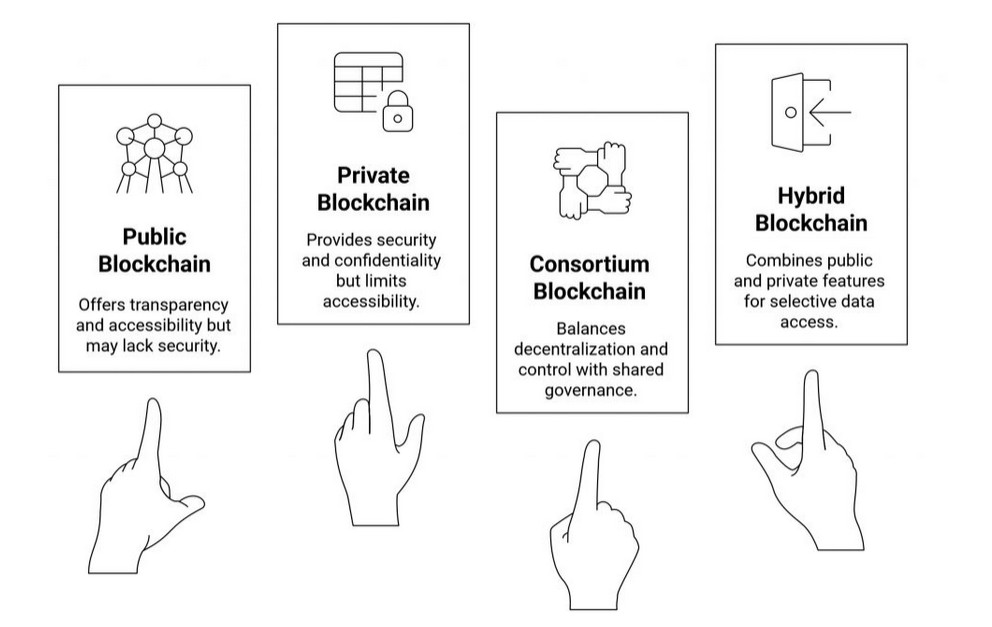
    Blockchain Technology

    Blockchain is a decentralized and distributed digital ledger technology that records transactions securely, transparently, and immutably across a network of computers.

    Key Features

    • Decentralization: No single central authority controls the data.
    • Transparency: Transactions are visible to all participants in the network.
    • Immutability: Once recorded, data cannot be altered easily.
    • Security: Uses cryptographic techniques to secure information.
    • Consensus Mechanism: Transactions are validated through mechanisms like Proof of Work (PoW) or Proof of Stake (PoS).
    [UPSC 2020] With reference to “Blockchain Technology” consider the following statements:
    1. It is a public ledger that everyone can inspect, but which no single user controls.
    2. The structure and design of blockchain is such that all the data in it are about cryptocurrency only.
    3. Applications that depend on basic features of blockchain can be developed without anybody’s permission.
    Which of the statements given above is/are correct?
    Options: (a) 1 only (b) 1 and 2 only (c) 2 only (d) 1 and 3 only*
  • Scientists use ‘Atomic Stencils’ to make designer Nanoparticles

    Why in the News?

    Scientists from the United States and South Korea have developed a novel “atomic stencilling” method to coat gold nanoparticles with polymer patches, enabling unprecedented nanoscale precision in material design.

    What is Atomic Stencilling?

    • Overview: A novel nanofabrication technique where iodide atoms act as nanoscale masks (stencils) on gold nanoparticle surfaces, allowing scientists to “paint” polymer patches with atomic-level precision.
    • Mechanism: These polymer-coated patches create distinct functional zones on each nanoparticle, enabling controlled self-assembly into complex 3D nanostructures.
    • Innovation Context: Represents a breakthrough in atomic-scale material patterning, advancing nanotechnology toward programmable matter and precision material design.

    Advantages Offered:

    • Atomic Precision: Achieves atomic-scale patterning, precisely controlling patch size, geometry, and placement.
    • High Uniformity: Generates identical nanoparticles for consistent, predictable self-assembly behaviour.
    • Scalability: Allows large-scale synthesis of patchy nanoparticles with simplified processing.
    • Material Versatility: Compatible with multiple materials — gold, silver, silica — and adaptable to various polymer coatings.
    • Enhanced Self-Assembly: Promotes spontaneous formation of ordered 3D superlattices and metamaterials.
    • Functional Tunability: Enables customisation of surface chemistry, optical, and electronic properties.

    Key Applications:

    • Targeted Drug Delivery: Functional patches enable selective binding and controlled release to specific biological targets.
    • Catalysis: Distinct surface domains improve reactivity and catalytic precision.
    • Optoelectronics & Photonics: Supports creation of plasmonic and light-responsive metamaterials.
    • Energy Systems: Enhances charge transfer and stability in batteries and solar cells.
    • Smart Materials: Forms basis for programmable, self-assembling nanostructures with adaptive functions.
    [UPSC 2022] Consider the following statements:
    1. Other than those made by humans, nanoparticles do not exist in nature.
    2. Nanoparticles of some metallic oxides are used in the manufacture of some cosmetics.
    3. Nanoparticles of some commercial products which enter the environment are unsafe for humans.
    Which of the statements given above is/are correct?
    Options: (a) 1 only (b) 3 only (c) 1 and 2 (d) 2 and 3 *


  • Tejas Light Combat Aircraft (LCA)-Mk1A

    Why in the News?

    Defence Minister inaugurated the third production line of Tejas Light Combat Aircraft (LCA) Mk1A at Hindustan Aeronautics Limited (HAL), Nashik.

    About Tejas Light Combat Aircraft (LCA)-Mk1A:

    • Overview: Single-engine, 4.5-generation, supersonic multirole fighter aircraft developed indigenously under India’s LCA programme.
    • Developers: Designed by the Aeronautical Development Agency (ADA) of DRDO and produced by Hindustan Aeronautics Limited (HAL).
    • Purpose: Conceived in the late 1980s to replace the ageing MiG-21 and Su-7 fleets of the Indian Air Force.
    • Operational Induction: Entered production for the Indian Air Force (IAF) in 2024 after extensive flight trials and certification.
    • Roles: Designed for air superiority, ground attack, close air support, and interception missions.
    • Manufacturing Hubs: Produced at HAL Bengaluru and HAL Nashik, with parallel assembly lines to meet IAF delivery targets.

    Key Features of Tejas LCA-Mk1A:

    • Design: Tailless compound delta-wing configuration ensuring high agility, aerodynamic efficiency, and reduced radar cross-section.
    • Engine: Powered by General Electric F404-GE-IN20 turbofan, enabling speeds up to Mach 1.8.
    • Avionics: Equipped with Active Electronically Scanned Array (AESA) radar, Electronic Warfare Suite, and Onboard Oxygen Generation System (OBOGS).
    • Flight Control: Features Digital Fly-by-Wire System for enhanced stability and pilot control.
    • Weapons Integration: Can carry air-to-air, air-to-ground, and precision-guided munitions, including Beyond Visual Range (BVR) missiles.
    • Cockpit: Modern glass cockpit with Helmet Mounted Display (HMD) and Hands-On-Throttle-And-Stick (HOTAS) controls.
    • Payload & Range: Payload capacity over 4,000 kg across eight external hardpoints; combat radius around 500 km, ferry range up to 1,700 km.
    • Network Capability: Integrated with secure data link systems for real-time communication and situational awareness.
    • Maintenance: Modular design allowing easy servicing, high turnaround rate, and improved mission readiness for sustained operations.
    [UPSC 2024] Consider the following aircraft:
    1. Rafael 2. MiG-29 3. Tejas MK-1
    How many of the above are considered fifth-generation fighter aircraft?
    Options: (a) Only one (b) Only two (c) All three (d) None*


  • Akash Missile System 

    Why in the News?

    India has pitched for the supply of the Akash missile system to Brazil.

    akash

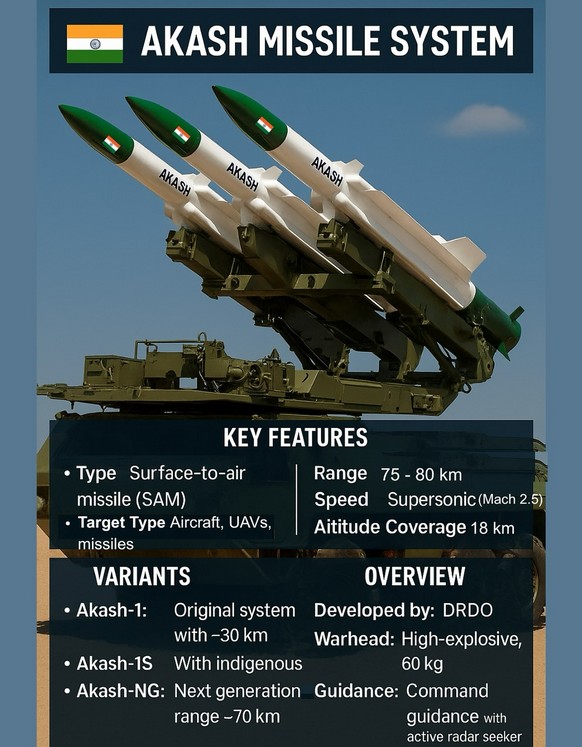
    About Akash Missile System:

    • Overview: Developed by the Defence Research and Development Organisation (DRDO) and manufactured by Bharat Dynamics Ltd (BDL).
    • Type: A short-range Surface-to-Air Missile (SAM) designed to defend against aircraft, UAVs, and helicopters.
    • Operational Users: Inducted by both the Indian Army and the Indian Air Force, forming part of India’s layered air defence grid.
    • Purpose: Protects vital assets from aerial threats within the short to medium range segment.
    • Deployment Mode: Mounted on mobile launchers for rapid positioning, flexibility, and operational agility.
    • Comparison: Functionally comparable to Israel’s Iron Dome, though Akash focuses on intercepting larger aerial targets rather than small projectiles.

    Key Features:

    • Range & Altitude: Effective range 4.5–25 km; altitude coverage 100 m–20 km.
    • Engagement Capacity: A single firing unit can engage four targets simultaneously in both autonomous and group modes.
    • Speed & Accuracy: Capable of high-speed interceptions with radar-guided precision.
    • Propulsion & Dimensions: Length 5.87 m, diameter 350 mm, weight 710 kg; powered by solid-fuel propulsion.
    • Automation: Fully automated system ensuring rapid reaction time from detection to neutralization.
    • ECCM Capability: Built-in Electronic Counter-Counter Measures (ECCM) to resist enemy jamming
    [UPSC 2023] Consider the following statements:

    1. Ballistic missiles are jet-propelled at subsonic speeds throughout their fights, while cruise missiles are rocket-powered only in the initial phase of flight.

    2. Agni-V is a medium-range supersonic cruise missile, while BrahMos is a solid-fuelled intercontinental ballistic missile.

    Which of the statements given above is/are correct?

    Options: (a) 1 only (b) 2 only (c) Both 1 and 2 (d) Neither 1 nor 2*


  • DRDO to extend Astra Mark 2’s range to 200 km

    Why in the News?

    The Defence Research and Development Organisation (DRDO) is developing an extended-range variant of the Astra Mark 2 beyond-visual-range (BVR) air-to-air missile.

    Astra Mark 2 Missile:

    • Overview: An indigenously developed Beyond Visual Range (BVR) air-to-air missile by the DRDO, enhancing the Indian Air Force’s long-range interception capability.
    • Lineage: Successor to Astra Mark 1 (range ~100 km); marks a leap in India’s self-reliance in advanced air combat systems.
    • Integration: Compatible with Su-30 MKI and LCA Tejas, with future integration planned for Rafale, AMCA, and TEDBF.
    • Industry Collaboration: Co-developed with over 50 industries, including Hindustan Aeronautics Limited (HAL) and Bharat Dynamics Limited (BDL).

    Key Features:

    • Dual-Pulse Propulsion: Incorporates dual-pulse solid rocket motor (vs. single-pulse in Mk-1) for sustained thrust and high terminal energy.
    • Range & Speed: Operational range of 150–200+ km, speed up to Mach 4.5, enabling engagement of fast aerial targets.
    • Guidance & Seeker: Equipped with indigenous RF seeker and Electronic Counter-Countermeasures (ECCM) for precision and survivability.
    • All-Weather & Agile: Works in day/night, adverse conditions; supports off-boresight targeting and mid-course data-link updates.
    • Stealth & Safety: Uses smokeless propulsion for reduced detectability during launch.

    Recent Upgrade:

    • Extended Range Variant: DRDO developing version exceeding 200 km, beyond initial 160 km design.
    • Strategic Parity: Comparable to Chinese PL-15 and US AIM-120D AMRAAM, reinforcing India’s deterrence capability.
    • Future Roadmap: Forms baseline for Astra Mark 3, featuring solid-fuel ducted ramjet propulsion, under Atmanirbhar Bharat in advanced missile systems.
    [UPSC 2023] Consider the following statements

    1. Ballistic missiles are jet-propelled at subsonic speeds throughout their fights, while cruise missiles are rocket-powered only in the initial phase of fight.

    2. Agni-V is a medium-range supersonic cruise missile, while BrahMos is a solid-fuelled intercontinental ballistic missile.

    Which of the statements given above is/are correct?

    (a) 1 only (b) 2 only (c) Both 1 and 2 (d) Neither 1 nor 2 *


  • RRI technique yields Certified Randomness with one Qubit

    Why in the News?

    The Raman Research Institute (RRI), Bengaluru team has mastered the Leggett–Garg Inequality (LGI)–based quantum randomness certification technique.

    What is Quantum Randomness?

    • Overview: Quantum randomness means true unpredictability, results that even nature or science cannot predetermine. They arise from the laws of quantum physics, not from computer programs or hidden causes.
    • Ordinary Computers: In normal computers, random numbers come from formulas called pseudorandom generators. They look random but can be predicted if someone knows the starting point (the “seed”).
    • Quantum Systems: In quantum physics, when you measure something tiny, like the spin of an electron or the path of a light particle (photon), the result is decided only at the moment of measurement. No one, not even nature, “knows” the answer before that.
    • Why it Matters: True randomness is important for data security, safe online transactions, scientific research, and encryption, where predictability can lead to hacking or errors.

    What has RRI achieved?

    • Discovery: Scientists at the Raman Research Institute (RRI), Bengaluru, led by Prof. Urbasi Sinha, have found a way to create and verify true quantum randomness using a regular cloud-based IBM quantum computer.
    • Why it’s Important: Earlier, proving quantum randomness needed expensive lab equipment. Now it can be done remotely and cheaply, accessible to anyone with internet and quantum cloud access.
    • How it Works: The RRI team used just one qubit (the quantum version of a computer bit) to show that the randomness came from quantum effects, not from hardware noise or computer errors.
    • Key Finding: This demonstrates that even imperfect quantum computers can still generate trustworthy and verifiable random numbers, a capability that classical computers cannot achieve.

    What is the Leggett–Garg Inequality (LGI)–Based Test?

    • Basic Idea: The Leggett–Garg Inequality (LGI) is a scientific test that checks whether something behaves like everyday objects (predictable) or like quantum systems (unpredictable).
    • How it was Used: The RRI scientists measured one qubit at three different times to see if its behavior followed normal physics or quantum rules.
    • Two Conditions Checked:
      • LGI Violation – confirmed the qubit was behaving in a truly quantum way.
      • No Signalling in Time – ensured that each measurement was independent and not influenced by the previous one.
    • Result: Meeting both tests proved that the numbers generated were certified as truly random, coming purely from quantum physics, not from any background noise or interference.

    Real-life Applications:

    • Cybersecurity: Such randomness can make unbreakable encryption keys, protecting sensitive data from hackers.
    • Cloud Computing: People using quantum computers online can now access trusted random numbers for research or secure systems anywhere in the world.
    • Testing Quantum Machines: Helps scientists check the quality of quantum computers, since randomness shows how genuinely quantum the machine is.
    • Better Science: Used in simulations, artificial intelligence, and data analysis where unpredictability makes results more reliable.
    • Big Scientific Message: Confirms that the quantum world is truly uncertain, proving one of the most fascinating truths of modern science, that randomness is built into nature itself.
    [UPSC 2025] Consider the following statements:

    I. It is expected that Majorana 1 chip will enable quantum computing.

    II. Majorana 1 chip has been introduced by Amazon Web Services (AWS).

    III. Deep learning is machine learning.

    How many of the statements given above are correct?

    (a) I and II only (b) II and III only (c) I and III only * (d) I, II and III