💥Mains Ready By December. Smash Mains & Smash PYQ Admissions Open

Subject: Local Self-Government

  • Analyse the role of local bodies in providing good governance at local level and bring out the pros and cons merging the rural local bodies with the urban local bodies.

    73rd and 74th CAA are the embodiment of grass-root democracy and democratic decentralization in India. They are inspired by Gandhiji’s concept of “Oceanic Circles of Power” and “Swaraj”.

    Role of Local Bodies in Ensuring Good Governance

    Citizen Participation in planning and decision-making through Gram Sabhas and Ward Committees. Eg- Kerala’s people plan campaign

    Transparency- Eg- Social audits under MGNREGA enhance transparency in fund utilization.

    Accountability- Elected representatives are directly answerable to citizens.

    Effectiveness and Efficiency- Proximity to citizens allows timely service delivery in areas like sanitation, water supply, and waste management.

    Equity and Inclusion through reservation for SCs, STs, OBCs, and women. Eg- Women’s Representation at 46.44%

    Responsiveness during Disasters. Eg- COVID-19 management and disaster relief in Kerala.

    Rule of Law- Local bodies function under constitutional and legal mandates of the 73rd and 74th Amendments, ensuring lawful governance.

    Consensus-Oriented Governance- Gram Sabhas and District Planning Committees promote coordination and collective decision-making.

    Sustainability- service delivery in waste recycling and water conservation. Eg- Hiware Bazar Model of watershed development.

    Challenges

    “PRIs exist as over-structured but underpowered organisations.” (2nd ARC)

    No decentralisation of power, rather decentralisation of corruption – Mani Shankar Iyer Committee

    Limited own-source revenue- Poor tax collection efficiency (>1% own tax).

    Incomplete devolution- less than 20% of States have transferred all 29 subjects under 11th Schedule (MoPR, 2022). (​​overall Panchayat Devolution Index is only 43.89% (2021-22))

    Weak Gram Sabhas- Low participation, elite domination, and token meetings.

    Gender and social barriers leading to proxy control. (Sarpanch Pati)

    Pros of Merging Rural and Urban Local Bodies

    Integrated Regional Planning – Addresses rurban challenges and ensures seamless infrastructure and service delivery.

    Uniform Standards of Governance – Streamlines policies, taxation, and land-use planning.

    Efficient Resource Utilization – Shared funding and manpower reduce duplication.

    Better Management of Peri-Urban Areas – Urban expansion can be better planned and regulated.

    Cons of Merging Rural and Urban Local Bodies

    Dilution of Constitutional Intent under 73rd and 74th Amendments.

    Political Resistance – Power redistribution may face bureaucratic and political opposition.

    Administrative Complexity due to different laws, tax systems, and governance mechanisms.

    Urban areas may dominate resource allocation and decision-making.

    Local bodies are the cornerstones of participatory democracy and good governance. A functional convergence, not structural merger, aligns better with India’s constitutional vision of decentralization.

  • Consider the following statements

    Consider the following statements:
    1. The minimum age prescribed for any person to be a member of Panchayat is 25 years.
    2. A Panchayat reconstituted after premature dissolution continues only for the remainder period.
    Which of the statements given above is/are correct?

  • Consider the following statements

    Consider the following statements:

    I. Panchayats at the intermediate level exist in all States.
    II. To be eligible to be a Member of a Panchayat at the intermediate level, a person should attain the age of thirty years.
    III. The Chief Minister of a State constitutes a commission to review the financial position of Panchayats at the intermediate levels and to make recommendations regarding the distribution of net proceeds of taxes and duties, leviable by the State, between the State and Panchayats at the intermediate level.

    Which of the statements given above are not correct?

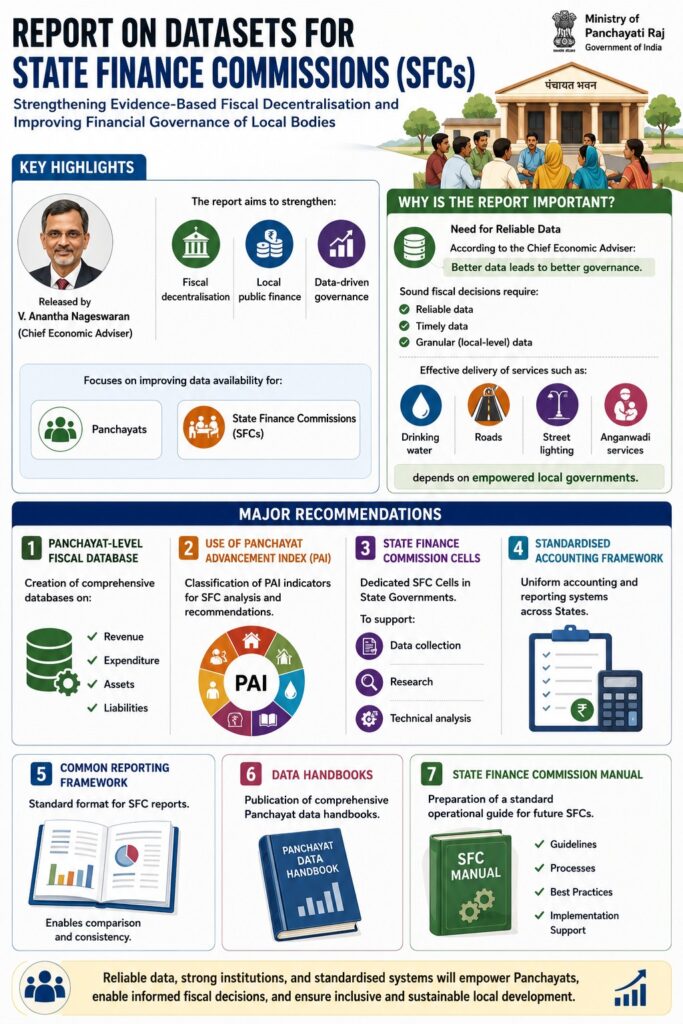
  • Report on Datasets for State Finance Commissions (SFCs)

    Why in the news?

    The Ministry of Panchayati Raj released the Report of the Committee on Datasets for State Finance Commissions to strengthen evidence-based fiscal decentralisation and improve financial governance of local bodies.

    Key Highlights

    • Released by V. Anantha Nageswaran.
    • The report aims to strengthen: Fiscal decentralisation, Local public finance, and Data-driven governance
    • Focuses on improving data availability for Panchayats and State Finance Commissions (SFCs)

    Why is the Report Important?

    According to the Chief Economic Adviser:

    • Better data leads to better governance.
    • Sound fiscal decisions require: Reliable data, Timely data, and Granular (local-level) data
    • Effective delivery of services such as: Drinking water, Roads, Street lighting, Anganwadi services depend on empowered local governments.

    Major Recommendations

    • Panchayat-Level Fiscal Database: Creation of comprehensive databases on: Revenue, Expenditure, Assets, Liabilities.
    • Use of Panchayat Advancement Index (PAI): Classification of PAI indicators for SFC analysis and recommendations.
    • State Finance Commission Cells: Dedicated SFC Cells in State Governments, to support: Data collection, Research, Technical analysis
    • Standardised Accounting Framework: Uniform accounting and reporting systems across States.
    • Common Reporting Framework: Standard format for SFC reports. Enables comparison and consistency.
    • Data Handbooks: Publication of comprehensive Panchayat data handbooks.
    • State Finance Commission Manual: Preparation of a standard operational guide for future SFCs.

    State Finance Commission (SFC)

    • Constitutional Basis: Article 243-I: Provides for constitution of a State Finance Commission by the Governor every five years.
    • Functions
      • Review financial position of Panchayats.
      • Recommend distribution of State taxes, Duties, Tolls, Fees between State Government and local bodies.
      • Suggest measures to improve local finances.

    [2025] Consider the following statements :
    I. Panchayats at the intermediate level exist in all States.
    II. To be eligible to be a Member of a Panchayat at the intermediate level, a person should attain the age of thirty years.
    III. The Chief Minister of a State constitutes a commission to review the financial position of Panchayats at the intermediate levels and to make recommendations regarding the distribution of net proceeds of taxes and duties, leviable by the State, between the State and Panchayats at the intermediate level.
    Which of the statements given above are not correct?

    [A] I and II only

    [B] II and III only

    [C] I and III only

    [D] I, II and III

  • In India, the first Municipal Corporation was set up in which one among the following

    In India, the first Municipal Corporation was set up in which one among the following:

  • If a Panchayat is dissolved, elections are to be held within

    If a Panchayat is dissolved, elections are to be held within:

  • Which one of the following authorities makes recommendation to the Governor of a State as to the principles for determining the taxes and duties which may be appropriated by the Panchayats in that particular State

    Which one of the following authorities makes recommendation to the Governor of a State as to the principles for determining the taxes and duties which may be appropriated by the Panchayats in that particular State?

  • The Constitution (Seventy-Third Amendment) Act, 1992, which aims at promoting the Panchayati Raj Institutions in the country, provides for which of the following

    The Constitution (Seventy-Third Amendment) Act, 1992, which aims at promoting the Panchayati Raj Institutions in the country, provides for which of the following?
    1. Constitution of District Planning Committees.
    2. State Election Commissions to conduct all Panchayat elections.
    3. Establishment of State Finance Commissions. Select the correct answer using the code given below:

  • Consider the following statements: In India, a Metropolitan Planning Committee

    Consider the following statements: In India, a Metropolitan Planning Committee
    1. is constituted under the provisions of the Constitution of India.
    2. prepares the draft development plans for the metropolitan area.
    3. has the sole responsibility for implementing Government sponsored schemes in the metropolitan area.
    Which of the statements given above is/are correct?

  • The fundamental object of Panchayati Raj system is to ensure which among the following

    The fundamental object of Panchayati Raj system is to ensure which among the following?
    (1) People’s participation in development
    (2) Political accountability
    (3) Democratic decentralization
    (4) Financial mobilization
    Select the correct answer using the code given below.