| PYQ Relevance [UPSC 2022] Reforming the government delivery system through the Direct Benefit Transfer Scheme is a progressive step, but it has its limitations too. Comment. Linkage: The PYQ Examines DBT-based welfare delivery, fiscal sustainability, and the trade-off between welfare transfers and human-capital expenditure. The article highlights the trade-off between cash transfers and spending on education, health and development. |
Mentor’s Comment
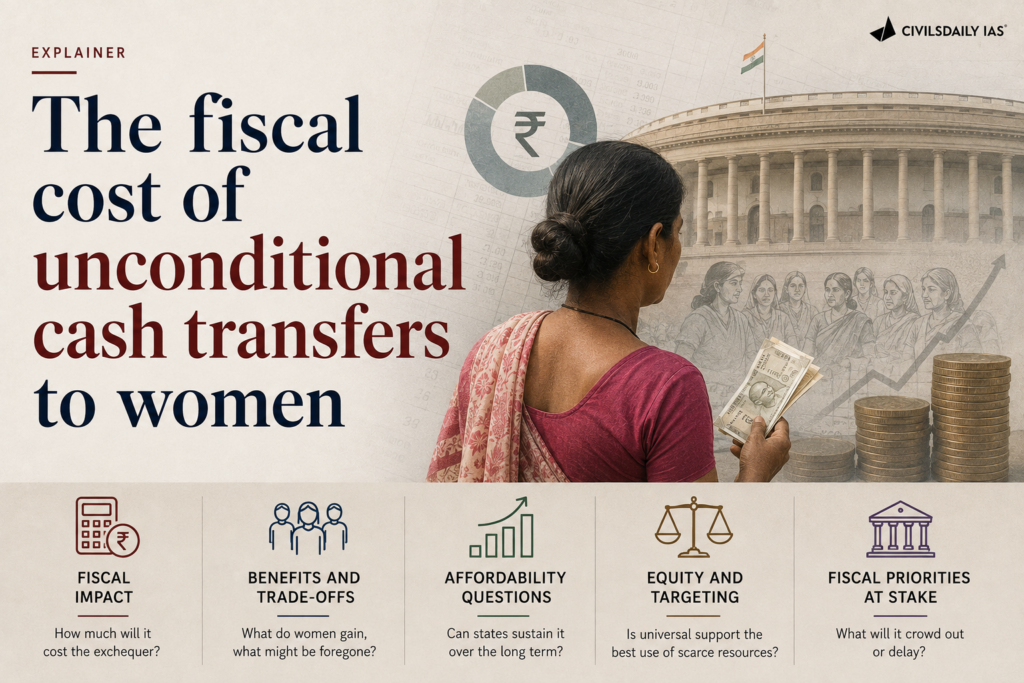
Delhi rolled out the Lakshmi Yojana on August 1, an unconditional cash transfer (UCT) of ₹2,500 a month for eligible women, joining a rapidly growing list of States running similar schemes since 2023. Fresh State-wise expenditure data show that in several States this spending already exceeds the entire education or health budget, reopening the question of what these transfers displace. The concern is set against the 16th Finance Commission’s award period.
What is an unconditional cash transfer?
- Definition: A UCT is a direct income payment to a beneficiary with no work, attendance, or behaviour condition attached, unlike a conditional transfer or an in-kind subsidy.
- This wave: The current schemes target women with a fixed monthly sum, framed as income support rather than a service.
Why are states rushing to launch women’s UCT schemes?
- Electoral promise: Most schemes were pledged at assembly elections and rolled out immediately, drawing the label of a pre-poll dole.
- Near-universal spread: From 2023 onward almost every major state added a scheme, making it politically hard for any state to abstain.
- Compensation framing: Some argue the transfers compensate women for the state’s failure to create broad opportunity and services.
Are these transfers a benefit to women or a burden on states?
- Used productively: Evaluations show women mostly spend the money on food, health and education, so the transfer reaches real welfare needs.
- Fiscal pressure: The same spending expands a recurring liability that presses on existing health and education budgets.
- Genuine trade-off: The tension is real, the cash is used well by recipients yet competes with the public services those recipients depend on.
How much fiscal space do states actually have?
- Committed spending: The 16th Finance Commission notes almost 44% of state expenditure is locked in interest payments, pensions and salaries.
- Shrinking social share: Social sector revenue expenditure has stayed stable as a share of total spending since 2011-12 but has declined as a share of GDP since 2020-21.
- Little room: With most of the budget pre-committed, new UCT outlays crowd against fresh investment in services and infrastructure.
How large are these schemes across states?
- Share of total spending: UCT outlays range from 10.03% of total expenditure in Jharkhand and 7.84% in West Bengal down to 0.97% in Goa and 0.26% in Himachal Pradesh.
- Share of education spending: In the largest-scheme states the UCT bill exceeds half the entire education budget, near 74% in Jharkhand and Karnataka and 54% in West Bengal.
- Named schemes and amounts: Karnataka Gruha Lakshmi (Rs 2,000), Madhya Pradesh Ladli Behna (Rs 1,500), Tamil Nadu Kalaignar Magalir Urimai Thogai (Rs 1,000), Maharashtra Majhi Ladki Bahin (Rs 1,500), Jharkhand Maiya Samman (Rs 2,500), Odisha Subhadra (Rs 10,000 a year), Assam Orunodoi (Rs 1,250), and Delhi Lakshmi Yojana (Rs 2,500).
Do the transfers reach the poorest, or do barriers exclude them?
- Rationalisation cuts: Maharashtra and Madhya Pradesh have reduced beneficiary numbers in the name of rationalisation.
- Gatekeeping criteria: Delhi’s scheme requires a recommendation from the local MLA or MP, plausibly to cap numbers before rollout.
- Access barriers: Lack of documents, weak bank access and errors in digital records still exclude eligible women.
Conclusion:
The transfers are used well by the women who receive them, but states have little fiscal room, since most spending is pre-committed and the social sector share of GDP is already falling. Without new resource mobilisation, the schemes are financed by squeezing the very education and health services their beneficiaries rely on. The unresolved question is whether states raise revenue to fund them or let public services erode.
Back2Basics: 16th Finance Commission
- Award period: The 16th Finance Commission’s recommendations cover the five years beginning 2026-27.
- What it is: A constitutional body under Article 280, constituted every five years.
- Mandate: Recommends the sharing of central taxes between the Centre and states (vertical devolution) and among states (horizontal devolution), plus grants-in-aid.
[2022, GS2, 10 marks] Reforming the government delivery system through the Direct Benefit Transfer Scheme is a progressive step, but it has its limitations too. Comment.