The Foreign Contribution (Regulation) Amendment Bill, 2026 was referred to a Joint Parliamentary Committee (JPC). The referral has renewed attention on how parliamentary committees shape legislation.
What is a Joint Parliamentary Committee?
Ad hoc committee: A JPC is set up for a specific bill or inquiry and dissolves after it reports.
Composition: Members are drawn from both Houses, in proportion to party strength.
Recommendations: Its recommendations are advisory, not binding on the government.
Why does the committee route matter?
Scrutiny space: Committees allow detailed, less partisan examination away from the floor.
Declining use: Bills referred to committees fell from about 71% in the 15th Lok Sabha to about 16% in the 17th.
Delay lever: Referral can also defer a contentious bill.
What is contested in the FCRA amendment?
Foreign funding control: The Foreign Contribution (Regulation) Act, 2010 governs foreign donations to NGOs and associations.
Civil society concern: Tighter rules are opposed as constraining non-governmental organisations and religious bodies.
Conclusion
The referral subjects a contested bill to committee scrutiny without settling it. The current status is examination by the JPC, with its report the next milestone.
Back2Basics: Parliamentary Committees
Standing committees: Permanent bodies such as the Public Accounts Committee and departmental committees.
Ad hoc committees: Temporary bodies such as a JPC or a Select Committee.
Financial committees: Public Accounts Committee, Estimates Committee, and Committee on Public Undertakings.
“[2023, GS2, 15] Explain the structure of the Parliamentary Committee system. How far have the financial committees helped in the institutionalization of Indian Parliament?”
[2018] With reference to the Parliament of India, which of the following Parliamentary Committees scrutinizes and reports to the House whether the powers to make regulations, rules, sub-rules, by-laws etc. conferred by the constitution of delegated by the Parliament are being properly exercised by the Executive within the scope of such delegation ?
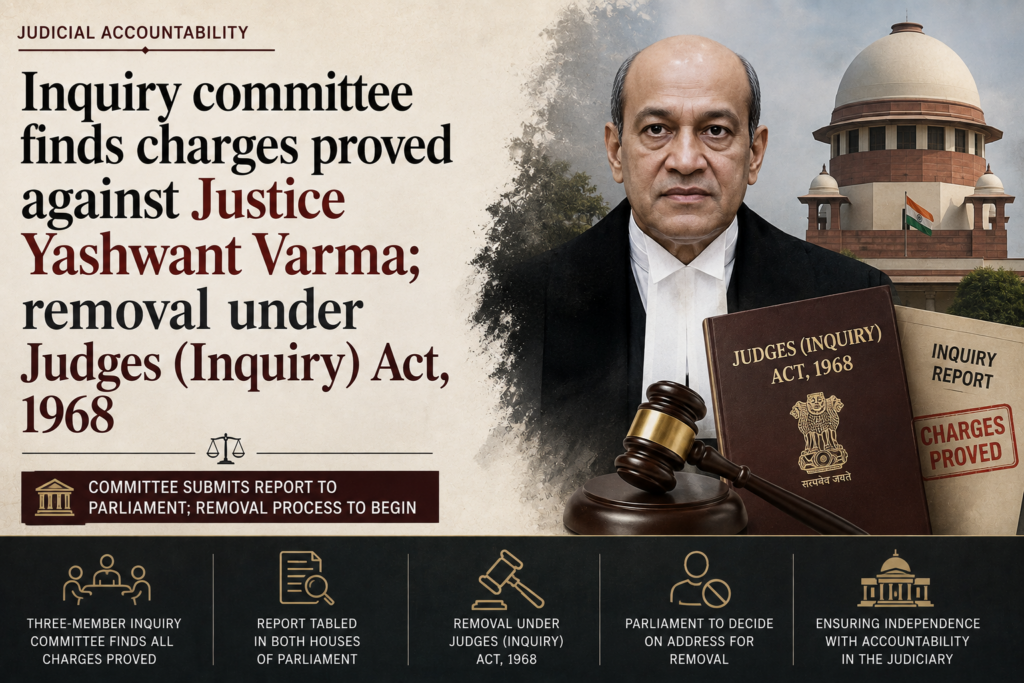
A parliamentary inquiry committee found all three charges proved against a former High Court judge, including failure to explain cash recovered from his residence and interference with evidence. The issue is whether the removal process can continue after his resignation.
Removal of Judges: Constitutional Framework
Article 124(4): Supreme Court judges can be removed only for proved misbehaviour or incapacity.
Article 217: Deals with the tenure and removal of High Court judges.
Judges (Inquiry) Act, 1968: Provides the inquiry mechanism and formulation of charges.
Parliamentary approval: Removal requires a special majority in each House, in the same session.
Final step: After Parliament passes the address, the President issues the removal order.
What did the Inquiry Committee Find?
All three charges were proved.
The judge failed to satisfactorily explain the cash recovered from his residence.
The committee found attempts to interfere with evidence.
Key Constitutional Issue After Resignation
Removal is primarily linked to holding judicial office.
Resignation ends the judge’s tenure, creating a question about whether Parliament can still complete the removal process.
Possible consequences involving pension or future disqualification make the issue constitutionally significant.
There is no settled precedent on completing the removal process against a judge who has already resigned.
Prelims Facts
Ground for removal → Proved misbehaviour or incapacity
High Court judge → Article 217
Supreme Court judge → Article 124
Inquiry procedure → Judges (Inquiry) Act, 1968
Removal requires → Special majority in both Houses
Final removal order → President
Policy disagreement → Not a ground for removal
Historical fact → No Indian judge has so far been removed after completion of the parliamentary removal process.
“[2025, GS2, 15] “Constitutional morality is the fulcrum which acts as an essential check upon the high functionaries and citizens alike…” In view of the above observation of the Supreme Court, explain the concept of constitutional morality and its application to ensure balance between judicial independence and judicial accountability in India.”
[2021] With reference to Indian Judiciary, consider the following statements: 1. Any retired judge of the Supreme Court of India can be called back to sit and act as a Supreme Court judge by the Chief Justice of India with prior permission of the president of India. 2. A High Court in India has the power to review its own judgement as the Supreme Court does. Which of the statements given above is/are correct?
An explainer revisits the constitutional limits on arrest after a 2025 Supreme Court ruling. It reaffirms that an arrested person must be meaningfully informed of the grounds of arrest.
What does Article 22 guarantee on arrest?
Grounds of arrest:Article 22(1) requires that grounds be communicated meaningfully, not as a formality.
Legal counsel: The arrested person has the right to consult a lawyer of choice.
Production before magistrate:Article 22(2) requires production within 24 hours of arrest.
No prolonged custody: Continued detention beyond 24 hours requires Magistrate’s authorisation.
Exception: These safeguards under Article 22(1) and 22(2) do not apply to enemy aliens and persons detained under preventive detention laws under Article 22(3).
What did the recent ruling and precedents establish?
Vihaan Kumar (2025): The Court held that failure to communicate grounds vitiates the arrest.
Arnesh Kumar (2014): Arrest must be the exception for offences carrying up to seven years, not routine.
D.K. Basu (1997): The Court prescribed safeguards including an arrest memo, informing relatives and medical examination to prevent custodial abuse.
Arrest memo: Procedural safeguards require a documented arrest memo.
What did the Supreme Court Rule in Vihaan Kumar Case?
The judgment of the Supreme Court of India (Supreme Court) in the case of Vihan Kumar vs. State of Haryana (2025) marked a crucial milestone in protecting the fundamental rights of arrested persons.
Mandatory information about the reasons for arrest: The Supreme Court has made it clear that the person arrested must be informed of the reasons for his arrest immediately. This is a fundamental right guaranteed under Article 22(1) of the Constitution.
Arrest is invalid: If the accused is not informed of the reasons for the arrest, the arrest becomes illegal and unconstitutional.
Cancellation of further proceedings: If fundamental rights are violated during the arrest process itself, subsequent remand orders issued by the courts or charge sheets filed by the police cannot rectify that mistake (Vitiated).
Language awareness: The reasons for the arrest should be communicated in a language that the accused understands, and should not be a mere formality.
Human rights and dignity (Article 21)
Ban on shackles in hospitals: The Supreme Court has strongly condemned the practice of shackles and chains on Vihan Kumar when he was admitted to the hospital due to medical reasons.
Right to Life: The court held that the right to live with dignity is part of Article 21 , and chaining the accused to a hospital bed falls under the category of human rights violation.
How is preventive detention different?
Without trial: Preventive detention permits custody without a charge to prevent an anticipated act.
Advisory Board: Detention beyond three months requires review by an Advisory Board.
Narrow safeguards: Several ordinary arrest protections under Article 22 do not apply to preventive detention.
Preventive: Unlike ordinary detention, it is not punitive. It is intended to prevent an anticipated act prejudicial to specified interests.
No 24-hour Magistrate requirement under Article 22(3).
Grounds of detention must generally be communicated, subject to non-disclosure in public interest.
What is the “Golden Triangle”?
Articles 14, 19, 21: Together they form the core of personal liberty jurisprudence.
Maneka Gandhi (1978): Established that a law depriving personal liberty must prescribe a procedure that is just, fair and reasonable.
Article 22: Provides specific procedural safeguards against arbitrary arrest and detention, complementing the broader protection under Article 21.
Conclusion
The ruling restates settled safeguards and closes an enforcement gap on communicating arrest grounds. It sharpens the line between lawful arrest and arbitrary detention.
PYQ Relevance
[UPSC 2023] “The Constitution of India is a living instrument with capabilities of enormous dynamism. It is a constitution made for a progressive society.” Illustrate with special reference to the expanding horizons of the right to life and personal liberty.
Linkage: The PYQ examines the expanding scope of the right to life and personal liberty under Article 21. Arrest safeguards and preventive-detention limits show how judicial interpretation strengthens protection against arbitrary deprivation of liberty.
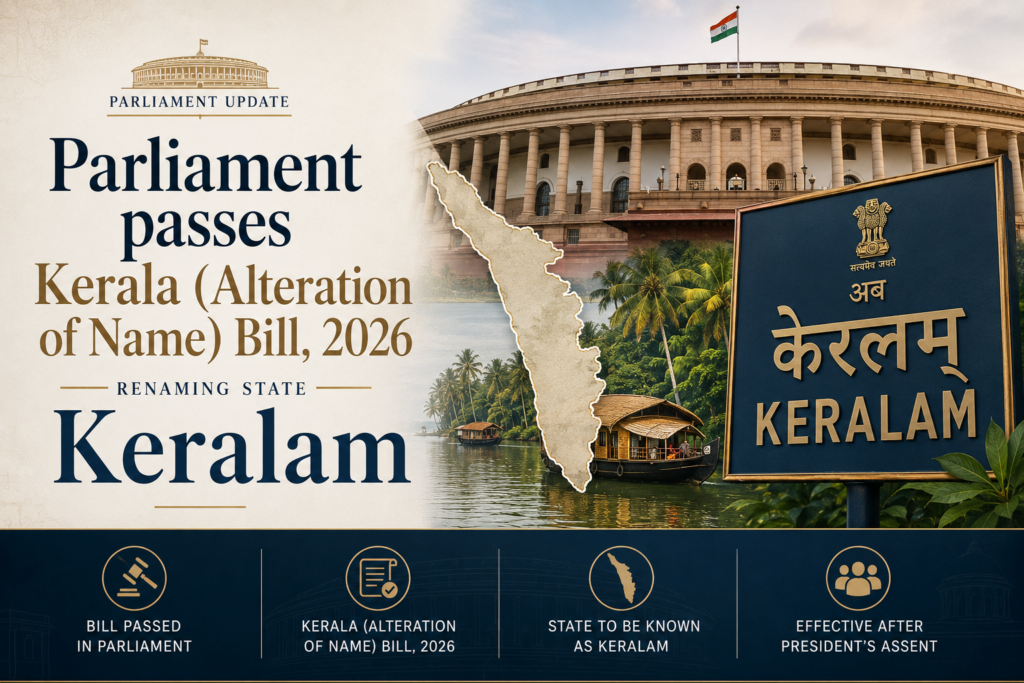
Both Houses passed a Bill to rename Kerala as “Keralam”, its name in Malayalam. The change follows two resolutions of the Kerala Assembly and routes through the constitutional process for altering a state’s name.
How is a state renamed under the Constitution?
Parliament’s power: Under Article 3, Parliament can alter the name of a state by law.
Presidential referral: Such a Bill needs the President’s recommendation and the views of the affected state legislature.
Simple majority: The change is passed by ordinary legislative majority, not a constitutional amendment.
Why “Keralam”?
Linguistic identity: “Keralam” is the state’s name in Malayalam, and the change aligns official usage with local usage.
Assembly resolutions: The Kerala Assembly twice sought the change unanimously.
Why does the process matter?
Union primacy: Only Parliament, not the state, can effect the legal renaming.
Federal courtesy: The state legislature’s view is sought, but its resolution is not binding.
Back2Basics: Article 3 of the Constitution
Scope: Formation of new states and alteration of areas, boundaries, or names of existing states.
Initiation: Only on the President’s recommendation, after seeking the state legislature’s views.
Nature: Treated as an ordinary law, reflecting the “indestructible states” feature of Indian federalism.
“[2022, GS1, 15] The political and administrative reorganization of states and territories has been a continuous ongoing process since the mid-nineteenth century. Discuss with examples.”
[2025] Consider the following pairs : State:Description 1. Arunachal Pradesh: The capital is named after a fort, and the state has two National Parks 2. Nagaland: The State came into Existence on the basis of a Constitutional Amendment Act. 3. Tripura: Initially a Part ‘C’ State, it became a centrally administered territory with the reorganization of State in 1956 and later attained the status of a full-fledged State How many of the above pairs are correctly matched?
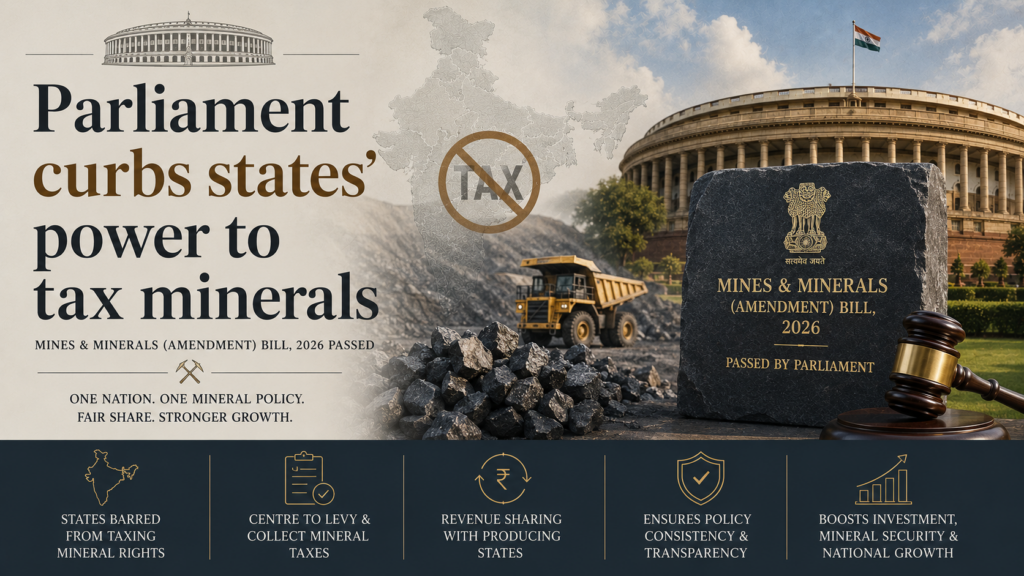
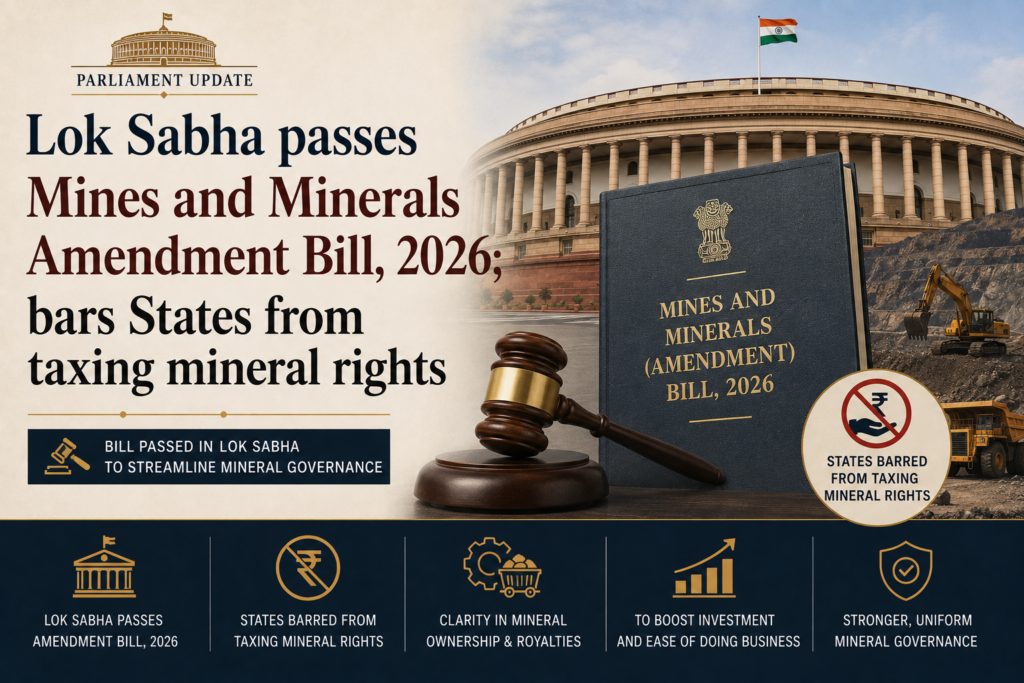
Parliament passed the Mines and Minerals (Development and Regulation) Amendment Bill, 2026. It bars states from imposing specified levies on mineral rights except on terms set by the Centre, reopening a fiscal federalism dispute.
What does the Mines and Minerals (Development and Regulation) Amendment Bill, 2026 do?
Levy restriction: States cannot impose specified taxes on mineral rights or mineral-bearing land except as the Centre prescribes.
Dues extinguished: Pre-amendment dues estimated near 2 lakh crore rupees stand extinguished.
Scope: The Bill applies to major minerals such as iron ore, coal, bauxite, manganese, and copper.
Why is this a fiscal federalism flashpoint?
2024 ruling reversed in effect: The Supreme Court in 2024 upheld states’ power to tax mineral rights, which the Bill now constrains.
Revenue dependence: Mining was 84.9% of Jharkhand’s non-tax revenue in 2024-25.
Mineral-rich states hit: States holding large mineral reserves lose an expected revenue stream.
What is the Centre’s justification?
Uniform rates: The government argues uniform mineral rates prevent a patchwork of state levies.
No revenue loss claim: The Centre states that states retain powers over minor minerals.
Investment climate: Predictable levies are framed as protecting mining-sector investment.
What are the major debates surrounding it?
Tax versus royalty: The dispute turns on whether a levy on minerals is a tax or a royalty, which the 2024 ruling addressed.
Tribal concerns: Mineral belts overlap with Scheduled Areas, raising questions of local benefit-sharing.
Divisible resource control: Centralising mineral levies shifts fiscal power toward the Union.
Conclusion
The amendment centralises control over mineral taxation soon after the Supreme Court affirmed states’ taxing power. The immediate stage is enactment, with a likely constitutional challenge the next development.
Back2Basics
Constitutional Framework Governing mineral taxation
Entry 50, State List: Taxes on mineral rights, subject to Parliament’s limitations relating to mineral development.
Entry 54, Union List: Regulation of mines and mineral development declared expedient in public interest.
Article 246: Distributes legislative power between Union and states via the Seventh Schedule.
What did the Supreme Court hold in 2024?
The Mineral Area Development Authority v. SAIL judgment is the constitutional backdrop to the 2026 amendment. The 9-judge Constitution Bench, by 8:1 majority, held that royalty is not a tax and that States have legislative competence to tax mineral rights under Entry 50, State List. It also recognised the States’ power to tax mineral-bearing land under Entry 49, State List.
Royalty ≠ Tax: Royalty paid under the MMDR Act is consideration for the right to extract minerals and is distinct from a tax.
State Taxing Power: States can impose taxes on mineral rights under Entry 50, List II, subject to limitations imposed by Parliament.
Mineral-Bearing Land: States can also levy taxes on land under Entry 49, List II.
MMDR Limitation: The Court held that the MMDR Act, as it then stood, did not impose a limitation on the States’ taxing power.
Why is the 2026 Amendment significant?
The 2026 amendment seeks to alter this position prospectively by restricting State taxation of mineral rights and mineral-bearing lands, except in accordance with conditions or restrictions prescribed by the Centre
PYQ Relevance
[UPSC 2025] Examine the evolving pattern of Centre-State financial relations in the context of planned development in India. How far have the recent reforms impacted the fiscal federalism in India?
Linkage: The 2025 PYQ examines the evolution of Centre–State financial relations and their impact on fiscal federalism. The Bill raises fresh concerns over the Union’s role in restricting States’ mineral revenue powers and fiscal autonomy.
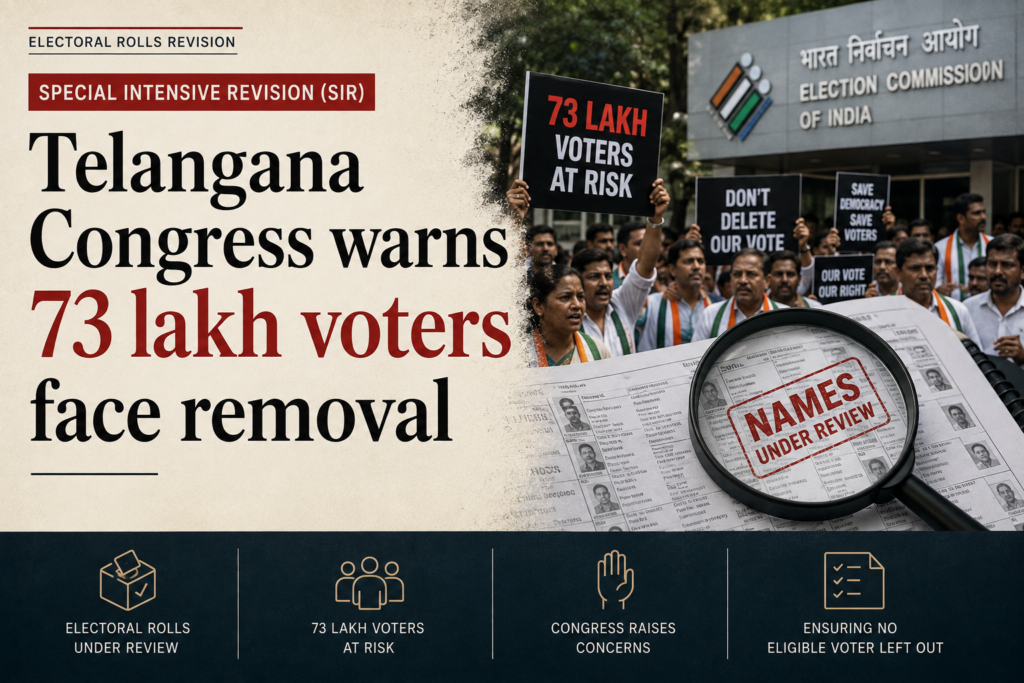
The Telangana Pradesh Congress Committee urged the Election Commission to re verify the 73 lakh voters proposed for deletion under the ongoing Special Intensive Revision (SIR) in the State. The controversy has exposed a tension between an inclusion driven history of the franchise and a revision that critics say works on a presumption of exclusion. The draft voters’ list is due on 17 August.
What is the Special Intensive Revision (SIR)?
Definition: The Special Intensive Revision is an exercise by the Election Commission to intensively update and verify electoral rolls, involving field verification of existing electors.
Deletion mechanism: Electors flagged as ineligible or unverified are proposed for deletion and published in a draft roll for objection.
Onus on the elector: The revision requires electors to establish continued eligibility, which critics read as a presumption of exclusion.
What is the Election Commission of India?
Constitutional authority: The Election Commission of India is the constitutional body under Article 324 responsible for superintendence, direction and control of the preparation of electoral rolls and the conduct of elections.
Composition: It presently functions as a multi member body of the Chief Election Commissioner and Election Commissioners.
Roll preparation: It prepares and periodically revises the electoral rolls on which the franchise depends.
What is the current status of the franchise and roll revision in India?
Universal adult franchise: Every citizen aged 18 and above is entitled to be registered as a voter, an entitlement extended from age 21 originally.
Historical inclusion drive: In the first election of 1952 the Commission worked to register 80 million eligible women, though 2.8 million were struck off for refusing to be recorded by name rather than as the wife or daughter of a man.
Gender gap closed: The gender gap in voting closed by 2019, marking the maturation of electoral equality into lived equality.
Draft roll timeline: In Telangana the draft roll is scheduled for 17 August, with 73 lakh electors proposed for deletion under the SIR.
Constitutional provisions related to elections and the electoral roll:
Article 324: Vests superintendence, direction and control of elections and roll preparation in the Election Commission.
Article 325: Bars exclusion from the electoral roll on grounds of religion, race, caste or sex, and provides one general roll for every constituency.
Article 326: Establishes elections to the House of the People and State Assemblies on the basis of adult suffrage.
Article 327: Empowers Parliament to make provision on all matters relating to elections, including preparation of electoral rolls.
What are the concerns raised in Telangana?
Scale of proposed deletion: The Telangana Congress flagged 73 lakh voters proposed for deletion and sought detailed re verification before any removal.
Genuine electors at risk: It maintained that genuine electors should not be removed without thorough scrutiny.
Opportunity to establish eligibility: It demanded that every genuine voter be given a chance to establish eligibility before deletion.
Draft roll deadline pressure: With the draft list due on 17 August, the window to correct wrongful deletions is compressed.
Why does the revision reopen the inclusion versus exclusion tension?
Presumption of exclusion: The current SIR appears to work on the presumption of exclusion, in contrast to the 1952 drive that worked to include the eligible.
Own name weaponised: Ownership of one’s own name, which historically announced gender electoral equality, has been turned against women in online attacks on female protesters.
Gendered doxxing: Women who joined recent protests were doxxed, with names, numbers and addresses uploaded and abuse directed at them.
Paternalistic framing: Public remarks singling out the conduct of women protesters divided the participants along gendered lines while ignoring identical conduct by men.
Erosion of an old promise: The revision and the online abuse together strain the founding promise of equality regardless of gender.
What are the major debates surrounding electoral roll revision?
Purity versus inclusion: A roll must exclude ineligible entries while not disenfranchising genuine electors, and the SIR is contested on which side it errs.
Burden of proof: Placing the onus on the elector to prove eligibility risks excluding the poor, the mobile and the marginalised.
Timeline adequacy: A compressed objection window after a large proposed deletion raises due process concerns.
Federal and political friction: State units allege that mass deletions fall unevenly, injecting the revision into electoral competition.
Conclusion: The SIR in Telangana has proposed 73 lakh voters for deletion, and the State Congress has demanded re verification before any removal. The dispute turns on whether the revision presumes inclusion or exclusion of the eligible voter. The draft rolls are due on 17 August, after which the objection and correction process will determine the final deletions.
Back2Basics: Election Commission of India
Constitutional basis: Article 324, with the Commission established on 25 January 1950.
Composition: Chief Election Commissioner and such number of Election Commissioners as the President fixes, currently a multi member body.
Tenure and removal: The Chief Election Commissioner is removable only by the process applicable to a Supreme Court judge, securing independence.
Functions: Superintends roll preparation, conducts elections to Parliament, State legislatures and the offices of President and Vice President, and resolves disputes on splits and mergers of recognised parties.
Statutory backing: The Representation of the People Acts of 1950 and 1951 govern roll preparation and the conduct of elections.
Way Forward:
Verification before deletion: Require field verification and notice to the elector before any name is struck off.
Accessible appeal: Provide accessible objection and appeal mechanisms with adequate time after the draft roll.
Protect vulnerable electors: Design safeguards so that the poor, migrants and women identified by their own names are not wrongly excluded.
Transparency of criteria: Publish the deletion criteria and category wise data to allow public scrutiny.
Grievance redress: Establish a time bound grievance channel for wrongful deletions before the final roll.
“[2017] Consider the following statements:
1. The Election Commission of India is a five-member body.
2. Union Ministry of Home Affairs decides the election schedule for the conduct of both general elections and bye-elections.
3. Election Commission resolves the disputes relating to splits/mergers of recognized political parties.
Parliament passed the Kerala (Alteration of Name) Bill, 2026, renaming the State Keralam and amending the First Schedule of the Constitution. The Rajya Sabha cleared the Bill by voice vote, over two years after the State Assembly unanimously resolved for the change. The measure has surfaced pending name change proposals from other States, including West Bengal’s request to become Bangla.
How is a State renamed under the Constitution?
Article 3 power: Parliament may by law alter the name of a State, and such a bill can be introduced only on the recommendation of the President.
State legislature reference: The President must refer the bill to the concerned State legislature for its views within a specified period, though those views are not binding.
First Schedule amendment: Renaming requires an amendment to the First Schedule, which lists the States and Union Territories, effected under Article 4 as an ordinary law.
What is the Kerala (Alteration of Name) Bill, 2026?
Core change: The Bill changes the name of the State from Kerala to Keralam and makes the consequential amendment to the First Schedule.
Origin: It continues the Kerala Assembly’s 2024 resolution urging the Union government to rename the State Keralam.
Passage: The Lok Sabha passed it on Tuesday and the Rajya Sabha by voice vote on Wednesday, with all MPs supporting the rename.
What is the current status of State name changes in India?
Precedents: Madras became Tamil Nadu, and several States and cities have been renamed over the decades.
Pending proposals: West Bengal’s proposal to become Bangla has been pending for eight years, and members sought renaming of other States, cities and railway stations.
Ordinary majority: A First Schedule amendment for renaming is passed as an ordinary law, not requiring the special majority reserved for other constitutional amendments.
Linguistic basis: Keralam is the Malayalam name of the State, and the change reflects respect for regional language identity.
Constitutional provisions related to State renaming:
Article 3: Empowers Parliament to form new States and to alter areas, boundaries or names of existing States.
Article 4: Provides that laws under Articles 2 and 3, including consequential First Schedule and Fourth Schedule amendments, are not deemed constitutional amendments under Article 368.
First Schedule: Lists the States and Union Territories and their territories, amended to record the new name.
Article 3 proviso: Requires presidential recommendation and reference to the State legislature before introduction.
What does the Bill do procedurally?
Amends the First Schedule: Substitutes Keralam for Kerala in the constitutional list of States.
Consequential amendments: Makes the necessary changes so that references in law read as Keralam.
Voice vote clearance: Passed in the Upper House by voice vote with cross party support during the Monsoon Session.
How does renaming differ from creating or altering a State?
Name only: Renaming changes only the label, leaving territory, boundaries and administrative structure intact.
Same Article, different effect: Article 3 covers both renaming and territorial reorganisation, but renaming carries no boundary or population change.
No special majority: Both are enacted by simple majority under Article 4, unlike amendments under Article 368.
What are the major debates surrounding State renaming?
Federal courtesy: Members urged that the Union work closely with States and respect regional languages, framing the change within cooperative federalism.
Pending parity: The eight year delay on West Bengal’s Bangla proposal raised the question of consistent and timely treatment of State requests.
Symbolic versus substantive: One member argued the Centre should change its behaviour on disaster funding, not just the name, contrasting symbolic recognition with substantive support.
Conclusion: Parliament has passed the Kerala (Alteration of Name) Bill, 2026, renaming the State Keralam and amending the First Schedule under Article 3. The change gives effect to the Kerala Assembly’s 2024 resolution and reflects the State’s Malayalam identity. The next step is presidential assent, after which the First Schedule stands amended.
Back2Basics: First Schedule and States reorganisation
First Schedule: Lists the 28 States and 8 Union Territories with their territorial extents.
States Reorganisation Act, 1956: Reorganised State boundaries largely on linguistic lines, the framework within which Kerala was formed.
Renaming precedents: Madras to Tamil Nadu (1969), Mysore to Karnataka (1973), Uttaranchal to Uttarakhand (2007), and Orissa to Odisha (2011).
Process anchor: Article 3 read with Article 4 governs formation, alteration and renaming of States.
The National Commission for Scheduled Castes (NCSC) has decided to comprehensively review all proposals from the Centre over the last three years to dereserve government posts. The decision has exposed a running clash between the Commission and Union departments over the practice of filling reserved vacancies as unreserved ones, particularly in promotion vacancies. The Commission holds that such proposals are often incomplete and fail to show alternate efforts to fill reserved posts.
What is de-reservation?
Definition: De-reservation is the practice of filling a reserved vacancy as an unreserved one, permitted only in exceptional circumstances.
General ban: Department of Personnel and Training rules impose a general ban on dereserving posts, with very specific exceptions.
Direct recruitment exception: A direct recruitment vacancy may be dereserved only where a Group A service vacancy cannot be allowed to remain vacant in public interest.
What is the National Commission for Scheduled Castes (NCSC)?
Constitutional body: The NCSC is a constitutional body established under Article 338 to safeguard the interests of Scheduled Castes against exploitation and to ensure their social, economic and educational advancement.
Composition: It consists of a Chairperson, a Vice Chairperson and three other members appointed by the President.
Advisory role on de-reservation: Any de-reservation proposal must first be examined by the Commission before it proceeds further.
What is the current status of reservation in India?
Category wise quotas: Scheduled Castes hold 15 per cent, Scheduled Tribes 7.5 per cent, Other Backward Classes 27 per cent for the non creamy layer, and Economically Weaker Sections 10 per cent.
Ceiling position: The judicially settled ceiling on reservation is 50 per cent, subject to exceptions such as the EWS quota upheld by the Supreme Court.
Promotion reservation: Reservation in promotions for SCs and STs is permitted subject to data on backwardness, inadequate representation and administrative efficiency.
Backlog and de-reservation: Reserved vacancies that remain unfilled generate a recurring pressure to dereserve, which the Commission is now examining across the last three years.
Constitutional provisions related to reservation:
Article 338: Establishes the NCSC and empowers it to investigate and monitor safeguards for Scheduled Castes, with the powers of a civil court.
Article 16(4): Enables reservation in appointments for backward classes inadequately represented in state services.
Article 16(4A): Enables reservation in promotions with consequential seniority for SCs and STs inadequately represented.
Article 335: Requires that SC and ST claims be considered consistently with the maintenance of efficiency of administration.
Article 341: Empowers the President to specify the castes deemed Scheduled Castes for a State or Union Territory.
Why is the NCSC reviewing de-reservation proposals now?
Recurring incompleteness: The Commission found that de-reservation proposals are often incomplete and do not reveal the alternate efforts made to fill the reserved posts.
Consistent rejection: In four of the five Full Commission meetings held since 2024, de-reservation featured high on the agenda, and none of the proposals was agreed to by the NCSC.
Spread of proposals: Proposals came for posts in public sector undertakings and in the Ministries of Law and of Housing and Urban Affairs, the Narcotics Control Bureau, the Central Reserve Police Force and the Ministry of Electronics and Information Technology.
Objection window extended: Nudging by the Commission led the Department of Personnel and Training to double the time SC and ST Commissions get to object, from two weeks to one month.
Systemic remedy sought: The June 4 Full Commission meeting resolved to examine recurring issues and formulate recommendations for effective implementation of the reservation policy.
What is the procedure for de-reservation?
First scrutiny: A proposal is examined first by the National Commissions for SCs, STs or OBCs, whichever is applicable.
Committee of Secretaries: It then goes to a Committee of Secretaries of the concerned Department, the Department of Personnel and Training and the Social Justice Ministry.
Final authority in direct recruitment: The final decision rests with the Minister of Personnel and Training.
Weaker check in promotions: For promotion vacancies, the recruiting Department or Ministry retains the final say even though it must submit a proposal to the National Commissions and the Department of Personnel and Training.
Alternatives suggested: The Commission proposed that departments explore deputation or short term contracts to fill reserved vacancies with eligible SC candidates rather than dereserving them.
What are the major debates surrounding de-reservation?
Public interest versus social justice: The Group A public interest exception is contested where it is used to bypass the effort to find eligible reserved candidates.
Weak promotion safeguard: The Commission’s objection carries less weight for promotion vacancies, where the recruiting Ministry retains the final say.
Efficiency argument: Departments invoke administrative efficiency under Article 335, while the Commission stresses the mandate to fill reserved posts first.
Data transparency: The dispute turns on whether departments disclose the alternate efforts and backlog data that justify de-reservation.
Conclusion: The NCSC has decided to review all Union de-reservation proposals of the last three years and to formulate recommendations on their recurring shortcomings. The immediate friction is the Commission’s finding that such proposals hide the alternate efforts made to fill reserved posts. The next step is the Commission’s examination of the flagged proposals and its recommendations to secure effective implementation of the reservation policy.
Back2Basics: National Commission for Scheduled Castes
Governing provision: Article 338 of the Constitution.
Origin: Created in its present form by the 89th Constitutional Amendment Act, 2003, which bifurcated the earlier combined Commission for SCs and STs.
Composition: Chairperson, Vice Chairperson and three other members appointed by the President by warrant.
Powers: Investigates and monitors safeguards, inquires into specific complaints, and has the powers of a civil court while inquiring.
Reporting: Submits reports to the President, which are laid before Parliament.
Way Forward:
Mandatory disclosure: Require every de-reservation proposal to attach the record of alternate efforts and the backlog position.
Strengthen promotion check: Give the Commission a binding role in promotion vacancy de-reservation, not merely a consultative one.
Backlog drives: Conduct special recruitment drives to clear reserved vacancy backlogs before considering de-reservation.
Time bound examination: Use the extended one month window to ensure substantive scrutiny rather than lapse by default.
Deputation and contract routes: Institutionalise deputation and short term contracts to keep reserved posts within the reservation policy.
Matching Previous Year Question
“[2018 GS2 10m] Whether National Commission for Scheduled Castes (NCSC) can enforce the implementation of constitutional reservation for the Scheduled Castes in the religious minority institutions? Examine.”
A three member inquiry committee found all three charges proved against former judge Justice Yashwant Varma over unexplained burnt currency found at his official residence. The key issue is whether Parliament can continue the removal process after his resignation.
Judicial Removal Process
Under the Judges (Inquiry) Act, 1968:
Motion: Signed by 100 Lok Sabha or 50 Rajya Sabha members.
Admission: Speaker/Chairman may admit or reject it.
Inquiry Committee: Supreme Court Judge, Chief Justice of a High Court, and Distinguished jurist
Parliamentary approval: Motion must pass in both Houses by:
Majority of total membership, and
2/3 of members present and voting
Final removal: President issues the removal order.
Constitutional Provisions
Article 124(4): Removal of Supreme Court judges for proved misbehaviour or incapacity.
Article 124(5): Parliament can regulate the inquiry procedure.
Articles 217 & 218: Apply the removal framework to High Court judges.
Article 121: Parliament cannot discuss a judge’s conduct except during a removal motion.
Varma Inquiry: Three Charges
Unexplained cash: Burnt currency found at his official residence.
Evidence preservation: Failure to preserve the material evidence.
Evasive explanations: Committee found his explanations misleading and unsupported.
Key Constitutional Issue
Removal motion was admitted before his resignation.
The law does not expressly clarify whether proceedings can continue after resignation.
The issue therefore exposes a legal gap concerning post resignation proceedings and consequences for pension and other benefits.
“[2019] Consider the following statements:
1. The motion to impeach a Judge of the Supreme Court of India cannot be rejected by the Speaker of the Lok Sabha as per the Judges (Inquiry) Act, 1968.
2. The Constitution of India defines and gives details of what constitutes “incapacity and proved misbehaviour” of the Judges of the Supreme Court of India.
3. The details of the process of impeachment of the Judges of the Supreme Court of India are given in the Judges (Inquiry) Act, 1968.
4. If the motion for the impeachment of a Judge is taken up for voting, the law requires the motion to be backed by each House of the Parliament and supported by a majority of total membership of that House and by not less than two-thirds of total members of that House present and voting.
Which of the statements given above is/are correct?
(a) 1 and 2 (b) 3 only (c) 3 and 4 only (d) 1, 3 and 4
The Lok Sabha passed the Mines and Minerals (Development and Regulation) Amendment Bill, 2026 without debate, barring State governments from imposing additional taxes, cesses or levies on mineral rights and giving the Centre greater control over regulating mineral-laden lands. The move exposes a fiscal federalism clash, since it curtails a State taxation power the Supreme Court had upheld in 2024 and shifts fiscal authority over a Concurrent-domain resource toward the Union.
What does the Mines and Minerals (Development and Regulation) Amendment Bill, 2026 do?
Bars State levies: It prevents State governments from imposing additional taxes, cesses or levies on mineral rights.
Central control: It gives the Centre greater control over regulating mineral-laden lands.
Stated rationale: The Coal and Mines Minister argued that divergent fiscal levies by States had created uncertainty in the mineral sector.
Feared effects cited: The government said such divergence could raise costs, encourage imports and undermine domestic supply chains.
What is the Mines and Minerals (Development and Regulation) Act, 1957?
Purpose: The MMDR Act, 1957 is the principal law regulating the mining sector, governing the grant of mineral concessions, leases and the development and regulation of mines.
Federal scheme: It empowers the Centre to frame rules for major minerals, while States frame rules for minor minerals and grant concessions for minerals in their territory.
Current Status of State taxation power over minerals in India
State entitlement: States levy royalty on extracted minerals and, since a 2024 Supreme Court ruling, hold constitutional competence to tax mineral rights and mineral-bearing lands.
The 2024 judgment: A nine-judge Bench held that royalty is not a tax and that States have legislative power to tax mineral rights, a power the present Bill now seeks to restrict.
Revenue stakes: Mineral-rich States such as Jharkhand, Odisha and Chhattisgarh rely on mining royalties and cesses as a significant own-revenue source.
Constitutional Provisions related to mineral regulation and fiscal federalism
Entry 54, Union List: Regulation of mines and mineral development to the extent Parliament declares expedient in the public interest.
Entry 23, State List: Regulation of mines and mineral development subject to the Union List entry.
Entry 50, State List: Taxes on mineral rights subject to any limitations imposed by Parliament relating to mineral development.
Entry 49, State List: Taxes on lands and buildings, the basis on which States tax mineral-bearing land.
Article 246 and Seventh Schedule: Distribute legislative competence between the Union and the States across the three Lists.
Article 265: No tax shall be levied or collected except by authority of law.
Why does the Centre want to bar State levies?
Uniformity: A single fiscal regime is intended to remove the uncertainty created by State-by-State levies.
Cost competitiveness: The government links divergent levies to higher input costs for downstream industry and greater import dependence.
Supply chain security: Uniform charges are framed as protection for domestic mineral supply chains, including critical minerals.
Why do States and the Opposition see this as an assault on federalism?
Overriding the Court: The Bill legislatively narrows a taxation power the Supreme Court affirmed for States in 2024.
Erosion of own-revenue: Barring cesses and levies removes a fiscal lever that mineral-rich States use to fund local development.
Centralising trend: Critics place it within a wider pattern of the Union tightening control over resources located in State territories.
Process objection: The Bill was passed without debate amid protests, which the Opposition cited as a denial of scrutiny on a federalism-sensitive measure.
Major debates surrounding mineral taxation federalism
Royalty versus tax: Whether royalty is a tax and where the line lies between Union regulation of mineral development and State taxation of mineral rights.
Parliamentary limitation: How far Parliament’s power under Entry 50 to limit State mineral taxation can extend before it hollows out the State entry.
Distributive justice: Whether mineral-bearing States should retain fiscal upside from resources extracted within their borders.
Investment climate: Whether uniform central levies genuinely lower costs or merely redistribute fiscal space from States to industry.
Challenges to a centralised mineral fiscal regime
Vertical fiscal imbalance: Reduced own-revenue deepens State dependence on central transfers.
Litigation risk: A statutory override of a constitutional ruling invites fresh challenges before the Supreme Court.
Regional equity: Resource-rich but income-poor States lose a development financing tool.
Cooperative federalism strain: Bypassing State consent on a shared-domain subject weakens negotiated federalism.
Compliance uncertainty: Transition from varied State levies to a single regime creates short-term ambiguity for operators.
Conclusion
The Lok Sabha has cleared a Bill that removes the States’ power to levy additional taxes on mineral rights and centralises regulatory control over mineral lands. The current status is passage in the Lower House amid Opposition protest; the next milestone is its consideration in the Rajya Sabha and likely constitutional scrutiny given its tension with the 2024 Supreme Court ruling on State taxation of minerals.
What is Fiscal Federalism? (Foundational Context)
About: Fiscal federalism is the division of taxation powers, expenditure responsibilities and transfers between the Union and the States.
Rationale: It exists to match revenue-raising capacity with spending needs across tiers of government.
Named typology: It addresses vertical imbalance between the Union and States, horizontal imbalance across States, and weak third-tier finances at the local level.
Key Concerns Regarding Fiscal Federalism
Shrinking divisible pool: Rising cesses and surcharges reduce the shareable tax pool with States.
Eroded State autonomy: GST and central levies have narrowed independent State taxation.
Resource control: Central assertion over minerals and land in State territories limits State fiscal levers.
Weak local finances: Third-tier bodies remain underfunded and dependent.
Constitutional Framework Governing Mineral Regulation
Entry 54 (List I): Union regulation of mines and mineral development in the public interest.
Entry 23 (List II): State regulation of mines subject to the Union entry.
Entry 50 (List II): State taxes on mineral rights subject to parliamentary limitation.
Article 246: Allocation of legislative competence across the three Lists.
Article 265: Taxation only by authority of law.
Way Forward
Consultative design: Frame mineral fiscal policy through the GST Council model of negotiated federalism.
Revenue neutrality: Compensate mineral-rich States for lost cesses through predictable transfers.
Legal clarity: Reconcile the amendment with the 2024 ruling to avoid protracted litigation.
District mineral funds: Strengthen use of mining revenues for affected local communities.
“[2025] Consider the following statements:
Statement I: In India, State Governments have no power for making rules for grant of concessions in respect of extraction of minor minerals even though such minerals are located in their territories.
Statement II: In India, the Central Government has the power to notify minor minerals under the relevant law.
Which one of the following is correct in respect of the above statements?
(a) Both Statement I and Statement II are correct and Statement II explains Statement I
(b) Both Statement I and Statement II are correct but Statement II does not explain Statement I
(c) Statement I is correct but Statement II is incorrect
(d) Statement I is incorrect but Statement II is correct