The Supreme Court held that protection against cruelty under Section 498A of the Indian Penal Code (IPC), 1860 extends to women in live-in relationships, provided the partners share a genuine intent to marry. The ruling is based on Article 14 (Right to Equality).
What is Section 498A?
Penalized cruelty by a husband or his relatives against a woman.
Now corresponds to Section 85 of the Bharatiya Nyaya Sanhita (BNS), 2023.
Traditionally applied only to legally valid marriages.
Supreme Court Ruling
Adopted a purposive interpretation to address changing social realities.
Extended protection to women in live-in relationships where there is: A relationship in the nature of marriage, and A genuine intent to marry.
Held that denying such protection violates Article 14.
Why is the Domestic Violence Act Not Enough?
The Protection of Women from Domestic Violence (PWDV) Act, 2005 covers women in relationships in the nature of marriage.
However, it provides civil remedies such as: Protection orders, Residence orders, and Maintenance
The Supreme Court extended mandatory Third-Party Motor Insurance to 4 years for new cars and 6 years for new two-wheelers. It also proposed a “No Insurance, No Fuel” pilot to improve compliance.
What is Third-Party Motor Insurance?
Mandatory under Section 146 of the Motor Vehicles Act, 1988.
Covers compensation for injury, death, or property damage caused to a third party.
Does not cover damage to the insured vehicle or owner.
Supreme Court Directions
Mandatory third-party cover:
4 years for new cars.
6 years for new two-wheelers.
Link Automatic Number Plate Recognition (ANPR) cameras with:
Insurance Information Bureau of India (IIB)
VAHAN portal.
Enable police to verify insurance in real time through mobile applications.
Explore a “No Insurance, No Fuel” pilot.
Why is Enforcement Needed?
Around 56% of vehicles reportedly operate without valid third-party insurance.
Victims face delays in compensation.
Insurance often lapses after the initial mandatory period.
Challenges
Lack of integration among IIB, VAHAN, and police databases.
Low renewal rates, especially for two-wheelers.
Concerns over denying fuel as an essential service.
The Finance Minister introduced the Taxation and Other Laws (Amendment) Bill, 2026 in the Lok Sabha to amend tax and payment laws, improve tax certainty, attract foreign investment, and support the Make in India initiative.
Key Highlights
Amends the Payment and Settlement Systems Act, 2007, Income-tax Act, 2025, and Finance Act, 2026.
Replaces the Income-tax (Amendment) Ordinance, 2026 with a permanent law.
Simplifies tax exemptions for foreign companies using Indian data centres.
Allows leased data centres to avail tax benefits.
Facilitates relocation of foreign fund managers to India without creating a taxable business presence.
Restores dividend tax exemption for REITs and InvITs under the new tax regime.
Other Legislative Business
Discussion on Demands for Excess Grants (FY 2022-23).
Introduction of the Appropriation (No. 3) Bill, 2026 to regularise excess government expenditure.
Statements on implementation of Parliamentary Standing Committee recommendations.
Consideration of the Bankers’ Books Evidence Bill, 2026 to modernise evidence laws for digital banking.
Appropriation Bill
Authorises the government to withdraw money from the Consolidated Fund of India to meet approved expenditure.
Required under Article 114 of the Constitution.
Demands for Excess Grants
Presented when actual government expenditure exceeds the amount approved by Parliament.
Examined by the Public Accounts Committee (PAC) before parliamentary approval.
Constitutional Basis: Article 115.
Bankers’ Books Evidence Bill, 2026
Seeks to modernise legal provisions governing bank records by recognizing digital banking and electronic records.
The Lok Sabha passed the Supreme Court (Number of Judges) Amendment Bill, 2026, increasing the sanctioned strength of the Supreme Court of India from 34 to 38 judges (including the Chief Justice of India (CJI)) to address rising case pendency.
Key Provisions
Increased Strength: Raises the sanctioned strength from 34 to 38 judges.
Replaces Ordinance: Converts the earlier ordinance into permanent law.
Objective: Improve disposal of cases and reduce judicial backlog.
Constitutional Basis
Article 124: Empowers Parliament to determine the number of Supreme Court judges by law.
Governing Law:Supreme Court (Number of Judges) Act, 1956.
Why is the Amendment Needed?
Over 92,000 cases were pending in the Supreme Court (as of 1 January 2026).
Growing gap between institution and disposal of cases.
Increasing litigation has added pressure on the Court.
Challenges
Sanctioned posts must be filled promptly.
Delays in the Collegium appointment process.
More judges require additional infrastructure and staff.
Procedural delays and frequent adjournments remain unresolved.
Back2Basics
Article 124: Establishes the Supreme Court and empowers Parliament to fix its strength.
Original Strength (1950):Chief Justice + 7 judges.
Appointment: By the President of India under the Collegium System.
Retirement Age:65 years.
Evolution: Three Judges Cases
First Judges Case (1981): Executive had primacy in appointments.
Second Judges Case (1993): Introduced the Collegium System; judiciary gained primacy.
Third Judges Case (1998): Expanded the Collegium to the CJI plus four senior-most Supreme Court judges.
[2014] The power to increase the number of judges in the Supreme Court of India is vested in?
The Noida Police registered a Zero FIR against a 25 year old protester over remarks about the Prime Minister during the July youth protests, invoking sections covering insult, public mischief and defamation rather than obscenity. The case surfaces a legal distinction courts have sharpened over six decades: crude or profane language is not automatically the same offence as obscenity, and each carries its own, narrower evidentiary bar.
How has India’s legal test for obscenity evolved?
Ranjit D. Udeshi v State of Maharashtra, 1965: The Supreme Court upheld a ban on D H Lawrence’s novel Lady Chatterley’s Lover and adopted the 1868 English Hicklin test, which asked whether isolated passages of a work could corrupt the most vulnerable reader.
Doordarshan v Anand Patwardhan, 2006: The Supreme Court cleared the broadcast of a documentary that had been denied airtime over its adult certificate, holding that obscenity must be judged by viewing a work as a whole, not by isolating individual scenes.
Aveek Sarkar v State of West Bengal, 2014: The Supreme Court discarded the Hicklin test in favour of a community standards test, holding that material is obscene only if it tends to arouse sexual feelings when judged by an average person applying contemporary standards.
What is Section 296 of the Bharatiya Nyaya Sanhita?
Section 296, Bharatiya Nyaya Sanhita (BNS): The successor to Section 294 of the Indian Penal Code, this is the default charge for loud, obscene public behaviour, punishing obscene acts or words uttered in or near a public place to the annoyance of others, with up to three months in jail.
Why is profanity not the same as obscenity?
College Romance ruling, 2024: The Supreme Court quashed an FIR against a web series over an expletive-heavy episode, holding that vulgarity and profanity are not, by themselves, the same as obscenity, since crude words in common usage reflect emotions such as anger or frustration rather than arousing sexual feelings.
Sivakumar v State, April 2026: The Supreme Court acquitted a man under Section 294 for calling someone a slur during a heated argument, holding it did not meet the threshold for obscenity.
Mani v State, July 2026: The Supreme Court held that swear words, profanities and vulgar expletives, however distasteful, cannot be equated with obscenity, since obscenity requires a showing that the utterance was lascivious.
What does the Noida FIR actually need to prove?
Section 352, insult: This requires proof that the accused intended, or knew it was likely, that the insult would provoke an actual breach of public peace, not merely that someone felt insulted.
Section 353(1), public mischief: This section targets incitement, such as inciting mutiny, fear likely to push people toward offences against the state, or enmity between communities, a considerably higher bar than sharp criticism of a leader.
Section 356(1), defamation: Defamation carries long standing exceptions for good faith comment on a public figure’s conduct in their public role.
Conclusion
Six decades of Supreme Court rulings have progressively narrowed what counts as obscenity while explicitly separating it from mere vulgarity or profanity. The Noida case will test whether remarks about the Prime Minister meet the considerably higher evidentiary bar the insult, public mischief and defamation provisions actually require.
Back2Basics
International Examples
United States: Brandenburg v. Ohio (1969): Speech can be punished only if it is intended and likely to incite imminent lawless action, not merely because it is offensive.
United Kingdom: Handyside v. UK (ECHR, 1976): Freedom of expression protects ideas that “offend, shock or disturb” the State or any section of society.
United States: Cohen v. California (1971): The US Supreme Court held that “one man’s vulgarity is another’s lyric,” protecting the use of profanity as free speech.
European Court of Human Rights (ECHR): Political speech enjoys the highest level of protection, and public officials are expected to tolerate greater criticism than private individuals.
PYQ Relevance
[UPSC 2013] Discuss Section 66A of IT Act, with reference to its alleged violation of Article 19 of the Constitution.
Linkage: The PYQ tests the balance between freedom of speech under Article 19(1)(a) and reasonable restrictions under Article 19(2). The article examines the legal limits of criminalising speech, highlighting judicial safeguards against misuse of obscenity and other speech-related offences.
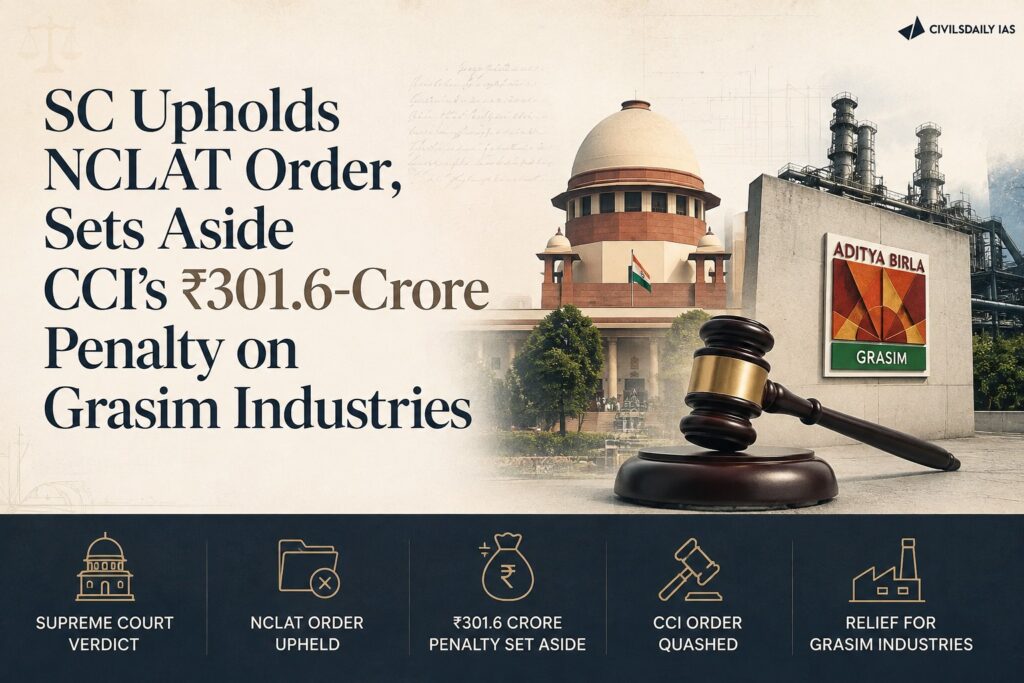
The Supreme Court dismissed the Competition Commission of India’s appeal against an NCLAT order that set aside a Rs 301.6 crore penalty on Grasim Industries, holding that the regulator breached natural justice by not giving the company a hearing after departing from its own investigative findings. The ruling exposes the boundary between a regulator’s power to penalise dominant firms and the procedural fairness it owes them before doing so.
What did the CCI originally rule and why was it set aside?
Original penalty: The Competition Commission of India imposed the Rs 301.6 crore penalty on Grasim Industries in March 2020 for allegedly abusing its dominant position in the supply of viscose staple fibre to spinners.
Departure from the Director General’s findings: The National Company Law Appellate Tribunal found that the CCI had departed from the findings of its own Director General, the regulator’s investigative arm, without giving Grasim a chance to respond to that departure.
NCLAT’s order: The NCLAT set aside the CCI’s order and remanded the matter back to the Commission for a fresh hearing that accounts for this procedural gap.
Why did the Supreme Court agree with the natural justice finding?
Hearing before departure: A bench of the Supreme Court held that once the CCI decided to differ from the Director General’s conclusions, natural justice required that Grasim be given an opportunity to present its arguments against that specific departure.
Procedural fairness as a substantive check: The ruling confirms that a regulator’s substantive finding of market dominance abuse can be undone purely on procedural grounds, regardless of the underlying merits of the dominance allegation.
What are the challenges this ruling poses for competition regulation?
Delay in enforcement: The case now returns to the CCI for a fresh hearing, meaning a matter that began with a 2020 penalty order will take years longer to resolve, weakening the deterrent effect of competition enforcement.
Procedural burden on the regulator: The CCI will need to build an additional hearing step into its process whenever it departs from Director General findings, adding to its administrative workload in future dominance cases.
Precedent for future appeals: Companies facing CCI penalties now have a clearer procedural ground to challenge orders that diverge from investigative findings without an intervening hearing.
Market conduct still unresolved: Whether Grasim actually abused its dominant position in the viscose staple fibre market remains unresolved and will only be settled after the CCI re-examines the case.
Conclusion
The Supreme Court’s ruling turns on procedure, not on whether Grasim actually abused its market position. The Competition Commission of India must now rehear the case with Grasim given the opportunity it was earlier denied, leaving the substantive dominance question open until that fresh hearing concludes.
Back2Basics:
Competition Commission of India (CCI)
The CCI is India’s cross-sectoral competition regulator, governed by the Competition Act, 2002, covering anti-competitive agreements, mergers and combinations, and abuse of dominance across all sectors.
It is not a price control body; it intervenes only where conduct is anti-competitive, a distinction commonly tested since CCI does not regulate prices directly.
The CCI acts as the first-instance adjudicator across all sectors, since there is no separate technical regulator performing a parallel function within its domain.
Appeals against CCI orders lie with the National Company Law Appellate Tribunal (NCLAT), as in the Grasim case, with further appeal lying with the Supreme Court.
The National Company Law Appellate Tribunal (NCLAT):
It serves as the direct appellate authority for orders, directions, and decisions passed by the Competition Commission of India (CCI). When the CCI rules on anti-competitive agreements, cartels, or abuse of dominant market positions, aggrieved parties challenge those decisions before the NCLAT
Key Aspects of the Relationship
Appellate Jurisdiction: Empowered under Section 410 of the Companies Act, 2013, NCLAT hears and disposes of all appeals arising from CCI rulings (replacing the erstwhile Competition Appellate Tribunal or COMPAT).
Judicial Review: NCLAT evaluates whether CCI orders follow principles of natural justice, properly weigh market evidence, or stay within regulatory jurisdiction
PYQ Relevance
[UPSC 2023] Discuss the role of the Competition Commission of India in containing the abuse of dominant position by the Multi-National Corporations in India. Refer to the recent decisions.
Linkage: The PYQ tests the role of the CCI in preventing abuse of dominant position and promoting fair competition. The article highlights the CCI’s enforcement powers and the need to uphold natural justice while regulating dominant firms.
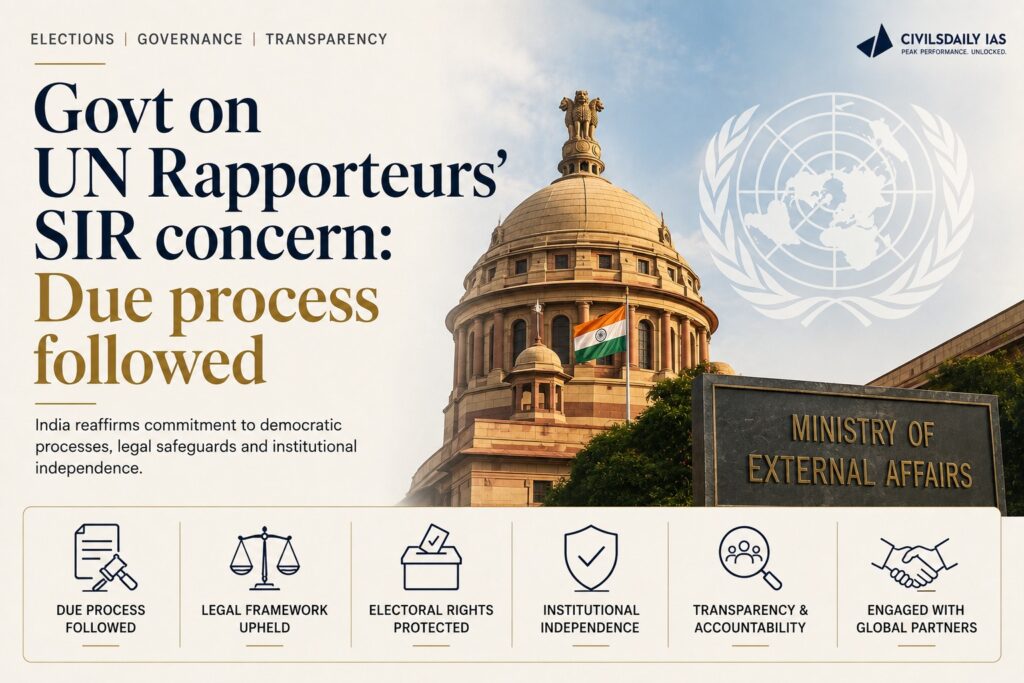
The Union government told the Rajya Sabha on 30 July that the Special Intensive Revision (SIR) of electoral rolls was carried out by following due process of law without prejudice to any group or community. The reply came almost three months after three United Nations (UN) Special Rapporteurs wrote to the government raising concern over large scale deletion of electors and alleged discrimination through the exercise.
How does the Special Intensive Revision work?
Enumeration: Booth level officers distribute and collect enumeration forms from every elector in the area under revision, requiring proof of citizenship, age and ordinary residence rather than relying only on the existing electoral roll entry.
Draft roll: Once forms are collected and verified, the Election Commission of India (ECI) publishes a draft electoral roll reflecting the revised list of electors.
Claims and objections: Electors and political parties can file claims for inclusion or objections to entries during a specified window before the roll is finalised.
Final roll: The ECI publishes the final electoral roll after disposing of claims and objections, and this roll is used for elections held after that date.
Who are UN Special Rapporteurs?
Independent experts appointed by the UN Human Rights Council to examine and report on specific human rights themes or country situations.
They do not represent the UN as an institution, and their communications, including the one on the SIR, carry no binding legal authority over member states.
What did the Special Rapporteurs allege?
Scale of deletion: The communication raised concern over large scale deletion of electors from the rolls during the SIR exercise.
Discrimination claim: It alleged the exercise had a discriminatory effect on specific groups or communities.
Delay in response: The government’s reply came nearly three months after the communication was received, and only after the matter was raised in the Rajya Sabha.
Why is a due process claim not enough to settle the matter?
No numbers offered: The government’s reply asserted due process was followed but did not place before Parliament the actual scale of deletions the Special Rapporteurs had flagged.
Parallel legal challenges: The same deletions remain under separate examination in pending petitions before the Supreme Court, meaning the due process claim is being tested in a forum whose outcome is still open.
International scrutiny continues: A reply to Parliament does not close the UN communication, which remains part of the Human Rights Council’s special procedures record regardless of the government’s domestic response.
Verification burden: Requiring citizenship and residence documents from every elector shifts the burden of proof onto individuals, affecting poor, migrant and undocumented voters more than others, the groups the Special Rapporteurs’ discrimination claim centres on.
What are the challenges to the Special Intensive Revision?
Documentation burden: Migrant workers, the poor and the elderly are least likely to hold the specific documents demanded, raising the risk of wrongful exclusion rather than genuine deduplication.
Timeline pressure: Conducting a house to house enumeration across a state within a compressed window increases the chance of errors by booth level officers working under time pressure.
Appeal window adequacy: A short claims and objections period limits the time available for a wrongly excluded elector to be restored to the rolls before an election is notified.
Judicial pendency: With petitions challenging the SIR still pending before the Supreme Court, the exercise continues in several states even as its legal validity remains undecided.
Reputational cost: Simultaneous scrutiny from Parliament, the courts and UN human rights mechanisms complicates the government’s ability to present the exercise as procedurally settled.
Conclusion
The government’s due process claim does not resolve the dispute over the SIR. The scale of the deletions remains undisclosed, petitions challenging the exercise remain pending before the Supreme Court, and the UN communication remains on record with no reply addressing its specific numbers. The next milestone is the Supreme Court’s disposal of the pending petitions, which will determine whether the due process claim withstands judicial scrutiny.
Back2Basics:
Special Intensive Revision (SIR)
An intensive, house to house revision of electoral rolls conducted by the Election Commission of India under its powers over preparation and revision of electoral rolls, distinct from the routine annual summary revision.
Requires fresh verification of every elector’s citizenship, age and ordinary residence rather than a review limited to additions and deletions since the last roll.
The current round began in Bihar and has since been extended to other states ahead of scheduled elections.
Political parties and civil society groups have challenged aspects of the exercise before the Supreme Court, citing the risk of wrongful deletion.
Special Summary Revision (SSR)
SSR is the routine, annual exercise conducted by the ECI to update existing voter lists.
How it works : Unlike SIR, it does not mandate a door-to-door check for every single person. It mostly relies on citizens voluntarily submitting online or offline applications for fresh registration, deletion, or corrections.
Purpose : Accommodating newly eligible young voters (who just turned 18) and making minor changes before an ordinary election cycle.
Continuous Revision (CR)
Continuous revision runs constantly between the conclusion of a summary revision and the announcement of the next major election.
How it works : The voter list remains open dynamically. Eligible citizens can use the ECI’s Voter Service Portal or Voter Helpline App to update their addresses or register at any point in the year
PYQ Relevance
[UPSC 2024] Examine the need for electoral reforms as suggested by various committees with particular reference to “one nation-one election” principle.
Linkage: The PYQ examines electoral reforms and measures to strengthen the integrity of the electoral process. The article analyses the Special Intensive Revision (SIR), highlighting concerns over voter roll verification, inclusion, and electoral fairness.
The Cauvery Water Management Authority (CWMA) on 30 July upheld an order of the Cauvery Water Regulation Committee (CWRC) directing Karnataka to release 3,500 cusecs of water a day to Tamil Nadu for 15 days despite Karnataka’s own appeal citing drought. The ruling exposes that Karnataka and Tamil Nadu still have no agreed formula for sharing shortfalls in the Cauvery basin, years after the Supreme Court’s final verdict on the dispute.
How does the Cauvery water sharing mechanism work?
Two tier structure: The CWRC functions within the CWMA, which implements the 2007 award of the Cauvery Water Disputes Tribunal as modified by the Supreme Court in 2018.
Composition: The CWRC is headed by the Member (Water Resources) of the CWMA and includes Chief Engineers of all basin states along with representatives of the India Meteorological Department (IMD), Central Water Commission and the Union Ministry of Agriculture and Farmers Welfare.
Monitoring role: It tracks daily water levels, inflows and storage at eight reservoirs, four in Karnataka, three in Tamil Nadu and one in Kerala. It also issues seasonal water release directions for each basin state.
Appeal route: A state aggrieved by a CWRC order can appeal to the CWMA. The CWMA, as the apex body monitoring compliance with the Supreme Court’s verdict, can uphold, modify or set aside the CWRC’s order.
Unit of measure: Releases are set in cusecs, a rate of flow measured in cubic feet per second, while cumulative volume is tracked in thousand million cubic feet, referred to as tmc ft.
Why did the CWRC order the release now?
Deficient inflows: Karnataka’s four reservoirs recorded a combined inflow shortfall of about 60% against the 30 year average, and the deficit at the Biligundulu gauge, where Karnataka’s flow to Tamil Nadu is measured, was 90%.
Storage position: As on 30 July, Karnataka’s four reservoirs held 65.34 tmc ft against a total capacity of 114.57 tmc ft.
Forecast: The IMD gave no optimistic outlook for the following weeks, which shaped the CWRC’s view that Karnataka could still spare water.
Buffer assessment: The CWMA noted Karnataka’s reservoirs stood to gain a minimum of 15 tmc ft in the next 15 days and that releasing 4.5 tmc ft would not affect Karnataka’s drinking water needs.
Why do both states reject the outcome as unfair?
Karnataka’s distress claim: Karnataka cited a super El Nino effect, said it had not begun irrigation releases this year, and argued Tamil Nadu would separately gain from the northeast monsoon later in the season.
Karnataka’s carryover argument: Karnataka contended Tamil Nadu already held substantial carryover storage from earlier releases, reducing its immediate need.
Tamil Nadu’s shortfall claim: Tamil Nadu sought 9.45 tmc ft over 15 days at 7,000 cusecs a day under the distress formula, arguing the ordered 3,500 cusecs was insufficient given a 90% deficit at Biligundulu.
Tamil Nadu’s cultivation needs: Tamil Nadu’s ongoing kuruvai season needs at least 30 tmc ft against a Mettur storage of about 36 tmc ft, of which 10 tmc ft is reserved for drinking water. The following samba thaladi season needs a minimum of 180 tmc ft.
Political fallout: Karnataka’s Chief Minister called an all party meeting in Bengaluru on 2 August to consider legal options, and farmer protests have already begun in the Cauvery basin against the release order.
What are the challenges to the Cauvery dispute resolution mechanism?
No distress sharing formula: Both the CWRC chief and Tamil Nadu’s position point to the absence of an agreed formula for splitting shortfalls in a deficient year, forcing an ad hoc order each time rainfall fails.
Recurring litigation: Karnataka has approached the CWMA and is weighing further legal options, repeating a cycle of appeals seen in nearly every distress year since the tribunal’s award.
Compliance risk: The CWMA can direct a release, but implementation still depends on Karnataka’s cooperation, a dependence that has previously produced Supreme Court contempt proceedings against Karnataka.
Climate variability: A pattern of super El Nino effects and deficient monsoons increases the frequency of distress years, straining a formula built around long term averages rather than year on year swings.
Political cost: A release ordered during an acknowledged drought risks becoming a flashpoint for farmer unrest and inter state friction, regardless of the technical merits of the CWRC’s assessment.
Conclusion
The CWMA’s ruling shows the institutional mechanism functioning as designed, yet satisfying neither riparian state. Karnataka calls the release unfair given its own distress, and Tamil Nadu calls the quantum inadequate for its cultivation needs. What remains unresolved is not whether the tribunal award should be enforced, but whether Karnataka and Tamil Nadu will ever agree on a distress sharing formula that removes the need for fresh litigation every deficient season. The CWRC is scheduled to meet again on 11 August to review compliance.
Back2Basics:
Cauvery Water Management Authority (CWMA)
Established in June 2018 by the Union Jal Shakti Ministry to implement the final award of the Cauvery Water Disputes Tribunal (2007) as modified by the Supreme Court’s verdict of the same year.
Constituted under Section 6A of the Inter State River Water Disputes Act, 1956, following the Supreme Court’s directions.
Composition includes a Chairman, a Secretary and Members, including a full time Member (Water Resources) who also heads the Cauvery Water Regulation Committee.
Jurisdiction covers water release, storage and supply regulation across the Cauvery basin states of Karnataka, Tamil Nadu, Kerala and Puducherry.
Functions as the apex body for compliance with the Supreme Court’s verdict, with the CWRC as its technical monitoring arm.
PYQ Relevance
[UPSC 2013] Constitutional mechanisms to resolve the inter-state water disputes have failed to address and solve the problems. Is the failure due to structural or process inadequacy or both? Discuss.
Linkage: It examines the effectiveness of constitutional and institutional mechanisms for resolving inter-state river water disputes. The article highlights recurring Cauvery disputes, the absence of a distress-sharing formula, and continuing litigation despite the CWMA framework.
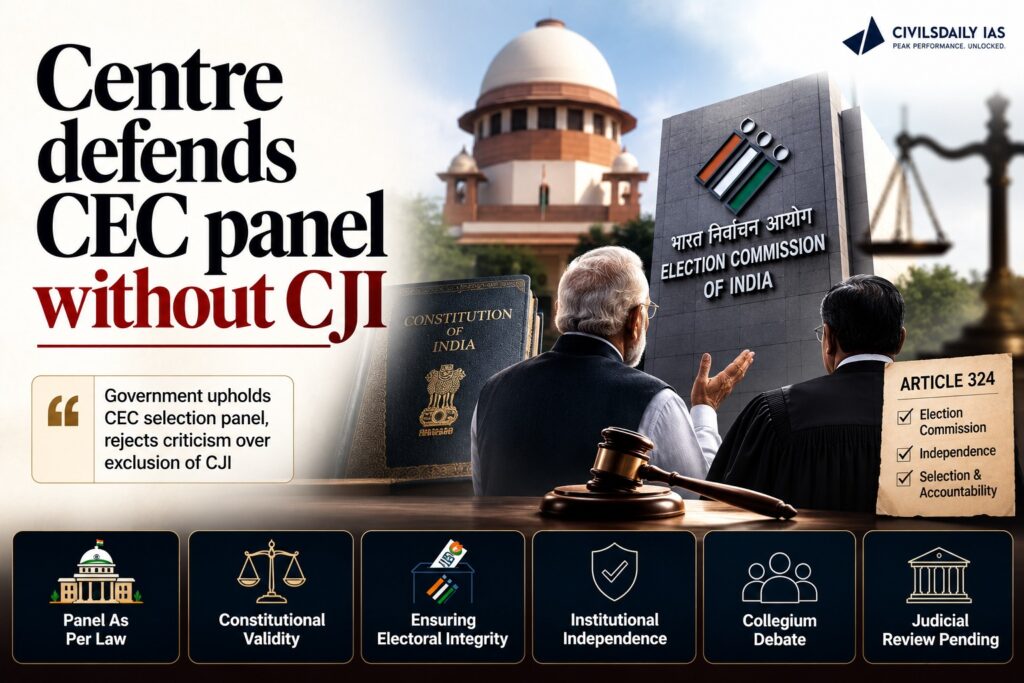
The Supreme Court is examining the constitutional validity of the Chief Election Commissioner and Other Election Commissioners (Appointment, Conditions of Service and Term of Office) Act, 2023, which gives the executive a majority in the CEC selection committee. The Court has reserved its decision on whether to refer the matter to a Constitution Bench.
What is the CEC Selection Committee under the 2023 Act?
The Act provides for a three-member selection committee comprising:
Prime Minister (Chairperson)
Union Cabinet Minister nominated by the Prime Minister
Leader of the Opposition (LoP) in the Lok Sabha
What changed?
The Act replaced the Chief Justice of India (CJI) with a Cabinet Minister.
This gives the executive two out of three votes, with the Opposition holding one.
What is the Anoop Baranwal Judgment (2023)?
Delivered by a five-judge Constitution Bench.
Held that until Parliament enacted a law, the CEC and Election Commissioners should be appointed by a committee comprising:
Prime Minister
Leader of the Opposition
Chief Justice of India
The Court stressed that the Election Commission must be independent, neutral, and free from executive control.
Centre’s Arguments
Parliament is competent to decide the appointment process.
The Prime Minister’s office carries constitutional trust.
Courts should not presume bad faith by constitutional authorities.
Replacing the CJI with a Cabinet Minister is within Parliament’s legislative powers.
Supreme Court’s Concerns
The committee lacks a neutral member.
A 2:1 executive majority may affect the perception of independence.
Appointments should not only be fair but also appear to be fair.
[2017] Consider the following statements regarding the Election Commission of India: 1.The ECI is currently a five-member body consisting of the Chief Election Commissioner and four Election Commissioners. 2.The Union Ministry of Home Affairs is the final authority that decides the election schedule for general elections. 3.The ECI is the designated authority to resolve disputes relating to splits or mergers of recognized political parties. Which of the statements given above is/are correct?
The Rajya Sabha passed the Prevention of Insults to National Honour (Amendment) Bill, 2026 on 29 July 2026, in the absence of most Opposition members who staged a walkout. The Bill extends criminal punishment for disrespecting national symbols to the National Song, Vande Mataram, placing it on the same legal footing as the National Anthem for the first time since the original 1971 law.
What does the Prevention of Insults to National Honour (Amendment) Bill, 2026 change?
Original law: The Bill amends the Prevention of Insults to National Honour Act, 1971, which criminalises insults to the National Flag, the Constitution and the National Anthem.
New provision: The amendment extends criminal punishment to acts of obstruction or disturbance during the singing of the National Song, Vande Mataram.
Penalty: Intentionally preventing the singing of the National Song, or causing disturbance to an assembly singing it, will be punishable with imprisonment up to three years, or a fine, or both.
Legislative path: The Bill was introduced in the Rajya Sabha on 24 July by Minister of State for Home Affairs Nityanand Rai and will now go to the Lok Sabha for consideration and passage.
What is the historical background to Vande Mataram’s status?
Origin: Vande Mataram was composed by Bankim Chandra Chatterjee in 1875, but only two stanzas were adopted as the National Song.
Adoption decision: Congress leader Jawaharlal Nehru limited the National Song to two stanzas in 1937, years before he became independent India’s first Prime Minister.
Constituent Assembly reference: On 24 January 1950, Rajendra Prasad told the Constituent Assembly that Vande Mataram should be honoured on par with Jana Gana Mana, the National Anthem.
What was the political dispute around the Bill’s passage?
Government framing: Minister of State for Home Affairs Nityanand Rai said the Bill represents “India’s soul, national awareness, and cultural heritage” and accused the Congress of engaging in appeasement politics by opposing it.
Opposition’s walkout reason: Nearly all Opposition members walked out demanding Union Home Minister Amit Shah’s statement on the police action against students protesting paper leaks at Jantar Mantar, rather than opposing the Bill’s substance.
Cross-party support noted: The Aam Aadmi Party’s Sanjay Singh said his party supports the Bill while also demanding a law against insulting the National Anthem and the Tricolour.
Conclusion
The Rajya Sabha has passed the Bill giving Vande Mataram the same criminal protection as the National Anthem, with the Lok Sabha’s consideration as the next legislative step. The Opposition’s walkout centred on demanding accountability for the police action against student protesters rather than opposing the Bill on its merits.
Back2Basics:
Prevention of Insults to National Honour Act, 1971
Enactment: The original Act was passed in 1971 to penalise insults to the National Flag, the Constitution of India, and the National Anthem.
Scope: It covers acts such as burning, mutilating or defacing the National Flag, and preventing or disturbing the singing of the National Anthem.
Amendment history: The Act has been amended before, including through the Prevention of Insults to National Honour (Amendment) Act, 2005, to add flag code violations.