Why in the News
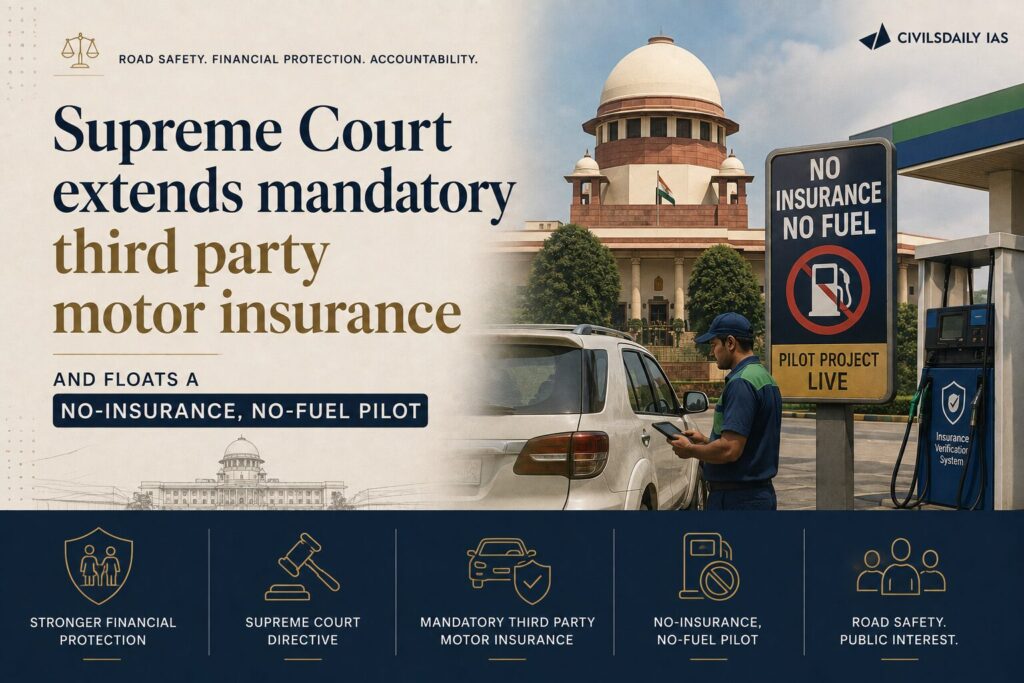
The Supreme Court extended mandatory Third-Party Motor Insurance to 4 years for new cars and 6 years for new two-wheelers. It also proposed a “No Insurance, No Fuel” pilot to improve compliance.
What is Third-Party Motor Insurance?
- Mandatory under Section 146 of the Motor Vehicles Act, 1988.
- Covers compensation for injury, death, or property damage caused to a third party.
- Does not cover damage to the insured vehicle or owner.
Supreme Court Directions
- Mandatory third-party cover:
- 4 years for new cars.
- 6 years for new two-wheelers.
- Link Automatic Number Plate Recognition (ANPR) cameras with:
- Insurance Information Bureau of India (IIB)
- VAHAN portal.
- Enable police to verify insurance in real time through mobile applications.
- Explore a “No Insurance, No Fuel” pilot.
Why is Enforcement Needed?
- Around 56% of vehicles reportedly operate without valid third-party insurance.
- Victims face delays in compensation.
- Insurance often lapses after the initial mandatory period.
Challenges
- Lack of integration among IIB, VAHAN, and police databases.
- Low renewal rates, especially for two-wheelers.
- Concerns over denying fuel as an essential service.
- Weak penalties and limited rural enforcement.
Comprehensive vs Third-Party Insurance
- Third-Party Insurance: Mandatory; covers third-party losses only.
- Comprehensive Insurance: Optional; covers both third-party liability and damage to the insured vehicle.
Key Platforms
- VAHAN: National vehicle registration database managed by Ministry of Road Transport and Highways (MoRTH).
- ANPR: Automatic Number Plate Recognition technology for vehicle identification.
- IIB: Insurance Information Bureau of India, maintains insurance-related databases.
Insurance Regulatory and Development Authority of India (IRDAI)
- Established under: Insurance Regulatory and Development Authority Act, 1999.
- Headquarters: Hyderabad.
- Functions: Regulates insurance companies and intermediaries. Protects policyholders’ interests. Prescribes solvency, pricing, and disclosure norms.
