💥Mains Ready By December. Smash Mains & Smash PYQ Admissions Open

Subject: RPAxElectoral Reforms

  • SC asks for data on SIR appeal disposal in West Bengal

    Why in the News

    The Supreme Court asked the Election Commission of India to furnish data on the disposal rate of appeals filed by persons excluded from the West Bengal electoral roll during the Special Intensive Revision. The court declined to fix a timeline for the appellate tribunals but signalled it would restructure the disposal architecture if performance is found wanting, exposing the tension between the right to an effective remedy and the slow pace of appeal disposal linked to welfare access.

    What is the Special Intensive Revision (SIR) of electoral rolls?

    1. Definition: The Special Intensive Revision (SIR) is an intensive, house to house verification of electoral rolls conducted by the Election Commission of India to add eligible voters and remove ineligible entries.
    2. Object: Its stated aim is that no eligible voter is excluded and no ineligible person is included in the draft electoral roll.
    3. Process: Booth Level Officers collect enumeration forms from households, after which the draft roll is published and objections are heard.
    4. Appeal route: Persons whose names are excluded may appeal before designated appellate tribunals set up following Supreme Court orders.

    What did the Supreme Court direct?

    1. Data on disposal: The court asked the Election Commission of India to furnish details on the quantum of appeals disposed by the appellate tribunals.
    2. No fixed timeline: It declined to bind the tribunals to a specific timeline for deciding appeals.
    3. Focus on quantum: The court clarified it is concerned with the volume and speed of disposal, not the outcome of individual appeals.
    4. Restructuring option: It indicated it may revisit and restructure the disposal architecture, including online access for the deciding officer, if performance appears wanting.
    5. Next hearing: The matter was listed for 25 August.

    Why does appeal disposal matter beyond the roll?

    1. Under one percent decided: The petitioner submitted that the tribunals had not decided even one percent of the appeals.
    2. Welfare linkage: Counsel argued that the State was denying ration and other benefits to those deleted from the rolls whose appeals were pending.
    3. Access barrier: People from distant areas found it difficult to physically reach the tribunals, prompting the court to examine logistical issues.
    4. Remedy must be effective: The court observed that merely filing an appeal may not satisfy a litigant if the due process does not yield an outcome.
    5. Separate cause of action: On the welfare denial, the court advised the petitioner to approach the Calcutta High Court as it involved a different cause of action.

    Where does the genuine tension lie?

    1. Judicial restraint versus effective remedy: The court will not fix a decision timeline for the tribunals, yet insists that an appeal must lead to a real outcome.
    2. Roll purity versus disenfranchisement: Intensive revision seeks accurate rolls, while slow appeal disposal risks keeping eligible voters excluded.
    3. Electoral right versus welfare access: Exclusion from the roll is linked to denial of ration and welfare, widening the stakes beyond voting.
    4. Creator’s duty: As the creator of the tribunals, the court accepts responsibility to ensure the due process it designed actually functions.

    About Electoral Roll Management in India

    1. Definition: The electoral roll is the list of eligible voters for a constituency, maintained and periodically revised by the Election Commission of India.
    2. Legal basis: Roll preparation and revision are governed by the Representation of the People Act, 1950, and the Registration of Electors Rules, 1960.
    3. Eligibility: A person may be enrolled only in the constituency where they are ordinarily resident and whose name appears on the roll may contest and vote.
    4. Revision types: Rolls are updated through summary revision and, where needed, intensive or special intensive revision.

    Statutory Framework Governing Electoral Rolls

    1. Article 324: Vests superintendence, direction, and control of elections and roll preparation in the Election Commission of India.
    2. Article 326: Provides for adult suffrage as the basis of elections to the Lok Sabha and State Assemblies.
    3. Representation of the People Act, 1950: Governs allocation of seats and preparation of electoral rolls.
    4. Representation of the People Act, 1951: Governs the conduct of elections, qualifications, and disqualifications of candidates.
    5. Registration of Electors Rules, 1960: Prescribes the procedure for enrolment, revision, appeals, and correction of rolls.

    Back2Basics: Election Commission of India (ECI)

    1. Constitutional basis: Established under Article 324 as an independent constitutional body.
    2. Composition: A Chief Election Commissioner and such number of Election Commissioners as the President fixes.
    3. Jurisdiction: Conducts elections to Parliament, State legislatures, and the offices of President and Vice President, and maintains electoral rolls.
    4. Tenure and removal: The Chief Election Commissioner can be removed only through the process applicable to a Supreme Court judge.
    5. Function in focus: Preparation and revision of electoral rolls, including intensive revision exercises.

    “[2017] For election to the Lok Sabha, a nomination paper can be filed by

    (a) Anyone residing in India.

    (b) A resident of the constituency from which the election is to be contested.

    (c) Any citizen of India whose name appears in the electoral roll of a constituency.

    (d) any citizen of India.
  • Are regional parties losing relevance in India?

    Why in the News?

    The defeat of the Trinamool Congress in the 2026 West Bengal Assembly elections and a wave of defections across regional parties have raised questions about their future. Lokniti CSDS data shows regional parties have retained a consistent one third vote share across four Lok Sabha elections, exposing that their challenge is organisational renewal rather than declining voter support.

    How are national and regional parties classified?

    1. What it is: The Election Commission of India classifies parties as national, state (regional), or registered unrecognised, based on vote share and seats won in general and state elections.
    2. Why vote share matters: Vote share is the best indicator of a party’s underlying support base, because India’s first past the post system magnifies both victories and defeats in seat terms.

    What do the Lok Sabha vote share figures show, 2009 to 2024?

    1. National parties combined: 63.59 per cent in 2009, 60.04 per cent in 2014, 68.15 per cent in 2019, and 62.72 per cent in 2024.
    2. Regional parties combined: 31.22 per cent in 2009, 35.85 per cent in 2014, 28.1 per cent in 2019, and 33.53 per cent in 2024.
    3. National seats: National parties won 376 seats in 2009, 342 in 2014, 397 in 2019, and 346 in 2024.
    4. BJP trajectory: The Bharatiya Janata Party (BJP) rose from 116 seats and 18.8 per cent in 2009 to 282 seats and 31 per cent in 2014, 303 seats and 37.3 per cent in 2019, and 240 seats and 36.56 per cent in 2024.
    5. Congress trajectory: The Congress fell from 206 seats and 28.55 per cent in 2009 to 44 seats and 19.31 per cent in 2014, then 52 seats and 19.46 per cent in 2019, and 99 seats and 21.19 per cent in 2024.
    6. Stable one third: Regional parties have consistently secured around one third of total votes, the only dip being 2019 at 28.1 per cent, held down by the Balakot air strike backdrop.

    What does the state wise picture show?

    1. Assembly preference: Voters display a much stronger preference for regional parties in Assembly elections than in Lok Sabha elections, underscoring the enduring pull of state level identities.
    2. Replacement within the regional camp: In Tamil Nadu, when the Dravida Munnetra Kazhagam faced a setback, it was replaced by another regional party rather than by a national one.
    3. Persistent strength: Regional parties retain significant vote share across several states despite fluctuations in seats won.

    Why do defections not signal shrinking support?

    1. Trinamool: The Trinamool Congress witnessed several defections following its West Bengal defeat.
    2. Aam Aadmi Party: The Aam Aadmi Party saw many of its Rajya Sabha members defect.
    3. Nationalist Congress Party (Sharad Pawar): It saw defections in Maharashtra.
    4. Distinction: These point to organisational vulnerabilities, but defections by themselves do not indicate a shrinking electoral support base.

    What is the governance footprint of regional parties?

    1. Independent rule: Regional parties independently govern four states, the lowest number in nearly two and a half decades, down from nine states independently governed between 2015 and 2020.
    2. Dominant coalition partners: Regional parties are the dominant partners in four states, namely Andhra Pradesh, Meghalaya, Nagaland, and Puducherry.
    3. Junior partners: The BJP leads coalitions with regional allies in Bihar, Uttar Pradesh, Assam, Goa, Maharashtra, and Tripura, while the Congress is a junior partner in Jharkhand, Jammu and Kashmir, and Tamil Nadu.
    4. Fewer governments, stable votes: The decline in the number of governments headed by regional parties does not imply a corresponding decline in their electoral support.

    Setback versus survival, the real challenge

    1. Not declining votes: The challenge before regional parties is not declining voter support but organisational renewal.
    2. FPTP distortion: The first past the post system magnifies seat swings even when vote share stays broadly stable.
    3. Too early for an obituary: A consistent one third vote share shows it is premature to write the obituary of regional parties.

    One Nation One Election context

    1. The proposal: The proposed One Nation One Election framework would synchronise Lok Sabha and state Assembly elections.
    2. Concern for regional parties: Regional parties fear that simultaneous polls could let national issues and better resourced national parties overshadow state level concerns where regional parties are strongest.

    What are the challenges to regional parties?

    1. Organisational decay: Weak cadre structures and dependence on single leaders leave parties fragile.
    2. Defections and poaching: Loss of legislators erodes bargaining power even when vote share holds.
    3. Leadership succession: Founder centric parties struggle with generational transition.
    4. Resource asymmetry: National parties command far greater funding and media reach.
    5. Simultaneous elections risk: One Nation One Election could dilute the salience of state issues.
    6. Coalition dependence: Falling numbers of independent governments push parties into junior roles.

    Conclusion

    Regional parties continue to retain a substantial and consistent support base despite electoral setbacks and defections. The evidence shows their difficulty is organisational renewal, not shrinking voter preference, since vote share has stayed near one third across four Lok Sabha elections. Both national and regional parties hold stable places in India’s party system.

    India’s Party System (Foundational Context)

    1. About: India has a multi party system with recognised national parties, recognised state parties, and registered unrecognised parties.
    2. Rationale: Party recognition governs privileges such as reserved election symbols, free broadcast time, and star campaigner allowances.
    3. Classification basis: The Election Commission of India recognises parties based on thresholds of vote share and seats won in Lok Sabha and Assembly elections.

    Key Concerns Regarding the Party System

    1. Intra party democracy deficit: Many parties lack transparent internal elections and leadership accountability.
    2. Money and elections: Rising campaign expenditure entrenches resource rich parties.
    3. Defections: Frequent defections weaken mandate stability despite anti defection law.
    4. Personality centric organisation: Dependence on individual leaders undermines institutional continuity.

    Back2Basics: Representation of the People Act, 1951

    1. What it is: The Representation of the People Act, 1951 governs the conduct of elections to Parliament and state legislatures.
    2. Coverage: It covers qualifications and disqualifications of members, registration of parties, and corrupt practices and offences.
    3. Party recognition: Party recognition and symbol allotment operate under this Act and the Election Symbols (Reservation and Allotment) Order, 1968.
    4. Regulator: It is administered by the Election Commission of India, a constitutional body under Article 324.

    Constitutional and Statutory Framework Governing Elections

    1. Article 324: Vests superintendence, direction, and control of elections in the Election Commission of India.
    2. Article 325: Provides a single general electoral roll and bars exclusion on grounds of religion, race, caste, or sex.
    3. Article 326: Provides for elections on the basis of adult suffrage.
    4. Representation of the People Act, 1950: Governs preparation of electoral rolls and allocation of seats.
    5. Representation of the People Act, 1951: Governs the actual conduct of elections and party registration.

    Way Forward

    1. Strengthen internal democracy: Institutionalise leadership succession and cadre building within regional parties.
    2. Reform party finance: Improve transparency to reduce resource asymmetry.
    3. Enforce anti defection: Tighten timelines and disqualification processes to deter defections.
    4. Protect federal representation: Design electoral reforms, including any simultaneous elections proposal, to safeguard state level voice.

    PYQ Relevance

    [UPSC 2024] Examine the need for electoral reforms as suggested by various committees with particular reference to “one nation-one election” principle.

    Linkage: The PYQ directly relates to electoral reforms and the One Nation-One Election proposal. The article highlights how simultaneous elections could affect regional parties, state-level issues and India’s federal party system.

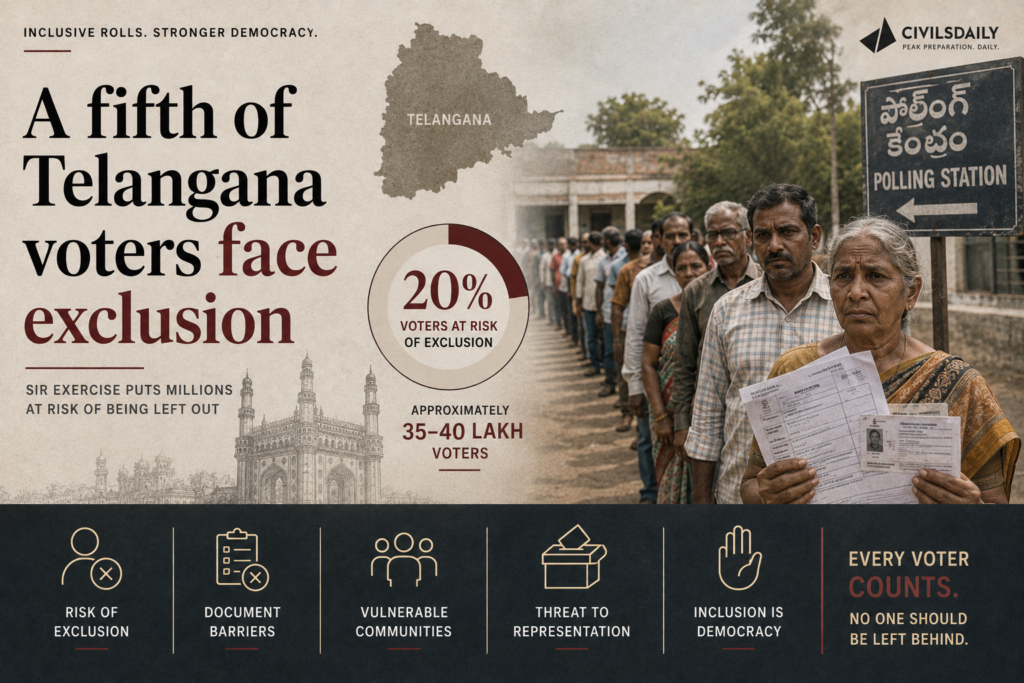
  • A fifth of Telangana voters face exclusion

    Why in the News

    In Telangana, 73.47 lakh enumeration forms, nearly 22% of the electorate, were marked “Uncollectable” during the Special Intensive Revision (SIR) of electoral rolls. The large number raises concerns about balancing clean electoral rolls with the risk of excluding genuine voters.

    What is Special Intensive Revision (SIR)?

    • SIR: Special Intensive Revision of electoral rolls.
    • Conducted by the Election Commission of India (ECI) through comprehensive, house-to-house enumeration.
    • Electors submit enumeration forms; non-returned forms may be marked “Uncollectable”.
    • Doubtful cases may receive notices from Electoral Registration Officers (EROs) for verification.

    Current Status in Telangana

    • Enumeration ended: August 10, 2026.
    • Uncollectable: 73,47,075 forms, nearly 22% of the electorate.
    • Draft rolls: Scheduled for August 17.
    • Claims and objections will follow publication of the draft rolls.

    Why is it Concerning?

    1. Disenfranchisement risk: Genuine voters may be deleted along with ineligible entries.
    2. Burden on voters: Migrants, poor households and hard-to-reach groups may struggle to submit forms.
    3. Short timeline: Limited time to reconcile uncollectable forms before draft publication.
    4. Legal concerns: The process has faced challenges regarding deletion procedures.

    Safeguards After Draft Roll

    • Claims and objections: Voters can seek restoration of wrongly deleted names.
    • ERO verification: Doubtful cases can be examined before finalisation.
    • Appeals: Aggrieved voters can approach higher electoral authorities and courts.

    Constitutional & Legal Framework

    • Article 324: Gives the Election Commission of India (ECI) superintendence, direction and control over elections and electoral rolls.
    • Article 325: Provides for one general electoral roll and prohibits exclusion on grounds of religion, race, caste or sex.
    • Article 326: Provides for adult suffrage.
    • Representation of the People Act, 1950 (RPA 1950): Governs preparation and revision of electoral rolls.
    • Registration of Electors Rules, 1960: Provides procedures for claims, objections and revision.

    Back2Basics: Election Commission of India

    • Type: Constitutional body under Article 324.
    • Established: 1950.
    • Composition: Chief Election Commissioner and other Election Commissioners.
    • Mandate: Conducts elections to Parliament, State legislatures, and the offices of President and Vice-President.
    • Role in rolls: Conducts summary and intensive revisions to maintain accurate electoral rolls.

    Challenges

    1. Wrongful deletion of genuine voters.
    2. Exclusion of migrants and seasonal workers.
    3. Duplicate, dead and ineligible entries.
    4. Compressed timelines for verification and objections.
    5. Documentation burden on vulnerable voters.
    6. Loss of public trust due to perceived lack of transparency.

    [2017] For election to the Lok Sabha, a nomination paper can be filed by

    (a) Anyone residing in India

    (b) A resident of the constituency from which the election is to be contested

    (c) Any citizen of India whose name appears in the electoral roll of a constituency

    (d) Any citizen of India

  • Centre defends CEC panel without CJI

    Why in the News?

    The Supreme Court is examining the constitutional validity of the Chief Election Commissioner and Other Election Commissioners (Appointment, Conditions of Service and Term of Office) Act, 2023, which gives the executive a majority in the CEC selection committee. The Court has reserved its decision on whether to refer the matter to a Constitution Bench.

    What is the CEC Selection Committee under the 2023 Act?

    The Act provides for a three-member selection committee comprising:

    • Prime Minister (Chairperson)
    • Union Cabinet Minister nominated by the Prime Minister
    • Leader of the Opposition (LoP) in the Lok Sabha

    What changed?

    • The Act replaced the Chief Justice of India (CJI) with a Cabinet Minister.
    • This gives the executive two out of three votes, with the Opposition holding one.

    What is the Anoop Baranwal Judgment (2023)?

    • Delivered by a five-judge Constitution Bench.
    • Held that until Parliament enacted a law, the CEC and Election Commissioners should be appointed by a committee comprising:
      • Prime Minister
      • Leader of the Opposition
      • Chief Justice of India
    • The Court stressed that the Election Commission must be independent, neutral, and free from executive control.

    Centre’s Arguments

    • Parliament is competent to decide the appointment process.
    • The Prime Minister’s office carries constitutional trust.
    • Courts should not presume bad faith by constitutional authorities.
    • Replacing the CJI with a Cabinet Minister is within Parliament’s legislative powers.

    Supreme Court’s Concerns

    • The committee lacks a neutral member.
    • A 2:1 executive majority may affect the perception of independence.
    • Appointments should not only be fair but also appear to be fair.

    [2017] Consider the following statements regarding the Election Commission of India:
    1.The ECI is currently a five-member body consisting of the Chief Election Commissioner and four Election Commissioners.
    2.The Union Ministry of Home Affairs is the final authority that decides the election schedule for general elections.
    3.The ECI is the designated authority to resolve disputes relating to splits or mergers of recognized political parties.
    Which of the statements given above is/are correct?

    [A] 1 and 2 only

    [B] 3 only

    [C] 2 and 3 only

    [D] 1, 2 and 3

  • [7th July 2026] The Hindu OpED: In India, voting cannot remain merely a statutory right 

    [UPSC 2024] Examine the need for electoral reforms as suggested by various committees with particular reference to ‘one nation-one election’ principle.
    Linkage: The PYQ examines reforms required to strengthen India’s electoral democracy and democratic participation.The article argues that constitutional recognition of the right to vote is a foundational electoral reform that would strengthen free and fair elections and deepen democratic legitimacy

    Mentor’s Comment

    A Congress leader has revived the demand to recognise voting as a fundamental right, reopening a settled constitutional debate. The demand exposes a growing inconsistency between the Supreme Court’s insistence that voting remains a mere statutory right and its own decisions constitutionalising nearly every facet surrounding the vote.

    Why has the Supreme Court traditionally treated the right to vote as a statutory right rather than a fundamental right?

    1. Foundational ruling: N.P. Ponnuswami vs Returning Officer (1952) held that the right to vote is not a common law right. Parliament created this right through statute.
    2. Reaffirmation: Jyoti Basu vs Debi Ghosal (1982) held the right to elect is “purely a statutory right.” Justice O. Chinnappa Reddy denied it the status of a fundamental right.
    3. Constitution Bench position: Kuldip Nayar vs Union of India (2006) held that democracy forms part of the basic structure (basic structure doctrine: the principle that certain core features of the Constitution cannot be altered even by a constitutional amendment). It held that the individual right to vote flows from the Representation of the People Acts, not from the Constitution.
    4. Textual basis: Part III of the Constitution does not list the right to vote among the fundamental rights.
    5. Parliamentary latitude: This textual silence gives Parliament wide discretion. Parliament prescribes qualifications, disqualifications, and procedures for elections.

    How has judicial interpretation constitutionalised individual facets of voting, and what anomaly does this create?

    1. Right to know: Union of India vs Association for Democratic Reforms (2002) held that voters have a right to know the criminal antecedents, educational qualifications, and financial assets of candidates. The Court grounded this right in Article 19(1)(a).
    2. Freedom to choose: People’s Union of Civil Liberties vs Union of India (2003) held that the freedom to make an informed choice is a fundamental right under Article 19(1)(a). The Court retained the position that the right to vote itself is statutory.
    3. Right to reject: The 2013 NOTA judgment held that a voter’s decision to reject all candidates is political expression protected by Article 19(1)(a). The Court extended ballot secrecy to voters who choose not to vote for any candidate.
    4. Emerging judicial view: Justice Ajay Rastogi’s separate opinion in Anoop Baranwal vs Union of India (2023) favoured recognising voting as a fundamental right. This view did not command a majority on the Constitution Bench.
    5. Resulting anomaly: The Court has made the right to know, the freedom to choose, and the right to reject all candidates fundamental. The act of voting itself remains a mere statutory entitlement.
    6. Logical inconsistency: The Constitution protects the right to reject every candidate. Denying protection to the right to choose one is incongruous.

    Does recognising a Fundamental Right to vote require removing Parliament’s power to regulate elections?

    1. Limited scope of the claim: Constitutional recognition is not required for every procedural detail of voting. It is required only for the core right to participate in the democratic process.
    2. Regulatory power retained: Parliament continues to prescribe qualifications, disqualifications, and age requirements for elections. Electoral rolls and residency conditions also remain within Parliament’s domain.
    3. Corrupt practices regulation: Disqualification for corrupt practices remains a statutory matter. This regulation is necessary for orderly elections.
    4. Entitlement distinguished from mechanics: The mechanics of voting may remain statutory. The citizen’s underlying entitlement to be a voter need not.

    Why does the basic structure doctrine make the statutory classification of voting untenable?

    1. Democracy as basic structure: Kesavananda Bharati vs State of Kerala (1973) held that democracy forms part of the Constitution’s basic structure.
    2. Free elections as essential feature: Indira Nehru Gandhi vs Raj Narain (1975) held that free and fair elections are an essential feature of democracy.
    3. Source of legitimacy: Elections derive legitimacy from citizen participation through the ballot. The vote is the instrument through which popular sovereignty is exercised.
    4. Constitutional source of entitlement: Article 326 mandates elections on the basis of universal adult suffrage. Every citizen above 18 is constitutionally entitled to be registered as an elector, subject only to narrowly defined disqualifications.
    5. Statute merely operationalises: The Representation of the People Acts operationalise the command in Article 326. They do not create the underlying entitlement.
    6. Exclusion as constitutional harm: Exclusion from the electoral roll strikes at a constitutional guarantee. This holds except where exclusion follows constitutionally permissible limitations.

    Conclusion

    The Supreme Court has extended constitutional protection to the right to know, the freedom to choose, and the right to reject candidates, while continuing to classify the act of voting itself as merely statutory. This position is inconsistent with the Court’s own recognition that democracy and free and fair elections form part of the basic structure. The Court must revisit the Ponnuswami-Jyoti Basu-Kuldip Nayar line of doctrine. The citizen’s entitlement to be a registered elector flows from Article 326 of the Constitution, leaving only the mechanics of voting to statutory regulation.

  • Criminal Cases Among Rajya Sabha MPs (ADR Report)

    Why in News?

    A report by the Association for Democratic Reforms and National Election Watch found that 31% of sitting Rajya Sabha MPs have declared criminal cases, while 16% have declared serious criminal cases in their election affidavits.

    Key Findings

    • Analysis covered 226 of 233 Rajya Sabha MPs.
      • 4 seats (West Bengal) were vacant.
      • 3 MPs were excluded as affidavits were unavailable.
    • 69 MPs (31%) declared criminal cases.
    • 36 MPs (16%) declared serious criminal cases.
    • Serious offences include:
      • 1 MP with a murder case.
      • 4 MPs with attempt to murder cases.
      • 4 MPs with crimes against women.

    Party-wise Criminal Cases

    • BJP: 28 of 107 MPs (26%), Congress: 12 of 29 MPs (41%), AITC: 2 of 9 MPs (22%), DMK: 2 of 8 MPs (25%), SP: 2 of 4 MPs (50%), TDP: 3 of 4 MPs (75%), BRS: 3 of 3 MPs (100%), CPI(M): 3 of 3 MPs (100%), RJD: 2 of 3 MPs (67%), AIADMK: 1 of 4 MPs (25%), NCP: 1 of 4 MPs (25%), and AAP: 1 of 3 MPs (33%)

    Wealth Profile

    • 31 MPs (14%) declared assets exceeding ₹100 crore.
    • Major parties: BJP: 7 MPs, Congress: 6 MPs, YSRCP: 2 MPs, TDP: 2 MPs, BRS: 2 MPs, and NCP: 2 MPs

    About ADR

    • The Association for Democratic Reforms (ADR) is a non-governmental, non-partisan organization established in 1999.
    • It works to promote:
      • Electoral transparency.
      • Political and electoral reforms.
      • Informed voting through analysis of candidates’ affidavits.
    • ADR uses disclosures mandated by the Supreme Court and the Election Commission of India.

    Constitutional and Legal Background

    • Article 80: Composition of the Rajya Sabha.
    • Representation of the People Act, 1951
      • Section 8: Disqualification upon conviction for specified offences.
    • Mere pendency of criminal cases does not disqualify a candidate unless a conviction attracts disqualification under law.
    • Candidates must disclose criminal antecedents in nomination affidavits following Supreme Court judgments.

    [2020] Consider the following statements:

    1. According to the Constitution of India, a person who is eligible to vote can be made a minister in a State for six months even if he/she is not a member of the Legislature of that State. 

    2. According to the Representation of People Act, 1951, a person convicted of a criminal offence and sentenced to imprisonment for five years is permanently disqualified from contesting an election even after his release from prison. 

    Which of the statements given above is/are correct?

    a . 1 only

    b . 2 only

    c. Both 1 and 2

    d . Neither 1 nor 2

  • In the light of recent controversy regarding the use of Electronic Voting Machines (EVM), what are the challenges before the Election Commission of India to ensure the trustworthiness of elections in India?

    In Abhiram Singh vs UoI, SC has held that elections are the biggest secular and democratic event. EVMs were introduced to improve transparency and efficiency of the electoral process.

    Challenges before the Election Commission of India (ECI)

    Technical and Operational Challenges

    Allegations of EVM tampering and demand for Postal Ballot system.

    EVMs are produced by PSU’s BEL and ECIL– concerns about source code security and potential government misuse.

    Large-scale deployment increases risk of technical failure, power supply issues, and storage vulnerability.

    Institutional and Procedural Challenges

    Political polarisation has led to accusations of bias against ECI decisions (timing of elections, model code enforcement).

    Lack of transparency- Limited access for political parties and civil society to audit or inspect EVM functioning.

    Opposition parties demand 100% VVPAT verification or return to ballot papers, which the ECI has resisted citing impracticality.

    Legal and Regulatory Challenges

    Use of EVMs is governed by Conduct of Elections Rules, 1961, not by a specific EVM legislation.

    Judicial scrutiny and legal disputes- Repeated petitions challenge credibility of EVMs and VVPAT counting procedures.

    Despite SC directives (2024) to improve VVPAT counting transparency and preserve paper trail records – compliance remains partial.

    Public Perception and Political Trust Deficit

    Decline in citizen confidence- Lack of understanding of EVM functioning leads to misinformation and conspiracy theories.

    Political blame culture- Losing parties often question EVM integrity, politicising the institution’s credibility.

    Social media misinformation- Viral false claims about EVM manipulation erode voter trust. Eg- “Black Box” Allegations (2024)

    ECI’s Stand

    EVMs are standalone, non-networked machines; cannot be hacked remotely.

    Rigorous mock polling, sealing, randomisation, and observer monitoring prevent manipulation.

    Technical Expert Committee (TEC) from IITs and DRDO regularly reviews EVM integrity.

    Way Forward

    Conduct independent third-party audits (IITs, NIC) of EVM software and random samples.

    VVPAT Verification – Increase sample size or audit entire constituency in disputed cases.

    Launch voter education campaigns explaining EVM and VVPAT mechanisms

    Enact a dedicated “Electronic Voting Regulation Act” ensuring independent oversight

    Free and fair elections are the cornerstone of democracy (Art. 324). Enhancing the transparency in use of EVM’s is thus essential.

  • Examine the need for electoral reforms as suggested by various committees with particular reference to “one nation-one election” principle.

    Free and fair elections are the foundation of Indian democracy (Article 324). Thus, Electoral reforms are considered as ‘Mother of all Reforms’.

    Need for one nation-one election

    According to ECI, ONOE reduces frequency of MCC & ensures policy continuity

    NITI Aayog (2017): simultaneous polls can cut election-related costs by 4500 Cr due to lower administrative and security deployment, single logistics cycle, and reduced campaign spending.

    Combined elections reduce voter fatigue and improve participation, especially in urban areas.

    Stability – Aligning Centre-State electoral cycles, making governments more accountable and stable

    ONOE discourages reckless dissolution of assemblies due to high political cost.

    Check on political populism due to reduced frequency of elections. Eg- farm loan waivers

    Reduction in vote bank politics and communalism. Promote social cohesion

    Challenges

    Constitutional Amendments Needed – Articles 83, 85, 172, 174, 356

    Weak Political Consensus as regional parties fear loss of visibility.

    Synchronisation Issues – Assemblies dissolved mid-term would require caretaker governments, raising constitutional questions.

    Logistical Requirements – Twice the number of EVMs & VVPATs, enhanced storage facilities, and large-scale training.

    As suggested by the Parliamentary Standing Committee (2015), there is a need for wide political consultations.