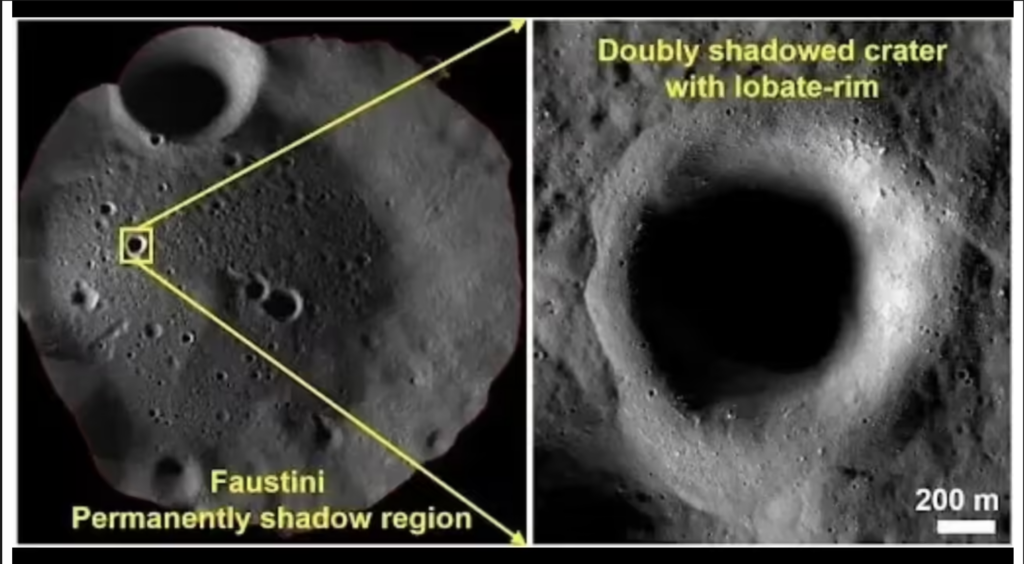
Scientists from the Physical Research Laboratory (PRL) used data from Chandrayaan-2’s Dual Frequency Synthetic Aperture Radar (DFSAR) to discover strong evidence of subsurface water-ice near the Moon’s South Pole.
Key Findings
Target Location: Four “doubly shadowed craters” located inside Permanently Shadowed Regions (PSRs) at the lunar south pole.
Extreme Thermal Environment: These locations are permanently shielded from solar radiation, maintaining temperatures around 25 Kelvin (-248°C), acting as ideal cold traps to preserve volatiles.
The Prime Candidate: A 1.1 km diameter micro-crater located within the larger Faustini Crater showed the highest probability of containing clean subsurface ice.
Geomorphological Evidence
Lobate-Rim Morphology: The highly-evident 1.1 km crater exhibits flow-like, lobed patterns along its rim.
Geological Meaning: This indicates that the initial meteoroid impact likely penetrated a layer of subsurface ice, melting it briefly to create a slurry-like, fluid ejecta pattern before re-freezing.
About Chandrayaan-2 & DFSAR
Mission Context: Launched in July 2019; while its Vikram lander failed to make a soft landing, the orbiter remains fully functional in lunar orbit.
DFSAR Instrument: Dual Frequency Synthetic Aperture Radar.
Capabilities: It is the first fully polarimetric radar sent to the Moon, operating across L-band and S-band microwave frequencies to penetrate deep into the lunar regolith.
Significance
In-Situ Resource Utilization (ISRU): Essential for future crewed bases (such as Artemis or India’s planned lunar base) to harvest local water for life support and rocket fuel production.
Strategic Mapping: Provides high-fidelity targeting data for future landing and excavation missions, including India’s upcoming Chandrayaan missions.
Challenges
Accessing Cold Traps: Operating mechanical equipment in permanent darkness at 25 Kelvin presents immense engineering challenges.
Regolith Depth Overburden: The ice is subsurface, requiring specialized drilling and extraction systems rather than surface scraping.
[2017] The terms ‘Event Horizon’, ‘Singularity’, ‘String Theory’ and ‘Standard Model’ are sometimes seen in the news in the context of
[A] Observation and understanding of the Universe
[B] Study of the solar and the lunar eclipses
[C] Placing satellites in the orbit of the Earth
[D] Origin and evolution of living organisms on the earth
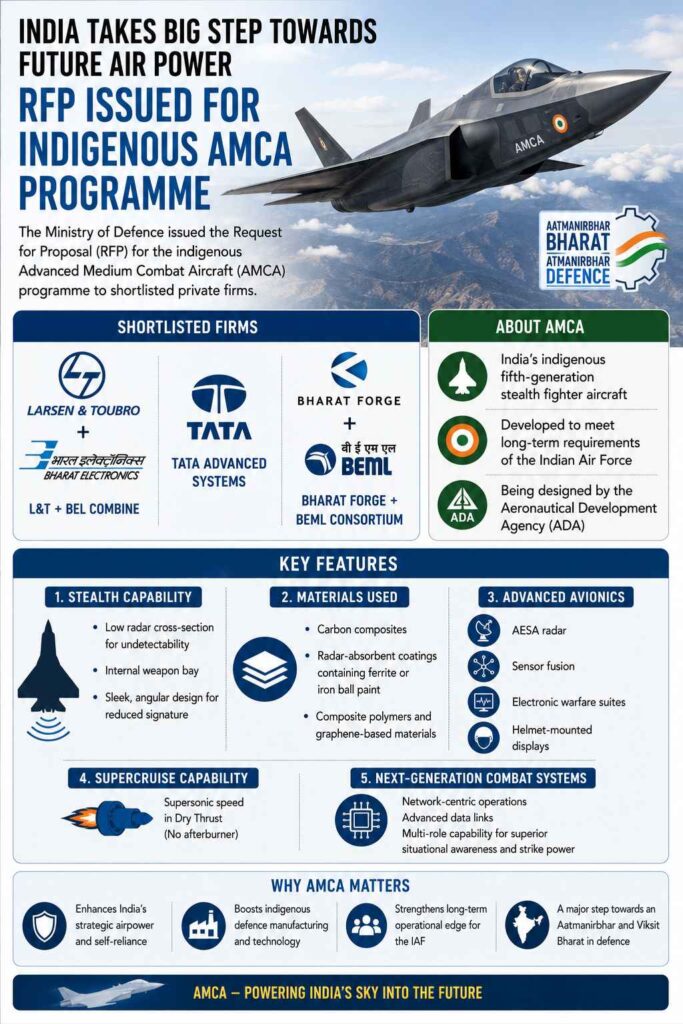
The Ministry of Defence issued the Request for Proposal (RFP) for the indigenous Advanced Medium Combat Aircraft (AMCA) programme to shortlisted private firms.
Developed to meet long-term requirements of the Indian Air Force
Being designed by the Aeronautical Development Agency (ADA)
Key Features
Stealth capability
Materials Used:
Carbon composites
Radar-absorbent coatings containing ferrite or iron ball paint
Composite polymers and graphene-based materials
Advanced avionics includes:
AESA radar
Sensor fusion
Electronic warfare suites
Helmet-mounted displays
Supercruise capability (Supersonic speed in Dry Thrust)
Next-generation combat systems
Programme Highlights
Government plans to build five prototypes
Selected private company will partner with ADA
Part of the “Make in India” and defence indigenisation push
Hindustan Aeronautics Limited (HAL) reportedly excluded from current process
Consider the following statements regarding the fifth-generation fighter jet configurations of India and Russia: 1.The Sukhoi Su-57, Russia’s operational fifth-generation stealth fighter, features supercruise capabilities but utilizes conventional round exhaust nozzles. 2.Under proposed partnerships, Russia has offered a twin-seat variant of the Su-57, which allows a second crew member to manage manned-unmanned teaming operations with stealth drones. 3.India’s indigenous fifth-generation Advanced Medium Combat Aircraft (AMCA) is being developed and manufactured solely under the Defence Research and Development Organisation (DRDO), with zero foreign collaboration for its engines. Which of the statements given above is/are correct?
An article in The Hindu explained the scientific principles behind thermometers, temperature scales, absolute zero, and ultra-cold atomic physics, highlighting how measurement of temperature evolved from mercury thermometers to quantum physics-based studies of cold atoms.
What is Temperature?
Temperature is a measure of the average kinetic energy of atoms and molecules in a substance.
When heat is supplied:
Atoms and molecules move faster.
When heat is removed:
Their motion slows down.
Thus, temperature reflects the degree of atomic agitation inside matter.
Celsius Scale
Developed by: Anders Celsius
Basis of the Scale
0°C: Freezing point of water
100°C: Boiling point of water
The interval between these two points is divided into 100 equal parts.
Mercury Thermometers
Why Mercury is Used
Uniform expansion on heating
Easily visible liquid metal
Good thermal conductor
Digital Thermometers
Modern digital thermometers use Semiconductor materials
Principle
Semiconductors conduct limited electricity.
Higher temperature releases more free electrons.
Increased electric current is measured electronically and converted into temperature readings.
[2021] In a pressure cooker, the temperature at which the food is cooked depends mainly upon which of the following? 1. Area of the hole in the lid 2. Temperature of the flame
3. Weight of the lid Select the correct answer using the code given below.
Google recently introduced “information agents,” AI assistants capable of continuously monitoring the web on behalf of users. These agents aim to automate information gathering, recommendations, and decision-making by integrating data across Google’s ecosystem such as Search, Gmail, Maps, Chrome, YouTube, Android, and Calendar.
What are Information Agents?
Google Information Agents are AI-powered assistants, announced at Google I/O 2026, designed to run continuously in the background of Google Search to monitor the web, synthesize information, and act on your behalf 24/7. They act as an evolution of Google Alerts, proactively providing updates on topics like apartment hunting or price tracking.
Key Features & Capabilities
Proactive Monitoring: Instead of waiting for a manual query, agents constantly check the web for updates tailored to specific goals.
Synthesis & Action: Agents gather data from multiple sources, provide insights, and can trigger actions (e.g., booking, alerting).
“AI Mode” in Search: Activated within the Google App, where users can set up and track these agents.
Personalization: Agents use user-provided details (budget, location, preferences) to provide personalized, actionable results.
Why Do Google’s Information Agents Represent a Structural Shift in the Nature of Internet Use?
Passive-to-Autonomous Transition: Traditional search depends on active human input where users consciously search for information. Information agents shift this model toward persistent AI monitoring that continuously scans the internet without repeated user intervention.
Continuous Monitoring: Agents remain active over time rather than responding to one-time prompts. They monitor categories such as housing, travel, stocks, health, or shopping preferences.
Cross-Ecosystem Integration: Google integrates information from Search, Gmail, Maps, Chrome, Calendar, YouTube, and Android, enabling deeper behavioural profiling than standalone AI assistants.
Predictive Personalization: Agents function by collecting increasing amounts of personal data because improved recommendations depend on richer behavioural information.
Machine-to-Machine Internet: The article highlights a structural change where digital interactions increasingly occur between automated systems instead of humans directly browsing websites.
How Could Information Agents Intensify Data Privacy and Surveillance Concerns?
Behavioural Profiling: Agents require intimate personal details to function effectively. A housing-monitoring request may reveal location preference, family size, budget, commuting constraints, timeline, and travel plans.
Sensitive Data Accumulation: Users may unintentionally disclose religious beliefs, political preferences, sexual orientation, medical history, and financial behaviour, expanding risks of sensitive profiling.
Indefinite Data Storage: Information collected for agentic services may remain stored for prolonged periods, increasing risks of misuse or surveillance.
Data Concentration: Google already possesses vast datasets through existing platforms. Information agents deepen concentration by linking fragmented behavioural data into unified user profiles.
Limited Regulatory Protection: Current frameworks remain underdeveloped regarding liability if AI agents influence financial or personal decisions that later harm users.
Can AI Information Agents Overload the Internet’s Infrastructure?
Bot Traffic Expansion: AI-driven internet activity is already increasing sharply.
Striking Data: The article cites the Thales 2026 Bad Bot Report, which estimates bots account for 53% of global web traffic.
Sharp Increase in Attacks: AI-driven bot attacks reportedly increased 15 times in 2025.
Blocked Requests Surge: Daily blocked bot requests reportedly increased from 2 million to 25 million within a year.
Exponential Crawling: A conventional Google search may trigger one crawl after a query. Information agents repeatedly scan websites, potentially generating hundreds of automated fetches daily per user.
Infrastructure Burden: Millions of subscribers using persistent agents could impose enormous computational and bandwidth costs on websites.
Example
Housing Listings: An agent monitoring apartment prices continuously would repeatedly crawl real-estate websites to detect changes.
Stock Monitoring: Persistent stock monitoring may generate frequent automated queries throughout the day.
How Could Information Agents Threaten the Economic Sustainability of the Open Web?
Publisher Revenue Erosion: AI agents may summarize content directly instead of redirecting users to publisher websites, reducing click-through traffic.
Server Cost Burden: Publishers would continue bearing infrastructure costs while AI systems scrape and synthesize content.
Content Extraction Problem: Information harvesting without proportional traffic or revenue could weaken incentives for quality journalism.
Potential Publisher Pushback: Websites may increasingly block Google crawlers or restrict access to AI scraping.
Negative Feedback Loop: Reduced publisher incentives may degrade content quality, weakening the informational ecosystem itself.
Comparative Contex
AI Search Platforms: Similar debates have emerged around AI-generated search summaries reducing website visits.
Media Compensation Models: Countries such as Australia introduced bargaining mechanisms between digital platforms and news publishers.
Does the Rise of Information Agents Deepen Market Concentration and Digital Inequality?
Platform Entrenchment: Google’s advantage lies in unmatched digital infrastructure across search, email, navigation, devices, and browsing behaviour.
Lock-In Effect: Users embedded in Google’s ecosystem may find switching increasingly difficult due to personalized AI assistance.
Subscription Divide: The information agents may initially launch for Google AI Pro and Ultra subscribers, creating differentiated access.
Informational Inequality: Wealthier users may gain persistent AI assistants while others continue manual searches, widening informational asymmetries.
Market Power Consolidation: Persistent agents could further strengthen dominance of already large digital platforms.
Are Existing Legal and Governance Frameworks Adequate for AI Agents?
Liability Gap: No clear framework exists regarding responsibility if an AI agent nudges users toward harmful financial or medical outcomes.
Assistant-versus-Advisor Problem: Companies classify agents as “assistants” rather than advisors, limiting accountability.
Regulatory Lag: Technology deployment currently outpaces legal adaptation.
Need for Algorithmic Transparency: Users require clarity regarding how recommendations are generated and monetized.
Data Governance Deficit: Existing laws inadequately address persistent behavioural monitoring by autonomous systems.
Possible Governance Measures
Consent Architecture: Ensures granular and revocable consent mechanisms.
Transparency Mandates: Requires disclosure regarding data collection, recommendation logic, and commercial influence.
Publisher Compensation: Develops fair economic arrangements for AI-generated content extraction.
AI Liability Standards: Establishes responsibility for harmful outcomes from automated recommendations.
Bot Governance Framework: Regulates autonomous web crawling and infrastructure burden.
Conclusion
Google’s information agents represent a transformative shift from search-based internet use to persistent AI-mediated interaction. While the model promises convenience and efficiency, it intensifies concerns relating to privacy, concentration of digital power, infrastructure strain, and publisher sustainability. The challenge for policymakers lies in balancing technological innovation with data protection, platform accountability, fair digital markets, and preservation of an open web ecosystem.
Important Value Additions for UPSC MainsKey ConceptsAgentic AI: AI systems capable of autonomous action, monitoring, and decision-making.Surveillance Capitalism: Monetization of behavioural data for predictive commercial outcomes.Platform Monopoly: Dominance arising from control over infrastructure, data, and network effects.Data Colonialism: Extraction and monetization of user data at scale.Algorithmic Governance: Decision-making increasingly shaped through digital systems.
PYQ Relevance
[UPSC 2018] Data security has assumed significant importance in the digitized world due to rising cyber crimes. The Justice B.N. Srikrishna Committee Report addresses issues related to data security. What, in your view, are the strengths and weaknesses of the Report relating to protection of personal data in cyberspace?
Linkage: The PYQ reflects UPSC’s focus on institutional and legal frameworks governing personal data in the digital age. Google’s information agents intensify concerns discussed in the PYQ by enabling persistent behavioural tracking and integrated profiling across digital ecosystems.
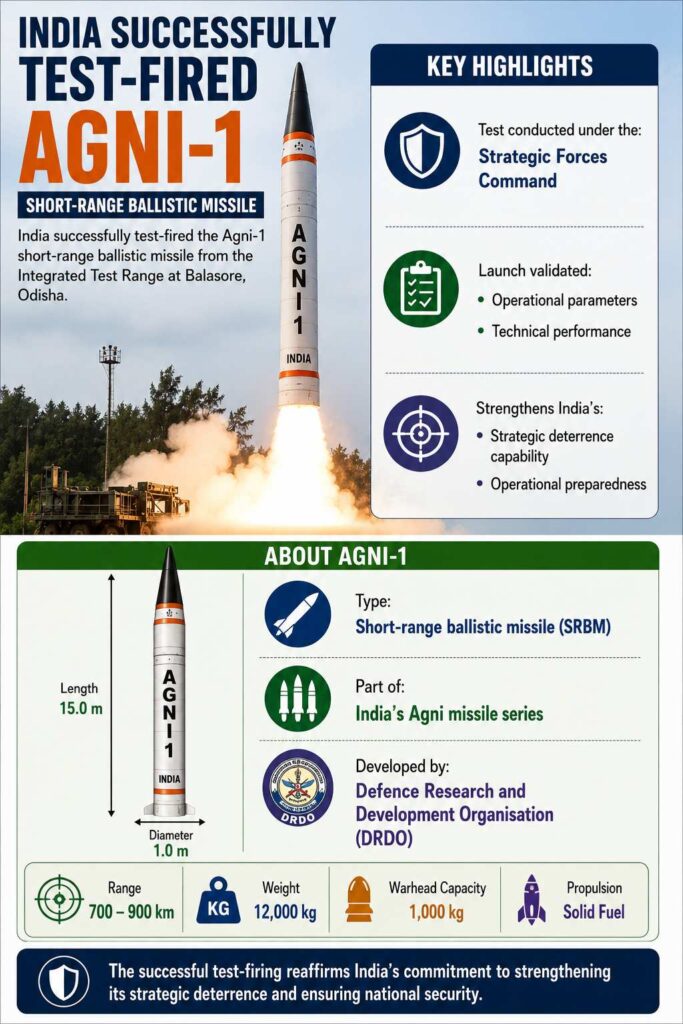
Warheads can strike Different targets independently
[2014] With reference to Agni-IV Missile, consider the following statements; 1.It is a surface-to-surface missile. 2.It is fuelled by liquid propellant alone. 3.It can deliver one-tonne nuclear warheads about 4000 kms. Which of the statements given above is/are correct?
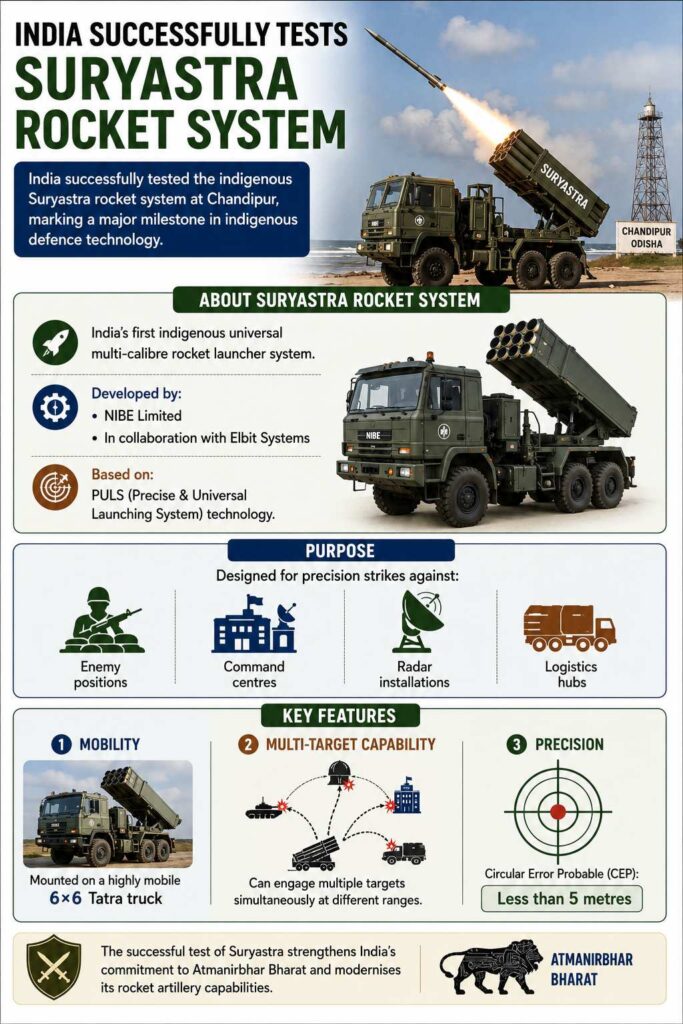
India successfully tested the indigenous Suryastra rocket system at Chandipur, marking a major milestone in indigenous defence technology.
About Suryastra Rocket System
India’s first indigenous universal multi-calibre rocket launcher system.
Developed by:
NIBE Limited
In collaboration with Elbit Systems
Based on: PULS (Precise & Universal Launching System) technology.
Range: 300 KM
Purpose
Designed for precision strikes against:
Enemy positions
Command centres
Radar installations
Logistics hubs
Key Features
Mounted on a highly mobile: 6×6 Tatra truck
Multi-target Capability
Can engage multiple targets simultaneously at different ranges.
Precision
Circular Error Probable (CEP): Less than 5 metres
[2025] With reference to India’s defense, consider the following pairs: Aircraft type Description 1. Dornier-228 Maritime patrol aircraft 2. IL-76 Supersonic combat aircraft 3. C-17 Globe Master IIIMilitary transport aircraft How many of the pairs given above are correctly matched?
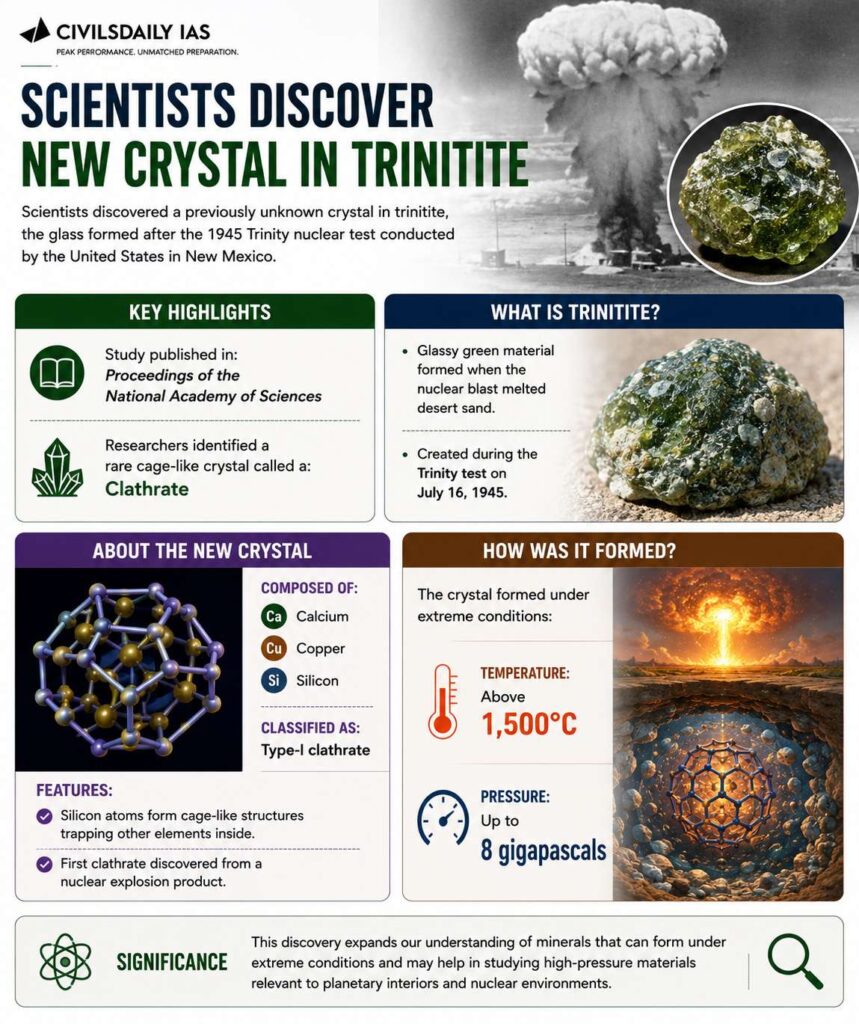
Scientists discovered a previously unknown crystal in trinitite, the glass formed after the 1945 Trinity nuclear test conducted by the United States in New Mexico.
Key Highlights
Study published in: Proceedings of the National Academy of Sciences
Researchers identified a rare cage-like crystal called a Clathrate
What is Trinitite?
Glassy green material formed when the nuclear blast melted desert sand.
Created during the Trinity test on July 16, 1945.
About the New Crystal
Composed of:
Calcium
Copper
Silicon
Classified as a Type-I clathrate
Features
Silicon atoms form cage-like structures trapping other elements inside.
First clathrate discovered from a nuclear explosion product.
How Was it Formed?
The crystal formed under extreme conditions:
Temperature Above 1,500°C
Pressure Up to 8 gigapascals
Rapid cooling preserved the crystal structure.
Link with Quasicrystals
The study followed earlier discovery of a Quasicrystal in red trinitite (2021)
Quasicrystals
Have ordered but non-repeating atomic patterns.
Earlier believed impossible in nature.
Researchers found Clathrates and quasicrystals formed separately during the blast.
Scientific Importance
The findings suggest:
Extreme environments can create entirely new forms of matter.
Nuclear blast conditions may help scientists develop novel synthetic materials.
[2013] The efforts to detect the existence of Higgs boson particle have become frequent news in the recent past. What is /are the importance/importances of discovering this particle? 1. It will enable us to understand why elementary particles have mass. 2. technology to transferring matter from one point to another without traversing the physical space between them. 3. It will enable us to create better fuels for nuclear fission. Select the correct answer using the codes given below:
[A] 1 only [B] 2 and 3 only [C] 1 and 3 only [D] 1, 2 and 3
Scientists analysing data from Chandrayaan-3 discovered that the Moon’s upper surface near the landing site has two distinct layers within a few centimetres of depth.
Key Findings
The lunar surface (regolith) is not uniform.
A loose porous upper layer quickly changes into a denser compact layer:
About 2 to 6 cm below the surface.
Role of the ‘Hop’ Experiment
Chandrayaan-3 lander performed a small “hop”.
The lander:
Lifted about 40 cm above the surface
Moved nearly 50 cm before landing again
ChaSTE Instrument
The findings are based on data from Chandra’s Surface Thermophysical Experiment (ChaSTE)
Function
Measured thermal properties and temperature profile of lunar soil.
Used a rod-shaped probe with temperature sensors.
Important Discoveries
Even at 6-9 cm depth, the Moon showed layered structure.
Temperature dropped sharply with depth:
Around 60°C lower at 10 cm depth compared to the surface.
[2016] Consider the following statements: The Mangalyaan launched by ISRO 1. is also called the Mars Orbiter Mission 2. made India the second country to have a spacecraft orbit the Mars after USA 3. made India the only country to be successful in making its spacecraft orbit the Mars in its very first attempt Which of the statements given above is/are correct? [A] 1 only [B] 2 and 3 only [C] 1 and 3 only [D] 1, 2 and 3
Scientists have developed advanced “DNA maps” to identify the origin and trafficking routes of illegally traded pangolins, helping expose international wildlife smuggling networks.
Key Highlights
Study published in PLOS Biology on May 7, 2026.
Researchers mapped trafficking routes of:
White-bellied pangolin
Sunda pangolin
Chinese pangolin
How the DNA Mapping Works
Scientists analysed 671 specific locations in the pangolin genome that differ across populations.
Used:
Museum specimens
Recent pangolin samples
Created a large geo-referenced genetic database to identify the origin of trafficked pangolins.
Major Findings
Researchers found evidence of trafficking routes from: Arunachal Pradesh and Assam
feeding illegal trade networks through Yunnan in China.
Significance
Helps identify poaching hotspots accurately.
Assists enforcement agencies in tracking wildlife crime networks.
Can improve international cooperation against illegal wildlife trade.
About Pangolins
Pangolins are scaly mammals threatened by:
Habitat loss
Illegal trafficking
Hunted mainly for:
Scales
Meat
Conservation Status
Protected under: Schedule I of the Wild Life (Protection) Act, 1972
Listed under: Appendix I of Convention on International Trade in Endangered Species of Wild Fauna and Flora
[2022] Consider the following statements: DNA Barcoding can be a tool to: 1. Assess the age of a plant or animal. 2. Distinguish among species that look alike. 3. Identify undesirable animal or plant materials in processed foods. Which of the statements given above is/are correct? [A] 1 only [B] 3 only [C] 1and 2 [D] 2 and 3
The Union Health Ministry stated that India has no reported Ebola cases and the current risk remains minimal, while closely monitoring the outbreak in Central Africa.
Key Highlights
The outbreak involves Ebola Virus Disease caused by the Bundibugyo virus strain.
Affected regions include:
Democratic Republic of the Congo
Uganda
Measures Taken by India
Enhanced surveillance at airports and ports
Monitoring of international travellers from affected regions
Isolation and quarantine preparedness
Coordination with relevant ministries and agencies
Agencies Involved
National Centre for Disease Control (NCDC)
Integrated Disease Surveillance Programme (IDSP)
Indian Council of Medical Research (ICMR)
About Ebola Virus Disease (EVD)
Severe viral haemorrhagic fever affecting humans and primates.
Spread through:
Direct contact with infected bodily fluids
Contaminated surfaces
Infected animals
Symptoms
Fever
Weakness
Bleeding
Organ failure in severe cases
What is PHEIC?
A Public Health Emergency of International Concern is declared by WHO under the International Health Regulations (IHR) when an outbreak:
Poses international public health risk
Requires coordinated global response
[2015] Among the following, which were frequently mentioned in the news for the outbreak of Ebola virus recently? (a) Syria and Jordan (b) Guinea, Sierra Leone and Liberia (c) Philippines and Papua New Guinea (d) Jamaica, Haiti and Surinam