💥Join UPSC 2027,2028 Mentorship (July Batch) + XFactor Notes & Microthemes PDF

Subject: Science and Technology

  • What is Axiom-4 Mission?

    Why in the News?

    The launch of Axiom-4 (Ax-4), a private mission to the International Space Station (ISS), has finally lifted-off after several postponements due to weather conditions.

    About Axiom-4 Mission:

    • Axiom Mission 4 (Ax-4) is a private spaceflight organized by Axiom Space.
    • It aims to transport a crew to the International Space Station (ISS) for a 14-day mission.
    • This will be Axiom Space’s 4th mission to the ISS, following their previous missions (Ax-1, Ax-2, and Ax-3).
    • The mission will launch from the Kennedy Space Center in Florida using SpaceX’s Falcon 9 rocket.
    • The spacecraft for this mission is a SpaceX Crew Dragon, known for its advanced technology and safety features.
    • This mission is organised in collaboration with NASA, highlighting a strong partnership between private space companies and government space agencies to further space exploration and research.
    • Crew:
      1. Peggy Whitson: A veteran astronaut with extensive experience, having completed multiple missions to the ISS.
      2. Sławosz Uznanski: A Polish astronaut joining the mission, marking a significant milestone for Poland in space exploration.
      3. Tibor Kapu: A Hungarian astronaut, adding to the diversity of the mission crew.
      4. Group Captain Shubhanshu Shukla: An Indian astronaut, making headlines as part of this international crew.

    Significance of Ax-4 Mission for India

    • The mission is a collaborative effort resulting from an agreement between ISRO and NASA.
    • It provides ISRO with an early opportunity to test experiments in space, originally planned for Gaganyaan.
    • Key Indian Experiments on Axiom-4:
      • Microgravitys impact on muscle dysfunction.
      • Use of computer screens in zero gravity and their effects on human cognition and vision.
      • Growth of six varieties of crop seeds in space conditions.
      • Tardigrade survival study—these microscopic creatures can endure extreme environments and may provide insight into life support systems in space.

    Back2Basics: International Space Station (ISS)

    • The ISS, orbiting 430 kilometres above Earth, completes 16 orbits daily, witnessing 16 sunrises and sunsets.
    • It orbits Earth every 90 minutes at 8 km per second.
    • Spanning 109 meters, it’s almost as long as an American football field.
    • It includes 6 sleeping areas, 2 bathrooms, a gym, and a panoramic view bay window.
    • Its solar array wingspan is 109 meters, and the station houses about 13 km of electrical wiring.
    • Its journey began on November 20, 1998, with Russia’s Zarya Control Module.
    • The US added the Unity Node 1 module on December 4, 1998, marking the start of a functional space lab.
    • It evolved into its current form after 42 assembly flights.


    PYQ:

    [2019] What is India’s plan to have its own space station and how will it benefit our space programme?

  • Sam Altman’s World ID Project

    Why in the News?

    World ID is Sam Altman’s ambitious project to create a secure, biometric-based digital identity for everyone in the age of AI.

    What is World ID?

    • World ID is a digital identity system launched by Sam Altman’s company Tools for Humanity as part of the Worldcoin project in July 2023.
    • It aims to verify that a person is a real, unique human being—especially in an age of AI-generated bots—using biometric iris scans.
    • How Does It Work?
      • The identity is created using a device called the Orb, which captures the iris pattern and generates a unique cryptographic code (not storing the image itself).
      • This ID is then linked to the World App, and the user can access various services while proving they are human—without revealing their actual identity.
      • The system is decentralized and uses blockchain technology to store identity proofs securely.

    Key Features of World ID:

    • Biometric Verification: Uses iris scanning through the Orb to establish a unique identity.
    • Global Access: Users from over 160 countries have access to Worldcoin and World ID features.
    • Decentralized Protocol: Built on open-source, privacy-preserving cryptography, such as zero-knowledge proofs.
    • World App Integration: Enables users to locate Orbs, receive Worldcoins, and use the digital ID across apps.
    • World Chain: A blockchain linked to World ID that supports apps and services tied to identity.
    • Crypto Incentive: Users may receive Worldcoin (WLD) tokens for enrolling.
    • Privacy Controls: Promises anonymity, non-surveillance use, and code transparency.
    • Hardware Dependency: Requires a physical Orb or the new Orb Mini to generate IDs.

    How it differs from Aadhaar?

    World ID Aadhaar
    Ownership Private project by Tools for Humanity Government of India
    Launch Year 2023 2009
    Technology Used Iris scan via Orb; Blockchain-based ID Biometric + Demographic data via central database
    Legal Framework No national law backing it yet Aadhaar Act, 2016
    Purpose Global ID to prove human uniqueness National ID for accessing services & welfare
    Data Privacy Claims privacy via zero-knowledge cryptography Data regulated by UIDAI under Indian law
    Adoption Level 12 million users globally Over 1.3 billion users in India
    Hardware Needed Orb device Fingerprint/iris scanners at enrollment centers
    Verification Use AI-bot detection, global ID use Government subsidies, banking, KYC, etc.


  • In-Body CAR T-Cell Therapy

    Why in the News?

    A new study published in Science journal shows that “In-Body CAR T-Cell Therapy” marks a breakthrough by enabling direct immune cell reprogramming for faster, safer treatment of cancer and autoimmune diseases.

    What is CAR T-Cell Therapy?

    • Overview: CAR T-cell therapy is a treatment where a patient’s own T cells are genetically modified to detect and kill cancer cells.
    • Science behind it: Scientists extract T cells and add a Chimeric Antigen Receptor (CAR) gene, which enables them to identify cancer cells.
    • Working: These modified T cells are infused back into the patient, where they multiply and actively attack cancer.
    • Effectiveness: The therapy has shown high success against certain blood cancers and is now being studied for autoimmune disorders like lupus.
    • Issues: The traditional therapy is expensive (₹60–70 lakh), slow, and requires chemotherapy and specialised lab facilities.

    Recent Breakthrough: In-Body CAR T-Cell Therapy

    • Approach: A new technique uses mRNA-loaded lipid nanoparticles (LNPs) to deliver instructions directly inside the body.
    • Targeting Cells: These nanoparticles are programmed to locate and enter killer T cells, converting them into CAR T-cells internally.
    • Benefits offered: This method eliminates the need for cell extraction, chemotherapy, or viral vectors, making it faster and safer.

    Significance for India:

    • Scalable Innovation: This platform may lower treatment costs and offer wider access in countries like India with high cancer and autoimmune burdens.
    • Infrastructure Relief: Its in-body nature avoids dependence on advanced labs, making it suitable for resource-constrained settings.
    [UPSC 2019] What is Cas9 protein that is often mentioned in news?

    Options: (a) A molecular scissors used in targeted gene editing* (b) A biosensor used in the accurate detection of pathogens in patients (c) A gene that makes plants pest-resistant (d) A herbicidal substance synthesized in genetically modified crops


  • India trails in critical tech, particularly semiconductor tech

    Why in the News?

    A new global index called the Critical and Emerging Technologies Index ranks 25 countries based on their strength in five key areas: AI, biotechnology, semiconductors, space, and quantum tech. India scored 15.2 overall, falling far behind top countries like the U.S., China, and those in Europe.

    What is the Critical and Emerging Technologies Index?

    • A global index launched to evaluate how 25 countries perform across five technology sectors: AI, biotechnology, semiconductors, space, and quantum.
    • Developed using public and commercial data, allowing policymakers to compare relative strengths and weaknesses.
    • Weighting of sectors: Semiconductors (35%), AI (25%), Biotechnology (20%), Space (15%), Quantum (5%), based on geopolitical relevance and dual-use potential.

    How does it assess countries’ performance?

    • Sector-wise Evaluation Using Pillars: Each of the five sectors—AI, biotechnology, semiconductors, space, and quantum—is assessed using multiple weighted pillars such as funding, talent, core technologies, infrastructure, and global influence.
    • Weighted Scoring System: The index assigns strategic weights to each sector (e.g., semiconductors 35%, AI 25%) based on geopolitical relevance and dual-use potential, resulting in an overall score that reflects each country’s relative technological strength.

    Why is India behind the top countries in key tech sectors?

    • Lower Investments and Talent Gaps: India lacks deep investments and a large skilled workforce in core tech sectors like semiconductors and quantum computing. Eg: The U.S. leads in AI and chip design due to massive R&D funding and strong academia-industry collaboration.
    • Fragmented Innovation Ecosystem: Unlike the U.S.’s decentralized model or China’s state-led coordination, India’s innovation lacks synergy across government, industry, and academia. Eg: India ranks below France and far behind China in biotech and space sectors despite policy efforts.
    • Limited Manufacturing and Infrastructure: India has weak chip fabrication and limited quantum labs or space tech facilities compared to countries like Taiwan (chips) or Russia (space assets). Eg: India ranks 7th in space while Russia is 3rd due to superior defence assets and launch capabilities.

    Which factors drive U.S. dominance in tech?

    • Massive Investments and Funding: The U.S. leads due to consistent and large-scale public and private investments in emerging technologies. Eg: Heavy funding in AI and semiconductors ensures global leadership in research and innovation.
    • Strong Talent and Research Ecosystem: A world-class workforce, top universities, and a decentralized innovation network strengthen its technological base. Eg: Institutions like MIT and Stanford produce cutting-edge research in quantum and biotech.
    • Strategic Global Partnerships: The U.S. collaborates closely with tech leaders like Japan, South Korea, and Europe, especially in semiconductorsand quantum. Eg: Joint ventures in chip production enhance U.S. resilience and global influence.

    How do China and Europe compare in tech strengths?

    Aspect China Europe Example
    Biotechnology Strong growth due to state-led investments and large talent pool Leading in vaccine R&D, genetic engineering, and pharma Eg: China’s focus on biotech parks; Europe’s mRNA vaccine leadership
    Quantum Technology Rapidly progressing with centralised planning and funding Strong academic research and early quantum computing breakthrough Eg: China’s Jiuzhang quantum computer; Europe’s QuTech (Netherlands)
    Semiconductors Lags behind due to foreign tech dependency and tool import barriers Moderate progress; behind East Asia and U.S. in manufacturing Eg: China’s reliance on ASML’s lithography; Europe’s low chip fab capacity
    Artificial Intelligence (AI) Excels in data volume and AI applications, but weaker algorithms Strong in ethical AI, policy, and funding, but lags behind in deployment Eg: China’s use of AI in facial recognition; Europe’s AI Act regulation
    Space Technology Advanced programs with state backing; lacks international openness Lower funding and limited military use; some success in space science Eg: China’s Chang’e missions; Europe’s ESA satellite projects


    Why is the above comparison between Europe and China important for India? 

    • Strategic Benchmarking for Policy and Investment: It helps India identify strength areas (e.g., biotech in Europe, quantum in China) and gaps (e.g., semiconductors) to shape its own technology roadmap, investments, and global collaborations. Eg: India can learn from China’s scale-driven investments in biotech and Europe’s regulatory models in AI for better domestic implementation.
    • Opportunity for Strategic Alliances: Understanding their strengths enables India to form targeted partnerships for tech transfer, research, and market access in complementary areas. Eg: India–EU cooperation in pharmaceutical innovation, or India–China dialogue in quantum research norms can enhance India’s tech footprint.

    Way forward: 

    • Enhance Strategic Investments in Core Tech Sectors: India should increase targeted funding and incentives in critical areas like semiconductors, AI, and biotech, with a focus on R&D, talent development, and infrastructure. Eg: Expanding PLI schemes to include quantum and chip design startups.
    • Build Global Tech Partnerships and Talent Pipelines: Proactively engage with Europe, Japan, South Korea, and the U.S. for joint research, mutual recognition of standards, and tech collaboration. Eg: Set up Indo-EU research hubs for biotechnology and semiconductor fabrication units with Japan.

    Mains PYQ:

    [UPSC 2022] Elucidate the relationship between globalization and new technology in a world of scarce resources, with special reference to India.

    Linkage: India “lags significantly” in critical technology sectors like semiconductors, which require substantial resources (e.g., advanced manufacturing capabilities, specialized raw materials, skilled talent, significant funding), this question implicitly probes India’s challenges and trailing position in the global technological landscape.

  • Quantum 5G Fixed Wireless Access Broadband

    Why in the News?

    BSNL announced the soft launch of Quantum 5G Fixed Wireless Access (FWA) broadband in Hyderabad.

    About Quantum 5G FWA:

    • Overviews: It is India’s first SIM-less, fixed wireless access broadband service.
    • Development: It delivers fibre-like internet over 5G radio and was developed entirely by Indian vendors under the Atmanirbhar Bharat initiative.
    • How does it work?
      • Customers are provided with a CPE (Customer Premises Equipment) device that connects wirelessly to the nearest BSNL 5G base station.
      • The CPE auto-authenticates without requiring a SIM card, using Direct-to-Device technology.
      • Internet is delivered over the air, eliminating the need for trenching or fibre installation.
      • The service currently reaches 85% of Hyderabad households using BSNL’s existing tower infrastructure.

    Key Features:

    • Indigenous: Includes core network, RAN, and CPE, all developed by Indian vendors.
    • High Performance: Achieves up to 980 Mbps download, 140 Mbps upload, and <10 ms latency—ideal for streaming, gaming, and remote work.
    • Quick Setup: Customers can self-install the device with no need for physical fibre connections.
    • Enterprise Capability: Supports network slicing and Service Level Agreement (SLA)-backed links for MSMEs and industrial clusters.
    • Strategic Vision: Positions BSNL as a leader in next-generation broadband and enhances rural and urban connectivity.
    [UPSC 2019] With reference to communication technologies, what is/are the difference/differences between LTE (Long-Term Evolution) and VoLTE (Voice over Long-Term Evolution)?

    1. LTE ‘is commonly marketed as 3G, and VoLTE is commonly marketed as advanced 3G.

    2. LTE is data-only technology, and VoLTE is voice-only technology.

    Options: (a) 1 only (b) 2 only (c) Both 1 and 2 (d) Neither 1 nor 2*


  • IIT-D demonstrates Quantum Communication over 1 Km

    Why in the News?

    The Defence Ministry announced a breakthrough as IIT-Delhi and DRDO scientists successfully demonstrated quantum communication over 1 km in free space.

    What is Quantum Communication?

    • It is a new way of sending messages so safely that no one can secretly listen in.
    • It uses the laws of quantum physics, especially something called quantum entanglement, to make sure that if someone tries to spy on your message, you’ll know immediately.
    • In quantum entanglement, two tiny particles (like photons of light) are connected in a mysterious way—whatever happens to one instantly affects the other, even if they’re far apart.
    • Because of this, if someone tries to distort one particle, it changes, and the system knows the message isn’t safe anymore.
    • This makes quantum communication perfect for defence, banking, and sensitive messages that must stay secret.

    Quantum Key Distribution (QKD) – Explained Simply:

    • Imagine you want to lock a box and send it to your friend, but you also want them to have the key—without anyone else being able to copy it.
    • QKD is a special way to share that key safely, using quantum particles instead of metal keys.
    • Two people use entangled particles to create the same secret key, without anyone else knowing it.
    • If someone tries to intercept the key while it’s being shared, the particles will show signs of disturbance, and the system will know to discard it and try again.
    • Once both people have the same key, they can use it to lock and unlock messages using regular encryption tools.
    • QKD doesn’t send the actual message—it just safely shares the key that keeps messages secret.

    What did the IIT-Delhi team achieve?

    • A team led by IIT-Delhi, in collaboration with DRDO, successfully demonstrated entanglement-based quantum communication over 1 km in free space.
    • This was done within the IIT-Delhi campus and marks a key advancement from previous experiments using only optical fibre.
    • The demonstration achieved a secure key rate of 240 bits per second and maintained a quantum bit error rate (QBER) of under 7%, which is considered acceptable for real-world QKD.
    • This capability is a step toward achieving satellite-to-ground quantum communication, enabling encrypted keys to be distributed across vast regions without physical links.

    India’s Quantum Communication Journey So Far:

    • In 2022, Prof. Kanseri’s team first demonstrated quantum communication between Vindhyachal and Prayagraj.
    • In 2023, they expanded this capability to 380 km using standard telecom fibre, achieving a low QBER of 1.48%.
    • By 2024, the team established a QKD link spanning over 100 km of optical fibre, further pushing the reliability and reach of India’s quantum infrastructure.
    • These achievements are part of India’s larger effort under the National Quantum Mission (2023–2031), which has a budget of ₹6,000 crore to support R&D and deployment in quantum computing, sensing, and communication.
    • India now joins an elite group of nations—alongside China and the US—actively building toward a quantum-secure internet, with potential applications in defence, finance, telecom, and cybersecurity.


    [UPSC 2025] Consider the following statements:

    I. It is expected that Majorana 1 chip will enable quantum computing. II. Majorana 1 chip has been introduced by Amazon Web Services (AWS). III. Deep learning is a subset of machine learning.

    Which of the statements given above are correct?

    Options: (a) I and only I (b) II and III only (c) I and III only* (d) I, II and III


  • [20th June 2025] The Hindu Op-ed: Why India should address its propulsion gap

    PYQ Relevance:

    [UPSC 2020] What is the significance of Indo-US defence deals over Indo-Russian defence deals? Discuss with reference to stability in the Indo-Pacific region.

    Linkage: The question regarding Indo-US and Indo-Russian defense deals is relevant because India’s propulsion gap directly influences its choices and reliance on these foreign defense partners for critical military hardware like engines. Addressing the propulsion gap would reduce this dependency, enabling India to better assert its strategic autonomy and contribute to regional stability (such as in the Indo-Pacific) without being constrained by external supply chain pressures or technology transfer limitations from other nations.


    Mentor’s Comment:  India’s Advanced Medium Combat Aircraft (AMCA) project is moving ahead quickly and is seen as a big step forward for the country’s aerospace sector. However, the excitement is being held back by a long-standing reliance on foreign engines. This same problem had earlier affected the HF-24 Marut and is now also troubling the LCA and AMCA fighter jet programs. Even after years of work and investment — including the unsuccessful Kaveri engine project and delays in getting engines from GE — India still depends heavily on other countries for engine technology. This not only affects military preparedness but also raises serious concerns about India’s ability to act independently in defence matters.

    Today’s editorial analyses the development of Indian fighter aircraft engines. This content would help in GS Paper II (International Relations) and GS Paper III (Science & Technology) in the mains Paper.

    _

    Let’s learn!

    Why in the News?

    Recently, there is growing excitement around India’s AMCA stealth fighter, seen as a major aerospace milestone. However, concerns remain due to a long-standing reliance on imported engines since the HF-24 Marut.

    Why has India failed to develop its own jet engine? 

    • Technological Challenges in Engine Design: Jet engines require high thrust-to-weight ratios, thermal stability, and advanced metallurgy, which India has struggled to achieve. Eg: The Kaveri GTX-35VS engine, under development since 1989 by DRDO-GTRE, failed to meet performance benchmarks in thrust and thermal management even after 3,000 hours of testing.
    • Lack of Core Materials and Manufacturing Capability: India lacks access to critical technologies like single-crystal turbine blades, thermal barrier coatings, and advanced cooling systems, essential for high-performance engines. Eg: Negotiations with GE for F414 engine hit a roadblock because GE refused full transfer of these core technologies despite India’s demand.
    • Fragmented and Short-Term Funding: Defence R&D funding in India is project-specific and often lacks a long-term strategic vision, affecting continuity and innovation in complex projects. Eg: Despite spending over ₹2,032 crore on the Kaveri project over 35 years, no operational engine was produced due to inconsistent support and shifting goals.
    • Over-Reliance on Foreign Engines: Dependence on foreign suppliers has created a complacency in indigenous R&D, slowing domestic capability-building. Eg: India continues to rely on GE F404 and F414 engines for its LCA Tejas variants, instead of pursuing an urgent push for domestic alternatives.
    • Institutional Inertia and Missed International Collaborations: Bureaucratic rigidity and institutional pride have caused India to reject key collaborative opportunities for engine co-development. Eg: A proposed joint project with Safran (France) for developing an engine for AMCA and Tejas MkII was reportedly declined by DRDO.

    What is HF-24 Marut?

    The HF-24 Marut (meaning “Spirit of the Tempest”) was India’s first indigenously designed and built fighter jet, developed in the 1950s and 1960s by Hindustan Aeronautics Limited (HAL).

    What caused the HF-24 Marut’s underperformance?

    • Underpowered Engine: The Marut was equipped with British Bristol Siddeley Orpheus 703 turbojets, which lacked the thrust needed for supersonic performance. Eg: Designer Kurt Tank had envisioned a more powerful engine, but it never materialised, severely restricting the aircraft’s speed and payload capabilities.
    • Failure to Acquire Suitable Alternatives: Despite multiple attempts, India could not procure or co-develop a more suitable engine to enhance the Marut’s performance. Eg: Efforts to source a better engine from Egypt and Germany failed, leaving the Marut stuck with the underpowered Orpheus units.
    • Operational Limitations in Combat: The aircraft performed well in ground-attack roles, such as in the 1971 war, but its overall combat effectivenesswas limited by its propulsion shortfall. Eg: Indian Air Force veterans cited that the engine limitation was the Marut’s Achilles’ heel, preventing it from evolving into a full-spectrum fighter.

    How does engine import dependency impact India’s defence?

    • Delays in Defence Production and Induction: Dependency on foreign engines leads to project delays when there are supply chain issues or export restrictions. Eg: Delivery of 99 General Electric F404 engines for the LCA Mk1A was delayed by 13 months, pushing back aircraft induction timelines.
    • Limited Operational and Strategic Autonomy: India becomes vulnerable to geopolitical pressures and foreign policy decisions of engine-supplying nations. Eg: U.S. reluctance to share core technologies like single-crystal turbine blades restricts India’s ability to upgrade or export its fighter aircraft.
    • Constraints on Defence Exports: Exporting platforms equipped with foreign engines requires third-party approvals, limiting India’s potential in global defence markets. Eg: India’s ability to export Tejas is restricted by U.S. controls on the GE F404 engine, limiting defence diplomacy options.

    What are the steps taken by the Indian Government? 

    • Strategic Collaborations for Technology Transfer: India has initiated joint ventures and international collaborations to acquire advanced propulsion technology. Eg: During PM Modi’s 2023 U.S. visit, HAL signed a deal with General Electric to co-produce GE F414 enginesin India for the LCA Mk2 and AMCA programs.
    • Revival of Indigenous Engine Projects: The government has revived and restructured efforts to develop indigenous jet engines under DRDO’s GTRE. Eg: The Kaveri engine project was decoupled from the LCA program and is being explored for use in UAVs and future aircraft with potential foreign assistance.
    • Promotion of Atmanirbhar Bharat in Defence: The Defence Ministry has prioritized self-reliance in critical technologies, including aero-engines, under the Atmanirbhar Bharat initiative. Eg: Several defence PSUs and private players have been incentivized to develop components and sub-systemsfor aerospace platforms under Make in India schemes.

    What must India do to achieve propulsion self-reliance? (Way forward)

    • Establish Strategic Global Partnerships for Technology Transfer: India must engage in joint ventures with trusted international engine manufacturers to acquire critical technologies like single-crystal turbine blades and thermal barrier coatings. Eg: The proposed GE-HAL deal to manufacture the F414 engines in India should ensure full transfer of know-how to avoid long-term dependency.
    • Develop an Integrated Indigenous R&D Ecosystem: India needs to create a cohesive framework connecting DRDO, GTRE, academia, and private industry to focus on advanced propulsion R&D with long-term investment. Eg: Encouraging private sector participation in defence through the Innovations for Defence Excellence (iDEX)platform can accelerate jet engine innovation.


  • Rice reveals surprise ability to adapt to cold faster than evolution 

    Why in the News?

    In a major study, scientists proved that cold exposure in rice plants can cause changes that improve stress tolerance and are inherited by the next five generations, supporting Lamarck’s old theory.

    What was Lamarck’s theory of acquired characteristics?

    This idea was formally presented by Jean-Baptiste Lamarck in 1809, and it was one of the earliest theories of evolution. When the traits developed during an organism’s lifetime due to use, disuse, or environmental influence could be inherited by its offspring. Eg: A giraffe stretching its neck to reach higher leaves would result in its offspring having longer necks.

    How did later scientific discoveries challenge it?

    • Weismann’s Tail-Cutting Experiment: August Weismann demonstrated that acquired traits are not inherited by cutting the tails of mice for five generations, yet their offspring were still born with tails.
    • Mendel’s Laws of Heredity: Gregor Mendel showed that traits are inherited through stable units (genes) passed unchanged from parents to offspring, rather than traits acquired during life. Eg: In pea plants, traits like flower colour were inherited predictably, regardless of environmental changes.
    • Discovery of DNA and Mutations: The discovery of DNA as the genetic material and that mutations cause heritable changes explained inheritance scientifically, without relying on acquired characteristics. Eg: Genetic disorders like sickle cell anemia are caused by specific DNA mutations, not by environmental use or disuse.

    How did Mendel’s work and DNA discovery change heredity understanding?

    • Introduction of Stable Hereditary Units: Mendel’s experiments introduced the concept of “genes” as stable, particulate units of inheritance passed from parents to offspring. Eg: Mendel’s pea plant experiments showed traits like seed shape and flower color followed predictable patterns.
    • Law of Segregation and Independent Assortment: Mendel proposed that alleles segregate independently, ensuring genetic variation without influence from acquired traits. Eg: A plant with one tall and one short gene could pass either to its offspring, not a mix of the two.
    • DNA Identified as Genetic Material: Later discoveries identified DNA as the carrier of genetic information, solidifying the molecular basis of heredity. Eg: Avery, MacLeod, and McCarty’s experiments in 1944 showed that DNA—not proteins—was responsible for heredity.
    • Mutation Explained Heritable Variation: The understanding that mutations in DNA cause changes in traits clarified how new heritable variations arise. Eg: Mutations in the hemoglobin gene lead to sickle cell anemia, a heritable disorder.
    • Disproved Lamarckian Inheritance: These findings rejected the idea that characteristics acquired during life could be inherited, as proposed by Lamarck. Eg: A bodybuilder’s muscular physique isn’t passed to their children genetically.

    Why is the Cell study on cold-tolerant rice significant?

    • Proof of Heritable Epigenetic Change Induced by Environment: The study demonstrated that cold exposure triggered an epigenetic modification (methylation) in rice plants, which was inherited for five generations. Eg: Rice plants exposed to cold passed on improved cold tolerance without any DNA sequence change.
    • Reinforced the Role of Epigenetics in Evolution: It showed that gene expression can be regulated by epigenetic marks rather than genetic mutations, suggesting Lamarck’s idea of environmental inheritance has merit. Eg: The ACT1 gene stayed active in cold-tolerant rice due to the absence of a methylation tag, helping them survive cold stress.
    • New Direction for Crop Improvement and Climate Resilience: The findings open doors for non-genetic crop adaptation methods to deal with climate change. Eg: Epigenetically trained rice varieties could be developed to withstand colder environments, improving food security.

    What are the steps taken by the Indian Government? 

    • Multigenerational Cold-Stress Breeding: Researchers implemented a directional selection process over multiple generations by exposing rice to cold during the vulnerable meiotic stage, breeding for improved cold resistance. Eg: After three generations, they developed rice lines with stable cold tolerance that persisted for at least five generations.
    • Epigenetic Mapping and Editing of the ACT1 Promoter: Through multi-omics analysis, scientists identified hypomethylation at the ACT1 promoter as the molecular basis for cold adaptation. They then used precision DNA methylation editing to confirm that removing methyl tags restored cold tolerance.  

    Way forward:

    • Incorporate Epigenetic Breeding in National Crop Improvement Programs: Government research bodies and agricultural universities should integrate epigenetic trait selection and editing into mainstream breeding to develop climate-resilient varieties, especially for stress-prone regions.
    • Strengthen Investment in Multi-Generational Stress Trials: Increase funding for long-term, controlled environment trials to identify and stabilize heritable epigenetic traitsacross major crops, ensuring sustainable food security under climate change.

    Mains PYQ:

    [UPSC 2019] How can biotechnology improve the living standards of farmers?

    Linkage: The core of the article reveals a novel mechanism for plant adaptation—epigenetic inheritance of cold tolerance in rice plants. This scientific breakthrough, falling under the broad umbrella of biotechnology, demonstrates a potential pathway to develop crops that can adapt to challenging environmental conditions (like cold stress) more rapidly than through traditional breeding or genetic modification.

  • What is Project Vishnu? 

    Why in the News?

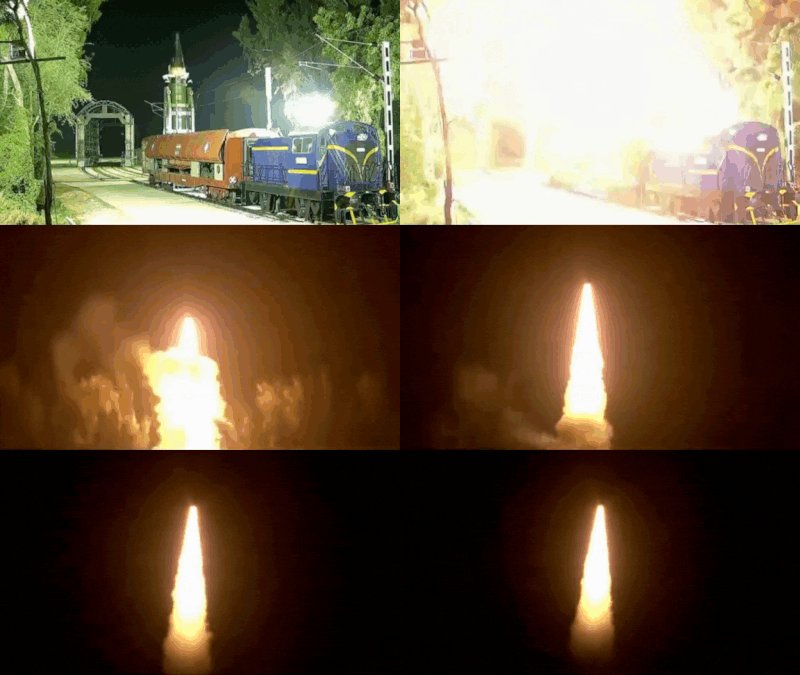
    India is set to test the Extended Trajectory-Long Duration Hypersonic Cruise Missile (ET-LDHCM), an advanced hypersonic missile developed by DRDO under the secretive Project Vishnu.

    What is Project Vishnu?

    • Overview: Project Vishnu is a top-secret initiative by India’s Defence Research and Development Organisation (DRDO) to develop hypersonic missile technologies.
    • Strategic Purpose: The project aims to enhance India’s strategic deterrence by delivering high-speed missiles capable of both conventional and nuclear roles.
    • Focus: It is specifically designed to counter threats from China and Pakistan, reinforcing regional strike capability.
    • Platform Flexibility: A core feature is multi-platform deployment, allowing the missile to be launched from land, air, and naval systems.
    • Integrated Technologies: It brings together scramjet propulsion, materials science, and precision guidance into a single hypersonic weapons system.
    • Doctrinal Alignment: It reflects India’s shift toward technology-driven warfare and supports its credible minimum deterrence doctrine.

    About the ET-LDHC Hypersonic Missile:

    • Overview: It is the flagship missile system under Project Vishnu.
    • Speed and Range: It reaches Mach 8 (~11,000 km/h) and has a strike range of 1,500 km, making it nearly impossible to intercept with current defence systems.
    • Payload Versatility: It can carry 1,000–2,000 kg of conventional or nuclear warheads, allowing mission-specific configurations.
    • Propulsion: Powered by an indigenously developed scramjet engine, it uses atmospheric oxygen for combustion, improving fuel efficiency and endurance.
    • Strike Capabilities: With evasive manoeuvrability and a flat trajectory, the missile is ideal for deep-penetration and precision attacks.
    • Next-Gen Materials: It is built from materials that withstand 2,000°C+ temperatures, ensuring oxidation resistance and structural integrity.
    • Launch Platforms: The missile is compatible with land systems, fighter jets, and naval vessels, offering operational flexibility.
    [UPSC 2024] Consider the following statements:

    1. Ballistic missiles are jet-propelled at subsonic speeds throughout their flights, while cruise missiles are rocket-powered only in the initial phase of flight.

    2. Agni-V is a medium-range supersonic cruise missile, while BrahMos is a solid-fuelled intercontinental ballistic missile.

    Which of the statements given above is/are correct?

    Options: (a) 1 only (b) 2 only (c) Both 1 and 2 (d) Neither 1 nor 2 *


  • Rudrastra UAV passes key army trial. 

    Why in the News?

    India advanced its indigenous defence tech with SDAL’s successful trial of the Hybrid VTOL UAV Rudrastra at Pokhran.

    Rudrastra UAV passes key army trial. 

    About Rudrastra:

    • Rudrastra is an indigenously developed Hybrid Vertical Take-Off and Landing (VTOL) UAV built by Solar Defence and Aerospace Limited (SDAL).
    • The UAV is engineered for deep-strike capabilities, capable of carrying out precision missions without endangering human soldiers.
    • It is tailored for anti-personnel roles, with airburst munitions designed to strike targets across hostile borders.
    • Rudrastra blends rotor-based vertical lift with fixed-wing cruise capability, enhancing deployment across diverse terrains.
    • It is considered a “stand-off” weapon, enabling missions deep into enemy territory with autonomous return capability.

    Key Features:

    • Hybrid VTOL Design: Can vertically take off and land like a helicopter and cruise like a fixed-wing aircraft, enhancing flexibility.
    • Extended Range: Demonstrated a total mission range of over 170 km, including loiter time over the target.
    • Real-Time Surveillance: Maintained a stable video link while covering a 50+ km mission radius.
    • Precision Strike Capability: Successfully deployed airburst munitions, effective for area damage and anti-personnel use.
    • Endurance: Achieved a flight endurance of 1.5 hours, ideal for extended ISR or strike operations.
    • Autonomous Navigation: Returned independently to the launch site after completing the mission.
    • Made in India: Fully developed by an Indian defence company, supporting indigenous innovation in combat drones.
    [UPSC 2025] With reference to Unmanned Aerial Vehicles (UAVs), consider the following statements:

    I. All types of UAVs can do vertical landing. II. All types of UAVs can do automated hovering. III. All types of UAVs can use battery only as a source of power supply.

    Which of the statements given above are correct?

    Options: (a) Only one (b) Only two (c) All the three (d) None*