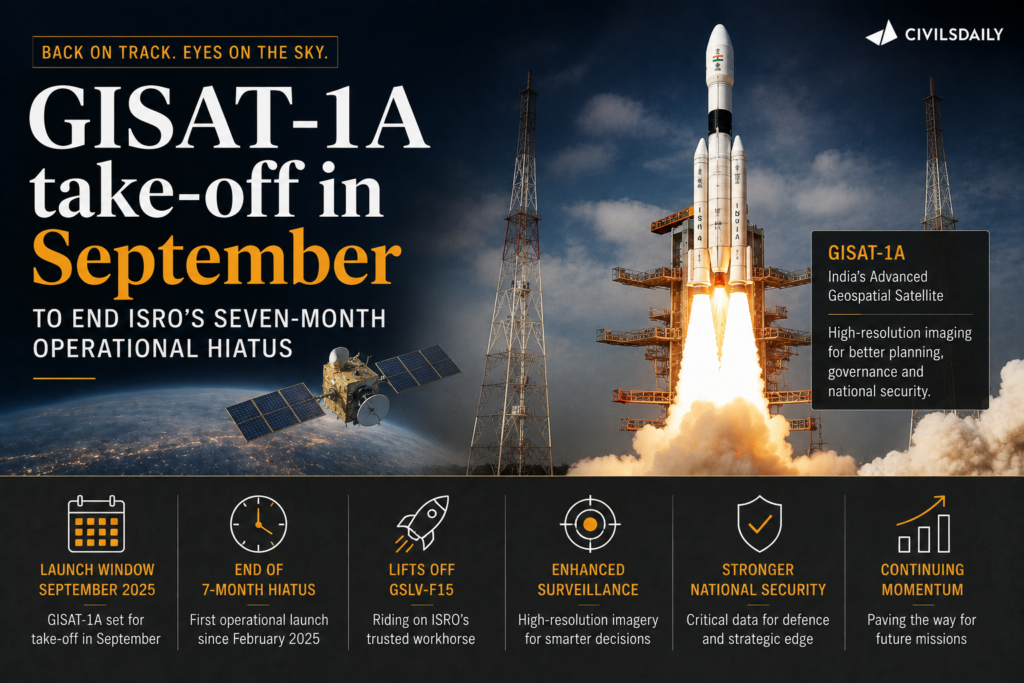
The Indian Space Research Organisation (ISRO) is set to resume launches in the first week of September 2026 with GISAT 1A, after a seven month operational pause.
The pause followed multiple mission failures and has affected NavIC, which currently has only 3 operational satellites, against the 4 required for basic standalone positioning.
What is GISAT 1A?
GISAT: Geo Imaging Satellite
Also designated EOS 05.
Earth observation satellite with a 10-year mission life.
Provides frequent imaging of large areas.
Applications include disaster monitoring, agriculture and forestry.
It replaces GISAT 1 / EOS 03, which failed to reach orbit in 2021.
What is NavIC?
NavIC: Navigation with Indian Constellation
Formerly called IRNSS: Indian Regional Navigation Satellite System.
Developed by ISRO.
Provides Positioning, Navigation and Timing (PNT) services.
Covers India and surrounding regions.
Reduces dependence on foreign navigation systems.
Currently operational: IRNSS 1B, IRNSS 1I and NVS 01.
Why are 4 Satellites Needed?
Positioning requires signals from at least 4 satellites to determine:
Three-dimensional position
Receiver clock error
With only 3 satellites, NavIC cannot provide standalone positioning, though its timing service remains functional.
What is PNT?
Positioning: Determines location.
Navigation: Determines movement and route.
Timing: Provides precise time reference.
Why Did ISRO’s Launch Calendar Stall?
Three of six missions during 2025 and 2026 failed to achieve their intended objectives:
PSLV C61 / EOS 9: Third-stage anomaly.
PSLV C62 / EOS N1: Third-stage anomaly in January 2026.
Failure analysis reports for these missions have not been made public.
What Comes Next?
September 2026: GISAT 1A
November 2026: NVS 03
NVS 03 is expected to restore NavIC to the 4-satellite minimum for standalone positioning.
Meanwhile, Indian armed forces continue using NavIC alongside GPS, Galileo and GLONASS.
“[2018] With reference to the Indian Regional Navigation Satellite System (IRNSS), consider the following statements : 1. IRNSS has three satellites in geostationary and four satellites in geosynchronous orbits. 2. IRNSS covers entire India and about 5500 sq. km beyond its borders. 3. India will have its own satellite navigation system with full global coverage by the middle of 2019. Which of the statements given above is/are correct ? (a) 1 only (b) 1 and 2 only (c) 2 and 3 only (d) None Answer: (a)”
Content generated by Claude will carry a machine readable marking, after Anthropic signed the transparency Code of Practice under Article 50(2) of the European Union Artificial Intelligence Act. The change extends watermarking from images and video to text itself, where the mark travels with copied text and detection is not reliable. The obligation arises from one regional law but the rollout is global.
What is Anthropic’s new watermarking system?
Trigger: The policy was introduced after Anthropic signed the EU AI Act’s Article 50(2) Code of Practice on Transparency of AI Generated Content.
Two forms of marking:Watermarks are embedded in text content produced by Claude. Signed provenance metadata is attached to supported files in formats such as .svg, .png and .jpg.
Applied at the model level: The text watermark is invisible to users. Anthropic has confirmed that it will not affect Claude’s response.
Persistence: The watermark is part of the text, so it travels with the text when it is copied and pasted elsewhere, and may persist through some editing.
Coverage of surfaces: Output from the Claude Platform (API), Claude, Claude Code, Claude Cowork and Claude Tag is set to carry the embedded watermarks. The same applies when Claude models are accessed through AWS, Google Cloud and Microsoft Foundry.
Detection still incomplete: Anthropic is still working on letting external parties detect the markings, and the rollout announcement did not reveal full technical details.
What is Article 50(2) of the European Union Artificial Intelligence Act?
Substance: It requires providers of AI systems that generate synthetic text, audio, image or video to mark their outputs in a machine readable format and make them detectable as artificially generated.
Code of Practice route: Signing the associated Code of Practice is the voluntary compliance instrument through which providers demonstrate that they meet the transparency duty.
What is signed provenance metadata?
About: It is a cryptographically signed record attached to a file that states the file’s origin and the tool that produced it, so a later viewer can verify where it came from.
Weak point: The record is stripped when the file format is converted, which breaks the chain of verification.
Why does watermarking text change the stakes for ordinary users?
Everyday written work is now in scope:Professional emails, personal messages, school assignments and workplace deliverables that could once pass as human made may carry an AI watermark.
Marginal AI involvement still marks the file: The mark can attach even where Claude’s involvement was close to negligible.
Second hand exposure: A human made file that is proofread, translated, summarised or converted by someone else using Claude can still carry a mark in the final output.
Non users are exposed: A person who never uses the tool can end up holding marked text produced by a collaborator, which has put non users on edge alongside users.
Workflow effect: Millions of customers are reconsidering their use of AI tools and debating at what point human content becomes AI content.
Why does the mark not settle the question of authorship?
Both error types admitted: Detecting a Claude mark does not confirm that the work was created by AI. The absence of a mark does not confirm that the work was fully human made.
Short text:Short text lengths can throw off the result, since a watermark needs sufficient text to be carried.
Post processing edits:Content changes made after Claude processed the text can degrade the signal.
Format conversion:Metadata is stripped when a file format is converted, removing the provenance record for images and documents.
Unsupported surfaces: Use of a Claude offering that does not yet support AI marking leaves the output unmarked.
What new risks has the announcement itself created?
A removal market: Multiple dubious websites offering watermark “removal” or “clean up” services came online within days of the announcement.
A repeat of the detector cycle: The earlier rise of AI text detectors was followed by AI text humanisers built to deceive those same detectors.
Reputational damage already recorded: Detector outputs have been involved in cases leading to cancelled book deals and social media trolling for authors and bloggers.
Tool quality: AI text detection tools remain experimental, fallible and prone to errors, yet are treated as evidence.
Credential risk: Users now face the prospect that their own tool damages their professional credentials.
Why do watermarks work for images but not yet for text?
Images and video are the solved case: Watermarks give regulators, fact checkers and journalists a reliable way to verify the origin of an image or video and trace it to a specific provider.
Text is not: Accurately detecting AI generated text remains uncharted territory, so the same verification logic does not transfer.
Circulation outruns labelling: AI generated content is circulated thousands of times on social media unchecked, as content moderation rules have been loosened across the Meta family of apps and X.
Users do not look: The average internet user scrolling on a phone misses even visible AI watermarks, and an invisible mark is weaker still.
Regulator dependence: A tangible reduction in misinformation and deepfakes requires technology providers and regulators to act together, not a marking standard alone.
Challenges to AI content watermarking
Adversarial removal: Paraphrasing, translation and dedicated stripping tools defeat statistical text watermarks. e.g. the removal and clean up websites that appeared within days of the Anthropic announcement.
No interoperable standard across providers: A mark from one model tells nothing about content from another, so an unmarked file proves nothing. e.g. the Coalition for Content Provenance and Authenticity (C2PA) standard is adopted by some providers and open source models remain outside it.
False accusation of students and writers: Detector outputs are used as disciplinary evidence despite admitted error rates. e.g. OpenAI withdrew its own AI Text Classifier in July 2023 citing low accuracy.
Open weight models cannot be compelled: A provider level obligation does not reach models that run on a user’s own machine. e.g. freely downloadable open weight models can generate unmarked text offline.
Jurisdictional mismatch: A duty created by one region’s law governs the provider, not the harm suffered elsewhere. e.g. an Indian user injured by unmarked synthetic content depends on a European regulator’s enforcement.
Labelling does not stop the harm: A deepfake remains persuasive even when correctly labelled, because the first viewing shapes belief. e.g. the November 2023 deepfake video of an Indian film actor circulated widely before any advisory was issued.
Conclusion
A transparency duty designed for synthetic images and video has been extended to text, where detection is unreliable and the mark attaches to work that may be substantially human. The result is a signal that users cannot see, verify or contest, carrying real reputational consequences. Labelling will reduce misinformation only if detection tools become accurate and platforms act on the marks, neither of which is settled.
Artificial Intelligence Governance in India
About: AI governance covers the rules on how AI systems are built, trained, deployed and labelled, and who is liable when they cause harm.
No dedicated statute: India regulates AI through existing law and subordinate rules rather than a single AI Act, unlike the European Union’s risk tiered model.
Scale: India has one of the largest AI talent pools and developer bases globally and is among the largest markets for consumer AI applications.
Institutional anchor: The Ministry of Electronics and Information Technology (MeitY) is the nodal ministry, working through the IndiaAI Mission and advisories to intermediaries.
Global positioning: India hosted the AI Impact Summit in New Delhi in February 2026, the successor to the AI Safety Summit series, and is a founding member of the Global Partnership on Artificial Intelligence (GPAI).
Laws and Rules Governing AI Generated Content in India
Information Technology Act, 2000: The parent statute for electronic records, intermediary liability and cyber offences.
Section 79 grants intermediaries safe harbour subject to due diligence, which is the hook for content labelling duties.
Section 66D penalises cheating by personation using a computer resource, used against deepfake impersonation.
Information Technology (Intermediary Guidelines and Digital Media Ethics Code) Rules, 2021: Impose due diligence, grievance redress and takedown timelines on intermediaries and significant social media intermediaries.
Amendment Rules on synthetically generated information, 2026: Require platforms to label synthetically generated information prominently and to obtain user declarations on whether uploaded content is synthetic.
Digital Personal Data Protection Act, 2023: Governs processing of personal data, including data used to train and prompt AI models, with consent and purpose limitation duties.
Bharatiya Nyaya Sanhita, 2023: Covers forgery, defamation and obscenity offences that synthetic media can constitute.
Copyright Act, 1957: Governs authorship and infringement questions raised by training data and machine generated output.
Back2Basics: European Union Artificial Intelligence Act
What it is: The world’s first comprehensive horizontal law on artificial intelligence, adopted by the European Union.
Entry into force:1 August 2024, with obligations applying in phases.
Approach: A risk based classification into unacceptable risk, high risk, limited risk and minimal risk, with duties scaled to the tier.
Prohibited practices: Social scoring by public authorities, untargeted scraping of facial images and manipulative techniques exploiting vulnerabilities.
Article 50: Sets transparency obligations for AI systems that interact with people or generate synthetic content, including machine readable marking of outputs.
Extraterritorial reach: It binds providers placing systems on the EU market irrespective of where they are established, which is why compliance measures are rolled out globally.
Government Initiatives
IndiaAI Mission: Approved in March 2024 with an outlay of about Rs 10,371.92 crore, built on seven pillars covering compute capacity, innovation centre, datasets platform, application development, future skills, startup financing and safe and trusted AI.
Safe and Trusted AI pillar: Funds work on deepfake detection, algorithmic bias audits and AI governance frameworks, and underpins the proposed AI Safety Institute.
National Strategy for Artificial Intelligence, 2018: NITI Aayog’s framework identifying healthcare, agriculture, education, smart mobility and smart cities as focus sectors under the AI for All approach.
Bhashini: The National Language Translation Mission building open speech and translation datasets across Indian languages.
Responsible AI for Youth: A skilling programme for government school students to build AI literacy at scale.
Digital India Act consultations: Proposed successor to the Information Technology Act, 2000, intended to address emerging technologies including AI and deepfakes.
Key Facts about AI Content Provenance
C2PA: The Coalition for Content Provenance and Authenticity is the main cross industry technical standard for attaching tamper evident provenance to media files.
SynthID: Google’s watermarking system for AI generated images, audio, video and text.
Deepfake: Synthetic media in which a person’s likeness or voice is replaced or generated, typically using generative adversarial networks or diffusion models.
Turing Test: The 1950 benchmark for machine indistinguishability from a human, now inverted by the problem of detecting machine authorship.
GPAI: The Global Partnership on Artificial Intelligence was launched in June 2020 with India as a founding member, and India held its chair in 2024.
Challenges in AI Governance in India
No binding statutory framework: India governs AI through advisories and subordinate rules that carry weaker enforceability than a statute. e.g. the March 2024 MeitY advisory on under tested AI models was revised within weeks after industry objections.
Compute dependence: Frontier model training depends on imported accelerators and foreign cloud capacity. e.g. the IndiaAI Mission empanelled over 18,000 graphics processing units in its first round in January 2025 to close this gap.
Data protection enforcement capacity: The Data Protection Board must supervise a very large volume of processors with limited staff. e.g. the Digital Personal Data Protection Act, 2023 rules were notified only in November 2025, years after enactment.
Copyright and training data disputes: Ownership of material used to train models is unresolved in Indian law. e.g. the news agency ANI’s suit against OpenAI in the Delhi High Court filed in November 2024.
Election integrity: Synthetic audio and video can be deployed at scale during compressed campaign periods. e.g. AI generated voice clips of political leaders circulated during the 2024 Lok Sabha campaign.
Algorithmic bias in public service delivery: Models trained on unrepresentative data misclassify beneficiaries. e.g. facial authentication failures for manual workers under Aadhaar based attendance systems.
Skill and audit gap: India lacks a trained cadre of independent AI auditors to test high risk deployments. e.g. no statutory conformity assessment body exists comparable to the notified bodies under the EU AI Act.
Way Forward
Enact a risk tiered statute: Replace advisory based governance with a law that classifies AI uses by risk and fixes provider and deployer liability.
Mandate interoperable provenance: Require adherence to a common content credential standard so a mark from one provider is readable by all platforms.
Build public detection capacity: Fund an independent testing facility to benchmark deepfake and text detectors and publish accuracy rates.
Protect against false accusation: Bar educational institutions and employers from acting on detector output alone, and require corroborating evidence.
Expand sovereign compute: Scale domestic graphics processing unit capacity and public datasets so Indian models are not fully dependent on foreign infrastructure.
Strengthen platform duties: Require prominent labelling at the point of display, not only in file metadata, and fix takedown timelines for unlabelled synthetic media.
Invest in digital literacy: Run sustained public campaigns so users check provenance labels rather than react to content at first sight.
“[2023, GS3, 10 marks] Introduce the concept of Artificial Intelligence (AI). How does AI help clinical diagnosis? Do you perceive any threat to privacy of the individual in the use of AI in healthcare?”
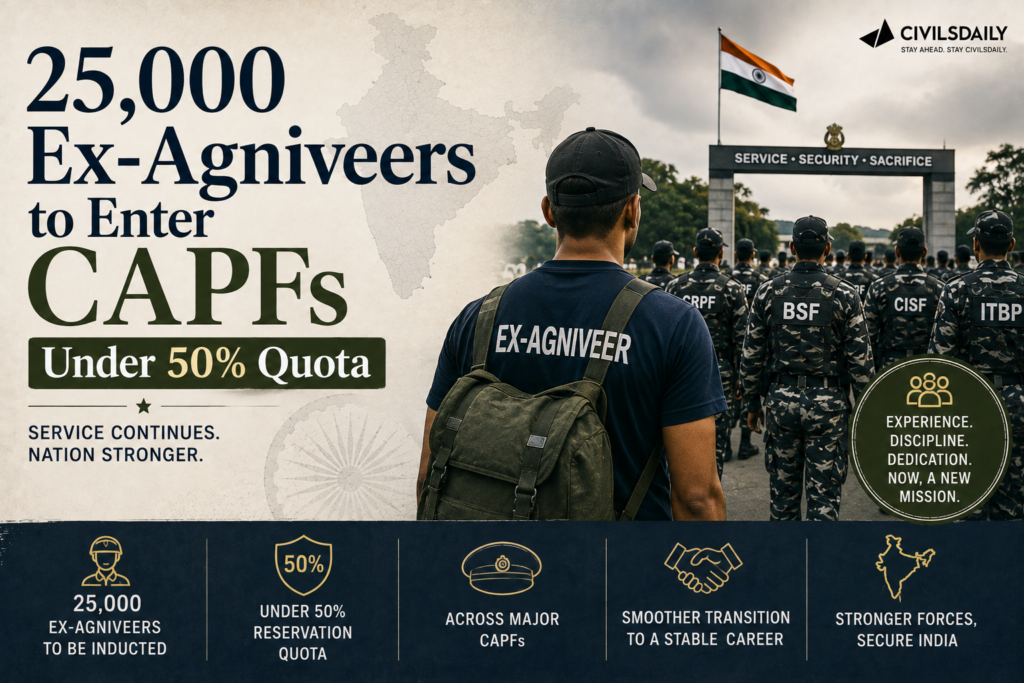
The armed forces will provide lists of eligible Agniveers to CAPFs for recruitment under the 50% reservation for former Agniveers. The first batch of around 25,000 Army Agniveers is expected to exit by December.
What is Agnipath?
Agniveers are recruited for a fixed 4-year tenure, including training.
Up to 25% are retained in the regular armed forces based on merit and organisational requirements.
The remaining 75% exit with a Seva Nidhi package.
They do not receive pension or gratuity.
What are CAPFs?
Central Armed Police Forces operate under the Ministry of Home Affairs, unlike the Armed Forces under the Ministry of Defence.
They include: BSF, CRPF, CISF, ITBP, SSB, Assam Rifles, and NSG
CAPF Recruitment for Former Agniveers
50% of Constable (GD) vacancies reserved for former Agniveers.
Eligible personnel will be identified through lists furnished by the Armed Forces.
Written examination, Physical Standard Test and Physical Efficiency Test are waived for former Agniveers.
Remaining 50% vacancies are filled through open recruitment.
Unfilled reserved vacancies are carried forward to open recruitment.
Why is it Important?
The framework provides Agniveers a pathway to a longer career, as CAPF personnel can serve up to 60 years, compared with the shorter service period in the armed forces.
Key Concerns
Eligibility depends on service-prepared lists, rather than direct application.
Criteria for inclusion in these lists are not clearly specified.
50% of CAPF Constable GD vacancies are reserved.
Former Agniveers enter at the entry grade without seniority/pay protection for military service.
Different States have adopted different reservation and age-relaxation policies.
Prelims Quick Facts
Agnipath tenure: 4 years
Retention: Up to 25%
Exit: Seva Nidhi, no pension/gratuity
CAPF quota: 50% of Constable GD vacancies
CAPFs: Under MHA
Armed Forces: Under Ministry of Defence
First Army Agniveer batch: About 25,000 expected to exit by December
“[2023] With reference to Home Guards, consider the following statements: 1. Home Guards are raised under the Home Guards Act and Rules of the Central Government. 2. The role of the Home Guards is to serve as an auxiliary force to the police in maintenance of internal security. 3. To prevent infiltration on the international border/coastal areas, the Border Wing Home Guards Battalions have been raised in some States. How many of the above statements are correct? (a) Only one (b) Only two (c) All three (d) None
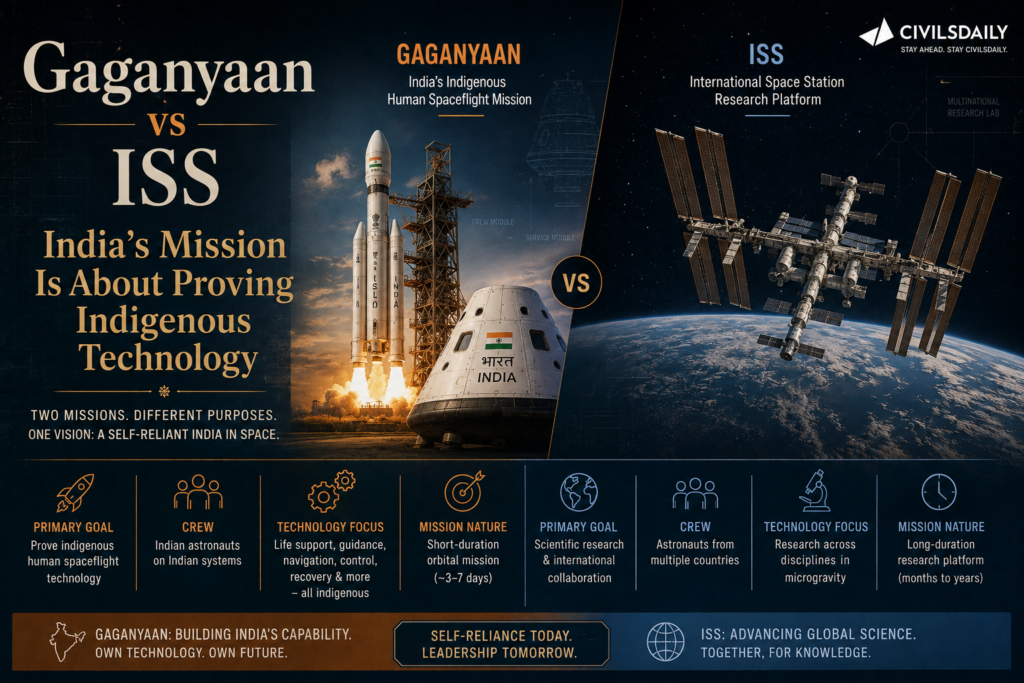
The Indian astronaut who flew on Axiom Mission 4 has described Gaganyaan as a prototype mission built to prove technology, test systems and communicate with the ground, unlike the International Space Station flight, which was an established mission of experiments and return. The distinction separates having flown from owning the capability to fly. Axiom Space owned no hardware, while the Indian Space Research Organisation (ISRO) is building the capsule and the spacecraft in house.
What is the Gaganyaan mission?
About: It is India’s first human spaceflight programme, designed to carry a crew to low Earth orbit in an indigenously built crew module and return them safely.
Nature of the mission: It is a prototype mission, focused on proving the technology, testing out systems and communicating with the ground, not on a defined experiment schedule.
In house hardware: ISRO is building the capsule and the spacecraft in which the astronauts will travel, and launching Indian astronauts on an Indian vehicle.
Engineering intensity: The work is described as heavy engineering, with robust processes and review mechanisms being set up around it.
Status: The programme is scheduled over the next year or two, and preparation is currently ground based.
What was Axiom Mission 4?
About: It was a commercial crewed mission to the International Space Station, on which an Indian became only the second Indian in space and the first in over four decades.
Duration: The Indian crew member spent 20 days at the International Space Station after a launch on 25 June.
What is microgravity?
About: It is the condition of near weightlessness experienced in orbit, where objects and fluids behave differently from how they behave on the ground.
Why it matters for training: Microgravity cannot be simulated on the ground, so the environment is encountered fully only in flight.
Why is the Axiom model not comparable to the Gaganyaan model?
Axiom owned no hardware: Axiom Space is a private company coordinating missions to space and did not own any of the hardware used.
Station ownership: The International Space Station is owned by NASA and its international partners, not by the mission coordinator.
Vehicle ownership: The crew flew in SpaceX’s Crew Dragon vehicle, launched by the Falcon 9 rocket, both owned by SpaceX.
ISRO’s position: India is attempting to make the hardware in house and launch its own astronauts in its own capsule, which is a different nature of work.
Consequence: The two programmes cannot be compared, because one buys access to space and the other builds the means of access.
What did India actually gain from the Axiom flight?
Stated objective: The primary objective of the mission was to learn as much as possible and use that experience to enable India’s own mission.
Observation team: An ISRO team was present alongside the astronaut to observe how operations were run.
End to end exposure: The team witnessed the end to end execution of an entire crewed mission, from preparation to recovery.
Ecosystem lesson: ISRO has launched many successful missions, but human spaceflight requires a different ecosystem, and the scale of operations was the biggest learning.
Disciplines identified: The flight showed the range of disciplines India must address before sending people to space and bringing them back.
Back2Basics: International Space Station
What it is: The largest crewed structure in low Earth orbit, operated as a multinational research laboratory.
First module: The Zarya module was launched in 1998, with continuous human occupation since November 2000.
Partners: Five participating space agencies, NASA, Roscosmos, the European Space Agency, the Japan Aerospace Exploration Agency and the Canadian Space Agency.
Orbit: It orbits at roughly 400 km altitude, completing an orbit in about 90 minutes and around 16 orbits a day.
Function: It hosts microgravity research in biology, human physiology, materials science and Earth observation.
Retirement: The station is planned for controlled deorbit around 2030 to 2031, which is driving commercial station projects.
Government Initiatives
Indian Space Policy, 2023: Opens the space sector to non government entities across the value chain and redefines the roles of ISRO, IN-SPACe and NSIL.
IN-SPACe: The Indian National Space Promotion and Authorisation Centre, a single window autonomous body that authorises and promotes private space activity.
NewSpace India Limited (NSIL): The commercial arm of the Department of Space, handling technology transfer and demand driven satellite and launch missions.
Gaganyaan Programme: Sanctioned in 2018 and later expanded in scope and outlay to include the first module of the Bharatiya Antariksh Station.
Foreign Direct Investment reform, 2024: Liberalised FDI limits for satellite manufacturing, launch vehicles and ground segment components.
SpaDeX: The Space Docking Experiment, which demonstrated autonomous docking of two Indian satellites, a prerequisite technology for a space station and crewed missions.
Key Facts about India in Space
First Indian in space: Flew aboard the Soviet Soyuz T-11 mission in 1984, spending about eight days aboard the Salyut 7 station.
Second Indian in space: Flew on Axiom Mission 4 in 2025, over four decades after the first flight, spending 20 days at the International Space Station.
ISRO: Established in 1969, headquartered in Bengaluru, functioning under the Department of Space.
Chandrayaan 3: Made India the first country to soft land near the lunar south pole, in August 2023, with National Space Day observed on 23 August.
Aditya L1: India’s first solar observatory, placed in a halo orbit around the Sun Earth Lagrange point L1.
Private launch: India’s first privately built rocket flew a suborbital mission in November 2022, marking the entry of startups into launch services.
“[2025] Consider the following space missions: I. Axiom-4 II. SpaDeX III. Gaganyaan How many of the space missions given above encourage and support microgravity research? (a) Only one (b) Only two (c) All the three (d) None
A study gave two doses of the Bacillus Calmette Guerin vaccine a month apart to 23 older adults and tracked blood and cerebrospinal fluid for a year, finding monocytes switching on genes for a faster immune response. This is evidence of trained immunity operating within the central nervous system. The tension is between a cheap, decades old vaccine with a large safety record and a study too small to establish clinical benefit.
Note: Bacillus Calmette-Guérin (BCG) vaccine is more than 100 years old. It was first given to a human on July 18, 1921. Two French scientists, Albert Calmette and Camille Guérin, made the vaccine to stop tuberculosis (TB).
What is trained immunity?
About: Trained immunity is the capacity of innate immune cells to mount a stronger response to a later, unrelated challenge after an initial exposure, through lasting changes in gene expression.
How it differs from adaptive immunity: Adaptive immunity is pathogen specific and mediated by lymphocytes. Trained immunity is non specific and mediated by innate cells such as monocytes.
Mechanism: The change operates through epigenetic and metabolic reprogramming rather than through antibody memory.
Why BCG: BCG is the best documented inducer of trained immunity, which is why it is used to test the effect.
What did the study actually find?
Sample and design:23 older adults were enrolled, roughly half with cerebrospinal fluid biomarkers of Alzheimer’s disease, given two BCG doses a month apart.
Immune change: Monocytes switched on genes associated with a faster immune response.
Functional test: Monocytes responded more strongly to lipopolysaccharide, a standard bacterial stimulus, confirming a functional and not merely transcriptional change.
Amyloid movement: Amyloid fell in cerebrospinal fluid and rose in blood among participants without established Alzheimer’s, and not among those with it.
Location of the effect: The change was detected in the central nervous system compartment, which is the finding’s principal claim.
What are the study’s stated limits?
Sample size: 23 participants is too small to detect a clinical effect.
No control arm: The study had no placebo group, so observed changes cannot be separated from natural variation.
No cognitive change: Cognitive scores were unchanged over the year.
Directional ambiguity: Amyloid shifting from cerebrospinal fluid to blood is consistent with clearance and is not proof of clearance.
Why does a cheap vaccine matter for this disease?
Cost comparison: BCG is inexpensive and carries decades of safety data, against anti amyloid drugs that are expensive and require infusion infrastructure.
Existing supply: BCG is already manufactured at scale for tuberculosis immunisation.
Repurposing precedent: A five year BCG cohort in type 1 diabetes established the model of testing the vaccine for a non tuberculosis indication.
Underlying hypothesis: Chronic low grade inflammation with ageing, described as inflammaging, is implicated in neurodegeneration, and trained immunity is one route to modulating it.
Challenges in translating this finding
Blood brain barrier access: Demonstrating that a peripheral vaccine changes central nervous system immunity requires invasive sampling. e.g. the cerebrospinal fluid collection this study depended on.
Amyloid hypothesis contestation: Amyloid reduction has not reliably produced cognitive benefit. e.g. the modest clinical effect sizes reported for approved anti amyloid antibodies.
Trial duration: Neurodegeneration progresses over years, so trials must run long. e.g. the five year design of the BCG type 1 diabetes cohort.
Vaccine supply competition: Diverting BCG to a new indication competes with tuberculosis immunisation demand. e.g. periodic global BCG supply shortages affecting national immunisation programmes.
Strain variability: BCG substrains differ in immunological potency, complicating replication. e.g. the differing efficacy estimates across BCG trials attributed to substrain variation.
Diagnostic access: Identifying preclinical Alzheimer’s requires biomarker testing unavailable at scale in India. e.g. limited availability of cerebrospinal fluid and amyloid imaging assays outside tertiary centres.
Conclusion
The study’s contribution is the demonstration that trained immunity can be detected within the central nervous system, which extends a peripheral immunology concept into neurology. It establishes a mechanism, not a treatment, since 23 participants without a control arm and with unchanged cognition cannot support a clinical claim. The next milestone is a randomised controlled trial with a placebo arm and cognitive endpoints over a multi year horizon.
Back2Basics: Bacillus Calmette Guerin vaccine
A live attenuated vaccine derived from Mycobacterium bovis, first administered in humans in 1921.
Used primarily against severe childhood forms of tuberculosis, including tuberculous meningitis and miliary tuberculosis.
Included in India’s Universal Immunisation Programme, given at birth or as early as possible thereafter.
Provides limited protection against pulmonary tuberculosis in adults, which is why a new tuberculosis vaccine remains a research priority.
Also used as an intravesical immunotherapy for non muscle invasive bladder cancer.
Manufactured in India at the BCG Vaccine Laboratory, Chennai, among other facilities.
Government Initiatives
National Tuberculosis Elimination Programme: Targets tuberculosis elimination, covering diagnosis, treatment and nutritional support for patients.
Ni-kshay Poshan Yojana: Provides direct benefit transfer for nutritional support to tuberculosis patients on treatment.
Universal Immunisation Programme: Provides BCG and other vaccines free of cost, targeting infants and pregnant women.
National Programme for Health Care of the Elderly: Provides dedicated geriatric health services including cognitive and mental health care.
Indian Council of Medical Research clinical trial network: Supports multicentre trials, including for tuberculosis vaccine candidates.
Way Forward
Run a controlled trial: Replicate the finding with a placebo arm and a sample large enough to detect a cognitive effect.
Standardise the substrain: Fix the BCG substrain across trial sites so results are comparable.
Protect immunisation supply: Ensure any repurposing trial does not draw on doses allocated to childhood tuberculosis immunisation.
Expand biomarker capacity: Build cerebrospinal fluid and blood biomarker testing capacity so preclinical cases can be identified for trial enrolment.
Fund domestic replication: Support an Indian cohort, since India carries both the largest BCG immunised population and a rapidly ageing one.
“[2022, GS3, 15 marks] What is the basic principle behind vaccine development? How do vaccines work? What approaches were adopted by the Indian vaccine manufacturers to produce COVID-19 vaccines?”
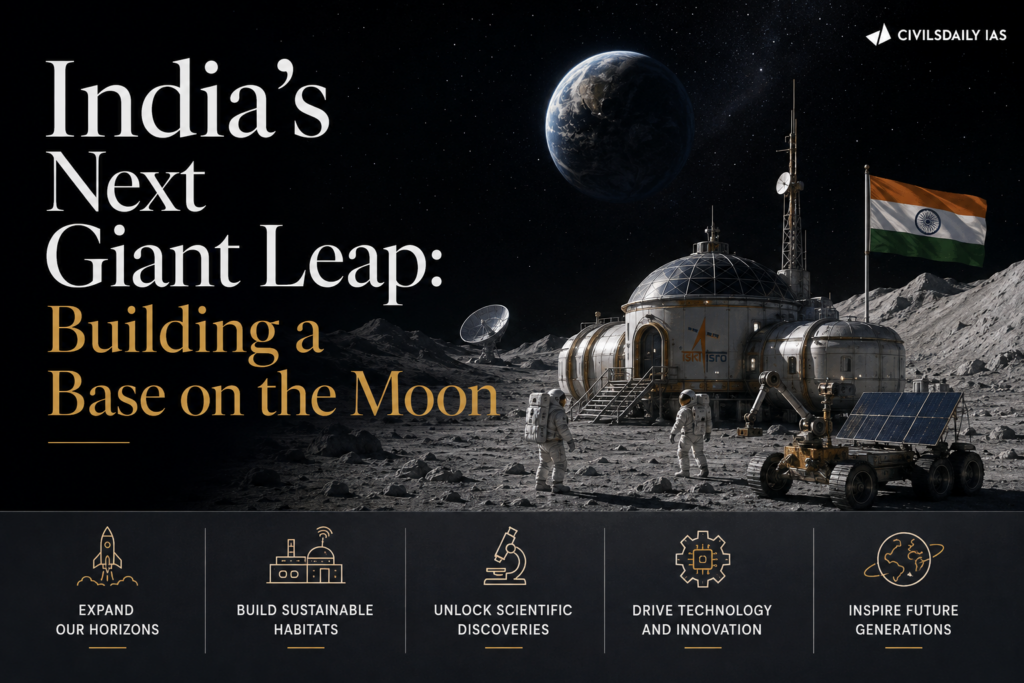
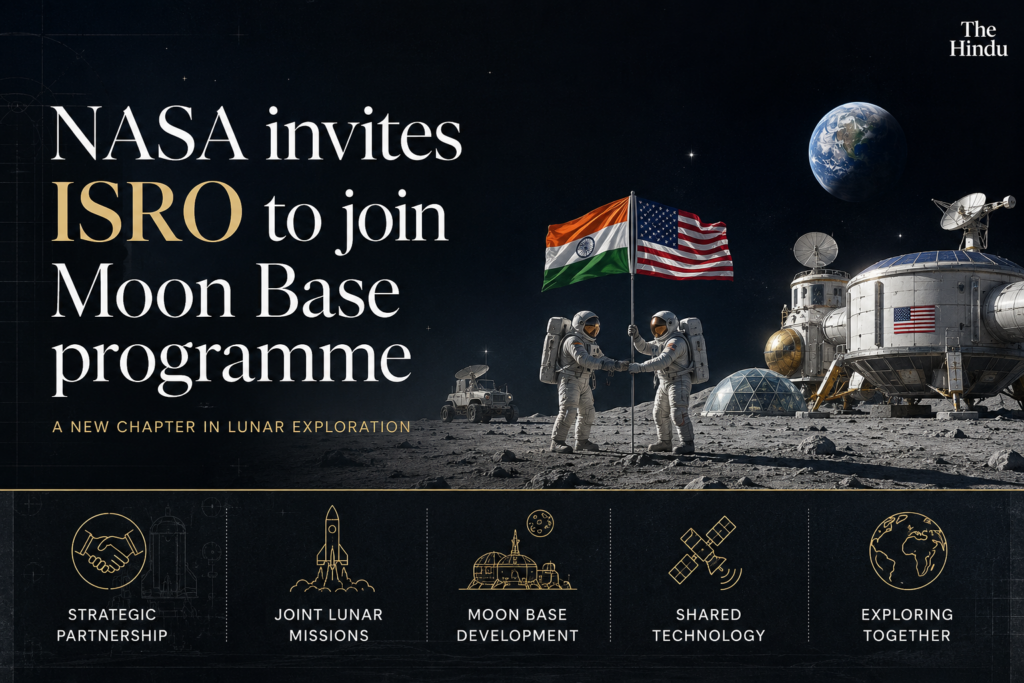
NASA invited ISRO at the ninth India United States Civil Space Joint Working Group meeting to join its Moon Base programme under the Artemis Accords, targeting a facility near the lunar south pole around 2030. A rival International Lunar Research Station led by China and Russia targets the same region by 2035. The tension is between the access a partnership offers and the interoperability standards that would extend terrestrial blocs onto the Moon.
What is the Moon Base programme?
About: Moon Base is the NASA led programme to establish a permanent crewed facility near the lunar south pole, operating under the Artemis Accords framework.
Why the south pole: The region offers longer sunlight for power generation and permanently shadowed craters holding water ice.
Target date: The facility is targeted for around 2030.
Contracting model: Delivery is contracted to commercial providers rather than built entirely in house.
What are the Artemis Accords?
About: The Artemis Accords are a set of non binding principles for civil space exploration, covering transparency, interoperability, emergency assistance, registration of objects, release of scientific data, preservation of heritage sites, deconfliction of activities and safe disposal of debris.
Legal basis: They build on the Outer Space Treaty, 1967 rather than replacing it.
India’s position: India signed the Accords in 2023.
What is the International Lunar Research Station?
About: The International Lunar Research Station (ILRS) is the China and Russia led lunar base programme announced in 2021.
Location and timeline: It targets the lunar south pole, with a stated completion horizon of 2035.
Participation: It counts 17 countries and organisations and more than 50 institutions.
What contracts define the NASA programme’s shape?
Terrain vehicles: Astrolab holds a $219 million contract and Lunar Outpost a $220 million contract for lunar terrain vehicles.
Delivery services: Blue Origin holds $188 million in delivery task orders.
Robotic missions: Astrobotic, Firefly Aerospace and Intuitive Machines together hold $600 million for four robotic missions.
Programme restructuring: Under the current NASA leadership, Artemis III becomes a crewed Earth orbit test flight in 2027 and Artemis IV the first landing in 2028.
Policy driver: The restructuring responds to the December 2025 United States space policy on cislunar space.
Where does the partnership become a constraint?
Exclusion clause: NASA excluded foreign entities with bilateral ties to China from a payload solicitation.
Budget framing: The NASA financial year 2027 budget request frames Moon Base as establishing United States superiority on the Moon.
Consequence for India: Deep integration could let United States objections constrain India’s independent cooperation choices.
Foreclosure risk: Accepting exclusionary terms now would foreclose future cooperation with the ILRS.
Why do interoperability standards decide the outcome?
What standards fix: Docking interfaces, power connections, communication protocols and navigation references determine which hardware can work with which.
Bloc formation mechanism: A closed standard makes participation conditional on political alignment, which transfers terrestrial blocs into cislunar space.
Open standards alternative: Open international standards preserve sovereign control of hardware and software while permitting cooperation.
India’s strategic interest: Strategic autonomy on the Moon depends on standards being open rather than on which partnership India joins.
Challenges to India’s lunar ambitions
Human spaceflight readiness: India has not yet flown a crewed mission. e.g. the Gaganyaan programme still in its uncrewed test flight phase.
Heavy lift constraint: Lunar cargo delivery requires launch capacity beyond the current fleet. e.g. GSAT-N2 flown abroad because it exceeded LVM-3 capacity.
Deep space communication: Sustained lunar operations need dedicated deep space network capacity. e.g. the Indian Deep Space Network at Byalalu operating a limited antenna set.
Dual bloc pressure: Partnering with one programme invites exclusion from the other. e.g. the NASA payload solicitation barring entities with bilateral ties to China.
Funding scale: India’s space budget is a fraction of the contracted value of individual NASA lunar task orders. e.g. $600 million contracted for four robotic missions against India’s annual space budget.
Resource law vacuum: The Outer Space Treaty bars national appropriation but does not settle resource extraction rights. e.g. the contested legal status of the Artemis Accords safety zones.
Conclusion
The decisive question for India is not which lunar programme to join but whether interoperability standards stay open, since standards rather than treaties will determine who can operate with whom on the Moon. Joining Moon Base delivers access, and it carries the risk of inheriting an exclusion clause aimed at a third country. The next milestone is whether India secures an explicit open standards position in any agreement arising from the Joint Working Group.
Back2Basics: India’s Decision to Sign the Artemis Accords
India signed the Artemis Accords in June 2023, becoming among the later major spacefaring signatories.
The Accords are a United States led set of non binding principles built on the Outer Space Treaty, 1967.
Core commitments cover peaceful purposes, transparency, interoperability, emergency assistance, registration of space objects, release of scientific data, protection of heritage, deconfliction through safety zones and orbital debris mitigation.
Signing enabled the joint NASA ISRO Synthetic Aperture Radar (NISAR) mission and the training of Indian astronaut candidates in the United States.
The Accords do not create binding treaty obligations and operate alongside, not in place of, the Outer Space Treaty.
Constitutional and Treaty Framework Governing Outer Space
Outer Space Treaty, 1967: Establishes outer space as the province of all mankind and bars national appropriation by claim of sovereignty.
Rescue Agreement, 1968: Requires assistance to and return of astronauts and space objects.
Liability Convention, 1972: Makes a launching state absolutely liable for damage caused by its space objects on the surface of the Earth.
Registration Convention, 1975: Requires states to register objects launched into outer space with the United Nations.
Moon Agreement, 1979: Declares the Moon and its resources the common heritage of mankind, and has not been ratified by any major spacefaring state.
Way Forward
Negotiate open standards explicitly: Make interoperability on open international standards a condition of participation rather than an assumption.
Preserve sovereign control of hardware: Retain control over Indian built systems and their software in any joint architecture.
Avoid exclusivity clauses: Decline terms conditioning participation on the exclusion of third country cooperation.
Build deep space capacity: Expand the deep space network and advance the Next Generation Launch Vehicle to support independent lunar operations.
Use multilateral forums: Press the lunar resource question at the United Nations Committee on the Peaceful Uses of Outer Space, where a universal rule can be built rather than a bloc rule.
“[2023, GS3, 15 marks] What is the main task of India’s third moon mission which could not be achieved in its earlier mission? List the countries that have achieved this task. Introduce the subsystems in the spacecraft launched and explain the role of the Virtual Launch Control Centre at the Vikram Sarabhai Space Centre which contributed to the successful launch from Srihari Kota.”
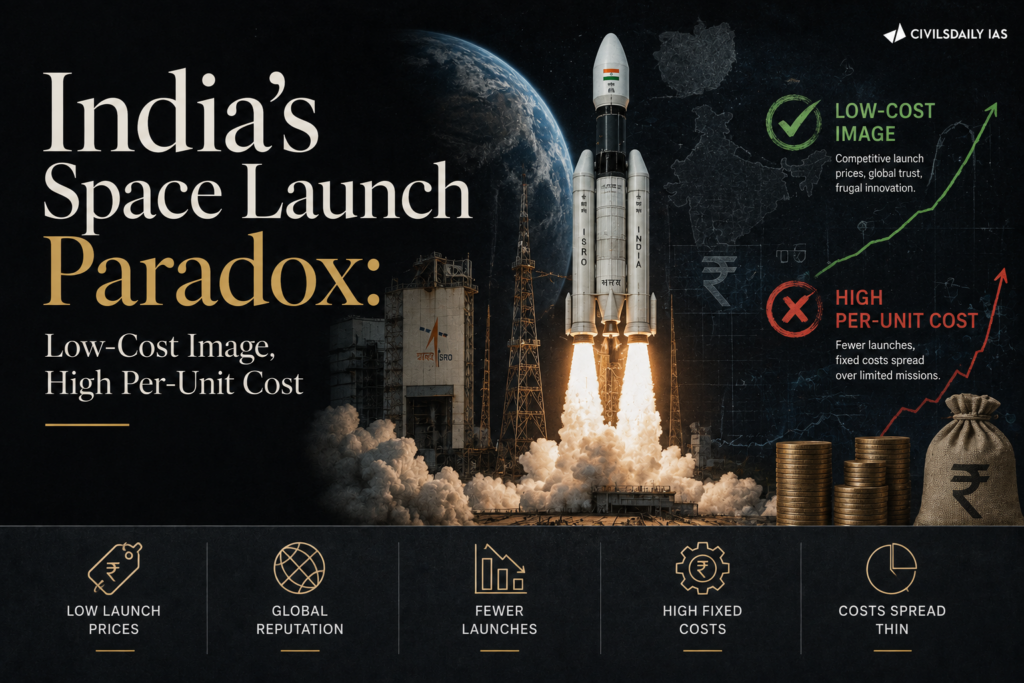
A peer-reviewed study estimates India’s 2025 launch cost to Low Earth Orbit (LEO) at $13,302/kg, the highest among major spacefaring nations and far above the global average of $3,868/kg.
The key distinction is between low mission cost and low cost per kilogram. India is efficient in spacecraft and mission design, but low launch frequency and limited payload capacity raise its per-kg cost.
Cost per kg to LEO
Meaning: Launch cost divided by payload mass delivered to LEO.
Why important: A low-cost mission can still have a high per-kg cost if it carries a small payload.
What it measures: Launch vehicle efficiency and utilisation, rather than spacecraft-design frugality.
Experience Curve
An experience curve shows declining unit costs as cumulative production or launch volume increases.
Since 2010, the study finds a significant experience curve mainly for the US and Europe.
Higher launch frequency allows fixed costs to be distributed across more missions.
Comparative Cost
India: $13,302/kg, Europe: $9,897/kg, Russia: $6,682/kg, China: $5,809/kg, Japan: $5,287/kg, USA: $3,225/kg, and Global average: $3,868/kg
A Bhubaneswar-based start-up, Serendipity Space, has flight-tested a prototype satellite carrying Alchemy, an autonomous pharmaceutical manufacturing payload, using a high-altitude balloon at the TIFR facility in Hyderabad. The technology aims to manufacture pharmaceutical products in microgravity without human supervision.
How does it work?
Microgravity: Near-weightlessness reduces sedimentation, buoyancy and convection.
Crystal growth: Crystals can form differently and potentially with greater uniformity than on Earth.
Autonomous processing: The satellite carries reagents and hardware and executes the manufacturing sequence independently.
Recovery: Processed material is returned to Earth using a re-entry system and heatshield.
What is LEO?
Low Earth Orbit (LEO) extends roughly up to 2,000 km above Earth.
The proposed system is intended for an altitude of about 400 to 500 km.
What did the balloon test demonstrate?
Tested the satellite prototype under near-space conditions.
Validated avionics, heatshield and Alchemy payload.
Demonstrated autonomous operation.
Tested controlled return to Earth.
Serves as a relatively low-cost step before orbital deployment.
How is it different from earlier space-based drug research?
Earlier experiments on platforms such as the ISS generally required crew involvement. The distinguishing feature here is a dedicated free-flying satellite designed for autonomous pharmaceutical manufacturing.
International examples include Varda Space Industries, Redwire and experiments aboard China’s Tiangong station.
Why is it important for India?
Promotes private-sector space innovation.
Expands India’s space ecosystem beyond Bengaluru to cities such as Bhubaneswar, Pune and Ahmedabad.
Creates opportunities in pharma, biotechnology, space engineering and advanced manufacturing.
Demonstrates potential convergence of space technology + biotechnology + pharmaceuticals.
Laws, Treaties and Rules Governing Space Activities
Outer Space Treaty, 1967: Bars national appropriation of outer space and makes States internationally responsible for national activities, including those of private entities.
Liability Convention, 1972: Makes the launching State absolutely liable for damage caused on the surface of the Earth or to aircraft in flight.
Registration Convention, 1975: Requires launching States to maintain a registry of objects launched into outer space and to furnish details to the United Nations.
Rescue Agreement, 1968: Obliges States to assist astronauts in distress and to return space objects to the launching State.
Indian Space Policy, 2023: Defines the roles of ISRO, IN-SPACe and NSIL and permits private entities across the full value chain from launch to satellite operations.
Space Activities Bill, 2017: Proposed a licensing and liability framework for private Indian space activity but lapsed without enactment.
Norms, Guidelines and Procedures issued by IN-SPACe: Prescribe the authorisation route, safety requirements and liability sharing for non governmental entities operating from India.
Telecommunications Act, 2023 and allied spectrum rules: Govern satellite spectrum assignment and the licensing of satellite based communication services.
Indian National Space Promotion and Authorisation Centre
What it is:IN-SPACe is the single window autonomous agency that authorises, promotes and supervises space activities by non governmental entities in India.
Year established: Announced in 2020 as part of the space sector reforms and made operational in 2022.
Parent department: It functions as an autonomous body under the Department of Space.
Headquarters:Ahmedabad, Gujarat.
Jurisdiction: It authorises private launches, satellite establishment and operation, ground station creation and the dissemination of space based data.
Enabling role: It permits private entities to use ISRO facilities and to access ISRO technologies through transfer agreements.
Distinction from NSIL: IN-SPACe regulates and promotes, while NewSpace India Limited is the commercial arm that contracts launches and technology transfers.
“[2026] Consider the following statements about involvement of private entities in India’s space programme: 1. IN-SPACe is an autonomous agency formed to facilitate participation of private entities. 2. Agnikul Cosmos launched the world’s first flight using 3D-printed rocket engine. 3. Skyroot Aerospace has developed liquid fuel for GSLV. (a) 1 only (b) 2 and 3 only (c) 1 and 2 only (d) 1, 2 and 3
The National Aeronautics and Space Administration (NASA) has asked the Indian Space Research Organisation (ISRO) to join its Moon Base programme, a project to establish a permanent research station on the Moon. The offer exposes a tension between the chance to accelerate ISRO’s own crewed-mission goals and the risk of locking India into another agency’s technology ecosystem. Space cooperation has continued to progress even amid the volatility of India-US relations.
What is the Moon Base programme?
About: An ambitious project to establish a permanent research station on the Moon where astronauts can live, work, and carry out experiments for extended periods.
Sequence: It is the logical follow-up to landing humans on the Moon, aimed at preparing the ground for longer stays.
What is the Artemis programme?
About: A US-led programme that aims to land humans on the Moon before 2028, the first crewed return since 1972.
Purpose: It is spearheaded by the United States and is designed to move faster and more efficiently by bringing in partner countries and private companies.
What are the Artemis Accords?
About: A US-led coalition of spacefaring countries setting principles for cooperative and sustainable lunar exploration, which India has already signed.
Contested feature: The Accords sidestep and seek to replace the 1979 Moon Agreement, a framework for multilateral governance of lunar resources.
What is the 1979 Moon Agreement?
About: An international agreement that seeks to develop a multilateral governance framework for the use of lunar resources.
Relevance: The Artemis Accords are seen as an alternative that the Moon Agreement’s supporters view as bypassing multilateral governance.
What does India gain from joining?
Crewed-mission experience: ISRO, which plans to land humans on the Moon by 2040, would gain hands-on experience in executing complex crewed missions.
Technology access: Participation offers access to technologies relevant to sustained lunar operations.
Existing commitments: India has signed the Artemis Accords and agreed with the US to develop a strategic framework for human spaceflight cooperation.
Strategic stakes: Over coming decades the Moon could become strategically and economically important as countries begin to extract lunar resources.
What are the risks of joining? (the central tension)
US-led alliance perception: The Artemis Accords are increasingly seen as a US-led alliance, and two major space powers, China and Russia, are not part of it.
Technology lock-in: It is important that ISRO does not get locked into NASA’s technology ecosystem, which would make it vulnerable to technology denial.
Goal displacement: Cooperation should help ISRO achieve its own goals faster, not lead it to abandon or delay them in the service of someone else’s goals.
Wariness of structures: India has been wary of joining such international structures, and signing the Accords already represented a choice.
Government Initiatives in the Space Sector
Gaganyaan: India’s human spaceflight programme to send astronauts to low-Earth orbit.
Bharatiya Antariksh Station: India’s planned space station for sustained microgravity research.
IN-SPACe: The body enabling private participation in the space sector.
Challenges for India’s Lunar Cooperation
Technology denial: Dependence on foreign systems risks future denial.
Alliance optics: Alignment with a US-led coalition affects ties with other space powers.
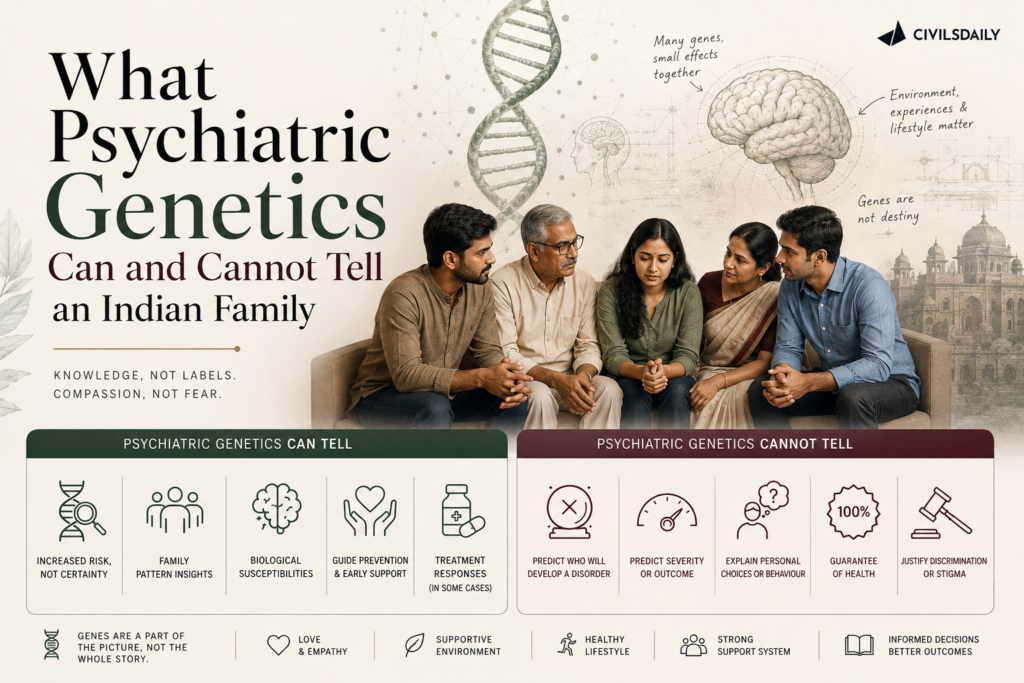
Families of patients with psychiatric illness increasingly ask whether the condition is in their blood and whether a genetic test can settle their child’s future. There is a tension between the real progress of psychiatric genetics and its limited power to predict individual outcomes, especially for Indian populations underrepresented in genomic databases. The central point is that genes load the dice but do not determine destiny.
What is a genome-wide association study (GWAS)?
About: A GWAS compares millions of common genetic variants across very large groups of people with and without a condition, to find variants that appear more often in one group. . It compares DNA markers, most often single-nucleotide polymorphisms (SNPs, between individuals with a condition and healthy control groups.
What it yields: It behaves like a satellite map highlighting genomic areas of interest, showing where to look for biological mechanisms rather than pinpointing a cause.
What does polygenic risk mean?
About: In common psychiatric disorders no single gene variant has a large effect, unlike single-gene diseases such as Tay-Sachs disease or Duchenne muscular dystrophy.
Mechanism: Risk is polygenic, emerging from the combined influence of thousands of variants together with rare genetic changes, development, environment, and chance.
What is a polygenic risk score?
About: A polygenic risk score (PRS) compresses many small genetic effects into a single number meant to estimate a person’s inherited susceptibility.
Limits: It cannot say whether a person will become ill, at what age, how severe it will be, or which medicine will work, because it captures only part of genetic liability.
How Polygenic Risk Works
Many small changes: Instead of one major gene causing an illness (like in cystic fibrosis), polygenic conditions involve hundreds or thousands of tiny DNA changes called single nucleotide polymorphisms
Adding it up: Each individual variant adds or subtracts a tiny amount of risk; a PRS totals these up to estimate your overall genetic predisposition.
Common conditions: It applies to complex diseases like heart disease, type 2 diabetes, schizophrenia, and certain common cancers
What have the major GWAS findings shown?
Schizophrenia: A 2022 landmark study identified associations at 287 genomic regions and pointed to genes active in neurons and synapses.
Bipolar disorder: A large 2021 study identified 64 associated regions.
Regulatory signals: Many signals lie in DNA that regulates when and where genes switch on, not in stretches that directly encode a protein.
Shared risk: A December 2025 study in Nature reported that some inherited risk is shared across schizophrenia and bipolar disorder.
Why is prediction unreliable, especially in India?
Score does not contain life: A person with a higher score may remain well while a person with a lower score may fall ill, because the score does not contain childhood adversity, sleep disruption, substance use, medical illness, or access to care.
Expert caution: The International Society of Psychiatric Genetics has cautioned that current scores for schizophrenia, bipolar disorder, and depression are not accurate enough for routine clinical prediction.
Ancestry bias: Genomic databases have drawn disproportionately from people of European ancestry, so scores are often less accurate in other populations.
Indian diversity: The GenomeIndia project generated whole-genome data from 10,000 healthy, unrelated Indians across 83 population groups and documented extraordinary genetic diversity, so a score developed elsewhere cannot simply be imported.
What can genetics usefully change in the clinic today?
Reduces blame: A mother did not cause schizophrenia by being too strict and a father did not transmit bipolar disorder through a moral failing, and biology matters.
Avoids fatalism: Genetic vulnerability should not be converted into a verdict, and no test can declare a person safe or doomed.
Focus on modifiable risk: The useful approach is to track early warning signs, avoid intoxicants, sleep well, seek help promptly, and focus on recovery.
Visible risks: Many risks are visible without sequencing, such as lost sleep before a manic episode, escalating cannabis use, treatment stopped due to stigma, and distance from specialist care.
Conclusion
The central idea is that psychiatric genetics will not identify people before they fall ill, but it can replace superstition and blame with a more accurate account of vulnerability. Prediction will remain probabilistic even as datasets grow larger and more representative. The task is to keep probabilities from being misunderstood, stigmatised, or commercialised, and to involve diverse populations while protecting privacy.
Back2Basics:
GenomeIndia Project
Convening body: Funded by the Department of Biotechnology (DBT), Government of India.
Aim: To build a catalogue of the genetic diversity of the Indian population.
Scale: Generated whole-genome data from 10,000 healthy, unrelated Indians across 83 population groups.
Significance: Provides an India-specific reference against which imported genetic risk scores can be tested rather than assumed to apply.
Genomics in India: About
Definition: Genomics studies the complete set of an organism’s DNA, including how variants relate to disease.
Diversity: India’s population carries extraordinary genetic diversity across many groups, making a single national reference essential.
Clinical caution: Risk scores derived from European-ancestry datasets can mislead when applied to Indian populations.
Challenges in Psychiatric Genetics
Weak prediction: Scores cannot forecast onset, severity, or treatment response for an individual.