💥Join UPSC 2027,2028 Mentorship (August Batch) + XFactor Notes & Microthemes PDF

Subject: Space Technology

  • Small Satellite Launch Vehicle (SSLV)

    The new chairman of the ISRO Dr S Somanath has indicated inauguration of indigenous new launch rockets, called the Small Satellite Launch Vehicle (SSLV).

    What is SSLV?

    • The SSLV is a small-lift launch vehicle being developed by the ISRO with payload capacity to deliver:
    1. 600 kg to Low Earth Orbit (500 km) or
    2. 300 kg to Sun-synchronous Orbit (500 km)
    • It would help launching small satellites, with the capability to support multiple orbital drop-offs.
    • In future a dedicated launch pad in Sriharikota called Small Satellite Launch Complex (SSLC) will be set up.
    • A new spaceport, under development, near Kulasekharapatnam in Tamil Nadu will handle SSLV launches when complete.
    • After entering the operational phase, the vehicle’s production and launch operations will be done by a consortium of Indian firms along with NewSpace India Limited (NSIL).

    Vehicle details

    (A) Dimensions

    • Height: 34 meters
    • Diameter: 2 meters
    • Mass: 120 tonnes

    (B) Propulsion

    • It will be a four stage launching vehicle.
    • The first three stages will use Hydroxyl-terminated polybutadiene (HTPB) based solid propellant, with a fourth terminal stage being a Velocity-Trimming Module (VTM).

    SSLV vs. PSLV: A comparison

    • The SSLV was developed with the aim of launching small satellites commercially at drastically reduced price and higher launch rate as compared to Polar SLV (PSLV).
    • The projected high launch rate relies on largely autonomous launch operation and on overall simple logistics.
    • To compare, a PSLV launch involves 600 officials while SSLV launch operations would be managed by a small team of about six people.
    • The launch readiness period of the SSLV is expected to be less than a week instead of months.
    • The SSLV can carry satellites weighing up to 500 kg to a low earth orbit while the tried and tested PSLV can launch satellites weighing in the range of 1000 kg.
    • The entire job will be done in a very short time and the cost will be only around Rs 30 crore for SSLV.

    Significance of SSLV

    • SSLV is perfectly suited for launching multiple microsatellites at a time and supports multiple orbital drop-offs.
    • The development and manufacture of the SSLV are expected to create greater synergy between the space sector and private Indian industries – a key aim of the space ministry.

    Back2Basics:

  • Gaganyaan and other new Missions in 2022

    After a rather muted 2021 in terms of satellite launches, Indian Space Research Organization (ISRO) is gearing up for a number of missions in 2022 including the launch of the first unmanned mission of Gaganyaan.

    Gaganyaan Mission

    • Gaganyaan is crewed orbital spacecraft intended to be the formative spacecraft of the Indian Human Spaceflight Programme (IHSP).
    • The IHSP was initiated in 2007 by ISRO to develop the technology needed to launch crewed orbital spacecraft into low Earth orbit.
    • The first uncrewed flight, named Gaganyaan 1, is scheduled to launch no earlier than June 2022 on a GSLV Mark III rocket.
    • ISRO had been working on related technologies and it performed a Crew Module Atmospheric Re-entry Experiment and a Pad Abort Test for the mission.
    • If completed in meantime, India will become the fourth nation to conduct independent human spaceflight after the Russia, US and China.

    Details of the project

    • The spacecraft is being designed to carry three people, and a planned upgraded version will be equipped with rendezvous and docking capability.
    • In its maiden crewed mission, this capsule will orbit the Earth at 400 km altitude for up to seven days with a two or three-person crew on board.
    • This Hindustan Aeronautics Limited (HAL) manufactured crew module had its first un-crewed experimental flight in 2014.
    • DRDO will provide support for critical human-centric systems and technologies like space-grade food, crew healthcare, radiation measurement and protection, parachutes for the safe recovery of the crew module and fire suppression system.

    Other missions this year

    • Earth Observation Satellites: EOS-4 and EOS-6
    • Flights for Crew Escape System of Gaganyaan
    • Chandrayaan-03
    • Aditya Ll
    • XpoSat

    New projects

    • Venus mission
    • DISHA –a twin aeronomy satellite mission
    • TRISHNA, an ISRO-CNES [Centre national d’études spatiales] mission


    UPSC 2022 countdown has begun! Get your personal guidance plan now! (Click here)

  • Status of 5G Rollout in India

    Delhi, Gurgaon, Mumbai, Bengaluru, Kolkata, Ahmedabad, Hyderabad, and Pune will be the first places to get 5G services next year in 2022, informed the Department of Telecommunications (DoT).

    Must read:

    [Burning Issue] 5G Technology

    What is 5G technology?

    • 5G or fifth generation is the latest upgrade in the long-term evolution (LTE) mobile broadband networks.
    • It’s a unified platform which is much more capable than previous mobile services with more capacity, lower latency, faster data delivery rate and better utilisation of spectrum.

    5G spectrum

    5G mainly works in 3 bands, namely low, mid and high-frequency spectrum — all of which have their own uses as well as limitations.

    (1) Low band spectrum

    • It has a great promise in terms of coverage and speed of internet and data exchange but the maximum speed is limited to 100 Mbps (Megabits per second).
    • So Telcos can use and install it for commercial cell phone users who may not have specific demands for very high speed internet, the low band spectrum may not be optimal for specialized needs of the industry.

    (2) Mid-band spectrum

    • It offers higher speeds compared to the low band, but has limitations in terms of coverage area and penetration of signals.
    • This band may be used by industries and specialized factory units for building captive networks that can be moulded into the needs of that particular industry.

    (3) High-band spectrum

    • It offers the highest speed of all the three bands, but has extremely limited coverage and signal penetration strength.
    • Internet speeds in the high-band spectrum of 5G has been tested to be as high as 20 Gbps (giga bits per second), while, in most cases, the maximum internet data speed in 4G has been recorded at 1 Gbps.

    Stipulated bands for roll-out

    • While the low band spectrum has shown great promise in terms of coverage and speed of Internet and data exchange, the maximum speed is limited to 100 Mbps (Megabits per second).
    • This means that while telecoms can use and install it for commercial cellphone users who may not have specific demands for very high speed Internet.
    • However the low band spectrum may not be optimal for specialised needs of the industry.
    • The mid-band spectrum, on the other hand, offers higher speeds compared to the low band, but has limitations in terms of coverage area and penetration of signals.

    Where does India stand in the 5G technology race?

    • Like other global players, India had, in 2018, planned to start 5G services as soon as possible, with an aim to capitalise on the better network speeds and strength that the technology promised.
    • India’s private telecom players have been urging the DoT to lay out a clear road map of spectrum allocation and 5G frequency bands.

    Issues in roll-out

    • Monopoly: One big hurdle, however, is the lack of flow of cash and adequate capital with some players due to an existing monopoly.
    • AGR dues: There is an ongoing dispute between the telecoms and the government mainly over the definition of Adjusted Gross Revenue.
    • Device upgrade: As far as commercial smartphones are concerned, some newer devices in the market claim to be 5G-ready but are much costlier.

    Why is there early roll-out in big cities?

    • Services penetration: One of the reasons why the bigger cities were chosen for these trials is their telecom services penetration, making it easier to convince more people to upgrade from 4G.
    • Cost management: Since the costs for 5G services are initially going to be on the higher side, it would be wise to test the service in areas where more consumers would find them affordable.
    • Testing ground: A third reason is that cities provide all kinds of locations, such as walled complexes and open spaces, that are suitable for testing of various 5G bands.

    What is the global progress on 5G?

    More than governments, global telecom companies have started building 5G networks and rolling it out to their customers on a trial basis.

    • South Korea: Samsung, which had started researching on 5G technology way back in 2011, has taken the lead when it comes to building the hardware for 5G networks for several companies.
    • USA: In countries like the US, companies such as AT&T, T-mobile, and Verizon have taken the lead when it comes to rolling out commercial 5G for their users.
    • China: In other countries such as China, some of the telecoms such as China Unicom had started 5G trials as early as 2018, and have since rolled out the commercial services for users.

    What changes for consumers with 5G?

    • One of the major changes will be in terms of rich experiences on their phones and other connected devices.
    • For instance, users will be able to stream videos with multiple camera angles during sports matches or even play immersive video games using VR headsets or other accessories.
    • This next-generation telecom network will also enable a mesh of connected Internet of Things (IoT)-enabled devices and services with zero-fail rate, as in the case of connected cars.
    • 5G could also draw high-speed mobile broadband connectivity to replace existing broadband services, especially in locations where these services are constrained, provided there isn’t a huge price differential.


    Try this question from CSP 2019:


    With reference to communication technologies, what is/are the difference/differences between LTE (Long-Term Evolution) and VoLTE (Voice over Long-Term Evolution)?

    1. LTE ‘is commonly marketed as 3G and VoLTE is commonly marketed as advanced 3G.
    2. LTE is data-only technology and VoLTE is voice-only technology.

    Select the correct answer using the code given below.

    (a) 1 only

    (b) 2 only

    (c) Both 1 and 2

    (d) Neither 1 nor 2


    [wpdiscuz-feedback id=”nqicad1d3m” question=”Please leave a feedback on this” opened=”1″]Post your answers here.[/wpdiscuz-feedback]


    UPSC 2022 countdown has begun! Get your personal guidance plan now! (Click here)

  • Study of distant Magnetar reveals facets of the Exotic Star

    An international group of researchers has succeeded in measuring for the first time the characteristics of a flare on a distant magnetar.

    What is a Magnetar?

    • Magnetars are the most magnetic stars in the universe.
    • It is a rare compact type of neutron star teeming with energy and magnetism.
    • It is an exotic type of neutron star, its defining feature that it has an ultra-powerful magnetic field.
    • The field is about 1,000 times stronger than a normal neutron star and about a trillion times stronger than the Earth’s.
    • Magnetars are relatively rare objects, with only about thirty having been spotted within the Milky Way so far.

    What is the recent study?

    • The studied magnetar is about 13 million light years away, in the direction of the NGC 253, a prominent galaxy in the Sculptor group of galaxies.
    • Its flare spewed within a few tenths of a second as much energy as the Sun would shed in 100,000 years.
    • It was captured accidentally on April 15, 2020, by the Atmosphere-Space Interactions Monitor instrument (ASIM) of the International Space Station.
    • This is the first study to characterize such a flare from so distant a magnetar.

    How do magnetars form?

    • During the course of their evolution, massive stars – with masses around 10-25 times the mass of the Sun – eventually collapse and shrink to form very compact objects called neutron stars.
    • A subset of these neutron stars is the so-called magnetars which possess intense magnetic fields.
    • These are highly dense and have breathtakingly high rotation speeds – they have rotational periods that can be just 0.3 to 12.0 seconds.

    What characterizes Magnetars?

    (1) Violent flares

    • The observed giant flare lasted approximately 160 milliseconds and during this time 1039 joules of energy was released.
    • The flare spewed as much energy in a tenth of a second that our Sun will radiate in 100,000 years.

    (2) Starquakes

    • Eruptions in magnetars are believed to be due to instabilities in their magnetosphere, or “starquakes” produced in their crust – a rigid, elastic layer about one kilometer thick.
    • This causes waves in the magnetosphere, and interaction between these waves causes dissipation of energy.


    UPSC 2022 countdown has begun! Get your personal guidance plan now! (Click here)

  • How James Webb Telescope seeks to unlock Universe’s Secrets

    Today, NASA’s James Webb Space Telescope (JWST), the largest and most powerful space telescope ever built, will be launched from French Guiana, on the northeast coast of South America on the European Ariane 5 rocket.

    James Webb Space Telescope

    • JWST is a space telescope jointly developed by NASA, the European Space Agency (ESA), and the Canadian Space Agency (CSA).
    • It is planned to succeed the Hubble Space Telescope as NASA’s flagship astrophysics mission.
    • It will conduct a broad range of investigations across the fields of astronomy and cosmology, including:
    1. Observing some of the most distant events and objects in the universe such as the formation of the first galaxies
    2. Detailed atmospheric characterization of potentially habitable exoplanets

    How is it different from other telescopes?

    • JWST is much more powerful and has the ability to look in the infrared spectrum, which will allow it to peer through much deeper into the universe, and see through obstructions such as gas clouds.
    • As electromagnetic waves travel for long distances, they lose energy, resulting in an increase in their wavelength.
    • An ultraviolet wave, for example, can slowly move into the visible light spectrum and the infrared spectrum, and further weaken to microwaves or radio waves, as it loses energy.
    • Hubble was designed to look mainly into the ultraviolet and visible regions of the electromagnetic spectrum.
    • JWST is primarily an infrared telescope, the first of its kind.

    Special features of JWST

    (1) Time machine in space

    • Powerful space telescopes, like JWST or the Hubble Telescope, are often called time machines because of their ability to view very faraway objects.
    • The light coming from those objects, stars or galaxies, which is captured by these telescopes, began its journey millions of years earlier.
    • Essentially, what these telescopes see are images of these stars or galaxies as they were millions of years ago.
    • The more distant the planet or star, the farther back in time are the telescopes able to see.

    (2) Farthest from Earth

    • JWST will also be positioned much deeper into space, about a million miles from Earth, at a spot known as L2.
    • It is one of the five points, known as Lagrange’s points, in any revolving two-body system like Earth and Sun, where the gravitational forces of the two large bodies cancel each other out.
    • Objects placed at these positions are relatively stable and require minimal external energy to keep them there. L2 is a position directly behind Earth in the line joining the Sun and the Earth.
    • It would be shielded from the Sun by the Earth as it goes around the Sun, in sync with the Earth.

    (3) Engineering marvel

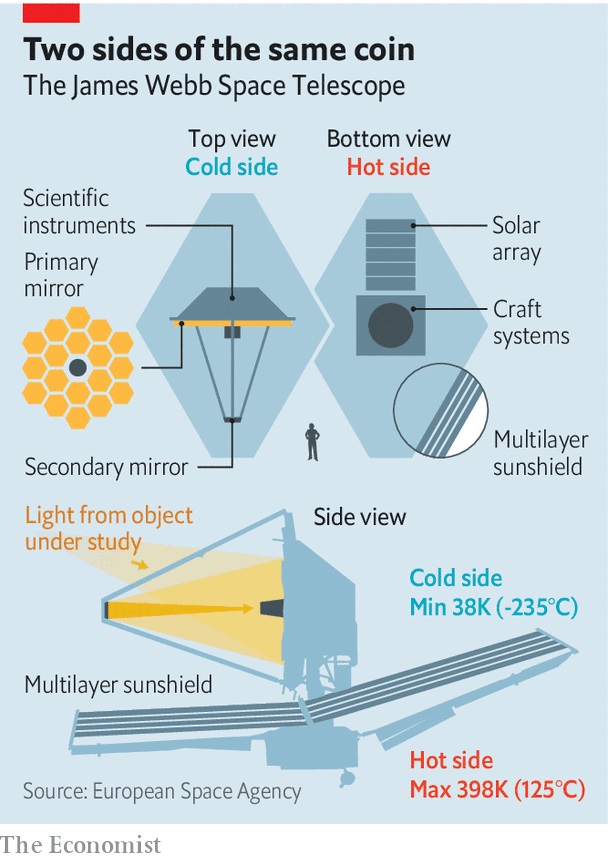
    • JWST has one large mirror, with a diameter of 21 feet (the height of a typical two-storey building), that will capture the infra-red light coming in from the deep universe while facing away from the Sun.
    • It will be shielded by a five-layer, tennis court-sized, kite-shaped sunscreen that is designed to block the heat from Sun and ensure the extremely cool temperatures that the instruments are built to operate at.
    • Temperatures on the sun-facing side can get as high as 110°C, while the other side would be maintained at –200° to –230°C.
    • The extremely cold temperatures are needed to detect the extremely faint heat signals from distant galaxies.
    • The mirror as well as the sunscreen is so large they could not have fit into any rocket. They have been built as foldable items and would be unraveled in space.


    UPSC 2022 countdown has begun! Get your personal guidance plan now! (Click here)

  • NASA’s Imaging X-Ray Polarimetry Explorer (IXPE) Mission

    NASA has launched a new mission named Imaging X-ray Polarimetry Explorer or IXPE.

    About IXPE

    • IXPE observatory is a joint effort of NASA and the Italian Space Agency.
    • The mission will study “the most extreme and mysterious objects in the universe – supernova remnants, supermassive black holes, and dozens of other high-energy objects.”
    • The mission’s primary length is two years and the observatory will be at 600 kilometers altitude, orbiting around Earth’s equator.
    • IXPE is expected to study about 40 celestial objects in its first year in space.

    What are the instruments onboard?

    • IXPE carries three state-of-the-art space telescopes.
    • Each of the three identical telescopes hosts one light-weight X-ray mirror and one detector unit.
    • These will help observe polarized X-rays from neutron stars and supermassive black holes.
    • By measuring the polarization of these X-rays, we can study where the light came from and understand the geometry and inner workings of the light source.
    • This new mission will complement other X-ray telescopes such as the Chandra X-ray Observatory and the European Space Agency’s X-ray observatory, XMM-Newton.

    Why is it important?

    The mission will help scientists answer questions such as:

    • How do black holes spin?
    • Was the black hole at the center of the Milky Way actively feeding on surrounding material in the past?
    • How do pulsars shine so brightly in X-rays?
    • What powers the jets of energetic particles that are ejected from the region around the supermassive black holes at the centers of galaxies?


    UPSC 2022 countdown has begun! Get your personal guidance plan now! (Click here)

  • Laser Communications Relay Demonstration (LCRD)

    NASA has launched its new Laser Communications Relay Demonstration (LCRD) — the agency’s first-ever laser communications system.

    What is LCRD?

    • LCRD involves laser communications – also called optical communications which uses infrared light to send information.
    • LCRD is launched in a geosynchronous orbit, over 35,000km above Earth.
    • LCRD has two optical terminals – one to receive data from a user spacecraft, and the other to transmit data to ground stations.
    • The modems will translate the digital data into laser signals. This will then be transmitted via encoded beams of light.

    Benefits offered by LCRD

    • Currently, most NASA spacecraft use radio frequency communications to send data.
    • Optical communications will help increase the bandwidth 10 to 100 times more than radio frequency systems.
    • The LCRD will help the agency test optical communication in space.

    Laser vs Radio

    • Laser communications and radio waves use different wavelengths of light. It uses infrared light and has a shorter wavelength than radio waves.
    • This will help the transmission of more data in a short time.
    • Using infrared lasers, LCRD will send data to Earth at 1.2 gigabits-per-second (Gbps).
    • It would take roughly nine weeks to transmit a completed map of Mars back to Earth with current radio frequency systems. With lasers, we can accelerate that to about nine days, says NASA.

    Other advantages

    Optical communications systems are smaller in size, weight, and require less power compared with radio instruments.

    • A smaller size means more room for science instruments.
    • Less weight means a less expensive launch.
    • Less power means less drain on the spacecraft’s batteries.


    UPSC 2022 countdown has begun! Get your personal guidance plan now! (Click here)

  • James Webb Space Telescope

    The James Webb Space Telescope, NASA’s largest space science telescope ever constructed, is scheduled to be sent into orbit in December.

    James Webb Space Telescope (JWST)

    • It is a space telescope being jointly developed by NASA, the European Space Agency (ESA), and the Canadian Space Agency (CSA).
    • It has taken 30 years and $10bn to develop, and is being described as one of the grand scientific endeavors of the 21st Century.

    What is the goal of this telescope?

    • The telescope will be able to see just about anything in the sky.
    • However, it has one overriding objective – to see the light coming from the very first stars to shine in the Universe.
    • These pioneer stars are thought to have switched on about 100-200 million years after the Big Bang, or a little over 13.5 billion years ago.
    • Webb will be picking out groupings of these stars.
    • They are so far away their light – even though it moves at 300,000km per second – will have taken billions of years to travel the cosmos.

    JWST mirror

    • One of the most important objects it will carry is a large mirror which will help collect light from the objects being observed.
    • The primary mirror is made of 18 hexagonal-shaped mirror segments — each 1.32 metre in diameter — stitched together in a honeycomb pattern.
    • The primary mirror is a technological marvel.
    • The lightweight mirrors, coatings, actuators and mechanisms, electronics, and thermal blankets when fully deployed form a single precise mirror that is truly remarkable.
    • Each mirror segment weighs approximately 20 kilograms and is made from beryllium.

    Why beryllium?

    • NASA explains that beryllium was used as it is both strong and light.
    • Beryllium is very strong for its weight and is good at holding its shape across a range of temperatures. Beryllium is a good conductor of electricity and heat and is not magnetic.
    • Because it is light and strong, beryllium is often used to build parts for supersonic airplanes and the Space Shuttle.
    • It added that special care was taken when working with beryllium because it is unhealthy to breathe in or swallow beryllium dust.

    So, it does not have gold?

    • After the beryllium mirror segments were polished a thin coating of gold was applied to it. Gold helps improve the mirror’s reflection of infrared light.
    • The gold was coated using a technique called vacuum vapour deposition.
    • The mirrors are kept inside a vacuum chamber and a small quantity of gold is vapourised and deposited on the mirror.
    • The thickness of the gold is just 100 nanometers. So less than 50 grams of gold was used for the entire mirror.
    • A thin layer of glass was also deposited on top of the gold layer to protect it from scratches.


    UPSC 2022 countdown has begun! Get your personal guidance plan now! (Click here)

  • A launch window for India as a space start-up hub

    Context

    After the launch of Sputnik in 1957, space race is on again, but this time, private players are on the power field. This has huge implications for original equipment manufacturers (OEMs) in the space sector in India and is a promising venture for global investors.

    Insignificant share of India in space economy

    • 2% India’s share: The space economy is a $440 billion global sector, with India having less than 2% share in the sector.
    • While total early-stage investments in space technologies in FY21 were $68 billion, India was on the fourth place with investments in about 110 firms, totalling not more than $2 billion.

    Reasons for India’s insignificant private participation

    • Absence of a framework: The reason for the lack of independent private participation in space includes the absence of a framework to provide transparency and clarity in laws.
    • Brain drain: Another aspect to throw light on is the extensive brain drain in India, which has increased by 85% since 2005.
    • Policy bottlenecks: Brain drain can be linked to the bottlenecks in policies which create hindrances for private space ventures and founders to attract investors, making it virtually non-feasible to operate in India.

    Suggestions

    • The laws need to be broken down into multiple sections, each to address specific parts of the value chain and in accordance with the Outer Space Treaty.
    • Dividing into upstream and downstream: Dividing activities further into upstream and downstream space blocks will allow legislators to provide a solid foundation to products/services developed by the non-governmental and private sectors within the value chain.
    • Timeline on licensing: With the technicalities involved in the space business, timelines on licensing, issuance of authorisation and continuous supervision mechanism need to be defined into phases.
    • Insurance and indemnification clarity: Another crucial aspect of space law is insurance and indemnification clarity, particularly about who or which entity undertakes the liability in case of a mishap.
    • In several western countries with an evolved private space industry, there is a cap on liability and the financial damages that need to be paid.
    • Need to generate own IP: Currently, many of the private entities are involved in equipment and frame manufacturing, with either outsourced specifications or leased licences.
    • However, to create value, Indian space private companies need to generate their intellectual property for an independent product or service with ISRO neither being their sole or largest customer nor providing them IP and ensuring buy-backs.

    Possibilities for India and the government’s effort

    • India currently stands on the cusp of building a space ecosystem and with ISRO being the guiding body, India can now evolve as a space start-up hub for the world.
    • Already 350 plus start-ups such as AgniKul Cosmos, Skyroot Technologies, Dhruva Space and Pixxel have established firm grounds for home-grown technologies with a practical unit of economics.
    • Last year the Government of India created a new organisation known as IN-SPACe (Indian National Space Promotion and Authorisation Centre) which is a “single window nodal agency” established to boost the commercialisation of Indian space activities.
    • A supplement to the Indian Space Research Organisation (ISRO), the agency promotes the entry of the Non-Government Private Entities (NGPEs) in the Indian space sector.

    Consider the question “Examine the factors responsible for hindering the participation of the private sector in India’s space industry? Suggest the ways to increase the participation of private sector.”

    Conclusion

    To continue the growth engine, investors need to look up to the sector as the next “new-age” boom and ISRO needs to turn into an enabler from being a supporter. To ensure that the sky is not the limit, investor confidence needs to be pumped up and for the same, clear laws need to be defined.

    UPSC 2022 countdown has begun! Get your personal guidance plan now! (Click here)

    Back2Basics: The Outer Space Treaty

    • The Outer Space Treaty was considered by the Legal Subcommittee in 1966 and agreement was reached in the General Assembly in the same year ( resolution 2222 (XXI)).
    • The Treaty was largely based on the Declaration of Legal Principles Governing the Activities of States in the Exploration and Use of Outer Space, which had been adopted by the General Assembly in its resolution 1962 (XVIII) in 1963, but added a few new provisions.
    • The Treaty was opened for signature by the three depository Governments (the Russian Federation, the United Kingdom and the United States of America) in January 1967, and it entered into force in October 1967.
    • The Outer Space Treaty provides the basic framework on international space law, including the following principles:
    • The exploration and use of outer space shall be carried out for the benefit and in the interests of all countries and shall be the province of all mankind;
    • Outer space shall be free for exploration and use by all States;
    • Outer space is not subject to national appropriation by claim of sovereignty, by means of use or occupation, or by any other means;
    • States shall not place nuclear weapons or other weapons of mass destruction in orbit or on celestial bodies or station them in outer space in any other manner;
    • The Moon and other celestial bodies shall be used exclusively for peaceful purposes;
    • Astronauts shall be regarded as the envoys of mankind;
    • States shall be responsible for national space activities whether carried out by governmental or non-governmental entities;
    • States shall be liable for damage caused by their space objects; and
    • States shall avoid harmful contamination of space and celestial bodies.
  • What is a Tundra Satellite?

    Russia has successfully placed into orbit a military satellite believed to be part of the Kremlin’s early warning anti-missile system. This launch could be delivering a Tundra satellite.

    Tundra Satellite

    • The Tundra or EKS (Edinaya Kosmicheskaya Sistema) series of satellites is the next generation of Russian early-warning satellites.
    • The development of the EKS started in 2000.
    • These satellites carry a secure emergency communications payload to be used in case of a nuclear war.
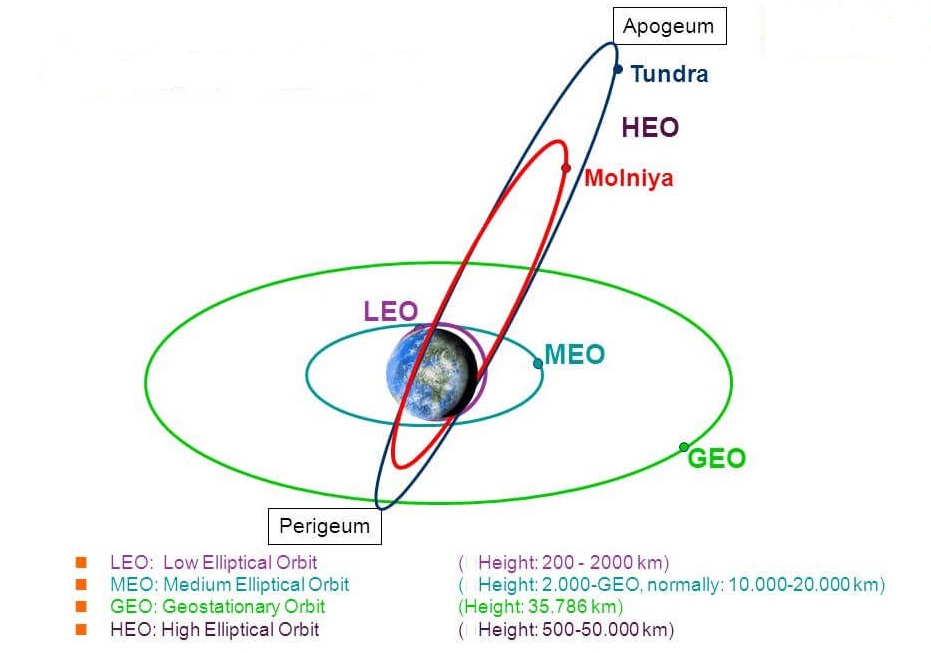
    • They are launched on Soyuz-2-1b Fregat boosters into Molniya-orbits, inclined highly elliptical 12 h orbits.

    What are Tundra Orbits?

    • A Tundra orbit is a highly elliptical geosynchronous orbit with a high inclination (approximately 63.4°), an orbital period of one sidereal day.
    • A satellite placed in this orbit spends most of its time over a chosen area of the Earth, a phenomenon known as apogee dwell.
    • It makes satellites particularly well suited for communications satellites serving high latitude regions.
    • The ground track of a satellite in a Tundra orbit is a closed figure 8 with a smaller loop over either the northern or southern hemisphere.
    • This differentiates them from Molniya orbits designed to service high-latitude regions, which have the same inclination but half the period and do not hover over a single region.

    Back2Basics: Types of Orbits

    [1] Geostationary orbit (GEO)

    • Satellites in geostationary orbit (GEO) circle Earth above the equator from west to east following Earth’s rotation – taking 23 hours 56 minutes and 4 seconds – by travelling at exactly the same rate as Earth.
    • This makes satellites in GEO appear to be ‘stationary’ over a fixed position.
    • In order to perfectly match Earth’s rotation, the speed of GEO satellites should be about 3 km per second at an altitude of 35 786 km.
    • This is much farther from Earth’s surface compared to many satellites.
    • GEO is used by satellites that need to stay constantly above one particular place over Earth, such as telecommunication satellites.
    • Satellites in GEO cover a large range of Earth so as few as three equally-spaced satellites can provide near-global coverage.

    [2] Low Earth orbit (LEO)

    • A low Earth orbit (LEO) is, as the name suggests, an orbit that is relatively close to Earth’s surface.
    • It is normally at an altitude of less than 1000 km but could be as low as 160 km above Earth – which is low compared to other orbits, but still very far above Earth’s surface.
    • Unlike satellites in GEO that must always orbit along Earth’s equator, LEO satellites do not always have to follow a particular path around Earth in the same way – their plane can be tilted.
    • This means there are more available routes for satellites in LEO, which is one of the reasons why LEO is a very commonly used orbit.
    • It is most commonly used for satellite imaging, as being near the surface allows it to take images of higher resolution.
    • Satellites in this orbit travel at a speed of around 7.8 km per second; at this speed, a satellite takes approximately 90 minutes to circle Earth.

    [3] Medium Earth orbit (MEO)

    • Medium Earth orbit comprises a wide range of orbits anywhere between LEO and GEO.
    • It is similar to LEO in that it also does not need to take specific paths around Earth, and it is used by a variety of satellites with many different applications.
    • It is very commonly used by navigation satellites, like the European Galileo system of Europe.
    • It uses a constellation of multiple satellites to provide coverage across large parts of the world all at once.

    [4] Polar Orbit

    • Satellites in polar orbits usually travel past Earth from north to south rather than from west to east, passing roughly over Earth’s poles.
    • Satellites in a polar orbit do not have to pass the North and South Pole precisely; even a deviation within 20 to 30 degrees is still classed as a polar orbit.
    • Polar orbits are a type of low Earth orbit, as they are at low altitudes between 200 to 1000 km.

    [5] Sun-synchronous orbit (SSO)

    • SSO is a particular kind of polar orbit. Satellites in SSO, travelling over the polar regions, are synchronous with the Sun.
    • This means they are synchronised to always be in the same ‘fixed’ position relative to the Sun.
    • This means that the satellite always visits the same spot at the same local time.
    • Often, satellites in SSO are synchronised so that they are in constant dawn or dusk – this is because by constantly riding a sunset or sunrise, they will never have the Sun at an angle where the Earth shadows them.
    • A satellite in a Sun-synchronous orbit would usually be at an altitude of between 600 to 800 km. At 800 km, it will be travelling at a speed of approximately 7.5 km per second.

    [6] Transfer orbits and geostationary transfer orbit (GTO)

    • Transfer orbits are a special kind of orbit used to get from one orbit to another.
    • Often, the satellites are instead placed on a transfer orbit: an orbit where, by using relatively little energy from built-in motors, the satellite or spacecraft can move from one orbit to another.
    • This allows a satellite to reach, for example, a high-altitude orbit like GEO without actually needing the launch vehicle.
    • Reaching GEO in this way is an example of one of the most common transfer orbits, called the geostationary transfer orbit (GTO).


    UPSC 2022 countdown has begun! Get your personal guidance plan now! (Click here)