💥Join UPSC 2027,2028 Mentorship (August Batch) + XFactor Notes & Microthemes PDF

Subject: Space Technology

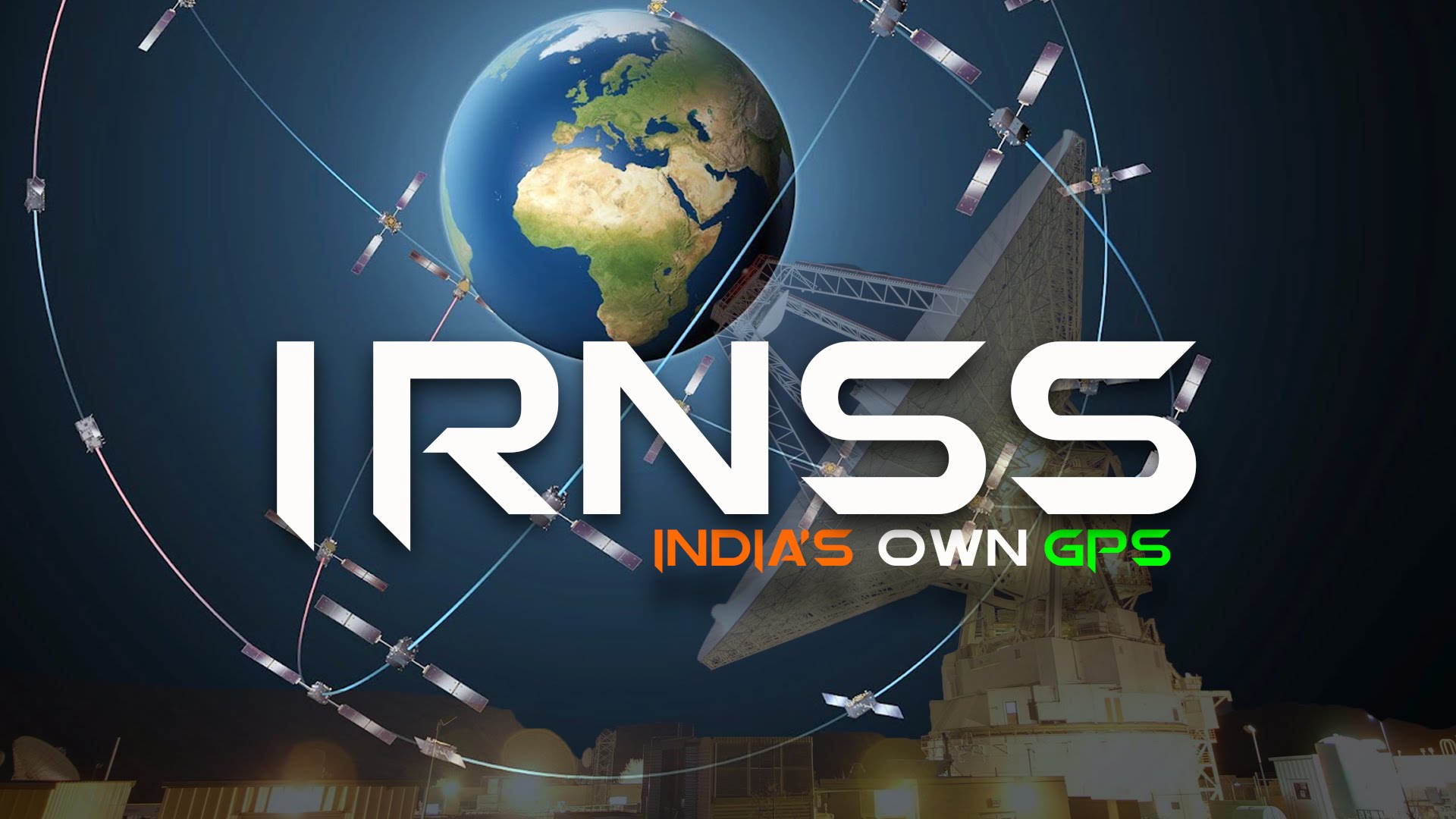
  • NavIC navigation system


    Qualcomm Technologies has released chipsets, supporting India’s own GPS system ‘Navigation with Indian Constellation’ (NavIC).

    New androids to be equipped with NavIC

    • The Qualcomm chipsets now supports up to 7 satellite constellations at the same time, including the use of all of NavIC’s operating satellites.
    • These enhancements will enable select mobile, automotive and IoT platforms to better serve key industries and technology ecosystems in the region.
    • It will help improve user experience for location-based applications especially in dense urban environments where geolocation accuracy tends to degrade, said the company earlier.

    About NavIC

    • The name NavIC was given by Prime Minister Narendra Modi after successful launch of the seventh navigation satellite, in April, 2016.
    • To date, ISRO has built a total of nine satellites in the IRNSS series, of which eight are currently in orbit.
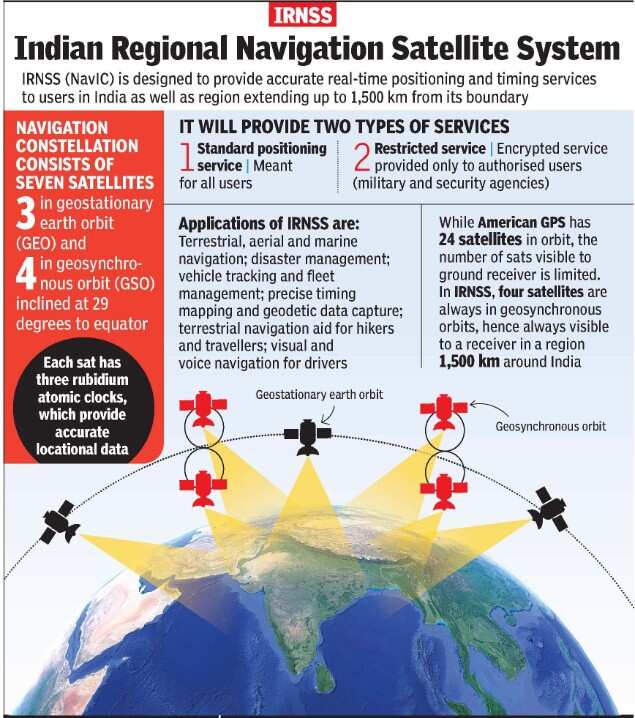
    • The constellation is designed to provide accurate position information service to users in India as well as the region extending up to 1,500 km from its boundary, which is its primary service area.
    • It is designed to provide two types of services – Standard Positioning Service (SPS), which is provided to all users and Restricted Service (RS), which is an encrypted service provided only to the authorised users.
    • The system is expected to provide a position accuracy of better than 20 m in the primary service area.

    For more readings about NAVIC, navigate to the page:

    https://www.civilsdaily.com/news/navic-navigation-in-indian-constellation/

  • [op-ed of the day] Lady Gaganaut

    Context

    The first gaganaut-Vyomamitra- to head for space in an Indian craft will not be human, but humanoid.

    What Vyomamitra would do on spaceflight?

    • Test the technological environment: Vyomamitra unveiled by ISRO will fly two missions to test the technological environment which human gaganauts will inhabit on India’s first demonstration of human spaceflight in 2022.
      • She will test the systems and instruments that they would use.
      • Vyomamitra cannot test the cabin ecosystem,  as she would not be able to breathe the air.
      • Other functions: Vyomamitra is perfectly capable of issuing commands, activating switches and, obviously, communicating with earth.
    • Give company to human travellers: Her prototype has already chatted with people at the Isro event where she was introduced to the public, and future iterations will be able to give company to human travellers at the loneliest frontier.

    A shift from sending animals to humanoids

    • Performing roles previously performed by animals: Vyomamitra will be executing the pioneering role which has traditionally been given to animals – testing systems for survivability.
      • Fruit flies and monkeys were the first beings to lift off, riding V2 rockets with devices monitoring their vital signs.
    • Why using humanoid is more useful: Using a humanoid robot is more useful because it can be used to replicate the behavioural and operational responses of a human.
      • Indeed, robots need not remain pioneers testing survivability, or assistants to the human crew, but are expected to crew missions that are too prolonged or too dangerous for a human pilot.

    Opportunities and the future of AI-powered humanoid

    • Russian robot in space: As India prepared for human flight, in August 2019, the Russian space agency Roscosmos sent up the anthropomorphic robot Skybot F-850 to dock with the International Space Station.
      • The mission has been halted because of technical issues.
      • Goals beyond survivability testing: If the nation which pioneered human spaceflight with Yuri Gagarin’s mission in 1961 is sending humanoid robots into space, survivability testing is not the only legitimate goal of missions powered by artificial intelligence and robotics.
    • Opportunity to develop new technologies: Humanoid in space also provide opportunities to test and develop these technologies under circumstances that do not prevail on earth.
      • The inputs, goals and skills learned are different and while AI on earth specifically focuses on creating systems which do not think like humans,
    • Human-like AI system need of industry: The space industry would value systems that are human-like, to stand in for crew.

    Conclusion

    Vyomamitra represents the very first iteration of AI in space, and later generations could prove to be as essential for spaceflight as cryogenic engines.


  • Thirty Metre Telescope (TMT) in Hawaii


    India, a partner in the construction of one of the largest telescopes in the world, TMT, has said it wants the project to be moved out of the proposed site at Mauna Kea, a dormant volcano in Hawaii.

    Thirty Metre Telescope

    • The TMT is a proposed astronomical observatory with an extremely large telescope (ELT) that has become the source of controversy over its planned location on Mauna Kea on the island of Hawaii in the US state of Hawaii.
    • It is being built by an international collaboration of government organisations and educational institutions, at a cost of $1.4 billion.
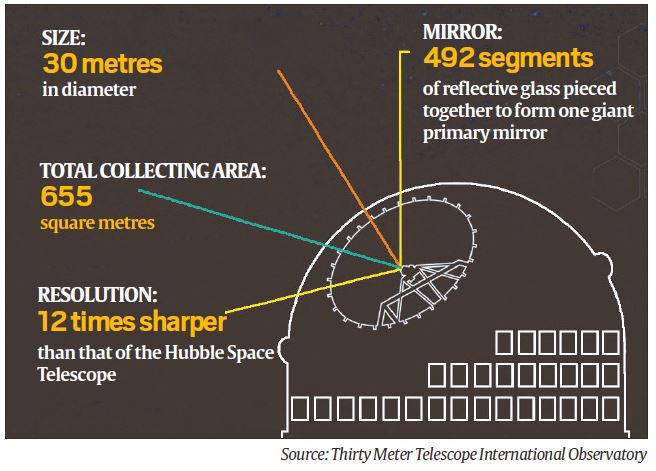
    • “Thirty Metre” refers to the 30-metre diameter of the mirror, with 492 segments of glass pieced together, which makes it three times as wide as the world’s largest existing visible-light telescope.
    • The larger the mirror, the more light a telescope can collect, which means, in turn, that it can “see” farther, fainter objects.
    • It would be more than 200 times more sensitive than current telescopes and would be able to resolve objects 12 times better than the Hubble Space Telescope.

    Utility of the telescope

    • One of its key uses will be the study of exoplanets, many of which have been detected in the last few years, and whether their atmospheres contain water vapour or methane — the signatures of possible life.
    • For the first time in history, this telescope will be capable of detecting extraterrestrial life.
    • The study of black holes is another objective.
    • While these have been observed in detail within the Milky Way, the next galaxy is 100 times farther away; the TMT will help bring them closer.
  • GSAT-30 successfully launched

    India’s first satellite of 2020, the GSAT-30 was successfully launched. The launch vehicle Ariane 5 VA-251 lifted off from Kourou Launch Base, French Guiana.

    GSAT-30 

    • GSAT-30 derives  its  heritage  from ISRO’s  earlier INSAT/GSAT  satellite  series  and  will  replace  INSAT-4A  in 
    • In the  days  ahead,  orbit-raising  manoeuvres  will  be  performed  to  place  the satellite  in  Geostationary  Orbit  (36,000  km  above  the  equator)  by  using  its  onboard  propulsion
    • During the  final  stages  of  its  orbit  raising  operations,  the  two  solar  arrays  and  the antenna  reflectors  of  GSAT-30  will  be
    • Following this,  the satellite will be  put in  its final orbital .     The satellite will  be  operational  after  the successful  completion  of  all in-orbit  tests.

    Utility of the satellite

    • GSAT-30 will provide  DTH  Television  Services, connectivity to  VSATs for  ATM,  Stock-exchange,  Television unlinking and Teleport  Services,  Digital  Satellite  News  Gathering  (DSNG)  and e-governance applications.
    • The satellite  will  also  be  used  for  bulk  data  transfer  for  a  host  of an emerging  telecommunication
  • Artemis Mission

    NASA wants to send the first woman and the next man to the Moon by the year 2024, which it plans on doing through the Artemis lunar exploration program. An Indian American astronaut named Raja Chari is set to accompany the crew in this mission.

    Artemis Mission

    • In 2011, NASA began the ARTEMIS (Acceleration, Reconnection, Turbulence, and Electrodynamics of the Moon’s Interaction with the Sun) mission using a pair of repurposed spacecraft and in 2012 the Gravity Recovery and Interior Laboratory (GRAIL) spacecraft studied the Moon’s gravity.
    • For the program, NASA’s new rocket called the Space Launch System (SLS) will send astronauts aboard the Orion spacecraft a quarter of a million miles away from Earth to the lunar orbit.
    • The astronauts going for the Artemis program will wear newly designed spacesuits, called Exploration Extravehicular Mobility Unit, or xEMU.
    • These spacesuits feature advanced mobility and communications and interchangeable parts that can be configured for spacewalks in microgravity or on a planetary surface.
  • Goldilocks Zone

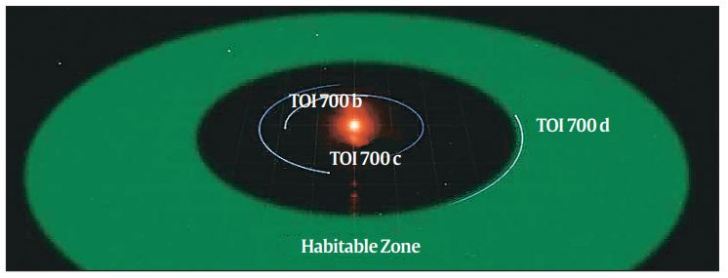
    NASA has reported the discovery of an Earth-size planet, named TOI 700 d, orbiting its star in the “habitable zone”.

    Goldilocks Zone

    • A habitable zone, also called the “Goldilocks zone”, is the area around a star where it is not too hot and not too cold for liquid water to exist on the surface of surrounding planets.
    • Our Earth is in the Sun’s Goldilocks zone. If Earth were where the dwarf planet Pluto is, all its water would freeze; on the other hand, if Earth were where Mercury is, all its water would boil off.
    • Life on Earth started in water, and water is a necessary ingredient for life as we know it.
    • So, when scientists search for the possibility of alien life, any rocky exoplanet in the habitable zone of its star is an exciting find.

    TOI 700 d

    • The newest such planet was found by NASA’s Transiting Exoplanet Survey Satellite (TESS) mission, which it launched in 2018.
    • The star, TOI 700, is an “M dwarf” located just over 100 light-years away in the southern constellation Dorado, is roughly 40% of our Sun’s mass and size, and has about half its surface temperature.
    • The find was confirmed by the Spitzer Space Telescope, which sharpened the measurements that TESS had made, such as orbital period and size.
    • TOI 700 d measures 20% larger than Earth. It orbits its star once every 37 days and receives an amount of energy that is equivalent to 86% of the energy that the Sun provides to Earth.
  • Indian Data Relay Satellite System (IDRSS)

    India plans to ring in its own era of space-to-space tracking and communication of its space assets this year by putting up a new satellite series called the Indian Data Relay Satellite System.

    Indian Data Relay Satellite System (IDRSS)

    • The IDRSS is planned to track and be constantly in touch with Indian satellites, in particular those in low-earth orbits which have limited coverage of earth.
    • In the coming years, it will be vital to ISRO whose roadmap is dotted with advanced LEO missions such as space docking, space station, as well as distant expeditions to moon, Mars and Venus.
    • It will also be useful in monitoring launches.
    • The first beneficiary would be the prospective crew members of the Gaganyaan mission of 2022 who can be fully and continuously in touch with mission control throughout their travel.
    • IDRSS satellites of the 2,000 kg class would be launched on the GSLV launcher to geostationary orbits around 36,000 km away.
  • Gravitational Wave Observations

    Eureka moment: Gravitational waves found


    Recently, Gravitational waves, the cosmic ripples that distort space-time itself, have been directly detected for the first time. Let’s know about this unprecedented discovery!

    What is so special about this eureka moment?

    • For the first time, scientists have observed ripples in the fabric of space-time called gravitational waves, arriving at the earth from a cataclysmic event in the distant universe
    • This confirms a major prediction of Albert Einstein’s 1915 general theory of relativity and opens an unprecedented new window onto the cosmos
    • Physicists have concluded that the detected gravitational waves were produced during the final fraction of a second of the merger of two black holes to produce a single, more massive spinning black hole
    • This collision of two black holes had been predicted but never observed

    Let’s first know about Albert Einstein’s general theory of relativity?

    • In 1905, Albert Einstein determined that the laws of physics are the same for all non-accelerating observers, and that the speed of light in a vacuum was independent of the motion of all observers. This was the theory of special relativity
    • It introduced a new framework for all of physics and proposed new concepts of space and time
    • Einstein then spent 10 years trying to include acceleration in the theory and published his theory of general relativity in 1915
    • In it, he determined that massive objects cause a distortion in space-time, which is felt as gravity

    [ Einstein’s mathematics showed that massive accelerating objects (such as neutron stars or black holes orbiting each other) would disrupt space-time in such a way that ‘waves’ of distorted space would radiate from the source ]

    What are Gravitational waves?

    Cataclysmic events, such as this artist's rendition of a binary-star merger, are believed to create gravitational waves that cause ripples in space-time
    Cataclysmic events, such as this artist’s rendition of a binary-star merger, are believed to create gravitational waves that cause ripples in space-time. Credits: NASA

    • Gravitational waves are distortions or ‘ripples’ in the fabric of space-time caused by some of the most violent and energetic processes in the Universe
    • These ripples would travel at the speed of light through the Universe, carrying with them information about their cataclysmic origins, as well as invaluable clues to the nature of gravity itself

    What are the Sources of Gravitational Waves?

    • Any object with mass that accelerates (which in science means changes position at a variable rate, and includes spinning and orbiting objects) produces gravitational waves, including humans and cars and airplanes etc.
    • But the gravitational waves made by us here on Earth are much too small to detect
    • The strongest gravitational waves are produced by catastrophic events such as colliding black holes, the collapse of stellar cores (supernovae), coalescing neutron stars or white dwarf stars, the slightly wobbly rotation of neutron stars that are not perfect spheres, and the remnants of gravitational radiation created by the birth of the Universe itself

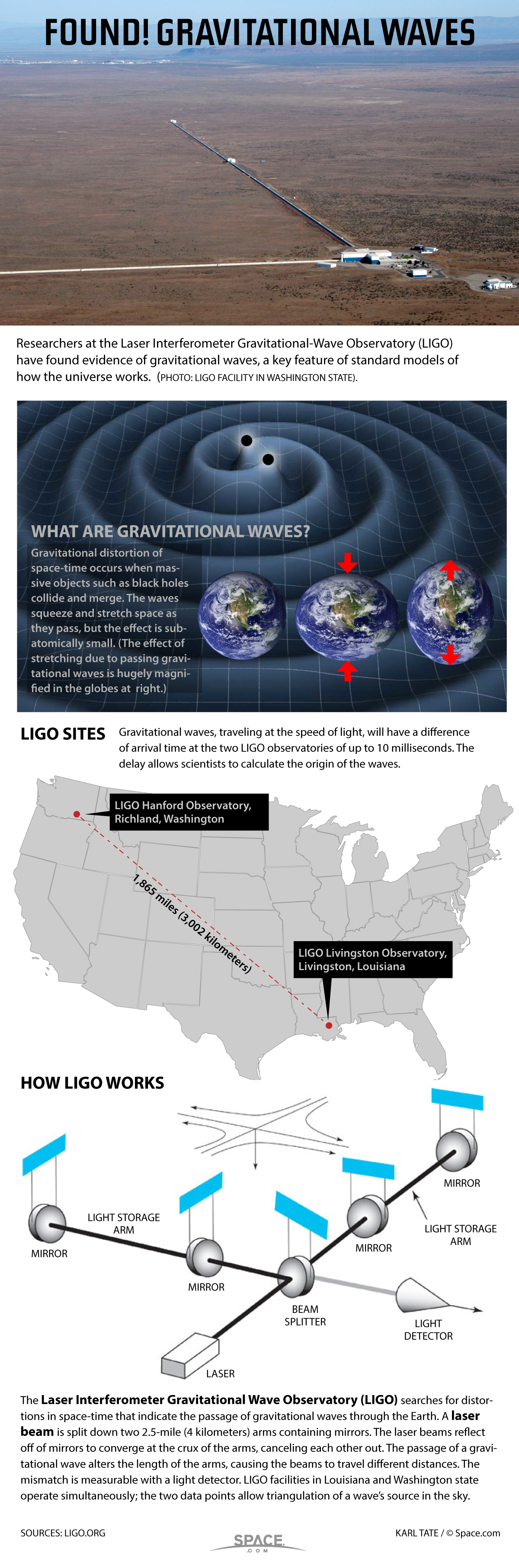
    InfographLigo-gravitational-waves


    Not one but four types of Gravitational Waves!

    • In order to understand the types of gravitational waves, Laser Interferometer Gravitational Wave Observatory (LIGO) scientists have defined 4 categories of gravitational waves
    • These categories are: Continuous Gravitational Waves, Compact Binary Inspiral Gravitational Waves, Stochastic Gravitational Waves, and Burst Gravitational Waves

    But, Why Detect Them?

    • This will open up a new window of study on the Universe, giving us a deeper understanding of these cataclysmic events, and usher in brand new cutting-edge studies in physics, astronomy, and astrophysics
    • More importantly, since gravitational waves don’t interact with matter (unlike electromagnetic radiation), they travel through the Universe completely unimpeded giving us a crystal clear view of the gravitational wave
    • This will provide astronomers and other scientists, first glimpses of previously unseen and unseeable wonders, and greatly adding to our understanding of the nature of space and time itself

    So, How does LIGO come into the Picture?

    • LIGO( Laser Interferometer Gravitational Wave Observatory) is the world’s largest gravitational wave observatory and a cutting edge physics experiment
    • LIGO exploits the physical properties of light and of space itself to detect and understand the origins of gravitational waves
    • LIGO has 2 widely separated identical detector sites working in unison as a single “observatory”: one in Hanford, southeastern Washington State and the other in rural Livingston, Louisiana
    • LIGO has a very close collaboration with the VIRGO collaboration that analyzes data from VIRGO, a 3 km gravitational wave interferometer located near Pisa, Italy
    • Data from LIGO and Virgo are combined and analyzed together by the LIGO and Virgo collaborations
    • Thus significantly increasing the capability of combined data for detecting and using gravitational waves to learn about nature

    Is there any Way ahead for India?

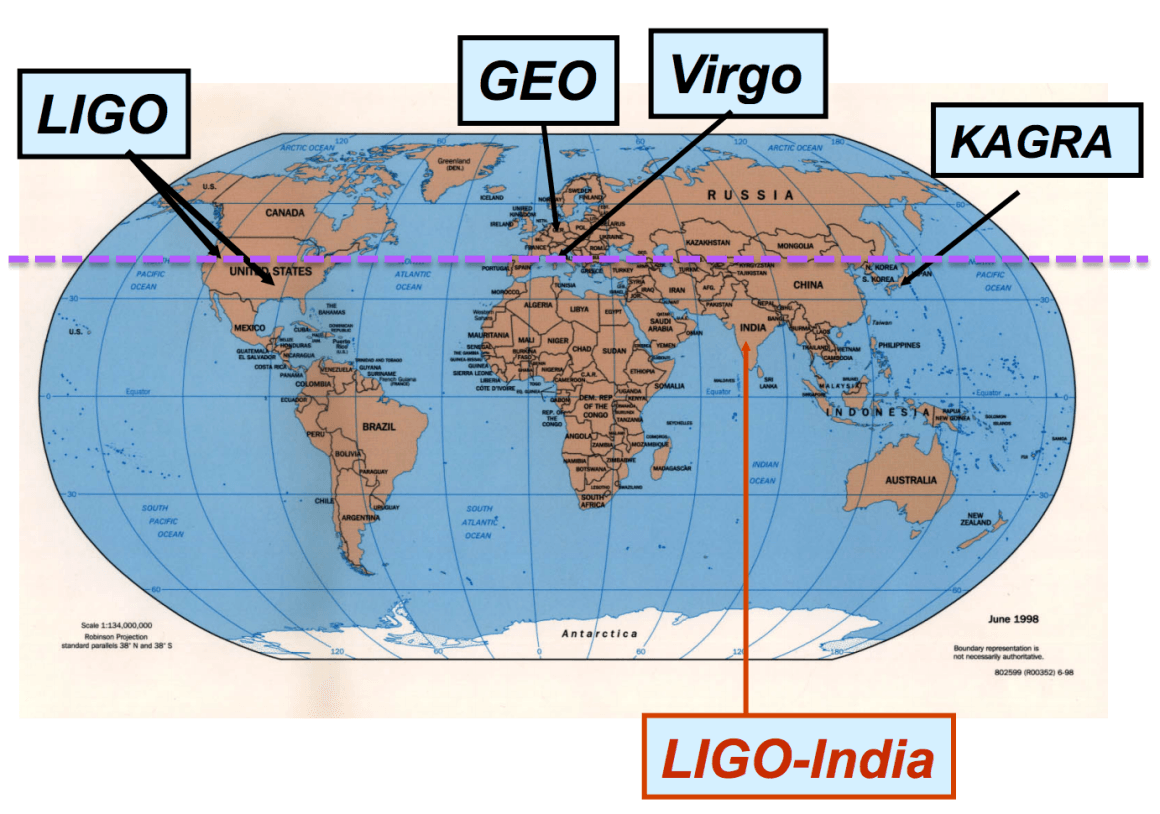
    Image - Locations of existing gravitational-wave detectors, and how far out a LIGO in India would be Source: LIGO
    Image – Locations of existing gravitational-wave detectors, and how far out a LIGO in India would be. Source: LIGO

    • Yes, because Union cabinet has approved a proposal to establish a state-of-the-art gravitational wave observatory in India in collaboration with LIGO in the US
    • The project will bring unprecedented opportunities for scientists and engineers to dig deeper into the realm of gravitational wave and take global leadership in this new astronomical frontier
    • This will also bring considerable opportunities in cutting-edge technology for the Indian industry which will be engaged in the construction of the 8-km long beam tube at ultra-high vacuum on a leveled terrain
    • With its establishment, India will join the global network of gravitational wave detectors
    • The establishment of an observatory in India assumes importance because the further the distance between the observatories, the greater will be the accuracy in locating gravity waves
    • Maharashtra and Madhya Pradesh are among the states shortlisted for the experiment

    Can we expect some answers from you guys?

    #Q. Recently, Union cabinet has approved a proposal to establish a gravitational wave observatory, one of the mega science projects in India. Discuss, how will this project help India if it becomes a reality.


    Published with inputs from Arun | Image: space.com
  • International Space Agencies – Missions and Discoveries

    Why Everyone has interest in Martian System exploration?

    1. Mars has long been the subject of human fascination. Early telescopic observations revealed color changes on the surface that were originally attributed to seasonal vegetation as well as apparent linear features that were ascribed to intelligent design.
    2. Telescopic observations found Mars’ two moons, Phobos and Deimos, the polar ice caps, and the feature now known as Olympus Mons, the solar system’s tallest mountain.
    3. These discoveries piqued further interest in the study and exploration of the red planet.
    4. Mars is a rocky planet, like Earth, that formed around the same time, yet with only half the diameter of Earth, and a far thinner atmosphere, it has a cold and desert-like surface.
    5. It is notable, however, that although the planet has only one quarter of the surface area of the Earth, it has about the same land area, since only one quarter of the surface area of the Earth is land.

    NASA's Journey to Mars infographic


    Then, How Mars Journey has started?

    NASA’s Mars Odyssey orbiter entered Mars orbit in 2001. Odyssey’s Gamma Ray Spectrometer detected significant amounts of hydrogen on Mars,thought to be contained in large deposits of water ice.

    The Mars Express mission of the European Space Agency (ESA) reached Mars in 2003. It carried the Beagle 2 lander, which was not heard from after being released and was declared lost in February 2004.

    In early 2004 the Mars Express Planetary Fourier Spectrometer team announced the orbiter had detected methane in the Martian atmosphere. ESA announced in June 2006 the discovery of aurorae on Mars.

    In January 2004, the NASA twin Mars Exploration Rovers named Spirit (MER-A) and Opportunity (MER-B) landed on the surface of Mars. Both have met or exceeded all their targets.

    On March 10, 2006, the NASA Mars Reconnaissance Orbiter (MRO) probe arrived in orbit to conduct a two-year science survey.

    The orbiter began mapping the Martian terrain and weather to find suitable landing sites for upcoming lander missions. The MRO snapped the first image of a series of active avalanches near the planet’s north pole.

    The Mars Science Laboratory mission was launched on November 26, 2011 and it delivered the Curiosity rover, on the surface of Mars on August 6, 2012 UTC.

    The Indian Space Research Organisation (ISRO) launched Mars Orbiter Mission (MOM) on November 5, 2013. It was successfully inserted into Mars orbit on 24 September 2014.


    Wow, so finally did we find water?

    New findings from NASA’s Mars Reconnaissance Orbiter (MRO) provide the strongest evidence yet that liquid water flows intermittently on present-day Mars.

    Using an imaging spectrometer on MRO, researchers detected signatures of hydrated minerals on slopes where mysterious streaks are seen on the Red Planet.

    They darken and appear to flow down steep slopes during warm seasons, and then fade in cooler seasons. They appear in several locations on Mars when temperatures are above min0us 10 degrees Fahrenheit (minus 23 Celsius), and disappear at colder times.

    It appears to confirm that water is flowing today on the surface of Mars.These downhill flows, known as recurring slope lineae (RSL), often have been described as possibly related to liquid water.

    The new findings of hydrated salts on the slopes point to what that relationship may be to these dark features. The hydrated salts would lower the freezing point of a liquid brine, just as salt on roads here on Earth causes ice and snow to melt more rapidly.

    Scientists say it’s likely a shallow subsurface flow, with enough water wicking to the surface to explain the darkening.


     What are the Garni crater on Mars?

    Dark narrow streaks called recurring slope lineae emanating out of the walls of Garni crater on Mars. The dark streaks here are up to few hundred meters in length.

    The spectral signatures as caused by hydrated minerals called perchlorates. The hydrated salts most consistent with the chemical signatures are likely a mixture of magnesium perchlorate, magnesium chlorate and sodium perchlorate.

    On Earth, naturally produced perchlorates are concentrated in deserts, and some types of perchlorates can be used as rocket propellant.


    What a Contribution by MRO in this enigmatical mission!!

    NASA’s Mars Reconnaissance Orbiter (MRO) has been examining Mars since 2006 with its six science instruments.

    The ability of MRO to observe for multiple Mars years with a payload able to see the fine detail of these features has enabled findings such as these:

    first identifying the puzzling seasonal streaks and now making a big step towards explaining what they are?

    The new findings are more proof that the mysterious lines he first saw darkening Martian slopes five years ago are, indeed, present-day water.

    The discovery is the latest of many breakthroughs by NASA’s Mars missions

    It took multiple spacecraft over several years to solve this mystery, and now we know there is liquid water on the surface of this cold, desert planet.It seems that the more we study Mars, the more we learn how life could be supported and where there are resources to support life in the future.

    Then, Mars is more habitable than previously thought so, Can we go to Mars for living really? Yes probably. Because NASA is planning for it by 2030.

    Published with inputs from Arun
     

  • ISRO Missions and Discoveries

    Let’s cover the entire gamut of projects concluded by ISRO in these 2 years.

    IRNSS will be covered in a separate article.

    GSAT Series

    #1. GSAT-6

    • GSAT-6 is the twenty fifth geostationary communication satellite of India built by ISRO and twelfth in the GSAT series
    • Five of GSAT-6’s predecessors were launched by GSLV during 2001, 2003, 2004, 2007 and 2014 respectively
    • After its commissioning, GSAT-6 has joined the group of India’s other operational geostationary satellites
    • GSAT-6 Satellite provides communication through five spot beams in S-band and a national beam in C-band for strategic users
    • It was launched using GSLV-D6 (Explained below in GSLV Missions)

    #2. GSAT-15

    • It is a high power satellite being inducted into the INSAT/ GSAT system
    • It carries a total of 24 communication transponders in Ku-band as well as a GPS
    • Aided GEO Augmented Navigation (GAGAN) payload operating in L1 and L5 bands
    • It is the third satellite to carry GAGAN payload after GAST-8 and GSAT-10, which are already providing navigation services from orbit
    • It carries a Ku-band beacon as well to help in accurately pointing ground antennas towards the satellite
    • It was launched by Ariane-5 VA-227 launch vehicle from Kourou, French Guiana on early morning of November 11, 2015

    #3. GSAT-16

    • GSAT-16, an advanced communication satellite, weighing 3181.6 kg at lift-off, is being inducted into the INSAT-GSAT system
    • GSAT-16 is configured to carry a total of 48 communication transponders, the largest number of transponders carried by a communication satellite developed by ISRO so far, in normal C-band, upper extended C-band and Ku-band
    • GSAT-16 carries a Ku-band beacon as well to help accurately point ground antennas towards the satellite
    • The designed on-orbit operational life of GSAT-16 is 12 years
    • The communication transponders on-board GSAT-16 together ensure continuity of various services currently provided by INSAT-GSAT system and serve as on-orbit spares to meet contingency requirements or for the augmentation of such services
    • GSAT-16 was launched into a Geosynchronous Transfer Orbit (GTO) by Ariane-5 VA-221 launch vehicle from Kourou, French Guiana
    • GSAT-16 was positioned at 55 deg East longitude in the Geostationary orbit and co-located with GSAT-8, IRNSS-1A and IRNSS-1B satellites

    PAYLOADS OF GSAT-16

    1. 12 Ku-band transponders each with 36 MHz usable bandwidth with footprint covering Indian mainland and Andaman & Nicobar islands
    2. 24 C-band transponders each with 36 MHz usable bandwidth with footprint covering Indian mainland and island territories
    3. 12 Upper Extended C-band transponders each with 36 MHz usable bandwidth with footprint covering Indian mainland and island territories

    PSLV Missions

    #1. PSLV C28/ DMC3 Mission: Heaviest commercial mission ever undertaken by ISRO

    • PSLV in its 30th flight (PSLV-C28) launched three identical DMC3 optical earth observation satellites built by Surrey Satellite Technology Limited (SSTL), UK
    • PSLV-C28 was the ninth flight of PSLV in ‘XL’ configuration
    • With the overall lift-off mass of the five satellites amounting to about 1440 kg, this mission becomes the heaviest commercial mission ever undertaken by Antrix/ISRO
    • The three DMC3 satellites, each weighing 447 kg, were launched into a 647 km Sun-Synchronous Orbit (SSO) using the high-end version of PSLV (PSLV-XL) from Satish Dhawan Space Centre, Sriharikota (SDSC-SHAR), the spaceport of India

    DMC3

    1. The DMC3 constellation comprises of three advanced mini-satellites DMC3-1, DMC3-2 and DMC3-3
    2. It is designed to address the need for simultaneous high spatial resolution and high temporal resolution optical Earth Observation
    3. Launched into a single Low-Earth Orbit plane and phased with a separation of 120° between them, these satellites can image any target on the Earth’s surface every day
    4. Major application areas include surveying the resources on earth and its environment, managing urban infrastructure and monitoring of disasters

    It also carried two auxiliary satellites from UK:

    1. CBNT-1, an optical technology demonstrator earth observation micro satellite built by SSTL
    2. De-OrbitSail, a technology demonstrator nano satellite built by Surrey Space Centre

    #2. PSLV C30/ Astrosat

    • PSLV, in its 31st flight (PSLV-C30), launched Astrosat into a 650 km orbit of 6 deg inclination to the equator
    • Along with Astrosat, six satellites from international customers viz. LAPAN-A2 of Indonesia, NLS-14 (Ev9) of Canada and four identical LEMUR satellites of USA were launched
    • PSLV-C30 is the tenth flight of PSLV in its ‘XL’ Configuration

    #3. PSLV C29/ TeLEOS-1 Mission/ 6 Singapore satellites

    • PSLV, in its 32nd flight (PSLV-C29), launched six satellites of Singapore into a 550 km circular orbit inclined at 15 degrees to the equator
    • This is the eleventh flight of PSLV in ‘core-alone’ configuration (without the use of solid strap-on motors)
    • Of these six satellites, TeLEOS-1 is the primary satellite weighing 400 kg
    • The other five are co-passenger satellites which include two micro-satellites and three nano-satellites:
    1. VELOX-CI, micro-satellite
    2. VELOX-II, 6U-Cubesat technology demonstrator
    3. Athenoxat-1, a technology demonstrator nano-satellite
    4. Kent Ridge-1, a micro-satellite
    5. Galassia, 2U-Cubesat

    IRNSS Constellation


    The recent launches in this series are:

    #1. PSLV C-27/ IRNSS-1D

    #2. PSLV C-31/ IRNSS-1E

    #3. PSLV C32/ IRNSS-1F

    #4. PSLV C33/ IRNSS-1G

    IRNSS-1G was the 7th and last satellite in the IRNSS constellation.

    With this, India has achieved the milestone of being one the very few countries to have its own Positioning System.

    [IRNSS will be dealt with in detail in a separate story]


    GSLV Missions

    #1. GSLV-D6/ GSAT-6

    • GSLV-D6 is the ninth flight of India’s Geosynchronous Satellite Launch Vehicle (GSLV)
    • It is also the fifth developmental flight of GSLV
    • This is the third time the indigenously developed Cryogenic Upper Stage (CUS) is being carried on-board during a GSLV flight
    • GSLV-D6 flight is significant since it intends to continue the testing of CUS
    • GSLV is designed to inject 2 ton class of communication satellites into Geosynchronous Transfer Orbit (GTO)
    • GSAT-6 is explained above

    #2. GSLV-Mk III: Launching humans into space

    • ISRO killed two birds with one stone when the GSLV Mk3 test with an inert cryogenic stage took off with the CARE (Crew Module Atmospheric Re-entry Experiment)
    • The module reached an altitude of 80 km and made a successful splash down in the sea using the largest parachutes ever made in the country
    • Once operational, the crew module will host up to three Indian astronauts for orbital missions lasting up to a week in space
    • It will make India only the fourth nation in the world after Russia, US and China to have the ability to send humans into space; maybe even to the moon one day
    • According to ISRO the schedule for sending the first Indian on an Indian rocket is planned for 2021
    • For this, the GSLV Mk3 will have to be man-rated – it has to demonstrate a set number of continuous successful launches

    Reusable Launch Vehicle- Technology Demonstrator (RLV-TD)

    The cost of access to space is the major deterrent in space exploration and space utilization. A reusable launch vehicle is the unanimous solution to achieve low cost, reliable and on-demand space access


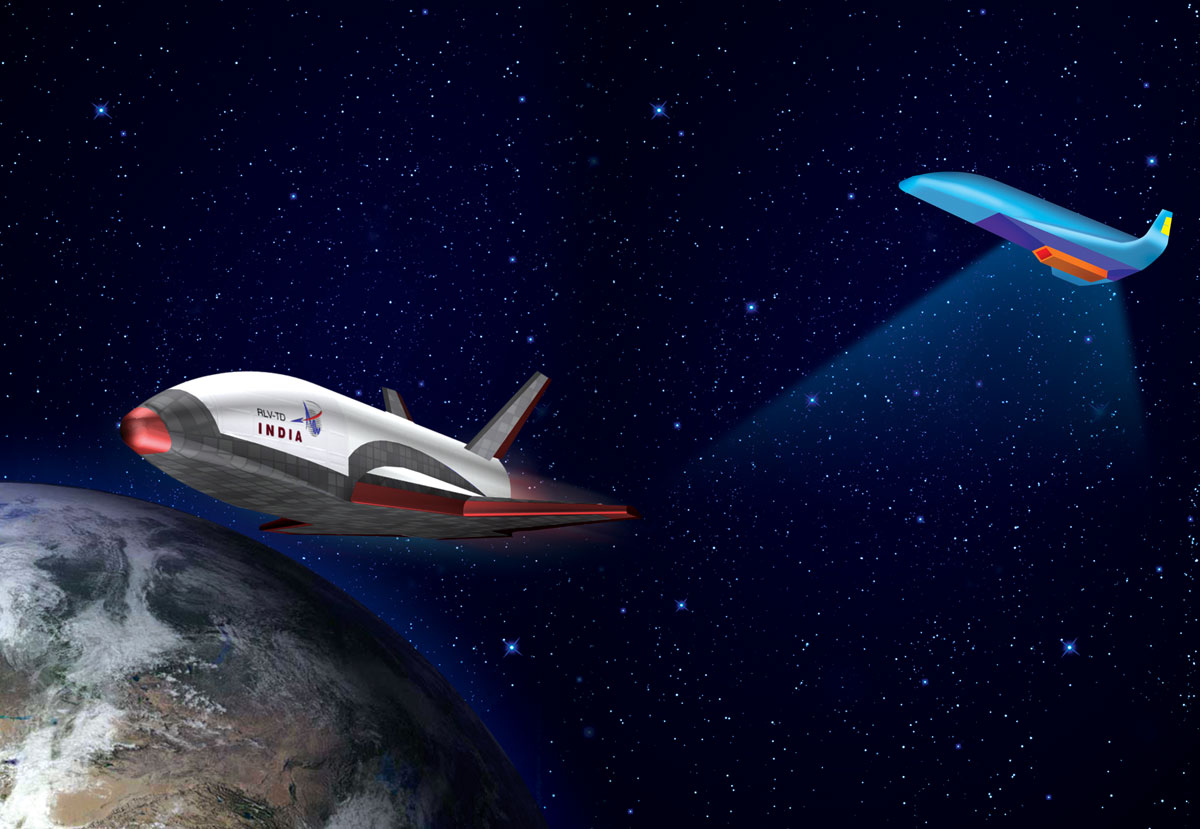
    Reusable Launch Vehicle-Technology Demonstration Program or RLV-TD is a series of technology demonstration missions that have been considered as a first step towards realizing a Two Stage To Orbit (TSTO) fully re-usable vehicle.

    A Winged Reusable Launch Vehicle technology Demonstrator (RLV-TD) has been configured to act as a flying test bed to evaluate various technologies, namely, hypersonic flight, autonomous landing, powered cruise flight and hypersonic flight using air-breathing propulsion.


    2015 Space Pioneer Award

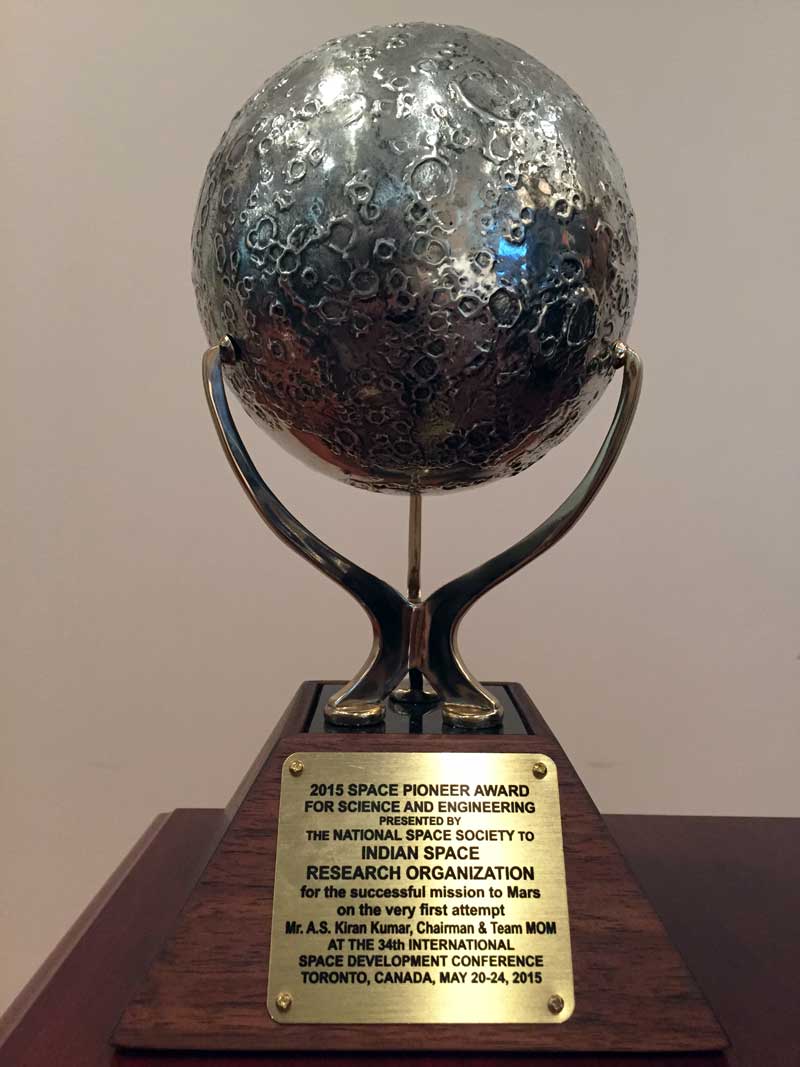
    • Space Pioneer award for the year 2015 was presented to Indian Space Research Organisation (ISRO) in the Science and Engineering category during the 34th Annual International Space Development Conference held at Toronto in Canada during May 20 -24, 2015
    • National Space Society (NSS) of USA presented this award in recognition of ISRO’s efforts in accomplishing Mars Mission in its very first attempt
    • In 2009, NSS has presented similar award to ISRO in recognition of the great accomplishment they have made in the success of the Lunar Probe, Chandrayaan-1
    • National Space Society (NSS) is an independent nonprofit educational membership organisation dedicated to the creation of a space faring civilisation