💥Join UPSC 2027,2028 Mentorship (August Batch) + XFactor Notes & Microthemes PDF

Subject: Space Technology

  • [pib] Super-luminous Supernova SN 2010kd

    Indian researchers have found that SN 2010kd, a super-luminous supernova stands out with the amount of mass as well as Nickel ejected during explosion.

    Space science-related terms these days are often focused on Gravitational waves, Black holes etc. But basic terminologies are very important and need to be taken care of. For example, a layman may hardly find any difference between Novae-Supernovae, Neutron star, Nebula etc. UPSC often tries to bust you with such basic differences.

    What are Supernovae?

    • Supernovae are kind of energetic explosions were the core of massive stars (a few times to that of the mass of our Sun) goes to a catastrophic phase of explosion liberating huge amounts of energy and mass.
    • These events are visible through very far away distances much beyond our own solar system.
    • Super-luminous supernovae are a special type of stellar explosions having energy output 10 or more times higher than that of standard supernovae.

    What is so distinct about SN 2010kd?

    • The mass ejection from SN 2010kd is metallic and is much more than seen in case of normal core-collapse supernovae.
    • The scientists found that SN 2010kd exploded with a larger velocity but decayed slower than other similar supernovae.
    • The observations show that parameters like rotation and metallicity play a crucial role in stellar explosions.
  • [pib] What is Big Bang Nucleosynthesis (BBN)?

    Indian researchers have discovered hundreds of Li-rich giant stars produced during BBN indicating that Li is being produced in the stars and accounts for its abundance in the interstellar medium.

    Most of the space based theories and missions are focussed on the formation of our solar system. BBN is the most basic auxillary among them.

    What is Big Bang Nucleosynthesis (BBN)?

    • BBN is the production of nuclei other than those of the lightest isotope of hydrogen during the early phases of the Universe.
    • Primordial nucleosynthesis is believed by most cosmologists to have taken place in the interval from roughly 10 seconds to 20 minutes after the Big Bang.
    • It is calculated to be responsible for the formation of most of the universe’s helium in various isotopic forms.
    • Essentially all of the elements that are heavier than lithium were created much later, by stellar nucleosynthesis in evolving and exploding stars.

    Lithium in space

    • Lithium (Li), is one of the three primordial elements, apart from Hydrogen and Helium (He), produced in the Big Bang Nucleosynthesis (BBN).
    • However, the present measurement of Li in the interstellar medium and very young stars is about 4 times more than the primordial value.
    • Thus, identifying sources of Li enrichment in our Galaxy has been a great interest to researchers to validate BBN as well as a stellar mixing process.
    • In general, stars are considered as Li sinks. This means that the original Li, with which stars are born, only gets depleted over stars’ life-time as Li burns at relatively very low temperatures.
  • [pib] What are Blazars?

    Researchers from the Indian Institute of Astrophysics (IIA), Bangalore have conducted the first systematic study on the gamma-ray flux variability nature on different types of Blazars.

    Strange terminologies from space-based studies are very important from prelims point of view.  We can expect a statement based question seeking to identify the term which is being referred to in the paragraph.

    What are Blazars?

    • At the center of most galaxies, there’s a massive black hole that can have mass of millions or even billions of Suns that accrete gas, dust, and stellar debris around it.
    • As these material falls towards the black hole, their gravitational energy gets converted to light forming active galactic nuclei (AGN).
    • A minority of AGN (~15%) emit collimated charged particles called jets travelling at speeds close to the speed of light.
    • Blazars are AGN whose jets are aligned with the observer’s line of sight.
    • Some blazars are thought to host binary black holes in them and could be potential targets for future gravitational-wave searches.

    Studying blazars

    • Blazars are the most luminous and energetic objects in the known universe were found to be emitters of gamma-rays in the 1990s.
    • It is only with the capability of Fermi Gamma-ray space telescope (launched in 2008) to scan the entire sky once in three hours one is able to probe the flux variability characteristics of blazars on a range of time scales.
    • Gamma-ray band is one of the bands of the electromagnetic spectrum on which there is limited knowledge on the flux variability of blazars.
    • Major problem while studying them is to localize the site for the production of gamma-rays.

    Significance

    • The study of blazars could provide clues to the processes happening close to the black hole, not visible through direct imaging.
    • Exploring blazars will provide key inputs to constrain the high energy production site as well as the high energy emission processes.
  • What are Primordial Black Holes (PBH)?

    A scientist duo from Pune has studied primordial black holes that were born as a result of a tiny bump in the potential energy levels of the universe, at a time when it was expanding rapidly.

    Strange space events are known to be the favourites of UPSC 🙂

    Primordial Black Holes (PBH)

    • PBH are a hypothetical type of black hole that formed soon after the Big Bang
    • It is believed that they are formed as a result of collapsing radiations as opposed to the collapse of massive stars, which is the case of any other black holes.
    • PBH can be massively large as 3000kms or be extremely tiny like nucleus of an atom.

    What did the study conclude?

    • The study has confirmed that this marginal rise in potential energy resulted in birth of several PBHs and also emitted very powerful gravitational waves.
    • Approximately 14 billion years ago before the commencement of the Hot Big Bang phase, the very young universe was found to be active and expanding at a highly accelerated rate.
    • This exponential growth in its size was fuelled by the presence of uniform energy field and density as the universe passed through the Cosmic Inflation phase.
    • According to the scientists, as time passes, this uniform energy prevailing in the Inflation Field wanes out.
    • As a result, the universe resumes its normal decelerating rate.

    Expansion of universe

    • Gravity is normally attractive in nature. The PBH did undergo rapid expansion due to the Inflation field which contrarily possessed repulsive gravity.
    • This pushed the universe to expand at a much faster rate than normal.
    • The universe had expanded to nearly 10^27 times its original size, that too, within just fraction of a second by the time Cosmic Inflation phase concluded.
    • Thereafter, the remnant energy possessed by this gravitational force got converted mainly into photons (light) in addition to protons, electrons, neutrons and other particles.
    • As the universe continued to grow exponentially during the Cosmic Inflation phase, it sent across tiny quantum jitters.
    • These fluctuations, released in a specific fashion, when sufficiently large, slowly give birth to galaxies and stars. Among those that were significantly large, helped form PBHs.


  • [pib] Ionospheric based monitoring of large earthquakes

    Scientists of Indian Institute of Geomagnetism (IIG) an autonomous institution of the DST have extensively studied the signatures of recent large earthquakes into the ionosphere with an ambitious aim to derive the seismic source characteristics from the ionosphere.

    CLAIMS

    • The research is a part of the interdisciplinary program ‘Coupled Lithosphere-Atmosphere- Ionosphere-Magnetosphere System (CLAIMS)’ of IIG.
    • CLAIMS focuses on energy transfer to the atmosphere during solid Earth processes such as earthquakes as well as tsunamis.

    Key terms: Co-seismic Ionospheric Perturbations (CIP)

    • In general, the Earth crust uplift during an earthquake produces compressional (i.e. pressure) waves in the overlying atmosphere.
    • These waves propagate upward in the region of exponentially decreasing atmospheric neutral density, and thus, wave amplitude increase with atmospheric heights.
    • On arrival at ionospheric heights, the waves redistribute ionospheric electron density and produce electron density perturbations (disruption) known as CIP.

    Objective of CLAIMS

    • The spatial distribution of near field co-seismic Ionospheric perturbations (CIP) associated with this event could reflect well the ground deformation pattern evolved around the epicentre.
    • These CIPs were derived using the Global Positioning System (GPS) measured Total Electron Content (TEC).
    • The CIP distribution was estimated at Ionospheric piercing point (IPP) altitude.

    Other factors affecting CIP

    The major effective non-tectonic forcing mechanisms at ionospheric altitudes are the-

    1. orientation between the ambient geomagnetic field and seismic induced neutral wave perturbations.
    2. orientation between the moving satellite line of sights and the wave perturbations.
    3. ambient ionospheric electron density gradient.

    Back2Basics

    Ionosphere

    • The ionosphere is the ionized part of Earth’s upper atmosphere, from about 60 km to 1,000 km altitude.
    • It is a region that includes the thermosphere and parts of the mesosphere and exosphere.
    • It is ionized by solar radiation.
  • What is Geo-fencing?

    The Centre is using powers under the Indian Telegraph Act to “fetch information” from telecom companies every 15 minutes to track COVID-19 cases across the country.

    What is Geo-fencing?

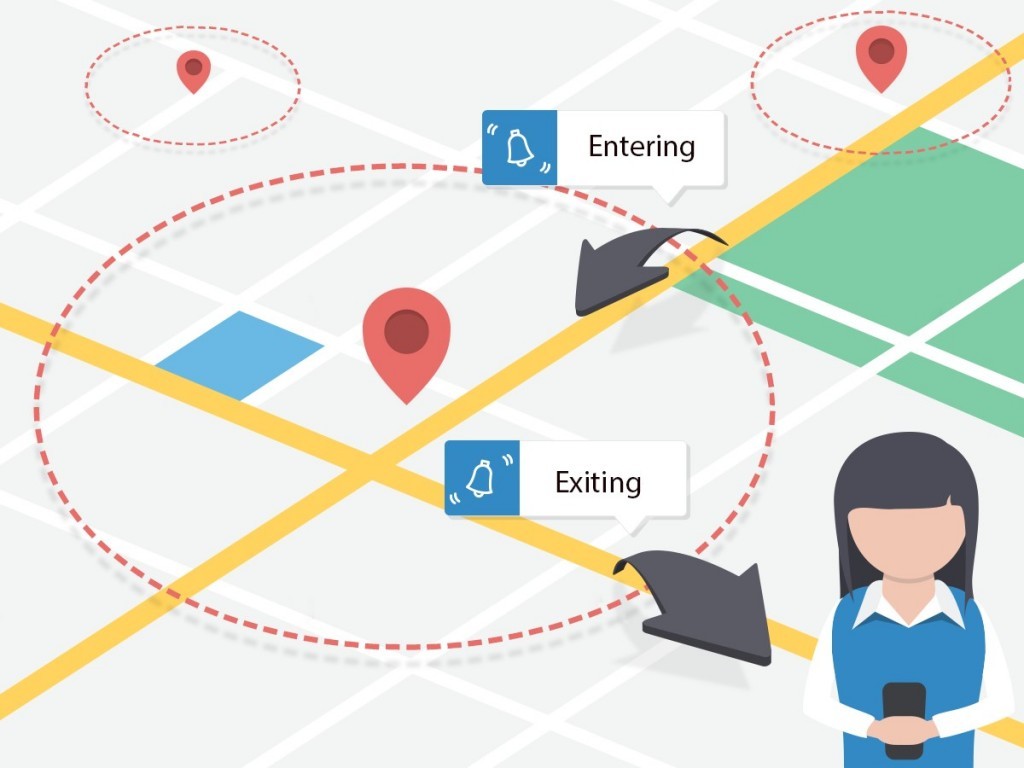
    • A geofence is a virtual perimeter for a real-world geographic area.
    • A geo-fence could be dynamically generated—as in a radius around a point location, or a geo-fence can be a predefined set of boundaries (such as school zones or neighbourhood boundaries).
    • The use of a geofence is called geofencing, and one example of usage involves a location-aware device of a location-based service (LBS) user entering or exiting a geo-fence.
    • This activity could trigger an alert to the device’s user as well as messaging to the geo-fence operator.

    Tracking COVID-19 patients

    • The government has tested an application that triggers e-mails and SMS alerts to an authorised government agency if a person has jumped quarantine or escaped from isolation, based on the person’s mobile phone’s cell tower location.
    • This “geo-fencing” is accurate by up to 300 m.
  • GRACE-FO Mission

    NASA releases new global maps mapping groundwater, soil wetness using GRACE-FO satellites.

    GRACE-FO Mission

    • The Gravity Recovery and Climate Experiment Follow-On (GRACE-FO) mission is a partnership between NASA and the German Research Centre for Geosciences (GFZ).
    • GRACE-FO is a successor to the original GRACE mission, which orbited Earth from 2002-2017.
    • It carries on the extremely successful work of its predecessor while testing a new technology designed to dramatically improve the already remarkable precision of its measurement system.

    Why need such data on groundwater and soil moisture?

    • Groundwater and soil moisture — which depicts wetness in soil — are crucial for irrigation and crop growth.
    • The need to constantly monitor groundwater and soil moisture is important since both act as useful indicators for predicting drought conditions.
    • One of the goals of the new global maps is to make the same consistent product available in all parts of the world, especially in countries that do not have any groundwater-monitoring infrastructure.
    • The data would help in managing the selection of appropriate agricultural crops and predicting yields.
  • Fast Radio Bursts (FRBs)


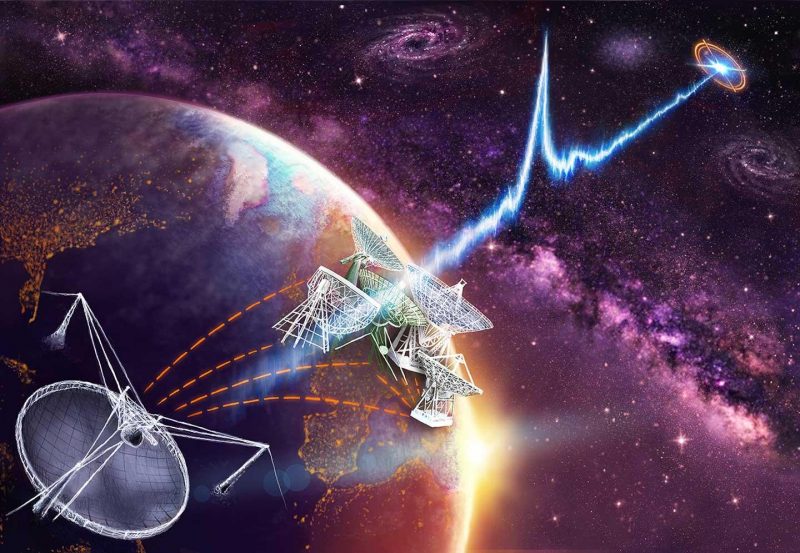
    Researchers from a Canadian space observatory have been recording the periodic radio waves hitting Earth from a neighbouring galaxy from past few years. These radio waves are called Fast Radio Bursts (FRBs).

    Fast Radio Bursts (FRBs)

    • FRBs are super intense, millisecond-long bursts of radio waves produced by unidentified sources in the space.
    • Their discovery in 2007 by American astronomer Duncan Lorimer led to the term ‘Lorimer Bursts’.
    • Since then, just a few dozen similar events have been observed in data collected by radio telescopes around the world, building evidence that points to a variety of potential causes.
    • Only a handful of emissions have been traced to specific areas of the sky, indicating sources in other galaxies.
    • The flash of radio waves is incredibly bright if distant, comparable to the power released by hundreds of millions of suns in just a few milliseconds.
    • This intensity suggests powerful objects like black holes and neutron stars could be involved.
    • The events were once considered to be largely transient – they seemed to happen once, without obvious signs of a repeat emission. However, a number of such bursts have been identified since then.

    Why are they significant?

    • First noticed in 2018 by the Canadian observatory the waves have created ripples across the globe for one reason — they arrive in a pattern.
    • This gave birth to theories that they could be from an alien civilization.
    • Initially, it was believed that the collision of black holes or neutron stars triggers them.
    • But the discovery of repeating FRBs debunked the theory of colliding objects.
  • NASA’s new Mars rover: Perseverance

    NASA has named its next Mars rover ‘Perseverence’.

    About Perseverance

    • The Perseverance rover weighs less than 2,300 pounds and is managed by NASA’s Jet Propulsion Lab.
    • The rover’s mission will be to search for signs of past microbial life. It will also collect samples of Martian rocks and dust, according to the release.
    • The rover will also be tasked with studying the red planet’s geology and climate.
    • All of NASA’s previous Mars rovers — including the Sojourner (1997), Spirit and Opportunity (2004) and Curiosity (exploring Mars since 2012) — were named in this way.
  • New forces in orbit

    Context

    As it looks at the growing role of the private sector and the effort by nations like the UAE and Luxembourg, Delhi needs to move quickly towards a new model for India’s space activity.

    Growing presence in the outer space

    • Outer space no longer a preserve of a few: When you think of outer space, you think of big powers like the United States, Russia and China.
      • You might also note the collective European effort under the European Space Agency as well as the impressive national space programmes of India and Japan.
      • Strategic or symbol of national pursuit: Space programmes have for long been viewed as either strategic or symbols of national prestige for big countries that are prepared to invest significant resources in the pursuit of a credible presence in outer space.
    • Two small countries challenging the narrative: Two small countries, the United Arab Emirates in the Gulf and the Grand Duchy of Luxembourg in Europe have begun to demonstrate that the outer space need not be the playing ground for big powers alone.
      • Sceptics might think it is pretentious for the UAE with its native population of barely one million and Luxembourg with 600,000 people to think of a place for themselves in space.

    UAE’s presence in the space

    • Reminder for India: The interesting path these two countries have set for themselves in outer space is a reminder that Delhi needs to adapt to the rapidly changing dynamic in outer space.
    • Hope Mars Mission: That size is not a constraint is reflected in the UAE’s plan to launch its Mars mission, “Hope”, later this year in partnership with a range of organisations across the world — including three universities in the US.
      • Japan is scheduled to launch the UAE Mars probe this year.
      • India’s own ISRO is also working with the UAE on its Mars mission.
    • Last year, the first Emirati Astronaut, Hazza al-Mansouri spent more than a week in the US-Russian space station.
    • What are the reasons for the UAE’s space strategy? It is about cornering a slice of the rapidly growing commercial space industry — part of a major effort to diversify the UAE economy away from its reliance on hydrocarbons.

    How Luxembourg is increasing its presence in the outer space

    • Commercial space as a major opportunity: Over the years, Luxembourg moved away from its past reliance on the steel industry to become a centre of European banking and finance.
      • It is now looking at commercial space as a major opportunity.
    • Regulatory steps: Luxembourg has taken a number of regulatory steps to create a vibrant ecosystem for space companies ranging from satellite operations to future extraction of resources from asteroids and other space objects.
    • Expansion of the space sector: At the moment, the space sector accounts for nearly 2 per cent of Luxembourg’s GDP.
      • There are more than 50 companies and two public research organisations that are driving the expansion of space sector in Luxembourg.
      • It entered the space sector only in the middle of the last decade. It is also driven by the need for economic diversification.
    • Leveraging new ideas: UAE and Luxembourg do have a reputation for leveraging new ideas to transcend the limitations of their size in the world.
      • But their space adventure was not possible without the structural changes that are reshaping the global space activity.

    How space industry underwent a change over the years

    • Preserve of national programs: Through the second half of the 20th century, outer space was the sole preserve of national space programmes driven by government-funding, direction and management.
    • The emergence of the private sector: As military uses of space and prestige projects like Moon-landing emerged, major private sector entities already in the aviation industry like Boeing and Lockheed won space contracts in the US.
      • Collaboration with government: The Pentagon and the National Aeronautics and Space Administration (NASA) told these companies what to do.
    • Expansion: The last decades of the 20th century saw significant expansion of satellite-based telecommunication, navigation, broadcasting and mapping, and lent a significant commercial dimension to the space sector.
      • As the digital revolution in the 21st century transformed the world economy, the commercial space sector has begun to grow in leaps and bounds.
      • The global space business is now estimated to be around $ 400 billion and is expected to easily rise to at least trillion dollars by 2040.
    • Rise of SpaceX: One example of the rise of private sector companies in the space sector is SpaceX run by the US entrepreneur Elon Musk.
      • Hired for a resupply mission for the space station, it now launches more rockets every year than NASA.
      • The entry of the private sector has begun to drive down the cost-per-launch through innovations such as reusable rockets.

    Scope of the expansion of the space industry

    • Decrease in launch cost and rise in ambition: As launch costs came down, the private sector has become more ambitious.
      • Internet through space: SpaceX plans to launch hundreds of satellites into the low-earth orbit to provide internet services. Amazon has plans to build a network of more than 3,000 satellites in the low-earth orbit.
      • Space tourism: Musk and Amazon’s Jeff Bezos have plans to develop space tourism and build human settlements on the Moon and on Mars.
      • Small private companies in the fray: It is not just big companies that are aiming for the Moon. Last year, a private company in Israel sent a lunar lander to the Moon. Although the lander crashed, much like India’s Vikram, the private sector has begun to do things that were once the monopoly of national agencies.

    India not in synch with the global changes

    • Not adapting to the change: India, however, is quite some distance away from adapting to the unfolding changes in the global space business.
      • In its early years, India’s space programme that was constrained by lack of resources found innovative ways of getting ahead in space.
    • Space sector dominated by the government: Although the ISRO encourages private sector participation in the national space programme, its model is still very 20th century — in terms of governmental domination.

    Conclusion

    As it looks at the growing role of the private sector and the effort by nations like the UAE and Luxembourg, India needs to move quickly towards a new model for India’s space activity. It needs a regulatory environment that encourages a more dynamic role for the private sector and promotes innovation.