đŸ’„Join UPSC 2027,2028 Mentorship (July Batch) + XFactor Notes & Microthemes PDF

Subject: Trivia

  • DM ‘turns’ clerk: finds way to get 2 years’ work done in a month

    Reviewing the functioning of the lower level of administration, Patna district magistrate Sanjay Kumar Aggarwal on Sunday took to a clerk’s job and suggested method to reduce time for completing the work.

    In his two-hour visit to the legal cell of the Secretariat, Aggarwal found that 375 cases of stamp refund were pending which would take about two years to dispose.

    But, the DM, who was transferred to the state capital in December last, found a way out to cut short the time and suggested how the work could be done in a month, an official statement said.

    During the visit, the DM came across an employee who appeared over-aged while one of her certificates, alleged to be forged, stated that she was 55 years old. Aggarwal has instructed officials to constitute a medical board to verify her age, the statement said.

    Starting Sunday, the DM decided to visit different sections of district administration once a week to improve the work culture at lower level. He has also ordered Section, Block, District and Circle officers to do the same every Tuesday and review work, it said.

    Aggarwal was recently awarded by the Election Commission of India for best electoral practices during his tenure as the DM of Gaya.


    Source: HT
  • Introducing Collections – Everything related to IAS Prep at one place


    A few days ago, we launched a survey inviting our readers to pitch in with ideas which can help Civilsdaily improve its offerings to get you that coveted rank in the Civil Services Examination.

    Among the many requests and suggestions, one which we have been hearing for quite sometime is this:

    It is difficult to find related long form writeups in Civilsdaily

    To solve for this particular problem, we have introduced a new concept called Collections. Collections are a group of posts which have similar theme. This is the most efficient way to discover relevant and related content for your IAS Prep in one place.

    Introducing Collections

    Over the last 2 days, we sat down and reviews all the long form write-ups written in last one year and put them into collection buckets. Now that we have segregated all the related posts, open them, read through, make notes and prepare well. Click on the headlines to go to the respective collections.

    #1. How to Clear IAS?

    Long term strategies for clearing the mother of all examination – The Civil Services Exam.

    #2. Toppers Speak

    Collection of blogs written by IAS rankers on their exam strategies and the ups and downs of preparation.

    #3. UPSC Analysis

    Previous years papers, exam patterns, answer keys and everything which can help you understand the IAS exam better.

    #4. GS Paper 1

    Official UPSC Syllabus – Indian & World History, Indian & World Geography, Topics related to Indian Society, Issues and Resolutions

    #5. GS Paper 2

    Official UPSC Syllabus – Indian Polity and Its Constitution, International Relations & World Institutions

    #6. GS Paper 3

    Official UPSC Syllabus – Indian Economics, Environment & Biodiversity, Science & Tech, Disaster Management & Internal Security

    #7. GS Paper 4

    All about Ethics

    #8. Intro to Civil Services

    Everything that you wanted to know about the Civil Services of India in one single place – exam, schedule, services, comparisons, life and job etc.

    #9. Daily Motivation

    Reflections and articles which help the aspirants stay on the path to conquer civil services. May contain anecdotes from in service officers or leaders from other walks of life.

    #10. Babus of India

    Everything about bureaucrats In India – News, Work, Life and Fun

    #11. Indian Economic Survey

    Everything related to discussions, chapter summaries, key takeaways and questions around the Indian Economic Survey. Most important annual document to study for IAS Prelims and Mains (GS papers).

    #12. Annual Budget

    Everything related to discussions, policy changes, key takeaways and questions around the Annual Budget. Most useful for statistics and policy comparison for IAS Prelims and Mains.

    #13. Preparation Hacks

    Hacks, Tips, Mnemonics, Last minute revision strategies from everyone and anyone to help you get past the IAS Pre-Mains-Interview hurdle.

    #14. UPSC Memes

    The lighter side of your IAS preparation. Enjoy and share the posts!

    #15. Optionals Strategy for IAS Mains

    Everything you need to know about how to pick an optional – recommended books, guide map, toppers’ strategy.

    #16. PIB Features

    PIB is a nodal agency of the Government of India to facilitate private media. This collection contains all the most important releases drafted over time.

    #17. Landmark Judgements in India

    Detailed explanation of some of the important judgements in India to help you understand the modern day evolution of Indian constitution. Beneficial for developing a thorough understanding for IAS Mains & interview.

    and finally…

    #18. CD Recommends

    Posts we think more aspirants should read. Recommended by Civilsdaily staff. For example, this post goes into the collection of CD recommends!


    PS: Aspirants who requested for more frequent email updates, please check on your *promotion* tab at the gmail. Most of our emails go directly to that tab (courtesy google). Please drag and drop any one of those emails in your personal tabs so that you get all information directly in your main inbox.

  • How to study Economics (GS) for cracking IAS Prelims

    First things first,

    Why is Economics important?

    economics


    On average 16 questions are asked from economy portion and all the questions are very doable i.e. solid 32 marks you can easily get out of 105-100 needed to clear prelims i.e. solid 30% from economy alone! Unlike Environment and Biodiversity part of syllabus, there is no Greek or Latin here.

    But very often when I talk to aspirants, I hear the usual refrain, I have no background in economics, my economy portion is weak, I don’t understand anything in economics and so I don’t read economics/ business section of newspaper  and am not able to attempt many questions correctly in mock tests as well as actual exam.

    What lies behind this mortal fear of economics?

    1. Before starting preparation for IAS, most of us have neither read economics as a subject in school or college nor would we follow news items related to economy save for budget may be. We only watch political debates on TV
    2. Economy section of newspaper is filled with economic jargon such as repo, SLR, CRR, core inflation, terms of trade, monetary transmission, real GDP, nominal GDP, fiscal deficit, current account deficit ..list just goes on. To average reader it doesn’t make any sense so he doesn’t care to read that section. It takes you into a vicious cycle and makes you hate economy
    3. Economics books available in the market for UPSC preparation ain’t great. They just write anything and everything under the sun in boring mundane language. Of course we all have better things to do in life. So, people buy the recommended books, read 10 pages and never open that book again for by now they hate economics even more
    4. Websites which simplify economics such as investopedia are not written with Indian audience in mind, people just get lost
    5. Fundamental questions are not answered on Indian Website while useless detail is incorporated in the article. Average reader begins to rattaofy every data set and soon loses interest

    We can hear you shouting, we all agree with you, that’s exactly the problem, now tell us the solution and if all books are shitty which one would you recommend. Please don’t tell us you are bringing a new book in the market.


    Before we come to the solution, let’s read the syllabus in the words of UPSC

    • Economic and Social Development Sustainable Development, Poverty, Inclusion, Demographics, Social Sector initiatives, etc.
    • It does not say anything about conceptual macroeconomics but we all know therein lies the crux of matter.

    We divide the conceptual part into following parts for convenience-

    National income accounting; Budget and Fiscal policy,Banking and finance,RBI and monetary policy; Money Market and Stock Market; International Market, trade and balance of payment; Micro economy

    So, what’s the solution?

    Solution emerges from the problem my friends. Real crux of the problem is economic jargon and solution lies in dejargonising economics. We can hear you whispering, what an idiot, there are so many economic dictionaries in the market to do just that thing.

    Friends problem with economic dictionary is the same as problem with normal English dictionary. You didn’t learn your vocabulary from dictionary, did you? We built our vocabulary as we kept reading. We can’t understand things without context and often the context is missing there.

    So what do we recommend?

    1. Start with NCERT class 12 Macroeconomics. This book has very very basic stuff, lots of derivations which will not be asked in exam but if you want to understand economics well, sit tight with pencil and paper and derive those equations. There are just 6 chapters, less than 100 pages yes, not even 100 pages. If you read one chapter at a time, it will take not more than two hours and in less than a week, you will be own the macroeconomics.
    2. Read 11th standard economics book, India’s economic development. Read it like a story but try to understand important stuff like poverty, human resource development etc. It won’t take many hours.
    3. For those who are game, read 12th standard microeconomics. It’s not a must read, sirf jinda dil logon ke liye.
    4. Now comes the most important part. Read economy/ business section of newspaper everyday. Ask questions,why has RBI raised rates, why are industrialists clamoring for rate cut and try to answer them when you read them. It will consolidate your concepts.
    5. Do a simple Google search whenever you come across a term you don’t understand. Still don’t understand, get it resolved here.
    6. If you are game, watch Crash Course Macroeconomics or Khan academy videos (just one 10 minute video a day)
    7. Having done one to six faithfully, read two volumes of Sriram Economy book. But only after doing point one to six.

    But certainly NCERT won’t be sufficient for UPSC right. That’s why I said, read volume one of economic survey line to line and selective reading of volume two. Keep reading business/economy section of newspaper. Get your doubts cleared then and there.

    Economics at the entry level (GS pre and mains) is the easiest subject. There’s not much to mug up and only two concepts, concept of demand and supply and that of opportunity cost. Every other principle, theorem can be derived from this concept. For instance, you think just because you don’t have to pay anything to read this article, it’s free. It has cost my friends, opportunity cost. You could be doing something else in the time if not reading the article. Why have I written this article? Simple, I feel there was demand for such an article. That’s it. These are the only concepts.

    You don’t trust us, right. Don’t trust anyone. Always verify. So here is my verification. Click on separate hyperlinks

    1. IAS pre Economy In depth analysis part 1  and solutions
    2. IAS pre Economy In depth analysis part 2  and solutions
    3. IAS pre Economy In depth analysis part 3  and solutions

    But, we would make things much simpler for you and this is what we have planned for you-

    1. Stories and news cards related to economy are already being covered regularly. That will help you with the current economics
    2. Economic survey will be covered very comprehensively chapter by chapter.
    3. Concepts presented in economic survey such as genesis of various financial crises or how the flexible exchange rate system reduces the ferocity of crisis or why government plans to disband classification into plan and non plan etc., will be dealt with separately depending on use appetite
    4. Concepts of economics will be covered in a very dynamic fashion. Everything will be dejargonisied by breaking them into component parts. Fundamental questions will be answered without cluttering the articles with useless data copy pasted from official reports. It will help you solidify your concepts but I would still recommend reading NCERT macro first.
    5. International organisations like WTO, IMF, World Bank group will be covered under our IR series, click here

    We have already pushed a few articles as back to basics. More will be available on your desk very soon. Every concept will be covered here but I would still recommend you read economic survey very carefully. More than half of your economics will be done.

    We don’t recommend Dutt and Sundaram, kapadia, Mishra and Puri, Ramesh Singh are useless books. Don’t waste your time over reading those books. Wikipedia and Investopedia will give you more information in a much better way.


    Economics for mains is a different story altogether but without basics, you won’t be able to do that either. We shall analyse economics for mains some other day.

    If you are at a stage where you can appreciate Indian Economics discussions or annual budget discussions, do give these a read – 


  • IAS Smita Sabharwal through a 10 point lens – schooling, UPSC Rank and more

    smita sabharwal

    1. This 38-year-old officer is a Bengali from Darjeeling. Her fans and supporters say she is a “Hyderabadi at Heart”.

    2. As her father Lt Col PK Das was a part of Indian defence force, she did her schooling in various parts of the country.

    3. From Class 9 onward, she studied only in Hyderabad. She first studied in Army School, Secundarabad, but then completed her Class XII from St Ann’s, Marredpally, Hyderabad. She got the first rank in the all-India ICSE Class 12 exams.

    4. In graduation, she studied commerce with accounts and economics as subjects. She did her BCom from St. Francis College.

    5. Before her UPSC examination, she said she studied six hours a day apart from reading news paper and magazines.

    6. She took public administration and anthropology for her mains examination in civil services.

    7. She failed to clear her prelims in the first attempt, but in the next chance, he clinched the all-India 4th rank. “It’s incredible! …After the grilling interview session, I expected maybe the 50th rank, but definitely not the 4th rank” she told in an interview to a newspaper then.

    8. In the UPSC interview, she was asked questions on foreign policy, China-US dispute, banking scenario in India and banks’ non-performing assets.

    9. She is a trained athlete. She also learnt Hindustani classical music, and she sings.

    10. Her inspiration: her mother Purabi Das. Her quote: “Everything becomes relevant once you put your heart into it.” (as quoted in an interview to Hyderabad Times after securing the 4th rank in civil services examinations)


    This article was first published here. 
  • Transforming Dantewada | O P Chaudhary


    About O P Chaudhary

    A 2005 batch IAS officer.
    He is the first IAS from Chattisgarh.
    He was posted as collector Dantewada, Chattisgarh.
    It is a Left Wing Extremism affected area.

    Everything you need to know about his stay at Dantewada

    In his stint as collector, he changed the face of Dantewada from an underdeveloped district into a progressive and vibrant one. His initiatives here were really path breaking and non-traditional. The key feature about these are the way he used the integration approach to arrange for funding, pooling being done from MGNREGS, BRGF, IAP, Sarva Siksha Abhiyaan, CSR and countless other schemes, whichever is appropriate. Against all odds, he proved that government schemes can function, despite the apparent perpetual crunch of funds.

    His initiatives:

    #1. Solar Powered Education City:
    As part of what he calls “the long-term solution”, he is supervising the construction of a 150-acre, solar-powered Education City. It aims to establish Dantewada as an education hub at the international level.
    It will house 15 institutions, including an industrial training institute, a polytechnic college and various residential schools. The campus would cater to more than 5,000 students and is expected to be completely functional in a-year-and-a-half.
    Recently, the consultancy firm KPMG listed it among the world’s top 100 innovative infrastructure projects for its potential to provide opportunities to the youth in developing their skills.

    #2. Choolo Asman:


    It comprises two coaching centres where the district’s brightest students are taught by teachers from the ‘Mecca’ of engineering and medical coaching, Kota, in Rajasthan.

    Moreover, Chaudhary turned the barracks vacated by the Border Roads Organisation into a campus for girls, adding an additional floor by using bamboo-based sheets so as not to overburden the existing structure. Thus, the existing space was doubled at half the cost of constructing new buildings.

    #3. Tamannah:
    This has been implemented after observing that the children in this part of the world lack even the basic exposure.
    Under the project, a science museum, district library, and a state of the art audio-visual theatre were set up with a view to broaden the horizons of all levels of students in the district.
    Tamanna film festivals were conducted where students from far off villages visit every day in the buses deployed by the administration and meet with district level functionaries.
    This helped to bridge the gap between citizens and administration.

    #4. Nanhey Parindey:
    To ensure the admission of deprived children in the quality schools like Navodaya Vidyalaya, Sainik Schools etc.
    These schools are providing opportunity for holistic growth of a child without any fee. But unfortunately, due to their basic admission process suitable to population that is relatively aware and exposed, they invariably end up enrolling only those children who are more aware, exposed to the world rather than the worse off who languish in the wilderness.

    To tackle this issue, project ‘NANHE PARINDE’ has been started, under which residential facilities were created at district headquarter and 105 children from interior villages belonging to marginalized background were provided special coaching for Navodaya and Sanik School entrance examination with 5th class regular schooling.

    With only 10 months of mentoring, 30 children were selected in Navodaya Vidyalaya Barsoor out of a total of 60 selections. Sainik School in Ambikapur-Surguja -1 child selected from NanheParinde project, 24 children selected in Karpawand, Eklavya Vidyalaya, Bastar 25 girls selected in Eklavya Kanya Shiksha Parisar, Katekalyan and 5 girls selected for Parchanpal Kanya Parisar, Bastar.

    #5. Education Clusters and Shiksha Savari Yojana:
    Dantewada suffered from one of the highest dropout rate at the stage of pre-matric level.
    This was because the high schools, which are lesser in numbers than the elementary schools, are located at places which are usually at some distance from their villages. Adding to this, poor transportation facilities and non-availability of residential facilities in high schools demotivate these children to go for higher studies.

    Clusters of important junctions in the district were chosen and Educational Clusters were created by providing residential facilities to children from 9th to 12th standard. Such residential facilities called Pota Cabins not only helped in increasing and sustaining the enrollment ratio but also improved quality of education for children in such schools.

    Additionally, the students getting enrolled in class 9th were provided bicycles under ‘Shiksha Savari Yojna’, a scheme initiated only in Dantewada District supported by IAP fund. As a result, dropout rate among school children decreased from 50% to 13% in just 2 years (2011-2013). This project is considered among top 100 most innovative projects throughout the world, by KPMG.

    #6. Livelihood College (GujarBasar College):
    This is a college for the unemployed youth, who have missed the formal education. It provides residential facility on PPP model.
    Admissions are open to all regardless of educational qualification, any income or caste criteria.

    Reputed organizations like IL&FS, IndiaCan, Tomorrow‘s Foundation, Cap Foundation, ISAP, ESAB, have been brought under the same umbrella to impart skill education to the youth. There is a provision for practical and class room training in more than 25 different trades and further linkages for placement with industries across India. Two types of trades have been focused upon : emerging market trends (hospitality, industrial stitching, sales, tally etc.) and to improve local skill deficit (plumber, electrician, mason, solar panel establishment and maintenance, mobile repairing etc.

    The recognition:

    For all his Herculean effort to achieve this miraculous feat, in which he literally risked his life many times, he got the well-deserved Prime Minister’s Award for Excellence in Public Administration for the year 2011-12.


    Published with inputs from Swapnil
  • How to best read India Year Book for IAS


    India 2016, better known as INDIA YEAR BOOK (IYB) among the IAS aspirants was released couple of weeks back. The book is considered as holy grail of UPSC preparation. Offline coaching wallahs and book publishers would give you separate notes for IYB.

    Online IAS gurus turned coaching wallahs (you know who I am talking about) would post a strategy with page numbers for most important stuff and after the exam, search from IYB for questions asked in the IAS prelims and sometimes even IAS mains and would put them in Yearbook stuff questions category.

    New age coaching wallahs (online test series and micro planing wallahs) would assure you that they would include questions from year book in their tests and they would make you read the IYB. Even some toppers would recommend reading IYB especially for first time aspirants (or freshers as they say).

    By all accounts IYB seems like a very important book to read for IAS preparation. It’s a very fat book, some 1000+ pages. It has a great cover pic jacket. So question arises, how to read this book effectively?

    Well I am not a big fan of this book. Naah, I said it very mildly, this book is pure rubbish. If you have already bought it, aaj hi raddi wale ko de do.


    First let me bust the myth of a lot questions being directly asked from the book and strategy of selective reading. Click on hyperlinked texts to read analysis and questions of coaching wallahs.

    VVRIAS analysis of IYB  and GS score or IAS score analysis of IYB

    Copy pasting a few questions directly from there

    #1. Consider the following rivers:

    1. Barak
    2. Lohit
    3. Subansiri

    Which of the above flows / flow through Arunachal Pradesh?

    (a) 1 only (b) 2 and 3 only (c) 1 and 3 only (d) 1, 2 and 3

    (Chapter Land the People: The Brahmaputra rises in Tibet, where it is known as Tsangpo and runs a long distance till it crosses over into India in Arunachal Pradesh under the name of Dihang. Near Passighat, the Debang and Lohit join the river Brahmaputra and the combined river runs all along the Assam in a narrow valley. It crosses into Bangladesh downstream of Dhubri. The principal tributaries of Brahmaputra in India are the Subansiri, Jia Bhareli, Dhansiri, Puthimari, Pagladiya and the Manas
.)

    1. Seriously, they want you to prepare geography from IYB. Are you kidding me?
    2. It does not tell anything about Barak river, how would I know whether or not Barak river flows from Arunachal or not. I would need to see the map and yessss IYB does not teach you geography through maps.
    3. It does not tell me whether or not Subansiri also flows through Arunachal.

    You decide it for yourself, if that’s not fraud, what is. Would you want to prepare polity from India year book? Okay, let’s see

    #2. The power of Supreme Court of India to decide disputes between the Centre and the States falls under its

    1. advisory jurisdiction
    2. appellate jurisdiction
    3. original jurisdiction
    4. writ jurisdiction

    Two questions which made IYB relevant again

    1. Saka era, 21st March
    2. Satyamev jayate, mundak upanishad

    These are given in the national symbol chapter but they come in news every year on 21st March.

    Satyamev jayate? Come onnnn, everyone studies it in 5th standard and if you didn’t remember it, chances are you wouldn’t even after reading this chapter.

    And national symbol chapter is also given in history book Grover and Grover, so i can say, questions directly asked from Grover, start reading Grover also for history.

    Other questions as you can all see are all far fetched hyperboles!

    Let’s come to their selective reading strategy. I read what they recommended. For instance in energy chapter, IAS Score recommended reading e wastes, renewable energy etc. I did and result was waste of 20 previous minutes of my life.

    A few facts

    1. India 2016 is updated only till November 2015, in most cases till June 2015. IAS Mains will be in Dec 2016, won’t be of any use
    2. There are only facts no analysis making it a very boring read (second to none)!
    3. Presentation is worse than the worst presented book you would have read. Someone ask them to at least put 10 images in a 1000 page book. In geography, they don’t even present maps. The font size is going to make you want to go for prescription glasses! 
    4. Every economic, commercial and agricultural data is infinite times better presented in economic survey.

    Then what explains the popularity and seemingly unwavering faith in the so called India year book?

    India year book was meant for the time when IAS paper was more static in nature and Internet was not available (80s, 90s even early noughties). It provided every scheme even if incomplete, non analytical and only factual information in one place.

    Internet 1st entered into India on 15th August 1995 and became ubiquitous if I can say so during last decade, more precisely in 2010s only.

    • IAS aspirants are budding bureaucrats. They are status quoists and risk averse (even though this exam itself is the biggest gamble). So for instance, when everyone had left Orkut and migrated to Facebook and other social platforms, they continued on Orkut. During its final days, Orkut was sustained by IAS aspirants community alone. You don’t believe me? check out with the ForumIAS admins!
    • On top of that fraud payed by coaching wallahs and online gurus help perpetuate the myth that is INDIA YEAR BOOK

    Now there are 4 options available with you

    1. Read the book from cover to cover or as coaching wallah and online gurus suggest, 1st reading only to highlight important stuff and then in 2nd reading highlighted stuff as well as notes making and 3rd reading, only reading notes. May god be with you!
    2. Buy any substandard summary of book from the market. Well, it will save time compared to option one but you would still get nothing out of that
    3. Read chapter 2 national symbols, chapter 4 agriculture , global and regional security scenario from chapter 9, defence and last chapter diary of national events. Read chapter 28, welfare if you do not have any idea about schemes for weaker sections
    4. Not reading the book at all and using that time to read good books, newspapers, magazines. Very decent approach.

    You can make out my order of recommendations.

    What you should do instead

    Use your time effectively and most efficiently. Good luck mitroooon!


    Want to read something more?

  • Budget Humour

    There are so many wisecracks about budgets. World over, budgets have managed to create madness, hysteria, protests, and satire. It is basic to the human mind that no other mind is possibly capable of carefully handling and allocating that joyous commodity, money. Add this sense of insecurity to the Orwellian point of view that all politicians are equal (in their incapability) but some politicians are more equal than the others, and you quintessentially have, what our Parliamentarians fondly call ‘The Budget Session’.

    Budgets are largely an exercise in philosophy; you deliver the numbers only to realise that they are never deliverable and never have been, to begin with. “Deficits satyam, Budget mithya” could well be the Indian take on the issue. Americans, those descendants of immigrants and revolutionaries, have scant regard for things as deep as the Shankara philosophy. Their philosophy about budgets goes about as deep as, errr, a bean bag. It was the inimitable Will Rogers, who in his loud style commented, “The budget is a mythical bean bag. Congress votes mythical beans into it, and then tries to reach in and pull real beans out.”

    American budgets have inspired perhaps the biggest quips and laughs. George W Bush, never quite revered across the globe for his intelligence, much to the delight of his critics, is believed to have said, “Of course it’s a budget. It’s got a lot of numbers in it.” Can’t get more dubiously Dubya than that, eh?

    Greeks, the other race that pride themselves on their philosophical underpinnings, have a different way of looking at budgets and debt burdens. When in trouble, they have a strange Greek way of using wonderful quotes by their forefathers in a most inappropriate fashion. “Speaking the truth and repaying your debts is not a correct definition of justice,” once said Plato. And now says Tsipras, to the great horror of Merkel and Co. It was humour in its blackest form that the Greeks recently passed an ‘austerity’ budget.

    Even the late Sophocles, that great master of tragedy who is believed to create despair even in Heaven, started laughing uncontrollably when he heard about that one. Merkel showed her technical German wit when she primly commented, “Austerity makes it sound evil. I prefer to call it balancing the budget.” Even the British raised their eyebrows in appreciation.

    Because, perhaps the greatest kind of budget humour can only come from the stiff upper lip of Europe, Great Britain. Unwittingly and unknowingly, George Osborne, the finance minister of UK, created complete confusion in Britain when he dared to claim last year in the British parliament, “This will be a budget for working people.” The Brits paused for a minute over their seventy-third cup of tea to exclaim, “I say, what does he mean, working people? We thought they were called Germans!”

    Back home at North Block, the entire team is getting serious about how to get funny. The FM has been braving suggestions on taglines that could scroll on the bottom of the TV screen whilst he would read the budget provisos. Senior advisors have suggested sher-o-shayari, but Ghalib makes you feel depressed, and Iqbal, Congressed. The younger interns are all for filmi taglines.

    Imagine, the FM would declare the fiscal deficit target for FY17 to be 4.2 per cent, markets would tank, only to be assured by the tagline scroll, “Bade bade deshon mein aisi choti choti baatein hoti rehti hain.” Or whilst talking of subsidies, “Hum AAP ke hain kaun.” The FM is hoping for an ‘Airlift’

  • How to go ahead with agriculture optional for IAS Mains prep?

    Hey aspirants,

    This post is aimed to help you in forming your strategy for Agriculture optional for Civil Services and Forest Services Exam, considering its various aspects.

    #1. Who should opt for Agriculture?

    Anyone who has academic background in Agriculture, Life Sciences, Botany, Biomedical Sciences, Biotechnology, Zoology, Dairy and other related fields.

    Any aspirant with no prior knowledge of Biology should not opt it. She may score good in Paper I which is like general studies but Paper II becomes the eliminating factor if it is not covered exhaustively.

    #2. Why should one not opt for ‘Botany’ instead?

    If you have Botany as your graduation or master’s subject then surely you should go with botany, but just in case if you don’t have interest in remembering all families characteristic features among others, then Agriculture is best optional for you.

    Secondly, Paper II of Botany and Agriculture is quite similar if you see the syllabus but if you analyse last year question papers, if you will see that questions in Agriculture are easy in comparison to ‘Botany Paper II’.

    #3. Can I change my optional from Botany to Agriculture?

    Yes, surely you can switch if you are struggling with Botany. In fact, you will be having an edge against Agriculture fresher aspirant as your Paper II of Agriculture is already completed (almost) if you have covered Botany syllabus exhaustively.

    #4. Is it scoring?

    Of course it is. If you have similar background as mentioned above, you must go for it.

    There is a myth that Agriculture is more scoring than Botany. Please don’t keep this in mind while preparing. Both are science subjects so if you know your concepts you can score equally in both.

    Both subjects has equal percentage of topics that aspirant has to mug up (literally). Think of families (Cryptogams, Phanerogams) in Botany, and Horticulture and Pathology (Diseases and Measures) in Agriculture.

    Agriculture got popular among Botany/ life sciences students after CSE 2013 in which Botany Paper was bit difficult and Agriculture was very easy. But in CSE 2015, both of these optionals were on equal footing. So, please do not hold opinions of one optional being easier than other, any optional demands right strategy and interest to excel.

    #5. How much time it takes to prepare?

    4-5 months, if you study Agriculture 12-15 hours per week. This should be enough. Also, it depends on how much can you recall your graduation concepts.

    Plant Breeding is the most conceptual, time taking and scoring part of the syllabus, while horticulture and pathology needs your notes making and revising skill to retain the topic.

    Recommended books for Agriculture:

    1. Plant Breeding Principles and Methods- B.D. Singh
    2. Fundamentals of Genetics- B.D. Singh
    3. Plant Physiology- V.K. Jain
    4. Introductory Soil Science- D.K. Das
    5. Economics of Farm Production and Management- Raju and Rao
    6. Principles of Agronomy-T.Y. Reddy and G.H.S. Reddi
    7. Plant pathology- P.D. Sharma
    8. Introduction to Horticulture- N Kumar

    Let us know if you find any problem in getting these books. Submit your comments below.

    These books covers whole syllabus. Also, one need not to study each and every chapter, instead cover topics syllabus wise. Syllabus is designed in a chronological way which will help in building concepts if you go according to it.

    No need to look out for other books. ICAR Handbook is not recommended at all instead cover relevant chapters of Economic Survey and Year Book related to Agriculture, it will help for both optional and GS.

    Few topics like Food Production and Consumption trends, Extension Schemes, Protein Energy Malnutrition can be googled. Ecology part can be covered from any standard book which you study for GS.


    Also, Quora helps in answering various general and specific questions related to the subject. Many senior scientists and academicians of Agriculture are there. You can follow Agriculture India topic there.

    Problems in Agriculture Sector in India

    Farmers and Climate Change

    Few websites helps in keeping abreast with current happenings and govt. initiatives.

    Dept. of Agriculture website

    Agriculturetoday

    Hope this may helps!


    Published with inputs from Vimal
  • What is Struggle?


    Hello,

    After our last post (The no-nonsense guide to motivation), we received 120+ emails from students/ aspirants (and some parents) baring their heart open over the struggles of coming to terms with failure and dejection. We respect your privacy (and won’t bare out names) but we couldn’t help but notice that the common themes around those letters were concerns regarding leaving a job, impending research work, lack of confidence, struggles with uncertainties.

    Most of all, everyone wrote about their struggle. Struggle – a word which we inevitably equate with failure.

    While most of the gurus and teachers focus on how to things correctly, so that you don’t screw up, we would like to take a moment and explore this phenomena of struggle and how you can best attempt to come out of it (after you have screwed up).

    Honeymoon Period = Start of your preparation


    This is the point where you start questioning yourself:

    • Where did I go wrong?
    • Why didn’t my results come out as I had thought they would?
    • Am I even good enough to continue?

    The Struggle is when you wonder why you started the preparation in the first place

    • The Struggle is when your parents ask you why you don’t quit and you don’t know the answer
    • The Struggle is when everyone starts doubting your abilities and you start to think that may be right
    • The Struggle is when self doubt becomes self hatred
    • The Struggle is when people start sympathising with you and no one would come out in open and confront you
    • The Struggle is when you want the pain to stop but it won’t
    • The Struggle is when you think of taking a timeout for some fresh air but everything just stifles you
    • The Struggle is when you are surrounded by people who did not qualify and you are all alone. No company is comfort. The Struggle has no mercy
    • You are in the land of broken promises and crushed dreams

    “The Struggle is not failure, but it causes failure. Especially if you are weak. Always if you are weak.”

    But the struggle is where greatness comes from

    “When you are in the Struggle, nothing is easy and nothing feels right. You have dropped into the abyss and you may never get out.” – The Hard Thing About Hard Things

  • A No-Nonsense Motivation Blog for IAS Aspirants

    This looong post is for everyone who could not make it to the list. Most importantly for those among you who really, really, really believed that they had a rock solid chance this year but UPSC still treated them like a spurned lover.

    This was originally intended to be a major motivational blockbuster blog. Trust us, we had even googled some of the oft quoted-recycled gyaan to get your attention and prep you up on a steroid enriched diet for the next year but, but, but… when has artificial motivation ever sustained? Never.

    The aim of this write up is to help you take a step back from all this commotion of success and failure and create a room to think. Let go of all the overwhelming niceties & consolations which your friends and families may shower at you (because they care and fear for your sanity). Although, we would advise you try and be nice to them and not air any of the “quotes written in blue” as a retort but let it pass over. This is not the time to resign to fate. Not just yet.

    The way of the samurai


    In his classic treatise on the philosophy behind the Samurai code of “Bushido,” entitled Hagakure, and often billed as “The Book of the Samurai,” retired Samurai-turned-monk Yamamoto Tsunetomo wrote that “the way of the samurai is found in death.”

    He admonished young warriors to calmly accept that death would occur on the battlefield, regardless of the efforts of the individual. Despite this, the samurai trained in earnest for battlefield effectiveness from youth onward. It didn’t matter that you calmly accepted that you were going to die, you still trained hard to be as lethal as humanly possible.


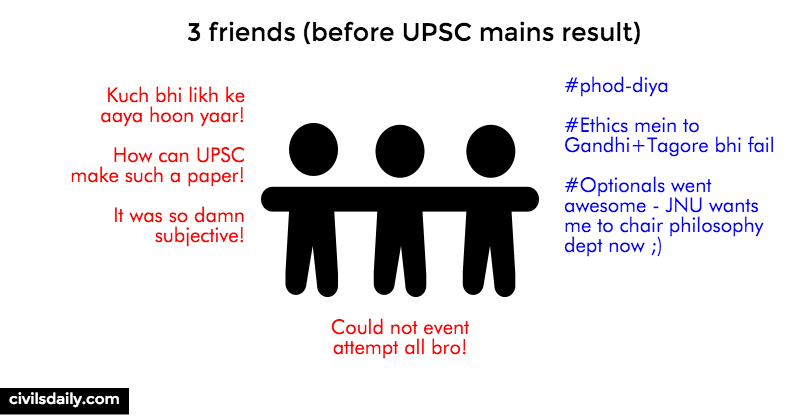
    If you have been sincere with your mains’ attempt, chances are that you would have directly or indirectly been a part of one such group.


    If you happen to identify with the guy on the middle or the left, there are high chances that you already know that you were not playing your “A game” at the mains this year. Your setback is understandable but you will soon be able to analyse your attempts and improve on your scores next year. Unless…. unless of course the scenario is this – 


    You are the guy on the right, who had done most of the things under his/ her control to optimise for high scores – demolished the GS papers comprehensively, quoted philosophers par excellence in the ethics paper and made sure that the optional papers rival the doctoral thesis of the examiner BUT STILL GOT DITCHED BY UPSC.

    And if this were not enough, your two buddies who up until now were not even sure of a respectable exit, qualify for the interview! That’s a classic case of what a famous american slang refers to as –

    SNAFU = Situation normal all fucked up


    If you are at this stage (or have been at it at some point or the other in life), you would agree that no amount of palliatives, niceties, wishes can really help you come out of the zone. You feel betrayed by some weird version of justice which you do not understand.

    You probably would have left a decent job and decided to pursue UPSC (among other choices of MBA, startups) OR made a promise to your parents and those around that you will sit out sincerely for an year for this prestigious exam OR other more equally compelling sacrifices and it’s understandable that you might feel angry for you did not sign up for this.

    Let yourself be. Release your emotions. Don’t put on an artificial smile (but be aware that it is a slippery slope and you need to pull yourself right back up).

    Try and be with people who can empathise with you and not sympathise.


    Preparing for UPSC is like running a marathon. And as with all good runners, with time and patience, you tend to understand yourself better. No other exam in the world expects you to open up your faculties to such gigantic amount of information and force you to process them at a speed which can put a reasonably outdated Intel processor to shame (that is still a lot to compare with you know!)

    By now, you would have developed a fair bit of liking to some subjects, appreciation for some finer aspects of life, possibly a bent of mind for public policy making, well nurtured interest in social sector landscape or a penchant for long distance hiking (or something equally exciting).

    Go to that island in your thoughts now. Remove yourself from the commotion. The shit has hit the fan here and you need to change a room till someone cleans it up!


    You are not alone in this dilemma


    This is the time that you need to be a master of your senses rather than a slave of emotional waves. Answer the big question for yourself. Keep mum but think hard.


    Civilsdaily is not an online coaching portal. We are sure that you are aware of that fact. We are dedicated to the cause of providing news with context and making content approachable to everyone BUT we do believe that many among you have the potential to dent the social fabric of our country in your own unique ways. Go ahead, identify the your angst and your driver and take the plunge.

    If you feel like talking to us, drop a mail at hello@civilsdaily.com

    If you think this long post was worth your time, do share it with your friends who may benefit reading from it.


    Want to read more?