When every economist worth his salt is getting pulled by print and digital media to share his/ her views on this topic, it calls for a deep introspection and a bout of Mussaddilal’s age old classic Office-Office to understand why things are not working for india on the Ease of doing business (World Bank Report).
If you want to follow the evolution of this news, follow this NewsTrail – Ease of Doing Business
If you want a quick infographic on the ranking methodology, we have an amazing infographic for you. Ignore the text in blue box at the end of the infographic but understand the static theory from this one.
Update: 11 parameters & 190 countries.
If you want to know more, read through what happened this year:
India remains one of the planet’s toughest places to do business, according to the World Bank.
In the development lender’s latest “Doing Business” report, which ranks 190 nations on how easy it is for private companies to follow regulations in 11 areas, India comes in 130th.
New Zealand tops this year’s ranking, dethroning Singapore. The World Bank highlighted Indonesia, Pakistan, Brunei and seven other economies for making the biggest improvements in their business environments in the past year.
The World Bank recognized some achievements by the Indian government this past year:
An electronic system for companies to pay employee insurance contributions,
Easier procedures for exporting and importing, and
New special mechanisms for resolving commercial disputes
What then is the reason for a relatively less improvement made by India at the world’s stage?
Due to even-larger improvements in other economies, India’s ranking in several areas fell this year.
On the ease of starting a business, it slipped to 155th from 151st.
On dealing with construction permits, it stumbled to 185th from 184th. On paying taxes, it held steady at 172nd.
Does this augur bad stuff for India? Are we not improving? Is the ranking an absolute measure to judge how we are doing?
NO. Far from it!
The World Bank report’s authors acknowledge that the ranking doesn’t reflect all the progress India has made recently in improving the business environment.
“Lawmakers have recommended the implementation of a large number of reforms across all states, going beyond the scope of Doing Business,” they write.
India of late has upgraded infrastructure,raised foreign-investment limits and digitized approvals and registrations. Groundwork was also laid this summer for a sales-tax revamp that hasn’t yet been implemented. (It might not even be implemented in time to affect next year’s Doing Business ranking, which will cover the business climate as of June 2017.)
So what went wrong?
First, some of the reforms undertaken missed this year’s bus—this report accounts for reforms which had been implemented by 1 June 2016. India also hopes that the insolvency and bankruptcy code will be implemented before the cut-off date for next year’s report
Second, the World Bank has included a new criterion “postfiling index” under the header “paying taxes”. Used in the report to measure the efficiency of “processes that occur after a firm complies with its regular tax obligations”, the post-filing index is a criterion in which India finds itself fourth from the bottom!
Third, there are other countries too trying their best to climb up the ease of doing business rankings.
Fourth, these rankings cover only the two cities of Delhi and Mumbai. A ranking of states last year showed the states of Gujarat, Andhra Pradesh, Jharkhand, Chhattisgarh and Madhya Pradesh leading the charts in implementing business reforms.
Therefore, India’s overall position may well be better than what this latest report shows!
TRIVIA:
Among the new features of this year’s Doing Business report is an attempt to gauge whether business rules apply differently to female and male entrepreneurs.
India should despatch a couple of envoys to Georgia and Kazakhstan each. In 2006, Georgia’s rank was 100; this year it ended up at No.16. Kazakhstan (now ranked 35) joined Georgia among the top improvers for the fourth time in the last 12 years.
In India, the bank found that despite yawning gender divides in many respects, the country makes doing business just as challenging for women as for men. It takes both male and female Mumbaikars 14 procedures and about a month, for instance, to start a new company. The irony of ironies!
If you want to take this time to revisit all the other important reports published by international organisations (for Prelims sake) – do visit this wholesome collection made by CD
#1. Consider following statements in regard with ‘Ease of Doing Business report’.
1.Ease of Doing Business report is published by World Bank.
2.India improved its position to 130 in the World Bank Ease of Doing Business 2017 report.
Which of the statements given above is/are correct?
a) 1 only
b) 2 only
c) Both 1 and 2
d) Neither 1 nor 2
#2. India’s ranking in the ‘Ease of Doing Business Index’ is sometimes seen in the news. Which of the following has declared that ranking?
a) Organization for Economic Cooperation and Development (OECD)
b) World Economic Forum
c) World Bank
d) World Trade Organization (WTO
Questions from Target Mains
#1. Ease of doing Business in India depends a lot on not just freedom to enter but also freedom to exit. In the light of the above statement critically discuss how the recently passed Bankruptcy Bill will improve the ease of doing business in India.
#2. According to a report, India is home to the third largest number of technology-driven start-ups in the world, with the US and the UK occupying the top two positions. Examine which factors have enabled India to achieve this feat.
#3. The marginal improvement by one rank i.e. from 131 to 130 in the Ease of Doing Business ranking is a reminder for several course corrections that are needed in the Indian politico-economic system. Comment.
UPDATE: Due to multiple requests from students to postpone the revision test (to give more time for revision and due to Diwali), we are postponing the revision test by 10 days. This means the revision test will be on 11th Nov and not 1st Nov. All subsequent tests will be postponed by 10 days to maintain the 10 day gap between them. The CA test is still going live on 28th October.
Flagship students,
Some very important takeaways from the basic tests
Hi guys, with TS6, the basic science test, all the basic tests have come to an end.
Aspirants of 2017 Prelims who want to leave no stone unturned in their preparation are advised to join our Flagship module. We are leaving nothing to luck as we ensure your basics are covered and neither should you.
Very soon the advanced level tests will start where our flagship students will compete with the senior players. But first we have an important revision test coming up on 1st of November.
Over time, we have seen students give tests and then forget about them. If they get a good score they are happy. If they get a bad score they get depressed or try to study harder for the next test.
But most students forget about the test they just gave. They forget that tests are for motivation AND for learning. Whether you get a good or bad score, always remember that you have to learn from that test. How do you learn?
First, you read all the answers given in the TS. Second, you find out all the questions you did wrong or were not able to attempt and pick up the book and start reading those entire chapters. Yes! The whole chapter, not just that one paragraph which contains the answer.
If you got a tributaries question wrong, don’t just see the answer for that tributary, but also see the whole river on the map, and also other rivers.
We have done an analysis of the 6 basic tests which just went by to find out what your weaknesses are. Do understand that the ideal score in each of the test should be 140+ Nothing less than that will give you the confidence of doing your NCERTs well.
Here are some of our observations regarding your attempts on Flagship Tests’ Basic module
1.Polity –
Some topics which everyone was weak in – history of constitution, executive (powers and roles of President, Vice-President, PM etc)
Strengths of students – basic understanding of concepts
Everyone is smart enough to understand the basic concepts, however details matter in polity. What is the term of the Vice-President? These are not just small details.
2.Economy –
Some weak spots include – history of economic reforms, details of government budget (details of revenue and capital expenditures etc), details of balance of payments.
3.History –
This is the subject you all could have done much better. Only one student got a 3 digit score!
Weak spots for students include – art and culture and medieval India. We understand that these sections are difficult to relate to or retain in long term memory but it has to be done.
Good News #1: The revision test on 1st Nov will have a lot of tough questions from history re-introduced
Good News #2: Civilsdaily is making rich, detailed course modules on art & culture basics for both Pre & Mains. Rich with detailed images and only the most relevant information – this module will serve as the one stop solution for all your art & culture basics
4.Geography –
Some weak spots here are map related questions (e.g. locations of hills, plateaus, rivers etc). Surprisingly climatology is a weak point.
As are questions on industries and resources. Students also tend to not pay attention to technical terms like diastrophism.
5.Science –
Weak spots here are in chemistry and physics. Reread basic NCERT’s.
Although you don’t need to memorise the chemical formulas, you should know what elements are contained in carbohydrates.
Overall we would like to point out that its not just concepts which are important, but details too. Reread your NCERT’s. Even more importantly, make notes from them.
To give you an opportunity to implement all this advice, we will be putting the tougher questions till now into our revision test.
Use the tests to learn, and not just as an item on your schedule or checklist.
Checking that your base is sound through these tests is very important. All Flagship students must give these tests. Reread you NCERT’s and aim to get 150 marks. Once you see these questions and they look like child’s play to you, the work will be done.
To all other IAS Prelims 2017 probables who are still deciding on which test series to join – Join any but stick to the philosophy of that test series. That’s the most important thing.
For students who joined our Flagship Course
We want to train you in the philosophy of covering your basics and advanced course along with the art of smart hacks (tikdams). Very sincere efforts are put into making the explanations richer and more meaningful for you so that you get to revisit the basics.
Make the most out of your efforts. After your revision test – we will give each of you a chance to talk to the mentors @CD so that you know how to make the most out of your advanced modules.
Anyone here with management optional? Unlike other optionals we don’t get much traction in terms of questionnaire, peer group, feedback etc. We can form a group if we find enough interest.
Although India is a secular country, religion has a significant role in politics. Do you agree? How does religion affect politics and peoples attitudes in matters of politics?
Ease of doing Business in India depends a lot on not just freedom to enter but also freedom to exit. In the light of the above statement critically discuss how the recently passed Bankruptcy Bill will improve the ease of doing business in India.
When you submit your answer, if possible, give some reasoning & more info. along with the ABACAA format. Elaborate on what you know. This helps the whole community to know more and learn more!
Q.1) Consider following statements about ‘National Institute of High Security Animal Diseases (NIHSAD).
1.NIHSAD is an independent institute established under Indian Council of Veterinary Research (ICVR).
2.It aims at research on exotic and emerging pathogens of animals.
Which of the statements given above is/are correct?
a) 1 only
b) 2 only
c) Both 1 and 2
d) Neither 1 nor 2
Q.2) Consider following statements in regard with ‘Ease of Doing Business report’.
1.Ease of Doing Business report is published by World Bank.
2.India improved its position to 130 in the World Bank Ease of Doing Business 2017 report.
Which of the statements given above is/are correct?
a) 1 only
b) 2 only
c) Both 1 and 2
d) Neither 1 nor 2
Q.3) Consider following statements about ‘Central Advisory Board of Education (CABE)’.
1.The Central Advisory Board of Education, the oldest and advisory body was first established in 1920.
2.The 64th Meeting of the Central Advisory Board of Education was held under the Chairmanship of Prime Minister at New Delhi.
Which of the statements given above is/are correct?
a) 1 only
b) 2 only
c) Both 1 and 2
d) Neither 1 nor 2
Q.4) ‘Hanuman Tok’ temple is maintained by the Indian Army, located in which of the following state?
a) Sikkim
b) Mizoram
c) Bihar
d) Assam
Q.5) Recently, The one-man judicial committee on One Rank One Pension (OROP) submitted its report to the Defence Ministry. Which of the following committee was appointed on OROP.
a) Lt. General DB Shekatkar Committee
b) Justice Reddy Committee
c) Dharmendra Pradhan Committee
d) Justice Lodha Committee
IMPORTANT STUFF:
1. These questions are mostly derived from our daily newscards. Reading daily news from Civilsdaily’s App (click here) or website + solving these questions will help you reinforce the basics.
2. For a comprehensive preparation of IAS Prelims 2017 – consider joining one of the three Prelims Modules by CD – prelims.civilsdaily.com
The 2015 south-west monsoon, which irrigates over half of India’s crop area, recorded a 14% deficit, while the previous year saw a 12% deficit.
In the month of May, 2016 – Supreme Court made some very hard hitting comments on the state of drought management in India and minced no words while doing so.
The apex court rapped state governments for showing an “ostrich-like attitude” and denying reality. Not just the state, it rapped in the Union Govt. with a follow up – “Surely, if a state government maintains an ostrich-like attitude, a disaster requires a far more proactive and nuanced response form the Union of India. Therefore, in such a state of affairs… Where does the buck stop?”
Drought management, as you can see has assumed a very important space in our national discourse. It spans disaster management, agriculture economics, social welfare schemes and some important environmental aspects. A comprehensive understanding of drought will help you appreciate the huge machinery this bureaucracy is.
In this continuing series on Indian Agriculture, we will take help of the recent directions given by SC to understand the core themes & build a comprehensive narrative around draught.
6 Supreme Court notes that speak about all that’s wrong with drought management in India
Since these are SC notes (and not random opinions), you can use them to enrich your answers for IAS Mains.
#1. The govt. has been asked to abandon the existing system and evolve a transparent, rules-based framework. There is no need to continue with colonial methods and manuals that follow a colonial legacy.
What are the lacunae of current system? What are the hangovers of the colonial legacy that need to be undone
#2. SC asked the centre to use modern technology for early determination of drought and take into account humanitarian factors such as migration, suicides and the plight of women and children while formulating policies.
Begs the question – what are the far reaching – immediate and long term effects of drought?
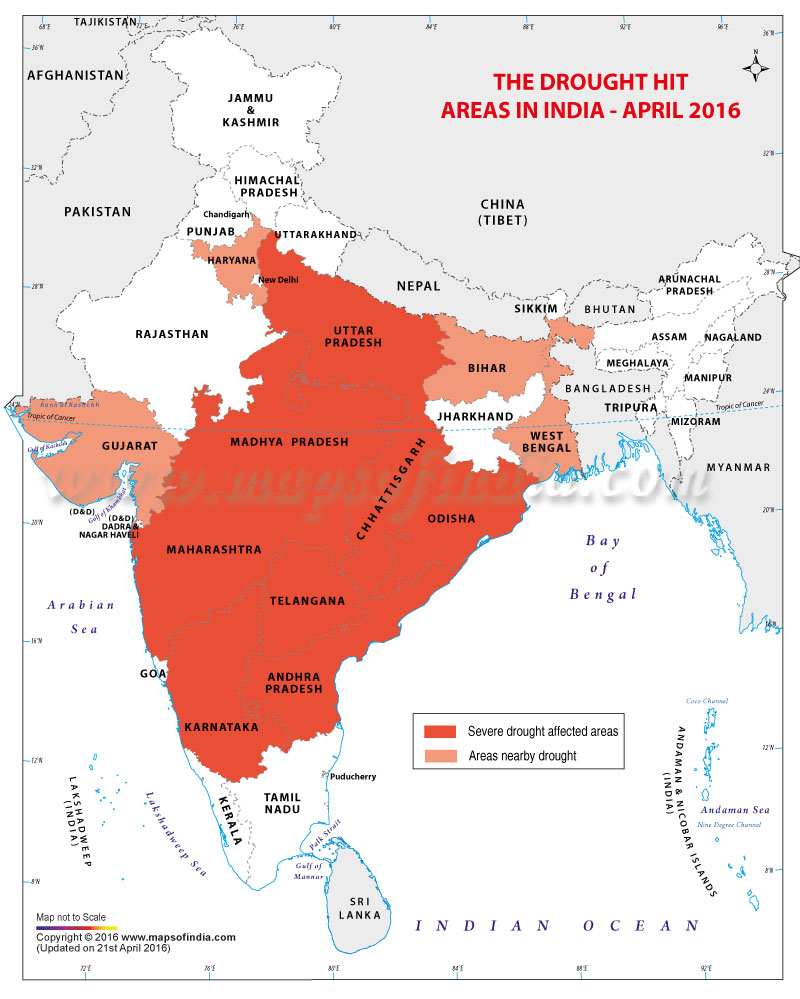
#3. States should be proactive in declaring drought. The judges criticized Bihar, Gujarat and Haryana for their hesitancy in acknowledging drought and failure to disclose the reality on the ground.
Why do state show hesitancy in declaring drought? It looks counterintuitive that a state should willfully let its farmers suffer in silence. What’s the missing picture here?
#4. The court also directed the centre to be proactive rather than introducing “the concept of federalism” to delegate responsibility and saying its only role is to provide financial assistance to states.
#5. A national plan had not been formulated even after 10 years of the Act coming into force and the centre must act immediately
#6. The court also ordered that the existing drought management manual of 2009 be revised by the end of the year (2016).
Drought is usually studied under 5 heads:
Understanding Drought
Monitoring Drought
Declaring Drought – We won’t go into much details here and will answer the question on colonial legacy of declaring droughts vs. the changes SC prescribed
Providing Relief – Not useful for UPSC prep. This includes steps to be taken by various agencies under centre and state. We will skip this as well
Mitigating Drought
#1. Understanding Drought
What is Drought?
There is no universally accepted definition of drought
Drought occurs in all climatic regimes and is usually characterised in terms of its spatial extension, intensity and duration
It is a temporary aberration (don’t confuse it with aridity, which is permanent)
Being of slow-onset it is difficult to determine the beginning and end of the drought
Duration may range from months to years and the core area or epicentre changes over time! Hence there is a need for close monitoring of drought indicators
No single indicator or index can identify precisely the onset and severity of the event and its potential impacts; multiple indicators are more effective
Impacts are generally non-structural and difficult to quantify
Impacts of Drought – Direct & Indirect
Impacts are complex to quantify. Why? Because water is integral to our ability to produce goods and provide services.
Direct impacts: Usually physical / material and include reduced agricultural production. But drought is not just an agrarian crisis. When these direct impacts have multiplier effects through the economy and society, they are referred to as indirect impacts.
Indirect impacts: A reduction in agricultural production that may result in reduced income for farmers and agribusiness, increased prices for food and timber, unemployment, reduced purchasing capacity and demand for consumption, default on agricultural loans, rural unrest, and reduction in agricultural employment leading to migration and drought relief programmes
These direct and indirect impacts can be categorised into Economic, Environmental and Social Impacts.
Classification of Drought
Meteorological drought is defined as the deficiency of precipitation from expected or normal levels over an extended period of time
Hydrological drought is defined as deficiencies in surface and subsurface water supplies leading to a lack of water for normal and specific needs
Agricultural drought, usually triggered by meteorological and hydrological droughts, occurs when soil moisture and rainfall are inadequate during the crop growing season causing extreme crop stress and wilting
But classification of drought is not this simple, either. Agricultural drought occurs after meteorological and hydrological droughts but it has further nuances to it. Think about it – different cropping patterns, water needs, and stage of crop growth will also play a big part in defining an agricultural drought, right?
The classification of drought is difficult, so what does our Met dept. do? In 2016, the IMD (India Meteorological Department) declared an end to droughts in India!
Since it can’t control the weather but can control language, the state forecaster India Meteorological Department (IMD) has decided to simply replace the word “drought” to describe poor rainfall with “deficient year” and “large deficient year”.
This is not just an exercise in euphemism. There was a practical problem at hand which is being solved here. There is a lot of politics involved in declaring droughts.
IMD can only define a meteorological drought, but agricultural and hydrological droughts are different – hence, the states are best equipped to decide whether they were experiencing a drought or not. This is why the SC pulled up the states for displaying an ostrich like behavior and letting their farmers suffer.
The conditions for onset of drought in India vary across agro-climatic zones.
In the semi-arid regions, even a 400 mm rainfall would be adequate for the growth of crops, while in high rainfall regions of Assam, even an annual rainfall of 1,000 mm would create conditions for drought.
Drought is a recurrent climatic phenomenon because:
About 73% of the total annual rainfall is received in less than 100 days during the south-west monsoon and the geographic spread is uneven
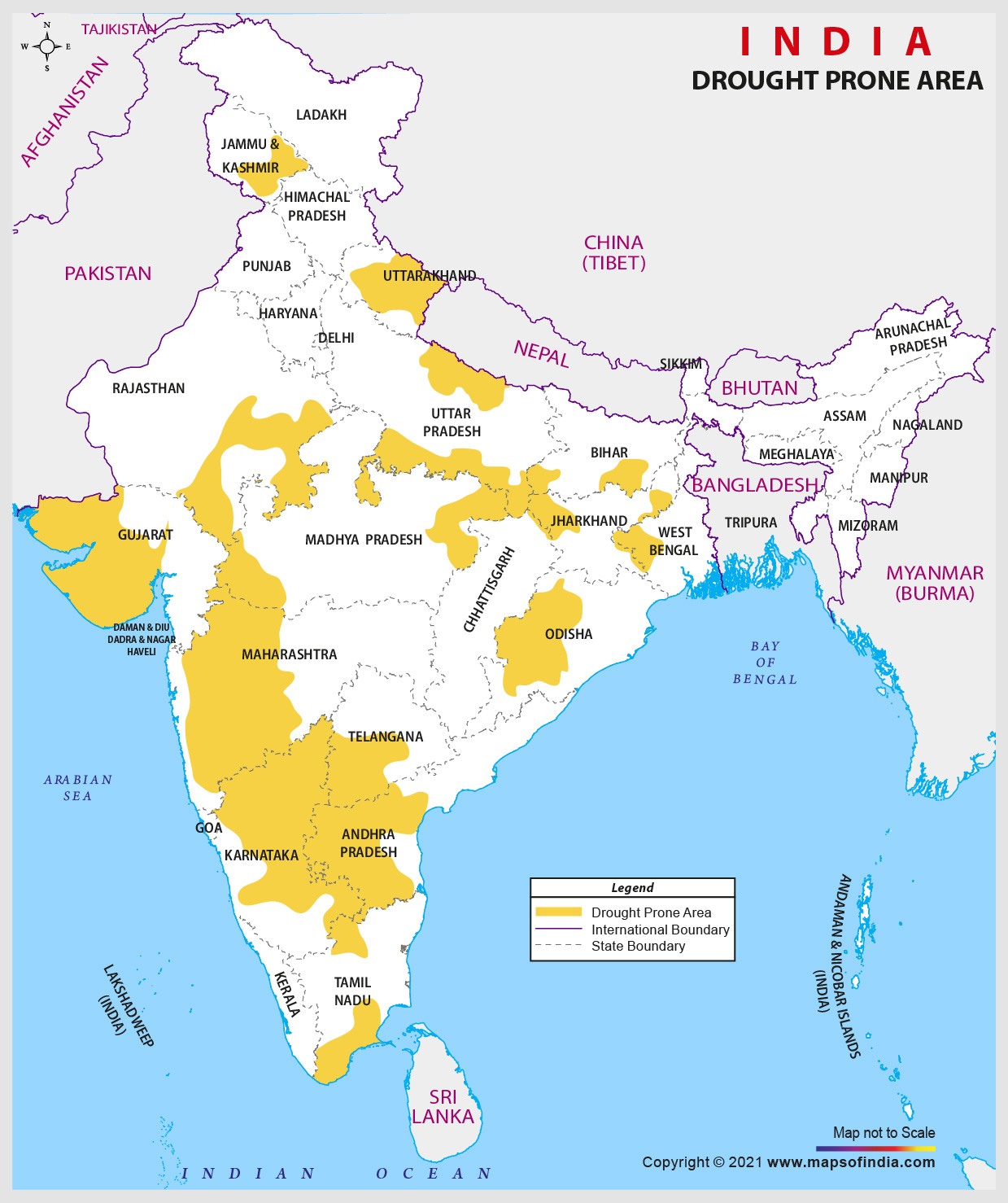
Around 33% of the cropped area in the country receives less than 750 mm rain annually making such areas hotspots of drought
Irrigation, using groundwater aggravates the situation in the long term as groundwater withdrawal exceeds replenishment
Per capita water availability in the country is steadily declining. Traditional water harvesting systems have been largely abandoned.
At this point, let’s take a direct comment from Sunita Narain (CSE fame) on 3 things India should do:
First, do everything we can to augment water resources – catch every drop of water; store it; recharge groundwater. To do this we need to build millions more structures, but this time based on planning for water and not just employment
Second, revise and update the drought code. It is not as if the richer parts of the world do not have droughts but their governments respond by shutting off all non-essential water use.
Third, obsessively work to secure water in all times. This means insisting on water codes for everyday India. We need to reduce water usage in all sectors – from agriculture, urban to industry
#2. Monitoring Drought
Monitoring and Early Warning Systems
As drought is a slow-onset disaster, its monitoring and early warning systems are central to drought management.
The early warning system should function at 3 levels:
Receiving forecasts, early warning, and advisories from scientific institutions;
Monitoring key drought indices at the National and State levels; and
Developing composite index of various drought indicators
Key Drought Indicators
Old vs. New System for Drought Management
Gaps in the colonial system of drought management:
It emphasizes a relief-based approach and provides certain other small concessions, which do little to alleviate the distress caused by widespread crop failure
It functions on the basis of a conclusive evidence of drought as derived from the crop production in a particular year, which takes a lot of time as well as prevents early and timely help to farmers
It did not integrate new technologies for early warning, nor did it emphasize mitigation as an essential element of drought management
A new approach to drought management focusses on:
State management of drought operations can make a radical difference to the impact of drought.
Focus on mitigation measures – An emphasis on mitigation measures would reduce the incidence and severity of drought, improve crop production and save resources spent recurrently on relief
Adopt newer technologies – Due to spectacular advances in climate forecast technologies, State Governments are in a position to outsource the forecast from many agencies other than the India Meteorological Department (IMD)
Adapt to the new legal framework – The local self-governments have become more important in terms of sharing authority and responsibility (due to 73rd and 74th Constitutional amendments), and it is necessary to assign meaningful roles in drought management to this level
Include employment and area development programmes in drought mitigation
#5. Implementing Drought Mitigation Measures
Artificial Recharge of Ground Water
A typical watershed development programme has several components, depending on the topography. These include – Contour Bunding, Contour Trenching, Contour Cultivation, Farm Ponds, Percolation Tanks (PT) / Spreading Basin etc.
One of the effective measures by which groundwater recharge can be achieved, is by the construction and use of percolation tanks. The efficacy and feasibility of percolation tanks is better established in hard rock formation where the rocks are highly fractured and weathered.
Long-term Irrigation Management
Integrated Basin Planning: This concept is aimed at coordinating water resources plans throughout a river basin, the most important example of which is the Tennessee Valley Authority in the USA. In India, the Damodar Valley Corporation covering the river Damodar and its tributaries in Bihar and West Bengal was modeled on the lines of the Tennessee Valley Authority.
Inter-basin Transfer of Water: The permanent long-term solution to the drought problem may be found in the basic principles of transfer of power from surplus river basins to the areas of deficit.
There are some success stories at regional basis under which water is transferred from one basin to another. For eg. –
Indira Gandhi canal – Transfer of water from Indus basin to deserts of Rajasthan
Periyar project – Transfer of water from Periyar basin to Vaigai basin
Kurnool Cudappah Canal – Transfer of water from Krishna basin to Pennar basin
Let us know if this article helped you understand the issue better. Your comments and appreciation is the only way we can gauge the relevance of our efforts put in researching these articles.
This year has been a hotbed of activities and high level meetings around this core topic. Now that you have understood this in good detail – answer this question.
“Drought is not a disaster, but a management issue”. Justify this statement.
References: Apart from extensive research around news articles, the mainstay of this series is the annual report of the Ministry of Agriculture to the GOI –Click to download a copy
** Don’t top post (start a new message ) unless it is a new topic. For the same topic : hit REPLY on the message you wish to respond to. This will increase readability.
** We will post the questions alternatively until someone else joins. Also post and review the answers.