Why in the news?
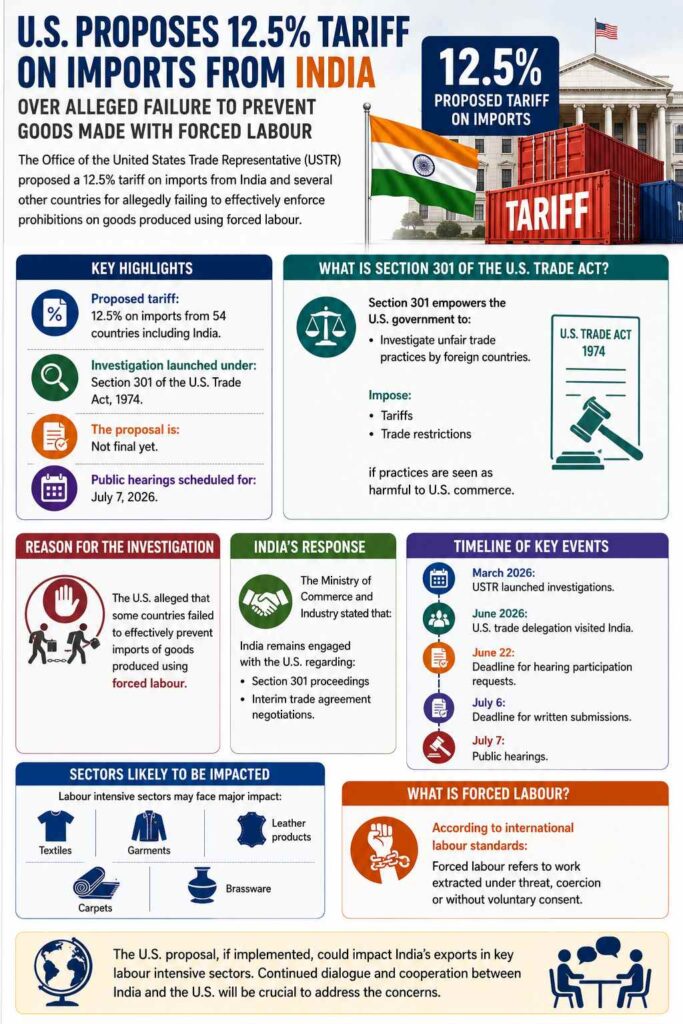
The Office of the United States Trade Representative proposed a 12.5% tariff on imports from India and several other countries for allegedly failing to effectively enforce prohibitions on goods produced using forced labour.
Key Highlights
- Proposed tariff: 12.5% on imports from 54 countries including India.
- Investigation launched under: Section 301 of the U.S. Trade Act, 1974.
- The proposal is: Not final yet.
- Public hearings scheduled for: July 7, 2026.
What is Section 301 of the U.S. Trade Act?
Section 301 empowers the U.S. government to:
- Investigate unfair trade practices by foreign countries.
- Impose:
- Tariffs
- Trade restrictions
if practices are seen as harmful to U.S. commerce.
Reason for the Investigation
The U.S. alleged that some countries:
- Failed to effectively prevent imports of goods produced using: Forced labour.
India’s Response
The Ministry of Commerce and Industry stated that:
- India remains engaged with the U.S. regarding:
- Section 301 proceedings
- Interim trade agreement negotiations.
Timeline of Key Events
- March 2026: USTR launched investigations.
- June 2026: U.S. trade delegation visited India.
- June 22: Deadline for hearing participation requests.
- July 6: Deadline for written submissions.
- July 7: Public hearings.
Sectors Likely to be Impacted
Labour intensive sectors may face major impact:
- Textiles
- Garments
- Leather products
- Carpets
- Brassware
What is Forced Labour?
According to international labour standards:
- Forced labour refers to work extracted under threat, coercion or without voluntary consent.
[2018] International Labour Organization’s Conventions 138 and 182 are related to –
A Child labour
B Adaptation of agricultural practices to global climate change
C Regulation of food prices and food security
D Gender parity at the workplace