Why in News?
The Government of India highlighted recent achievements and policy measures related to biodiversity conservation, governance, and sustainable use under the Convention on Biological Diversity (CBD).
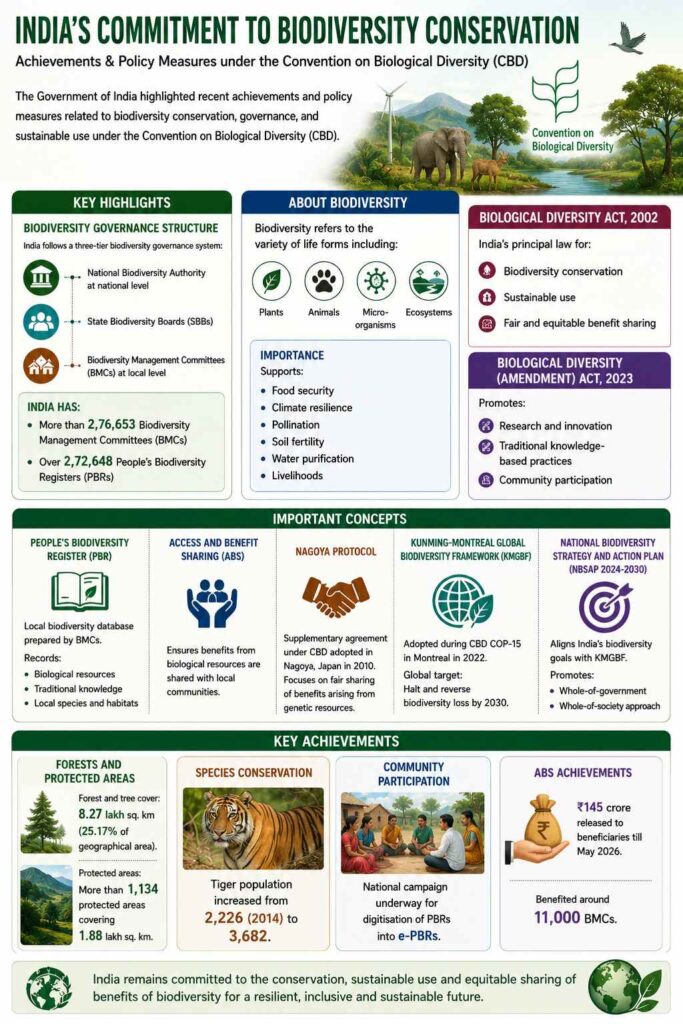
Biodiversity Governance Structure
- India follows a three-tier biodiversity governance system:
- National Biodiversity Authority at national level
- State Biodiversity Boards (SBBs)
- Biodiversity Management Committees (BMCs) at local level.
- India has:
- More than 2,76,653 Biodiversity Management Committees (BMCs)
- Over 2,72,648 People’s Biodiversity Registers (PBRs).
Note: Biodiversity Management Committees (BMCs) are local-level statutory bodies in India, mandated by the Biological Diversity Act of 2002.
About Biodiversity
- Biodiversity refers to the variety of life forms including:
- Plants
- Animals
- Microorganisms
- Ecosystems.
Biological Diversity Act, 2002
- India’s principal law for:
- Biodiversity conservation
- Sustainable use
- Fair and equitable benefit sharing.
Biological Diversity (Amendment) Act, 2023
- Promotes:
- Research and innovation
- Traditional knowledge-based practices
- Community participation.
Important Concepts
People’s Biodiversity Register (PBR)
- Local biodiversity database prepared by BMCs.
- Records:
- Biological resources
- Traditional knowledge
- Local species and habitats.
Access and Benefit Sharing (ABS)
- Ensures benefits from biological resources are shared with local communities.
Nagoya Protocol
- Supplementary agreement under CBD adopted in Nagoya, Japan in 2010.
- Focuses on fair sharing of benefits arising from genetic resources.
Kunming-Montreal Global Biodiversity Framework (KMGBF)
- Adopted during CBD COP-15 in Montreal in 2022.
- Global target:
- Halt and reverse biodiversity loss by 2030.
National Biodiversity Strategy and Action Plan (NBSAP 2024-2030)
- Aligns India’s biodiversity goals with KMGBF.
- Promotes:
- Whole-of-government
- Whole-of-society approach.
Key Achievements
Forests and Protected Areas
- Forest and tree cover: 8.27 lakh sq. km (25.17% of geographical area).
- Protected areas: More than 1,134 protected areas covering 1.88 lakh sq. km.
Species Conservation
- Tiger population increased from: 2,226 (2014) to 3,682.
Community Participation
- National campaign underway for digitisation of PBRs into e-PBRs.
ABS Achievements
- ₹145 crore released to beneficiaries till May 2026.
- Benefited around 11,000 BMCs (Biodiversity Management Committees).
[2023] Consider the following statements:
1. In Biodiversity the India, Management Committees are key to the realization of the objectives of the Nagoya Protocol.
2. The Biodiversity Management Committees have important functions in determining access and benefit sharing, including the power to levy collection fees on the access of biological resources within its jurisdiction.
Which of the statements given above is/are correct?
[A] 1 only
[B] 2 only
[C] Both 1 and 2
[D] Neither 1 nor 2
