Why in the news?
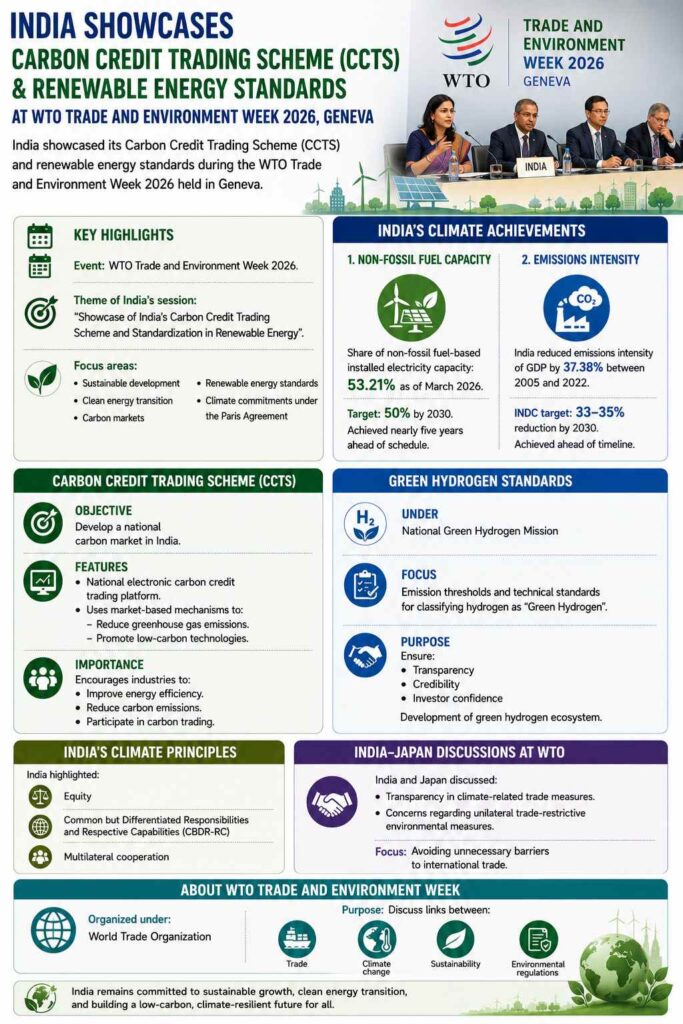
India showcased its Carbon Credit Trading Scheme (CCTS) and renewable energy standards during the WTO Trade and Environment Week 2026 held in Geneva.
Key Highlights
- Event: WTO Trade and Environment Week 2026.
- Theme of India’s session:
- “Showcase of India’s Carbon Credit Trading Scheme and Standardization in Renewable Energy”.
- Focus areas:
- Sustainable development
- Clean energy transition
- Carbon markets
- Renewable energy standards
- Climate commitments under the Paris Agreement.
India’s Climate Achievements
Non-Fossil Fuel Capacity
- Share of non-fossil fuel-based installed electricity capacity: 53.21% as of March 2026.
- Target: 50% by 2030.
- Achieved nearly five years ahead of schedule.
Emissions Intensity
- India reduced emissions intensity of GDP by: 37.38% between 2005 and 2022.
- NDC target: 33–35% reduction by 2030.
- Achieved ahead of timeline.
Carbon Credit Trading Scheme (CCTS)
- Objective: Develop a national carbon market in India.
Features
- National electronic carbon credit trading platform.
- Uses market-based mechanisms to Reduce greenhouse gas emissions. Promote low-carbon technologies.
Importance
- Encourages industries to:
- Improve energy efficiency.
- Reduce carbon emissions.
- Participate in carbon trading.
Green Hydrogen Standards
- Under National Green Hydrogen Mission
- Focus: Emission thresholds and technical standards for classifying hydrogen as “Green Hydrogen”.
- Purpose: Ensure Transparency, Credibility, Investor confidence, Development of green hydrogen ecosystem.
India’s Climate Principles
India highlighted: Equity, Common but Differentiated Responsibilities and Respective Capabilities (CBDR-RC), Multilateral cooperation.
India-Japan Discussions at WTO
- India and Japan discussed:
- Transparency in climate-related trade measures.
- Concerns regarding unilateral trade-restrictive environmental measures.
- Focus: Avoiding unnecessary barriers to international trade.
About WTO Trade and Environment Week
- Organized under: World Trade Organization
- Purpose: Discuss links between Trade, Climate change, Sustainability, and Environmental regulations.
[2025] Consider the following statements:
Statement I: Article 6 of the Paris Agreement on climate change is frequently discussed in global discussions on sustainable development and climate change.
Statement II: Article 6 of the Paris Agreement on climate change sets out the principles of carbon markets.
Statement III: Article 6 of the Paris Agreement on climate change intends to promote inter-country non-market strategies to reach their climate targets.
Which one of the following is correct in respect of the above statements?
[A] Both Statement II and Statement III are correct and both of them explain Statement I
[B] Both Statement II and Statement III are correct but only one of them explains Statement I
[C] Only one of the Statements II and III is correct and that explains Statement I
[D] Neither Statement II nor Statement III is correct
