Why in News?
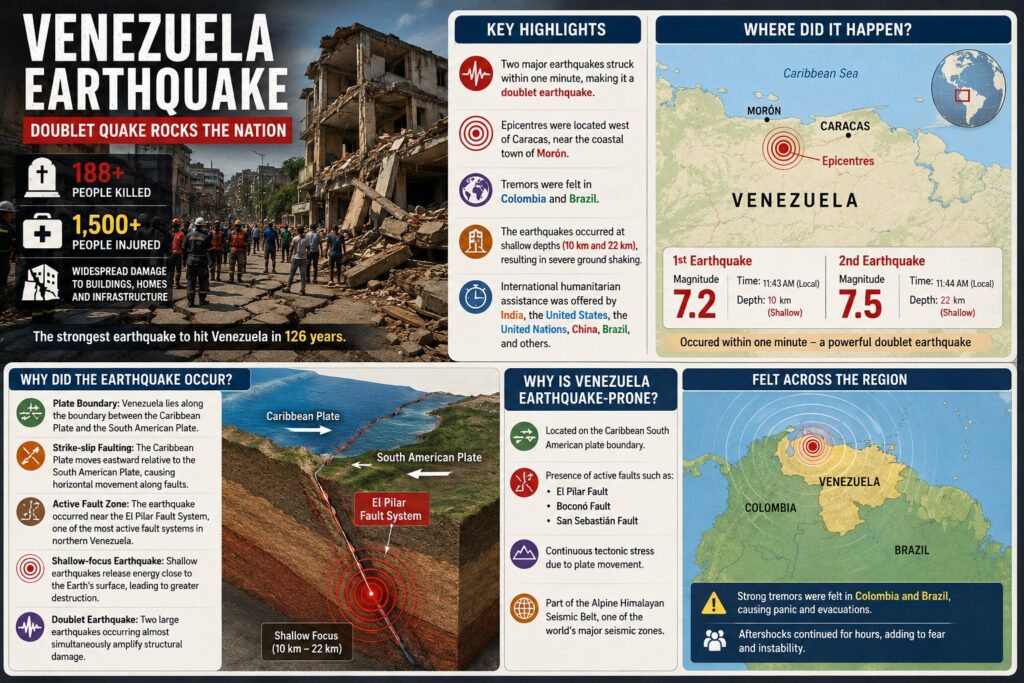
A powerful doublet earthquake (Magnitude 7.2 followed by 7.5) struck Venezuela, killing over 188 people and injuring more than 1,500. It is the strongest earthquake to hit Venezuela in 126 years.
Key Highlights
- Two major earthquakes struck within one minute, making it a doublet earthquake.
- Epicentres were located west of Caracas, near the coastal town of Morón.
- Tremors were felt in Colombia and Brazil.
- The earthquakes occurred at shallow depths (10 km and 22 km), resulting in severe ground shaking.
- International humanitarian assistance was offered by India, the United States, the United Nations, China, Brazil, and others.
Why Did the Earthquake Occur?
- Plate Boundary: Venezuela lies along the boundary between the Caribbean Plate and the South American Plate.
- Strike-slip Faulting: The Caribbean Plate moves eastward relative to the South American Plate, causing horizontal movement along faults.
- Active Fault Zone: The earthquake occurred near the El Pilar Fault System, one of the most active fault systems in northern Venezuela.
- Shallow-focus Earthquake: Shallow earthquakes release energy close to the Earth’s surface, leading to greater destruction.
- Doublet Earthquake: Two large earthquakes occurring almost simultaneously amplify structural damage.
Prelims Pointers
- Earthquake: Sudden release of energy in the Earth’s crust due to movement along faults.
- Focus (Hypocentre): Point inside the Earth where an earthquake originates.
- Epicentre: Point on the Earth’s surface directly above the focus.
- Shallow-focus earthquakes: Depth less than 70 km; generally cause maximum damage.
- Strike-slip fault: Fault where two blocks move horizontally past each other.
- Doublet earthquake: Two major earthquakes of similar magnitude occurring close together in time and location.
[2023] Consider the following statements :
1. In a seismograph, P waves are recorded earlier than S waves.
2. In P waves, the individual particles vibrate to and fro in the direction of wave propagation whereas in S waves, the particles vibrate up and down at right angles to the direction of wave propagation.
Which of the statements given above is/are correct?
[A] 1 only
[B] 2 only
[C] Both 1 and 2
[D] Neither 1 nor 2
