Why in News?
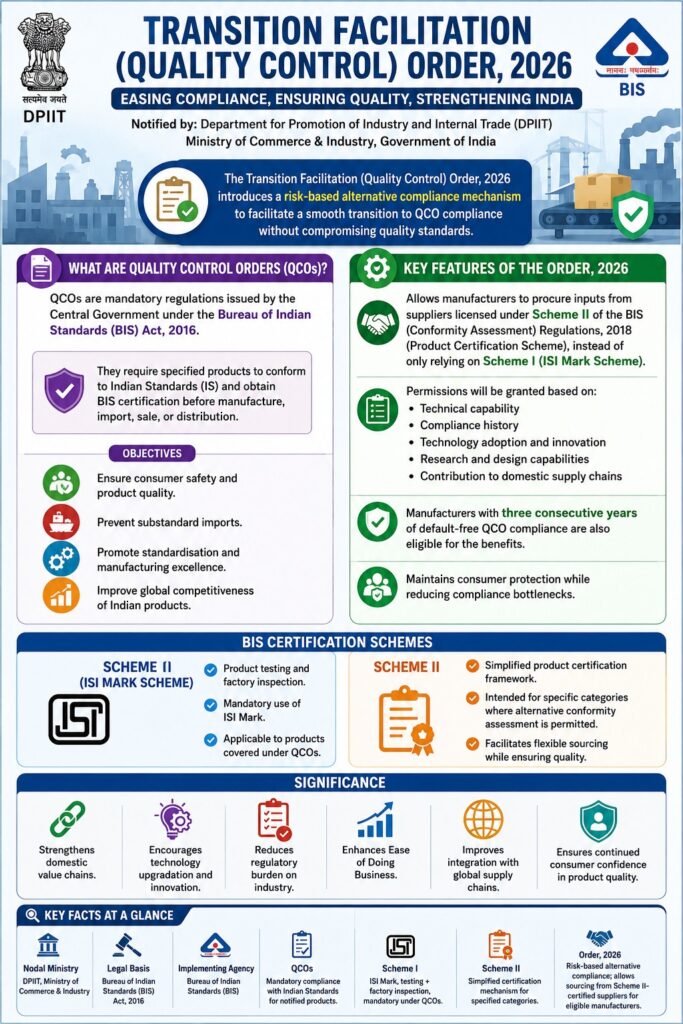
The Department for Promotion of Industry and Internal Trade (DPIIT) has notified the Transition Facilitation (Quality Control) Order, 2026 to ease industry compliance while maintaining product quality and strengthening domestic supply chains.
What are Quality Control Orders (QCOs)?
- Quality Control Orders (QCOs) are mandatory regulations issued by the Central Government under the Bureau of Indian Standards (BIS) Act, 2016.
- They require specified products to conform to Indian Standards (IS) and obtain BIS certification before manufacture, import, sale, or distribution.
- Objectives:
- Ensure consumer safety and product quality.
- Prevent substandard imports.
- Promote standardisation and manufacturing excellence.
- Improve global competitiveness of Indian products.
What is the Transition Facilitation (Quality Control) Order, 2026?
The Order introduces a risk-based alternative compliance mechanism to facilitate a smooth transition to QCO compliance without compromising quality standards.
Key Features
- Allows manufacturers to procure inputs from suppliers licensed under:
- Scheme II of the BIS (Conformity Assessment) Regulations, 2018 (Product Certification Scheme),
- instead of only relying on Scheme I (ISI Mark Scheme).
- Permissions will be granted based on:
- Technical capability.
- Compliance history.
- Technology adoption and innovation.
- Research and design capabilities.
- Contribution to domestic supply chains.
- Manufacturers with three consecutive years of default-free QCO compliance are also eligible for the benefits.
- Maintains consumer protection while reducing compliance bottlenecks.
BIS Certification Schemes
- Scheme I (ISI Mark Scheme): Product testing and factory inspection. Mandatory use of the ISI Mark. Applicable to products covered under QCOs.
- Scheme II: Simplified product certification framework. Intended for specific categories where alternative conformity assessment is permitted. Facilitates flexible sourcing while ensuring quality.
Significance
- Strengthens domestic value chains.
- Encourages technology upgradation and innovation.
- Reduces regulatory burden on industry.
- Enhances Ease of Doing Business.
- Improves integration with global supply chains.
- Ensures continued consumer confidence in product quality.
Prelims Pointers
- DPIIT: Department under the Ministry of Commerce and Industry responsible for industrial policy, startup promotion, and quality ecosystem.
- Bureau of Indian Standards (BIS):
- National Standards Body of India.
- Established under the BIS Act, 2016.
- Functions under the Ministry of Consumer Affairs, Food and Public Distribution.
- Formulates Indian Standards and operates certification schemes, including the ISI Mark.
