Why in the News?
Union Minister of Commerce, at a London business conference, accused global sovereign credit rating agencies of being “unfair to India” while praising India-headquartered CareEdge Ratings as “objective.” The remark reopens a standing government charge that international agencies keep India’s rating just above junk grade by over-weighting subjective, opinion-based judgments of “willingness to repay” over India’s stronger, verifiable “ability to repay” data.
What are sovereign credit ratings?
- A sovereign credit rating is an independent evaluation of a country’s creditworthiness.
- It measures a government’s ability and willingness to repay its debt obligations, helping global investors assess the risk of investing in that nation’s bonds or lending it money.
- Working: Ratings are assigned by independent credit rating agencies, most notably Standard & Poor’s (S&P), Moody’s, and Fitch Ratings.
- High Ratings (e.g., AAA, Aaa): Signal strong economic stability, low risk of default, and allow the government to borrow money at lower interest rates.
- Low Ratings (e.g., BB+, Ba1): Indicate higher credit risk and are typically labeled as “speculative” or “junk” grade, forcing the country to pay higher interest to compensate investors for the increased risk.
How do rating agencies define and measure sovereign creditworthiness?
- Rating universe: India is rated by seven international sovereign credit rating agencies, S&P, Moody’s, Morningstar DBRS, Fitch, Japanese Credit Rating Agency (JCRA), Rating and Investment Information (R&I), and CareEdge Ratings. The three most widely accepted globally are S&P, Fitch, and Moody’s.
- Rated entities: The same alphabet-scale logic applies not only to sovereigns but to companies, municipal corporations, and state governments.
- Scale mechanics: Fitch and S&P run from AAA downward through AA+, AA, AA-, A+, A, A- into the B-grade band, ending at D for default. Moody’s follows an identical structure using different letters, starting at Aaa.
- Price-of-risk function: The rating fixes the interest rate at which an entity can borrow. AAA signals zero default risk and the lowest borrowing cost; each downward notch raises the rate to compensate lenders for higher perceived risk.
- The dual metric: Ability to repay is quantitative, drawn from hard, verifiable macroeconomic data. Willingness to repay is qualitative, resting on an agency’s opinion of intent rather than capacity. This distinction structures India’s later grievance against the agencies.
What has India’s rating trajectory looked like?
- Persistent floor: Across most agencies, India has stayed at the lowest rung of investment grade, a grade or two above junk status, the threshold at which institutions stop lending for fear of default.
- Long stagnation: Until recently, this rating stayed unchanged for more than a decade, and in some cases for nearly two decades.
- S&P upgrade: S&P raised India’s long-term sovereign rating to BBB from BBB- in August 2025, its first upgrade of India in 18 years.
- Moody’s upgrade: Moody’s raised India to Baa2 (equivalent to BBB) from Baa3 in 2017, its first upgrade of India in 13 years.
- Other 2025 movements: R&I upgraded India to BBB+ from BBB in September 2025; Morningstar DBRS upgraded India to BBB in May 2025.
Why does the government call the ratings agencies’ methodology unfair to India?
- Persisting grievance despite upgrades: Even after the 2025 upgrades, India’s rating remains just above junk grade. India argues that agencies have not credited India’s growth story, its fundamentals, or its sovereign capabilities as a rating agency should.
- Official continuity: The Finance Minister of India has separately called for reform of the agencies’ methodologies, establishing this as a standing government position rather than a one-off remark.
- Economic Survey precedent: The 2020-21 Economic Survey devoted a full chapter to the issue. It noted this was the first time the world’s fifth-largest economy had been assigned such a low rating.
- Ability case made: The Survey argued India’s macroeconomic fundamentals were strong enough to demonstrate ability to repay debt.
- Willingness case made: It also argued India’s record of never defaulting on sovereign debt despite multiple crises should establish willingness to repay.
- Core allegation: The central charge is that agencies weigh the qualitative willingness metric (grounded in the opinions of a small group of experts and prone to subjectivity) more heavily than the quantitative ability metric, on which India performs comparatively well but which carries lower weightage.
Why is CareEdge Ratings being held up as the corrective model?
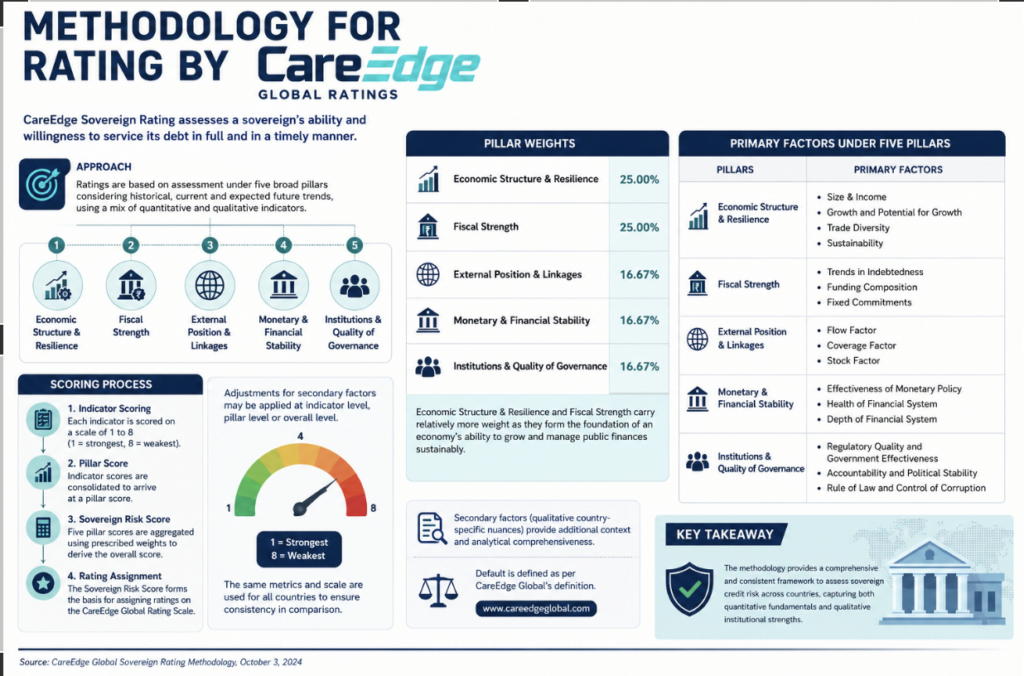
- Origin and perception: CareEdge is the first sovereign ratings agency headquartered in India, feeding the perception that it can better capture the ground realities of the Indian economy.
- Methodological difference: CareEdge’s own methodology note assigns primary importance to quantitative factors, directly inverting the qualitative-heavy approach India accuses the major agencies of using.
- Political endorsement: Goyal singling out CareEdge as “objective” aligns with the government’s broader argument that a quantitative-first method would rate India more favourably.
Conclusion
India’s persistently sub-BBB sovereign rating, despite improving fundamentals, stems from ratings agencies’ structural preference for qualitative, opinion-driven assessments of willingness to repay over quantitative measures of ability to repay. This is a metric on which India performs well. The government’s promotion of CareEdge Ratings, a domestic agency that weights quantitative factors more heavily, functions less as a technical fix than as an assertion that India deserves to be rated on its own terms. This does not resolve who sets the criteria for creditworthiness: India’s grievance can only be addressed if the major agencies alter their own weighting, a decision outside New Delhi’s control. Until then, India’s rating will likely continue to lag its economic weight.
PYQ Relevance
[UPSC 2017] Among several factors for India’s potential growth, the savings rate is the most effective one. Do you agree? What are the other factors available for growth potential?
Linkage: Sovereign credit ratings directly influence investment flows and borrowing costs, which affect capital formation and India’s long-term growth potential. The article argues that global rating agencies undervalue India’s macroeconomic strengths and growth prospects, thereby increasing borrowing costs despite strong economic fundamentals.
