Why in News?
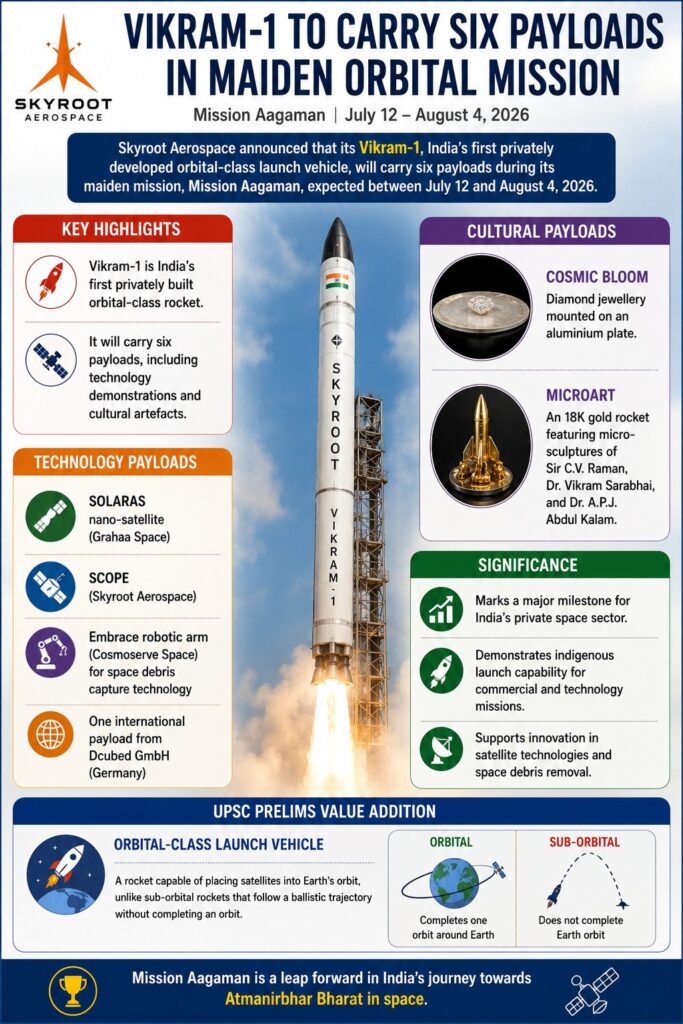
Skyroot Aerospace announced that its Vikram-1, India’s first privately developed orbital-class launch vehicle, will carry six payloads during its maiden mission, Mission Aagaman, expected between July 12 and August 4, 2026.
Key Highlights
- Vikram-1 is India’s first privately built orbital-class rocket.
- It will carry six payloads, including technology demonstrations and cultural artefacts.
- Technology payloads include:
- SOLARAS nano-satellite (Grahaa Space)
- SCOPE (Skyroot Aerospace)
- Embrace robotic arm (Cosmoserve Space) for space debris capture technology
- One international payload from Dcubed GmbH (Germany).
- Cultural payloads:
- Cosmic Bloom: Diamond jewellery mounted on an aluminium plate.
- Microart: An 18K gold rocket featuring micro-sculptures of Sir C.V. Raman, Dr. Vikram Sarabhai, and Dr. A.P.J. Abdul Kalam.
Significance
- Marks a major milestone for India’s private space sector.
- Demonstrates indigenous launch capability for commercial and technology missions.
- Supports innovation in satellite technologies and space debris removal.
Orbital-class Launch Vehicle
- A rocket capable of placing satellites into Earth’s orbit, unlike sub-orbital rockets that follow a ballistic trajectory without completing an orbit.
[2026] Consider the following statements with regard to involvement of private entities in India’s space programme :
1. The Indian National Space Promotion and Authorisation Centre (IN-SPACe) is an autonomous agency formed to facilitate participation of private entities.
2. Agnikul Cosmos launched the world’s first flight using 3D-printed rocket engine.
3. Skyroot Aerospace has developed liquid fuel for GSLV.
Which of the statements given above is/are correct?
[A] 1 only
[B] 2 and 3 only
[C] 1 and 2 only
[D] 1, 2 and 3