Why in the News?
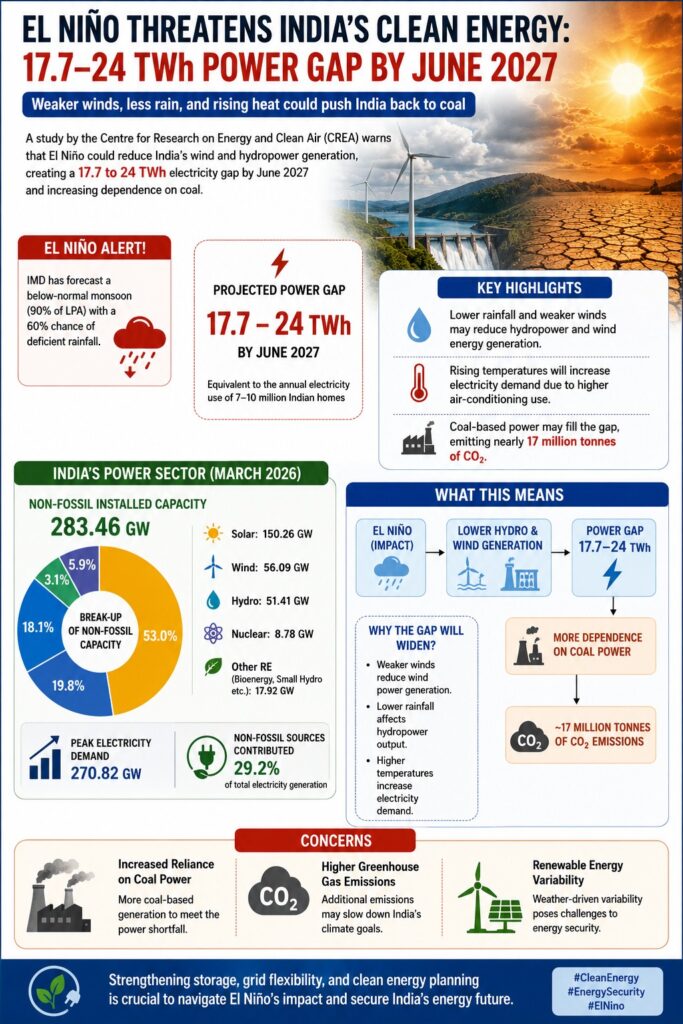
The Centre for Research on Energy and Clean Air (CREA) projects an 18 TWh clean-power shortfall for India by June 2027, driven by El Niño-linked weakness in wind and hydropower output and rising cooling demand. The finding exposes a gap between the record renewable capacity India has installed and the storage needed to actually deliver that capacity as power, forcing the shortfall to be filled by coal.
What has changed in India’s exposure to this El Niño cycle?
- Monsoon deficit: June rainfall closed with an all-India deficit of about 40%, the fifth-lowest June since 1901, with the cumulative shortfall at 20% below normal by July 6.
- IMD forecast: The India Meteorological Department has forecast below-normal southwest monsoon rainfall at 90% of the long-period average, with a 60% chance of a deficient season.
- Generation gap: CREA projects a median shortfall of 17.7 TWh and a severe-case shortfall of 24 TWh, against India’s total 2025-26 generation of about 1,846 billion units.
- Emissions cost: A coal-led response to the gap would release an estimated 17 million tonnes of additional carbon dioxide.
Is this a capacity shortfall or a utilisation shortfall?
- Record capacity base: Non-fossil installed capacity reached 283.46 GW by March 31, including 150.26 GW of solar and 56.09 GW of wind.
- Record additions: India added 44.6 GW of solar and 6 GW of wind capacity in 2025-26 alone.
- Curtailment: Grid operators curtailed about 2.1 TWh of solar and wind generation last year to keep coal plants running.
- Storage gap: CREA estimates roughly 10 GWh of battery storage could have averted this curtailment.
Why does the response default to coal rather than storage?
- Coal’s continuing weight: Coal remains about 42% of installed capacity even as coal generation fell 3.69% over the year.
- New coal pipeline: India is adding around 130 GW of new coal capacity to buffer peak demand, such as the 270.82 GW peak recorded on May 21.
- Policy diagnosis: CREA director Nandikesh Sivalingam states India must move faster on batteries and grid upgrades to meet future demand surges.
- Dispatch logic: Coal capacity can be dispatched on demand without storage investment, making it the default buffer despite its emissions cost.
Conclusion
India’s projected clean-power shortfall is a storage and grid-integration deficit, not a generation deficit. The 130 GW of new coal capacity being planned addresses the symptom of demand variability, not the missing battery and transmission investment needed to convert installed renewable capacity into reliable output. Without storage scaling alongside capacity addition, each future El Niño cycle will repeat the same coal fallback and its emissions cost.
