Why in News?
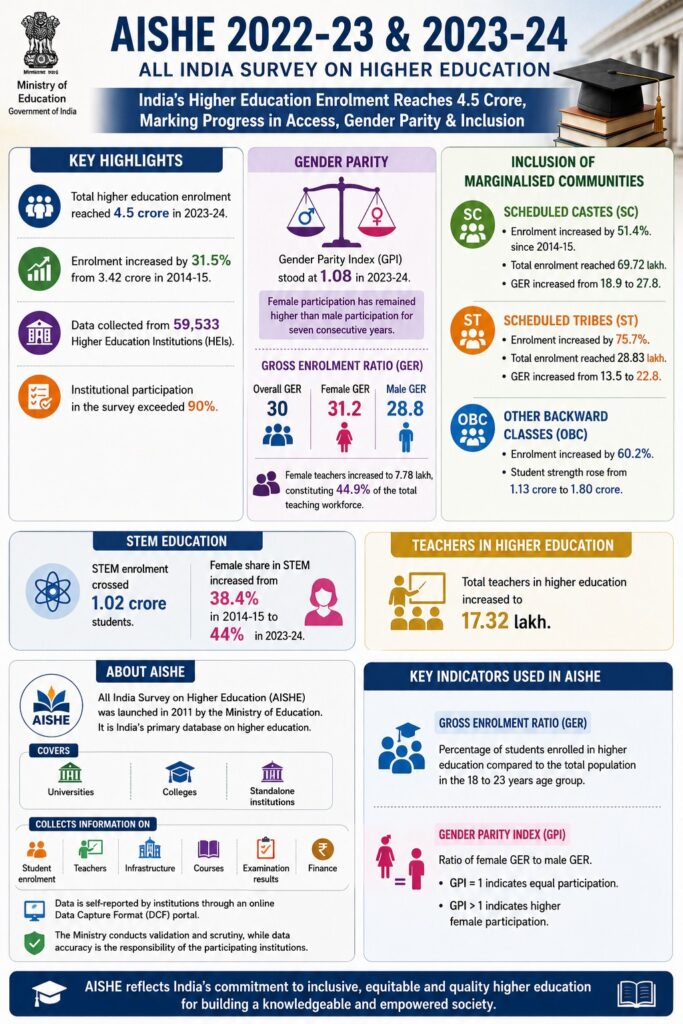
The Ministry of Education has released the All India Survey on Higher Education (AISHE) 2022-23 and 2023-24, showing that India’s higher education enrolment has reached 4.5 crore, reflecting significant improvements in access, gender parity, and participation of socially disadvantaged groups.
Key Highlights
- Total higher education enrolment reached 4.5 crore in 2023-24.
- Enrolment increased by 31.5% from 3.42 crore in 2014-15.
- Data was collected from 59,533 Higher Education Institutions (HEIs).
- Institutional participation in the survey exceeded 90%.
Gender Parity
- Gender Parity Index (GPI) stood at 1.08 in 2023-24.
- Female participation has remained higher than male participation for seven consecutive years.
- Gross Enrolment Ratio (GER): Overall GER: 30, and Female GER: 31.2
- Female teachers increased to 7.78 lakh, constituting 44.9% of the total teaching workforce.
Inclusion of Marginalised Communities
- Scheduled Castes (SC): Enrolment increased by 51.4% since 2014-15. Total enrolment reached 69.72 lakh. GER increased from 18.9 to 27.8.
- Scheduled Tribes (ST):Enrolment increased by 75.7%. Total enrolment reached 28.83 lakh. GER increased from 13.5 to 22.8.
- Other Backward Classes (OBC): Enrolment increased by 60.2%. Student strength rose from 1.13 crore to 1.80 crore.
STEM Education
- STEM enrolment crossed 1.02 crore students.
- Female share in STEM increased from 38.4% in 2014-15 to 44% in 2023-24.
- Total teachers in higher education increased to 17.32 lakh.
About AISHE
- All India Survey on Higher Education (AISHE) was launched in 2011 by the Ministry of Education.
- It is India’s primary database on higher education.
- Covers: Universities, Colleges, and Standalone institutions
- Collects information on: Student enrolment, Teachers, Infrastructure, Courses, Examination results, and Finance
- Data is self-reported by institutions through an online Data Capture Format (DCF) portal.
- The Ministry conducts validation and scrutiny, while data accuracy is the responsibility of the participating institutions.
Key Indicators Used in AISHE
- Gross Enrolment Ratio (GER): Percentage of students enrolled in higher education compared to the total population in the 18 to 23 years age group.
- Gender Parity Index (GPI): Ratio of female GER to male GER. GPI = 1 indicates equal participation. GPI > 1 indicates higher female participation.
[2017] What is the aim of the programme ‘Unnat Bharat Abhiyan’?
[a] Achieving 100% literacy by promoting collaboration between voluntary organizations and government’s education system and local communities.
[b] Connecting institutions of higher education with local communities to address development challenges through appropriate technologies.
[c] Strengthening India’s scientific research institutions in order to make India a scientific and technological power.
[d] Developing human capital by allocating special funds for health care and education of rural and urban poor, and organizing skill development programmes and vocational training for them.
