Why in News?
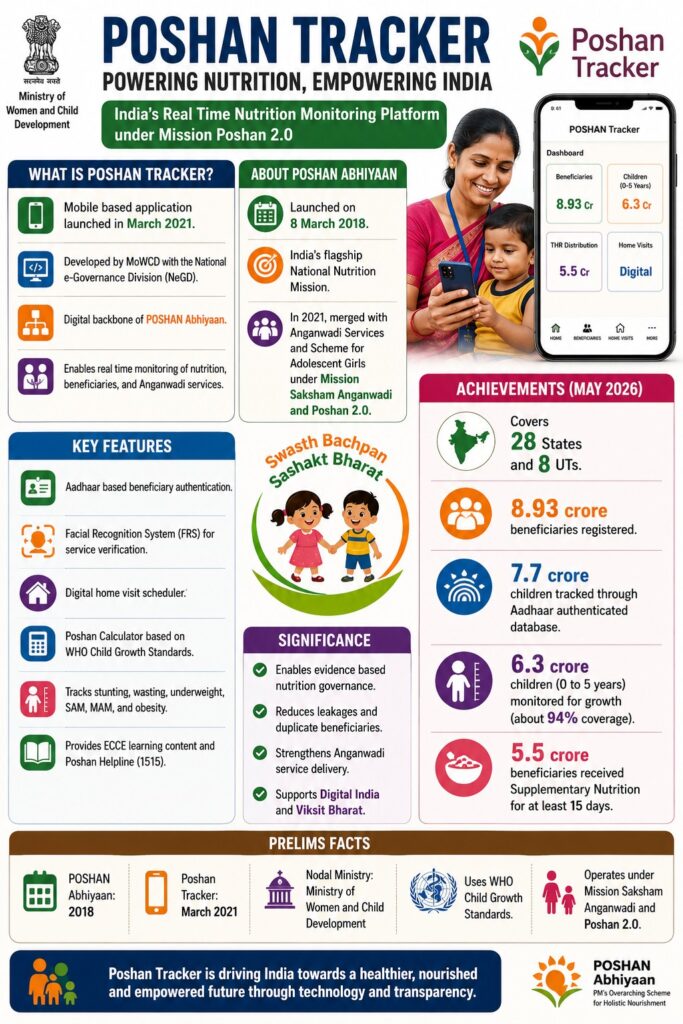
The Ministry of Women and Child Development (MoWCD) highlighted the achievements of the Poshan Tracker, India’s real time nutrition monitoring platform under Mission Poshan 2.0.
What is Poshan Tracker?
- Mobile based application launched in March 2021.
- Developed by MoWCD with the National e-Governance Division (NeGD).
- Digital backbone of POSHAN Abhiyaan.
- Enables real time monitoring of nutrition, beneficiaries, and Anganwadi services.
About POSHAN Abhiyaan
- Launched on 8 March 2018.
- India’s flagship National Nutrition Mission.
- In 2021, merged with Anganwadi Services and Scheme for Adolescent Girls under Mission Saksham Anganwadi and Poshan 2.0.
Key Features
- Aadhaar based beneficiary authentication.
- Facial Recognition System (FRS) for service verification.
- Digital home visit scheduler.
- Poshan Calculator based on WHO Child Growth Standards.
- Tracks stunting, wasting, underweight, SAM, MAM, and obesity.
- Provides ECCE learning content and Poshan Helpline (1515).
Achievements (May 2026)
- Covers 28 States and 8 UTs.
- 8.93 crore beneficiaries registered.
- 7.7 crore children tracked through Aadhaar authenticated database.
- 6.3 crore children (0 to 5 years) monitored for growth (about 94% coverage).
- 5.5 crore beneficiaries received Supplementary Nutrition for at least 15 days.
Significance
- Enables evidence based nutrition governance.
- Reduces leakages and duplicate beneficiaries.
- Strengthens Anganwadi service delivery.
- Supports Digital India and Viksit Bharat.
Prelims Facts
- POSHAN Abhiyaan: 2018.
- Poshan Tracker: March 2021.
- Nodal Ministry: Ministry of Women and Child Development.
- Uses WHO Child Growth Standards.
- Operates under Mission Saksham Anganwadi and Poshan 2.0.
[2023] Consider the following statements in the context of interventions being undertaken under Anaemia Mukt Bharat Strategy:
1. It provides prophylactic calcium supplementation for pre-school children, adolescents and pregnant women.
2. It runs a campaign for delayed cord clamping at the time of child- birth.
3. It provides for periodic deworming to children and adolescents.
4. It addresses non-nutritional causes of anaemia in endemic pockets with special focus on malaria, hemoglobinopathies and fluorosis.
How many of the statements given above are correct?
[A] Only one
[B] Only two
[C] Only three
[D] All four
