Why in News?
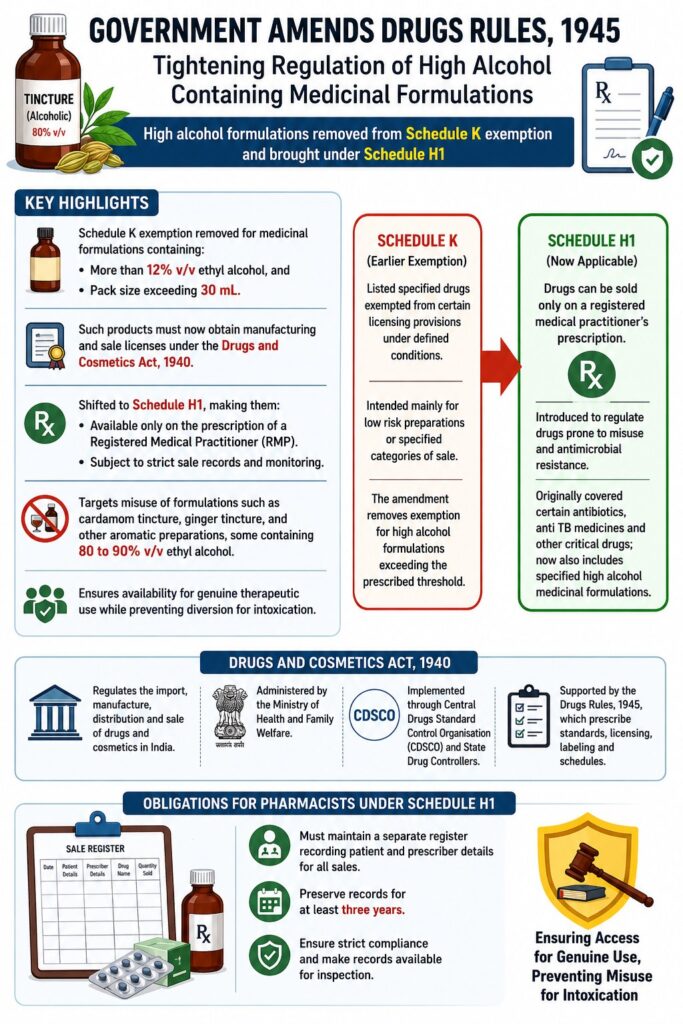
The Central Government has amended the Drugs Rules, 1945 to tighten regulation of high alcohol containing medicinal formulations, removing their exemption under Schedule K and bringing them under Schedule H1.
Key Highlights
- Schedule K exemption removed for medicinal formulations containing:
- More than 12% v/v ethyl alcohol, and
- Pack size exceeding 30 mL.
- Such products must now obtain manufacturing and sale licenses under the Drugs and Cosmetics Act, 1940.
- Shifted to Schedule H1, making them:
- Available only on the prescription of a Registered Medical Practitioner (RMP).
- Subject to strict sale records and monitoring.
- Targets misuse of formulations such as cardamom tincture, ginger tincture, and other aromatic preparations, some containing 80 to 90% v/v ethyl alcohol.
- Ensures availability for genuine therapeutic use while preventing diversion for intoxication.
Drugs and Cosmetics Act, 1940
- Regulates the import, manufacture, distribution and sale of drugs and cosmetics in India.
- Administered by the Ministry of Health and Family Welfare.
- Implemented through the Central Drugs Standard Control Organisation (CDSCO) and State Drug Controllers.
- Supported by the Drugs Rules, 1945, which prescribe standards, licensing, labeling and schedules.
Schedule K
- Lists specified drugs exempted from certain licensing provisions under defined conditions.
- Intended mainly for low risk preparations or specified categories of sale.
- The amendment removes exemption for high alcohol formulations exceeding the prescribed threshold.
Schedule H1
- Introduced to regulate drugs prone to misuse and antimicrobial resistance.
- Drugs can be sold only on a registered medical practitioner’s prescription.
- Pharmacists must:
- Maintain a separate register recording patient and prescriber details.
- Preserve records for at least three years.
- Originally covered certain antibiotics, anti TB medicines and other critical drugs; now also includes specified high alcohol medicinal formulations.
[2018] Consider the following statements:
1. The Food Safety and Standards Act, 2006 replaced the Prevention of Food Adulteration Act, 1954.
2. The Food Safety and Standard Authority of India (FSSAI) is under the charge of Director General of Health Services in the Union Ministry of Health and Family Welfare.
Which of the statements given above is/are correct?
(a) 1 only
(b) 2 only
(c) Both 1 and 2
(d) Neither 1 nor 2
