Why in News?
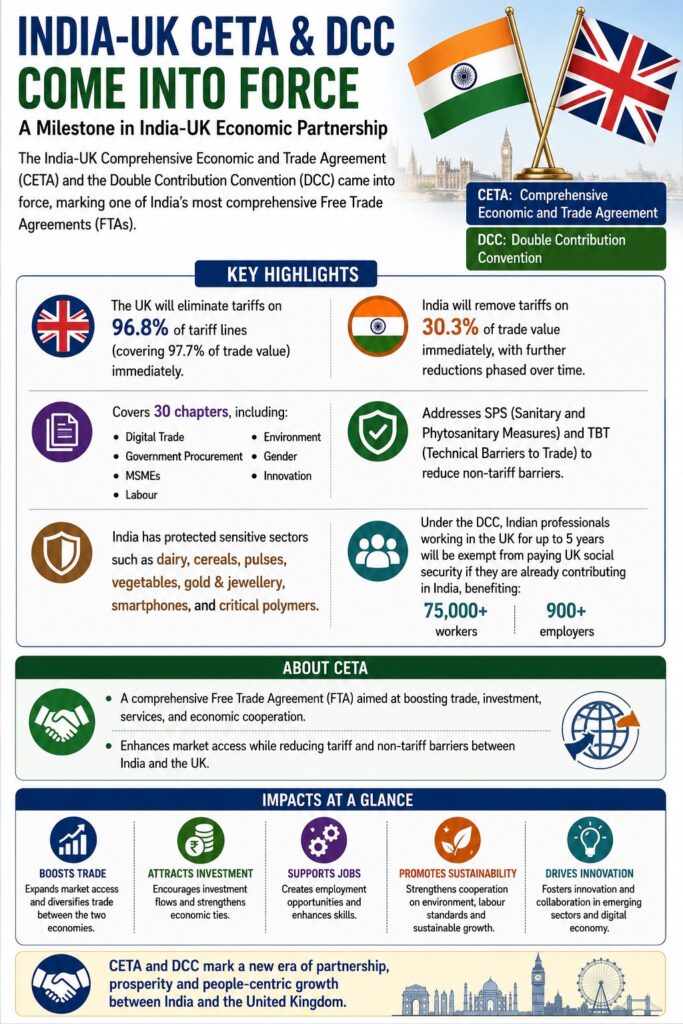
The India-UK Comprehensive Economic and Trade Agreement (CETA) and the Double Contribution Convention (DCC) came into force, marking one of India’s most comprehensive Free Trade Agreements (FTAs)
Key Highlights
- CETA: Comprehensive Economic and Trade Agreement
- DCC: Double Contribution Convention
- The UK will eliminate tariffs on 96.8% of tariff lines (covering 97.7% of trade value) immediately.
- India will remove tariffs on 30.3% of trade value immediately, with further reductions phased over time.
- Covers 30 chapters, including: Digital Trade, Government Procurement, MSMEs, Labour, Environment, Gender, and Innovation
- Addresses SPS (Sanitary and Phytosanitary Measures) and TBT (Technical Barriers to Trade) to reduce non-tariff barriers.
- India has protected sensitive sectors such as dairy, cereals, pulses, vegetables, gold & jewellery, smartphones, and critical polymers.
- Under the DCC, Indian professionals working in the UK for up to 5 years will be exempt from paying UK social security if they are already contributing in India, benefiting 75,000+ workers and 900+ employers.
About CETA
- A comprehensive Free Trade Agreement (FTA) aimed at boosting trade, investment, services, and economic cooperation.
- Enhances market access while reducing tariff and non-tariff barriers between India and the UK.
[2017] ‘Broad-based Trade and Investment Agreement (BTIA)’ is sometimes seen in the news in the context of negotiations held between India and
[A] European Union
[B] Gulf Cooperation Council
[C] Organization for Economic Cooperation and Development
[D] Shanghai Cooperation Organization