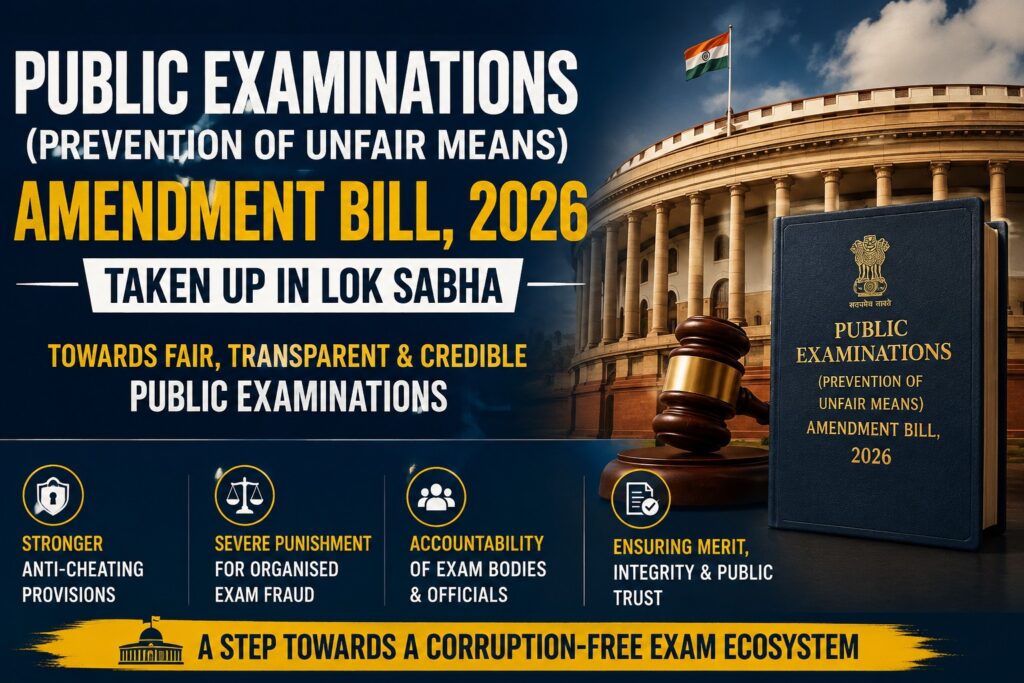
Why in News
The Public Examinations (Prevention of Unfair Means) Amendment Bill, 2026 has been passed by both Houses of Parliament, having first been cleared by the Lok Sabha on July 29, 2026, followed by approval from the Rajya Sabha on July 30, 2026.
Key Highlights
- Stricter punishment: Maximum imprisonment for offences involving unfair means increased to 10 years, from the earlier 3 to 5 years.
- Higher penalty: Maximum fine for individual offences enhanced to ₹50 lakh.
- Organised examination fraud: Punishable with a minimum imprisonment of 7 years and a fine up to ₹10 crore.
- Procedural reforms: Provides for fast-track courts and mandates completion of investigations within two months.
- Companion legislation: The Prevention of Insults to National Honour (Amendment) Bill, 2026 was also introduced during the same session.
Background
- The amendment strengthens the Public Examinations (Prevention of Unfair Means) Act, 2024.
- The Act aims to prevent paper leaks, impersonation, organised cheating and other examination-related malpractices in public examinations conducted by designated authorities.
Objectives
- Ensure fairness, transparency and credibility in recruitment and entrance examinations.
- Deter organised examination fraud through stringent penalties.
- Protect the interests of genuine candidates.
- Improve the speed of investigation and prosecution.
Significance
- Enhances the integrity of public recruitment and competitive examinations.
- Acts as a deterrent against paper leak mafias and organised crime networks.
- Strengthens public confidence in examination systems.
- Supports merit-based selection and good governance.
[2026] Mr. X, a senior officer, was overseeing a critical vaccination programme during a pandemic. He found that a private service provider responsible for vaccine distribution was compromising on quality to make profits. Despite immense pressure to manage the issue due to vested interests, he raised his voice based on the principles of public administration which he learnt during various training programmes attended across his career. He reported the issue to the appropriate vigilance authority and halted the contract to ensure citizen welfare.
Which one among the following principles of public administration was most strongly demonstrated by Mr. X’s actions?
[A] Esprit de corps
[B] Equity
[C] Accountability
[D] Delegation