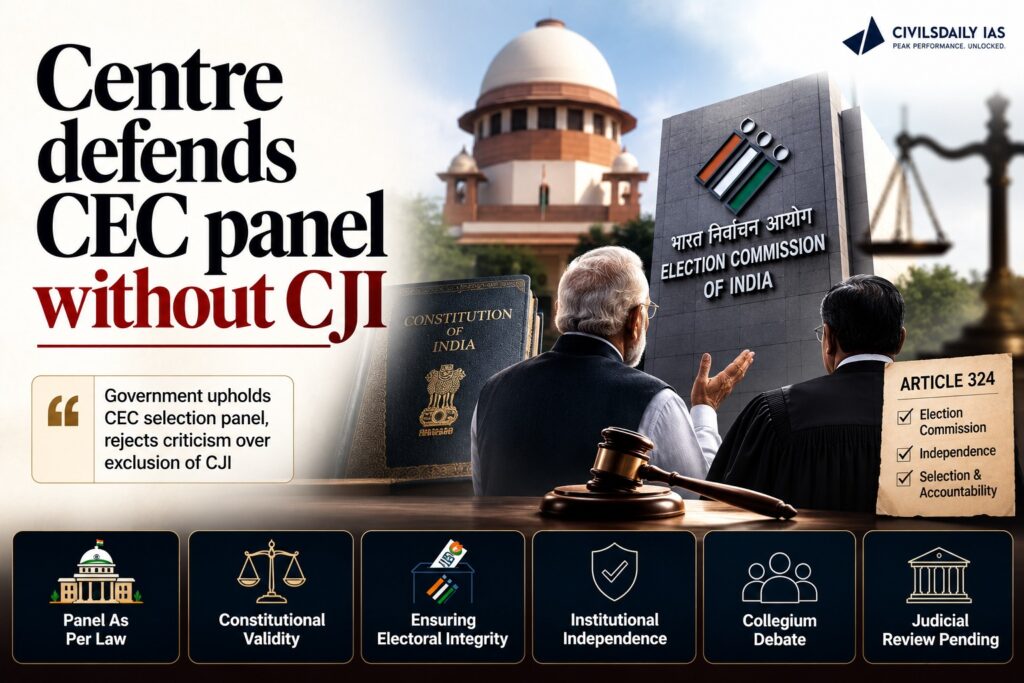
Why in the News?
The Supreme Court is examining the constitutional validity of the Chief Election Commissioner and Other Election Commissioners (Appointment, Conditions of Service and Term of Office) Act, 2023, which gives the executive a majority in the CEC selection committee. The Court has reserved its decision on whether to refer the matter to a Constitution Bench.
What is the CEC Selection Committee under the 2023 Act?
The Act provides for a three-member selection committee comprising:
- Prime Minister (Chairperson)
- Union Cabinet Minister nominated by the Prime Minister
- Leader of the Opposition (LoP) in the Lok Sabha
What changed?
- The Act replaced the Chief Justice of India (CJI) with a Cabinet Minister.
- This gives the executive two out of three votes, with the Opposition holding one.
What is the Anoop Baranwal Judgment (2023)?
- Delivered by a five-judge Constitution Bench.
- Held that until Parliament enacted a law, the CEC and Election Commissioners should be appointed by a committee comprising:
- Prime Minister
- Leader of the Opposition
- Chief Justice of India
- The Court stressed that the Election Commission must be independent, neutral, and free from executive control.
Centre’s Arguments
- Parliament is competent to decide the appointment process.
- The Prime Minister’s office carries constitutional trust.
- Courts should not presume bad faith by constitutional authorities.
- Replacing the CJI with a Cabinet Minister is within Parliament’s legislative powers.
Supreme Court’s Concerns
- The committee lacks a neutral member.
- A 2:1 executive majority may affect the perception of independence.
- Appointments should not only be fair but also appear to be fair.
[2017] Consider the following statements regarding the Election Commission of India:
1.The ECI is currently a five-member body consisting of the Chief Election Commissioner and four Election Commissioners.
2.The Union Ministry of Home Affairs is the final authority that decides the election schedule for general elections.
3.The ECI is the designated authority to resolve disputes relating to splits or mergers of recognized political parties.
Which of the statements given above is/are correct?
[A] 1 and 2 only
[B] 3 only
[C] 2 and 3 only
[D] 1, 2 and 3
