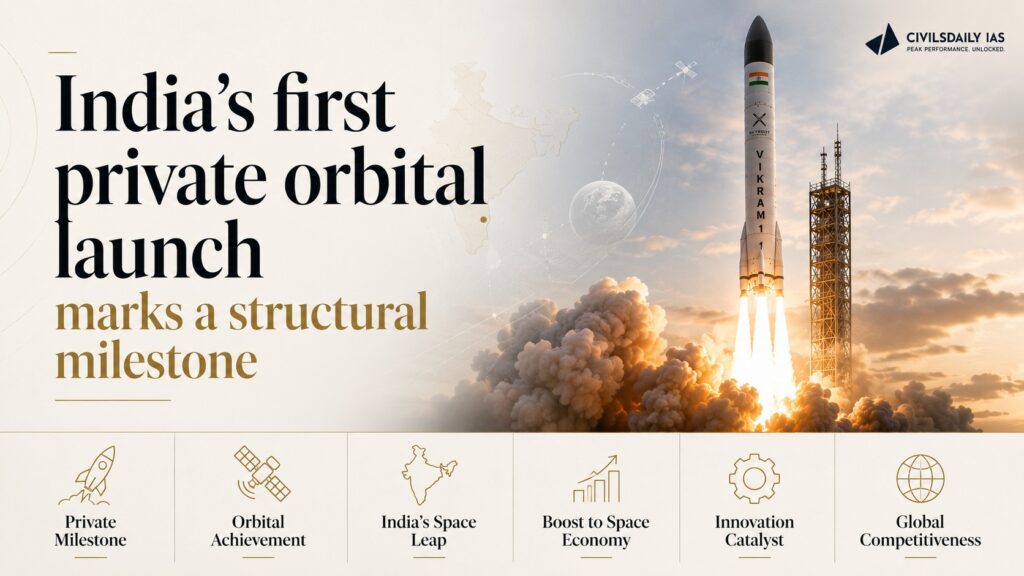
Why in the News?
Skyroot Aerospace’s Vikram-1 successfully reached orbit on 18 July 2026, becoming the first privately developed Indian rocket to achieve orbital launch. India is now among the few countries where a private company has independently built and launched an orbital rocket.
What is Vikram-1?
- Vikram-1 is Skyroot Aerospace’s orbital launch vehicle.
- Built using carbon composite structures with solid and liquid propulsion stages.
- Developed by Skyroot Aerospace, a Hyderabad-based startup founded in 2018 by former ISRO scientists.
- Follows the successful launch of Vikram-S under Mission Prarambh (2022).
Key Highlights
- First privately built Indian rocket to reach orbit.
- Demonstrates India’s growing commercial space capabilities.
- Marks a major milestone after the 2020 space sector reforms.
India’s Private Space Ecosystem
- 285 space startups, with 274 active.
- 72 startups have received equity funding.
- Total funding reached $871 million across 241 funding rounds (July 2026).
- Annual funding increased from $43 million (2021) to $200 million (2025).
What is IN-SPACe?
- Indian National Space Promotion and Authorisation Centre (IN-SPACe).
- Established in 2020 under the Department of Space.
- Acts as the single-window agency for authorising and promoting private participation in the space sector.
- Facilitates private access to ISRO’s testing and launch facilities.
Significance
- Strengthens India’s commercial space industry.
- Reduces dependence on government-led launch services.
- Encourages innovation, investment, and private participation.
- Enhances India’s competitiveness in the global launch market.
Challenges
- High capital requirement for launch vehicle development.
- Need for a regular commercial launch cadence.
- Dependence on imported critical components.
- Evolving insurance and liability framework.
- Competition from low-cost global launch providers like SpaceX.
Skyroot Aerospace
- Headquarters: Hyderabad, Founded: 2018, Founders: Former ISRO scientists
- First Rocket: Vikram-S (Mission Prarambh, 2022)
- Naming: Vikram rockets are named after Dr. Vikram Sarabhai.
- Developed the Dhawan-II, India’s first privately developed 3D-printed cryogenic engine.
2020 Space Sector Reforms
- Opened the space sector to private players.
- Created IN-SPACe.
- Enabled private firms to build satellites, launch vehicles, and offer launch services.
- Encouraged technology transfer and infrastructure sharing with ISRO.
Key Space Institutions
- ISRO: National space agency.
- IN-SPACe: Promotes and authorises private participation.
- NSIL (NewSpace India Limited): Commercial arm of ISRO for technology transfer and commercialisation.
[2026] Consider the following statements about involvement of private entities in India’s space programme:
1. IN-SPACe is an autonomous agency formed to facilitate participation of private entities.
2. Agnikul Cosmos launched the world’s first flight using 3D-printed rocket engine.
3. Skyroot Aerospace has developed liquid fuel for GSLV.
(a) 1 only
(b) 2 and 3 only
(c) 1 and 2 only
(d) 1, 2 and 3