Why in the News
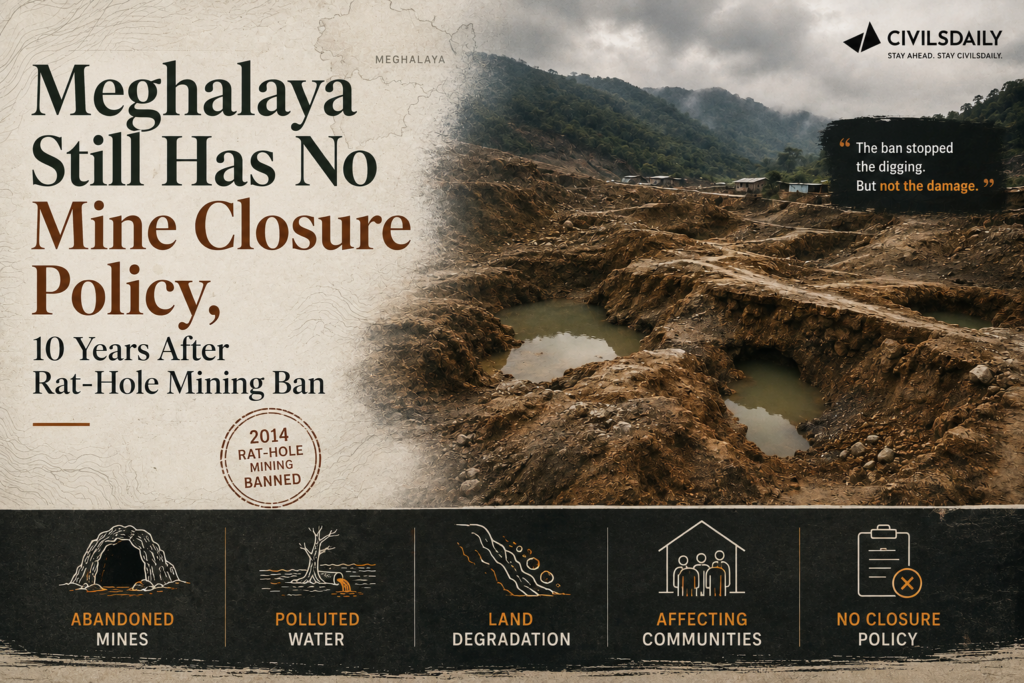
The 39th interim report of the Justice B.P. Katakey Committee has flagged Meghalaya’s failure to adopt a comprehensive policy for closing and fencing abandoned rat-hole coal mines. The issue has shifted from merely stopping illegal extraction to managing the dangerous legacy of thousands of abandoned mine pits.
What is Rat-Hole Mining?
- A manual coal mining method involving a vertical pit and narrow horizontal tunnels.
- Tunnels may extend 150 to 300 metres underground.
- Side cutting: Tunnels follow exposed coal seams along hill slopes.
- Box cutting: A vertical pit is dug first, followed by horizontal tunnels.
- Meghalaya’s thin coal seams made this method economically attractive.
Why is Meghalaya’s Mine Closure Issue Important?
- The NGT banned rat-hole coal mining in April 2014.
- The Supreme Court in 2019 upheld the prohibition and held that the MMDR Act, 1957 applies to Meghalaya.
- Thousands of abandoned pits remain uncovered and unfenced, creating risks to people and livestock.
- East Jaintia Hills alone is reported to have around 60,000 mines across 360 villages.
- Sulphur-rich coal contributes to acid mine drainage, affecting rivers such as the Lukha and Myntdu.
What is Mine Closure?
Mine closure means planned decommissioning of a mine after extraction, including:
- Sealing and fencing mine openings
- Backfilling and slope stabilisation
- Land restoration
- Water treatment
- Revegetation
- Post-closure monitoring
Indian mining regulations provide for both progressive closure during the life of a mine and final closure after mining ends. Financial assurance is maintained through an escrow mechanism for eligible mines.
Why is Meghalaya Different?
Meghalaya comes under the Sixth Schedule. Land and mineral resources are substantially associated with private and community ownership, creating a distinct governance framework compared with conventional state-leased mining.
Constitutional provisions to remember
- Article 244(2): Administration of tribal areas under the Sixth Schedule.
- Entry 23, State List: Regulation of mines and mineral development, subject to Entry 54.
- Entry 54, Union List: Union regulation of mines and mineral development when Parliament declares it in public interest.
- Article 21: Right to life includes the right to a clean and healthy environment.
- Article 48A: State duty to protect the environment.
- Article 51A(g): Fundamental duty to protect the environment.
Important Laws and Institutions
- MMDR Act, 1957: Parent legislation governing mineral concessions, leases and mining regulation.
- Mineral Conservation and Development Rules, 2017: Provide for progressive and final mine closure plans and financial assurance.
- Mines Act, 1952: Deals with health, safety and working conditions in mines. The Directorate General of Mines Safety (DGMS) is the safety regulator.
- National Green Tribunal Act, 2010: Created the National Green Tribunal (NGT), a specialised statutory environmental tribunal. Its 2014 order banned rat-hole mining in Meghalaya.
- District Mineral Foundation: A non-profit trust in mining districts, funded through a levy on mining lessees, for the benefit of communities affected by mining.
“[2025, GS3, 15 marks] Mineral resources are fundamental to the country economy and these are exploited by mining. Why is mining considered an environmental hazard? Explain the remedial measures required to reduce the environmental hazard due to mining.”