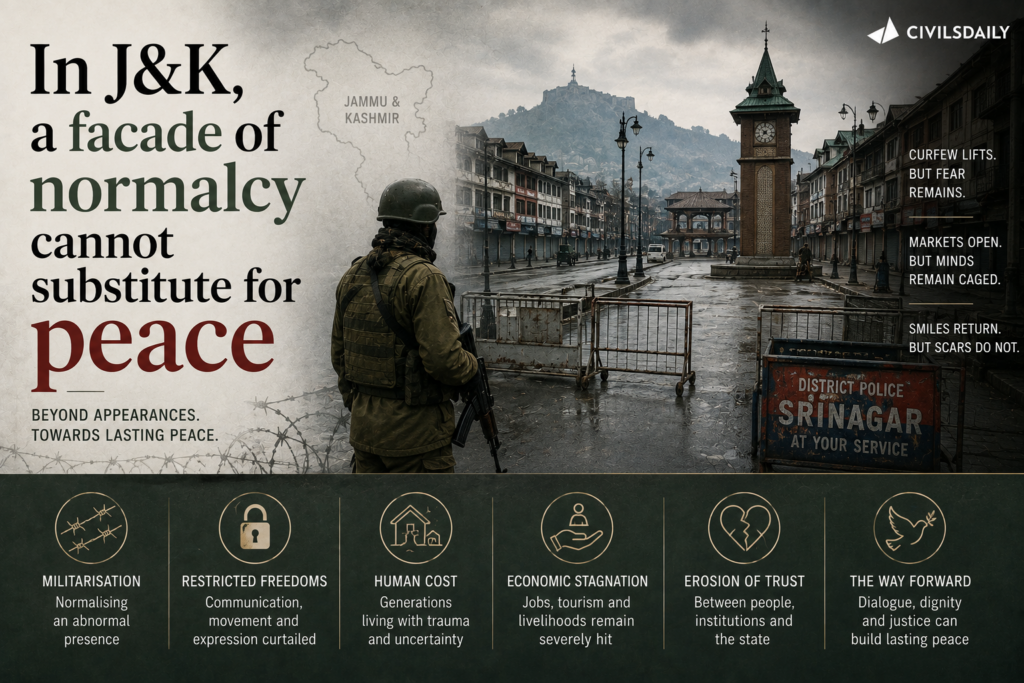
Why in the News
An administrative order circulating in Anantnag directed government employees to take part in a Tiranga Rally, making attendance at a State sponsored event an official obligation. The order brings out the central tension in the governance of Jammu and Kashmir since August 2019, between an official account of restored normalcy and a security regime of raids, dismissals, detentions and attachments that continues without pause. Whether participation of this kind reflects public enthusiasm or administrative compulsion is the question the order leaves unanswered.
What is Article 370 of the Constitution?
- What it provided: A temporary provision under Part XXI that limited Parliament’s legislative power over Jammu and Kashmir to defence, foreign affairs and communications, with other laws requiring the State government’s concurrence.
- The linked provision: Article 35A, added by a 1954 Presidential Order, allowed the State to define permanent residents and reserve rights in employment and property for them.
- What changed in 2019: Presidential Orders of August 2019 applied the whole Constitution to the State and rendered Article 370 inoperative, and Article 35A ceased to apply.
- The statutory change: The Jammu and Kashmir Reorganisation Act, 2019 split the State into two Union Territories, Jammu and Kashmir with a legislature, and Ladakh without one.
- The judicial outcome: The Supreme Court upheld the 2019 measures in In re Article 370 of the Constitution (2023) and directed that statehood be restored and elections held.
- The contested question: The argument advanced in this piece treats the 2019 change as an abrogation imposed without consent, and reads subsequent governance as its continuation.
Who is an overground worker?
- The term: A person alleged to provide logistical support to militants, such as shelter, transport, money or information, without taking part in armed action.
- Why the term matters: It is not defined in statute, so the label carries no fixed evidentiary threshold and can be applied to large numbers after a single incident.
What is preventive detention?
- What it is: Detention ordered by the executive to prevent an anticipated act, without any charge, trial or conviction.
- Its basis: Article 22(3) to 22(7) carve preventive detention out of the ordinary protections against arrest, and permit detention up to three months before an Advisory Board must review it.
What is the United Liberation Council?
- What it is: The name attached to a purported threat letter reported on 12 August, described by authorities and sections of the media as an affiliate of Lashkar e Taiba.
- What the letter did: It reportedly named several Kashmiri Pandit government employees and carried their telephone numbers.
Why is the Tiranga Rally order treated as symptomatic rather than isolated?
- The object is not the issue: The objection is not to the national flag but to the coercive form of the instruction.
- Obligation replaces participation: When attendance at a government event becomes an administrative duty, the resulting turnout cannot be read as evidence of public sentiment.
- A pattern of governance: The order fits a style of administration that has defined the region since the Union government took direct control in August 2019.
- Display as policy output: A visible ceremony is treated as the deliverable, so the appearance of normalcy substitutes for the conditions that would produce it.
- Self defeating measurement: A government that compels attendance loses the only instrument that could have told it whether sentiment had actually changed.
What measures define administration in the Valley since 2019?
- Raids and investigations: Searches and investigations by multiple central and State agencies have become a recurring feature of life in the Valley.
- Dismissals from service: Government employees have been dismissed over alleged links with militancy or with militant sympathisers, without the ordinary departmental process.
- Mass detention: Thousands have been detained after militant incidents, at times under broad allegations of being overground workers.
- Institutional closure: Educational and charitable institutions have faced closure or restriction over alleged links with banned organisations.
- Property attachment: Properties worth hundreds of crores of rupees have been attached under various laws.
- House demolition: Homes have been demolished where a member of the family stands accused of militancy.
- Post incident crackdowns: Thousands were reportedly detained after the killing of a police constable in south Kashmir, and the cycle of raids, detentions and suspicion followed the killing of migrant workers.
What does the record on the Kashmiri Pandit community show?
- The threat letter: Reports on 12 August described a purported threat letter naming several Kashmiri Pandit government employees along with their telephone numbers.
- The attributed source: The letter was attributed to the United Liberation Council, described as an affiliate of Lashkar e Taiba.
- The casualty count: 25 members of the community have been targeted and killed since 2019.
- The named victims: They include Ajay Pandita Bharti, Rakesh Pandita, Makhan Lal Bindroo, Rahul Bhat, Rajni Bala, Puran Krishan Bhat and Sanjay Sharma.
- Why the memory matters: For a community displaced in the 1990s, each such threat revives the circumstances of that displacement rather than reading as an isolated crime.
- The return condition: Return has to rest on an environment in which the community feels safe, not on participation in official ceremonies designed to demonstrate that everything is normal.
Why do the claim of normalcy and the continuing security regime contradict each other?
- The official account: The government tells the rest of India that Kashmir has entered a new era of peace and normalcy.
- The parallel reality: Extraordinary security measures, raids, detentions, dismissals and restrictions continue to shape the everyday lives of ordinary people.
- Both cannot be operative: A settled peace does not require a standing apparatus of preventive detention and property attachment to maintain it.
- The tourist test fails: Busy markets, full hotels and traffic on the roads are what a visitor sees in a few days. They measure commerce, not security of person.
- What each side gains: The government gains a demonstrable output in the display. The population gains nothing it can rely on when the display ends.
- The unresolved reminder: The threat letter of 12 August is the demonstration that the underlying problem has not closed, whatever the ceremonies record.
How should normalcy actually be measured?
- Freedom to speak: Whether ordinary people feel secure enough to speak freely without anticipating consequences.
- Law as protection: Whether families believe the law will protect them rather than intimidate them.
- A visible future: Whether young people see a future for themselves in the region.
- Safe return: Whether communities that have suffered displacement and violence feel safe enough to return and rebuild their lives.
What does the security regime do to a generation born after the conflict?
- Who they are: Those in their teens and twenties in Kashmir were born decades after the worst years of the conflict and bear no responsibility for the violence of the 1990s.
- What they observe: Many grow up watching fathers, brothers, relatives and neighbours being summoned, detained or questioned.
- Collective punishment: Large scale detentions and punitive measures after militant attacks deepen the perception that a whole community is being punished for the acts of individuals.
- The asymmetry they learn: One section of society is repeatedly assured that everything is normal while another is continually asked to prove that it is not a threat.
- The outcome: This produces bruised memory rather than reconciliation, and bruised memory does not disappear because officials are instructed to display flags.
- The time horizon: Brute force can silence a street for a period. It cannot silence a generation’s memory.
What distinctions must the state draw?
- Militant and citizen: The State must distinguish between a militant and an ordinary citizen, which mass categorisation after an incident destroys.
- Accused and convicted: It must distinguish between an accused person and a convicted person, which dismissal, attachment and demolition before trial collapse.
- Family member and accused: It must distinguish between a family member and the person accused of committing a crime, which punitive action against a household erases.
Challenges to restoring political normalcy in Jammu and Kashmir
- Punitive measures before adjudication: Attachment and demolition operate before a court has decided guilt, so the penalty precedes the finding. e.g. property attachments running to hundreds of crores of rupees under various laws since 2019.
- Undefined categories in enforcement: Terms such as overground worker carry no statutory definition, so detention scales with suspicion rather than evidence. e.g. thousands reportedly detained after the killing of a police constable in south Kashmir.
- Employment as a security instrument: Dismissal without departmental inquiry converts government service into a lever of security policy. e.g. dismissals of employees over alleged links with militancy since 2019.
- Targeted killings of minorities: The safety of returning and resident minority employees remains unsecured. e.g. 25 members of the Kashmiri Pandit community killed since 2019 and a threat letter naming employees on 12 August 2026.
- Statehood still pending: Restoration of full statehood remains incomplete, leaving an elected government without control over police and public order. e.g. the Supreme Court’s 2023 direction to restore statehood at the earliest.
- Space for civil society: Closure of educational and charitable institutions removes the mediating layer between the State and the population. e.g. restrictions on institutions over alleged links with banned organisations.
- Cross border sponsorship: Infiltration and external support keep the security justification alive irrespective of local political settlement. e.g. attacks on migrant workers in the Valley followed by area wide crackdowns.
- Economic dependence on tourism: A single security incident removes the region’s main visible income source. e.g. the collapse of bookings in the Valley after major attacks on visitors.
Conclusion
The administrative order in Anantnag is a small instrument, and its significance lies in what it substitutes for. Kashmir needs healing built on dignity, justice, security and dialogue, and healing cannot be produced by an order requiring attendance. A facade of normalcy may impress visitors, and it cannot substitute for real peace. The measure of whether the situation has changed is whether the State begins to distinguish the militant from the citizen and the accused from the convict, not whether the flag is displayed on schedule.
Jammu and Kashmir after 2019
- Constitutional status: The former State was reorganised on 31 October 2019 into the Union Territory of Jammu and Kashmir, with a legislature, and the Union Territory of Ladakh, without one.
- Political timeline: Assembly elections were held in 2024, the first since 2014, restoring an elected government to the Union Territory.
- Statehood question: Full statehood has not been restored. Public order and police remain with the Union government under the Reorganisation Act.
- Security geography: The region has a Line of Control of about 740 km with Pakistan and a Line of Actual Control segment with China in Ladakh.
- Displacement history: Large scale displacement of the Kashmiri Pandit community occurred from 1990, and return and rehabilitation remains an unfinished policy objective.
- Economy: Horticulture, handicrafts and tourism dominate the economy, all of which are directly sensitive to security incidents.
Constitutional Framework Governing Jammu and Kashmir and Security Measures
- Article 1: Declares India a Union of States and makes the territories in the First Schedule part of that Union.
- Article 3: Empowers Parliament to form new States and Union Territories and to alter boundaries, the provision used for the 2019 reorganisation.
- Article 370: The temporary provision governing the State’s relationship with the Union, rendered inoperative by the Presidential Orders of August 2019.
- Article 14: Requires equality before the law, which limits arbitrary classification of persons or communities in security administration.
- Article 19: Guarantees freedom of speech, assembly, association and movement, subject to reasonable restrictions on the specified grounds.
- Article 21: Protects life and personal liberty, and requires that any deprivation follow a procedure that is fair, just and reasonable.
- Article 22: Provides protections on arrest, and separately permits preventive detention with an Advisory Board review after three months.
- Article 239A read with the Reorganisation Act: Provides the framework for a legislature in a Union Territory, with police and public order reserved to the Union in the case of Jammu and Kashmir.
- Article 355: Places a duty on the Union to protect every State against external aggression and internal disturbance.
Laws and Rules Governing Security Administration in Jammu and Kashmir
- Jammu and Kashmir Reorganisation Act, 2019: Created the two Union Territories and set out the distribution of legislative and executive power between them and the Union.
- Unlawful Activities (Prevention) Act, 1967: The principal anti terrorism statute, providing for banning organisations, designating individuals and attaching proceeds of terrorism.
- Jammu and Kashmir Public Safety Act, 1978: Permits preventive detention for up to two years on grounds of security of the State or maintenance of public order.
- Armed Forces (Jammu and Kashmir) Special Powers Act, 1990: Confers search, arrest and use of force powers on the armed forces in areas declared disturbed, with prior sanction required for prosecution.
- National Investigation Agency Act, 2008: Establishes the central counter terrorism investigation agency and defines the scheduled offences it can take over.
- Prevention of Money Laundering Act, 2002: Provides for provisional attachment of property representing proceeds of crime, used in terror financing investigations.
- Bharatiya Nagarik Suraksha Sanhita, 2023: Replaces the Code of Criminal Procedure, 1973 and carries the powers to issue prohibitory orders and regulate assemblies.
Back2Basics: In re Article 370 of the Constitution (2023)
- What it was: A Constitution Bench judgment of the Supreme Court on the validity of the Presidential Orders of August 2019 and the Jammu and Kashmir Reorganisation Act, 2019.
- Holding on sovereignty: The Court held that Jammu and Kashmir retained no element of internal sovereignty after its accession and the adoption of the Constitution.
- Holding on Article 370: Article 370 was held to be a temporary provision, and the President’s power to declare it inoperative was held to survive the dissolution of the Constituent Assembly of the State.
- Holding on Article 35A: The Court held that the removal of Article 35A did not violate the fundamental rights framework.
- Direction on statehood: The Court directed that the statehood of Jammu and Kashmir be restored at the earliest, while upholding the carving out of Ladakh.
- Direction on elections: The Election Commission was directed to hold Assembly elections by 30 September 2024.
- Additional direction: The Court recommended a truth and reconciliation commission to examine human rights violations in the region since the 1980s.
Government Initiatives
- Prime Minister’s Development Package, 2015: An outlay of about Rs 80,068 crore covering road, power, health, tourism and rehabilitation projects in the region.
- Prime Minister’s Package for Kashmiri Migrants: Provides government jobs and transit accommodation to support the return of displaced Kashmiri Pandit families to the Valley.
- Udaan and Himayat: Skill development and placement schemes for youth of the region, run through the National Skill Development Corporation and the rural livelihoods mission.
- Prime Minister’s Special Scholarship Scheme: Funds higher education outside the region for students from Jammu and Kashmir and Ladakh.
- Security Related Expenditure scheme: Reimburses the Union Territory for expenditure on security, relief and rehabilitation of surrendered militants and civilian victims.
- Operation Sadbhavana and the Civic Action Programme: Army and central armed police force programmes that fund schools, medical camps and community infrastructure in border and affected areas.
- New Central Sector Scheme for Industrial Development, 2021: An outlay of about Rs 28,400 crore of capital and interest incentives to attract manufacturing investment to the Union Territory.
Key Facts about Jammu and Kashmir
- Reorganisation date: The two Union Territories came into existence on 31 October 2019, observed as National Unity Day.
- Representation: The Union Territory of Jammu and Kashmir returns five members to the Lok Sabha and Ladakh returns one.
- Delimitation: The 2022 delimitation raised Assembly seats to 90, with 43 in the Jammu division and 47 in the Kashmir division, besides seats reserved for Scheduled Castes and Scheduled Tribes for the first time.
- Reservation extension: Central laws on reservation, including for Scheduled Tribes such as the Gujjar, Bakarwal, Gaddi and Sippi communities, now apply to the Union Territory.
- Boundaries: The region borders Pakistan along the Line of Control and China along the Line of Actual Control in Ladakh.
- Geography: The Pir Panjal range separates the Jammu division from the Kashmir Valley, and the Jhelum, Chenab and Indus are the principal rivers.
- Treaty link: The Indus Waters Treaty of 1960 governs the use of the western rivers that flow through the region, and India placed it in abeyance in 2025.
Challenges in Internal Security Management
- Balancing force and consent: Security operations that succeed tactically can widen alienation and cost the political objective. e.g. area wide cordon and search operations following a single militant incident.
- Preventive detention without adjudication: Detention laws allow long custody without trial, which produces grievance even where the intelligence is sound. e.g. detention up to two years permitted under the Jammu and Kashmir Public Safety Act, 1978.
- Radicalisation through digital channels: Recruitment and propaganda have moved online, beyond the reach of physical area domination. e.g. encrypted messaging used for handler communication in recent militancy cases.
- Terror financing: Funding routes through hawala, cryptocurrency and front organisations are hard to interdict. e.g. investigations into non governmental organisations and trusts by central agencies since 2017.
- Rehabilitation of surrendered cadre: Without livelihood and social acceptance, surrendered militants relapse. e.g. surrender and rehabilitation policies across the Northeast and Left Wing Extremism affected districts.
- Centre and State coordination: Multiple agencies operating in the same theatre create gaps in intelligence handover. e.g. the multi agency centre framework created after the 2008 Mumbai attacks.
- Human rights accountability: Sanction requirements delay prosecution in cases of alleged excess, which erodes trust in the process. e.g. the prior sanction requirement for prosecuting armed forces personnel.
- Border management technology: Infiltration continues where terrain defeats physical fencing. e.g. tunnels detected along the international boundary in the Jammu sector.
Way Forward
- Restore statehood on a stated timeline: Give the elected government responsibility for public order so accountability for security decisions is politically located.
- Individualise security action: Confine dismissal, attachment and demolition to persons against whom a case is established, with reasons recorded and an appeal available.
- Institutionalise dialogue: Create a standing channel with elected representatives, civil society and displaced communities rather than event driven engagement.
- Secure minority employees: Provide verified protection and posting choices to Kashmiri Pandit employees rather than requiring presence at ceremonial events.
- Time bound trials: Expand special court capacity so that persons in preventive detention are either charged and tried or released.
- Youth employment at scale: Convert skill schemes into placement linked outcomes so that the young have a visible economic route.
- Independent grievance mechanism: Set up an accessible body to examine complaints of excess, following the reconciliation mechanism the Supreme Court recommended in 2023.
“[2023, GS3, 10 marks] Winning of ‘Hearts and Minds’ in terrorism-affected areas is an essential step in restoring the trust of the population. Discuss the measures adopted by the Government in this respect as part of the conflict resolution in Jammu and Kashmir.”
