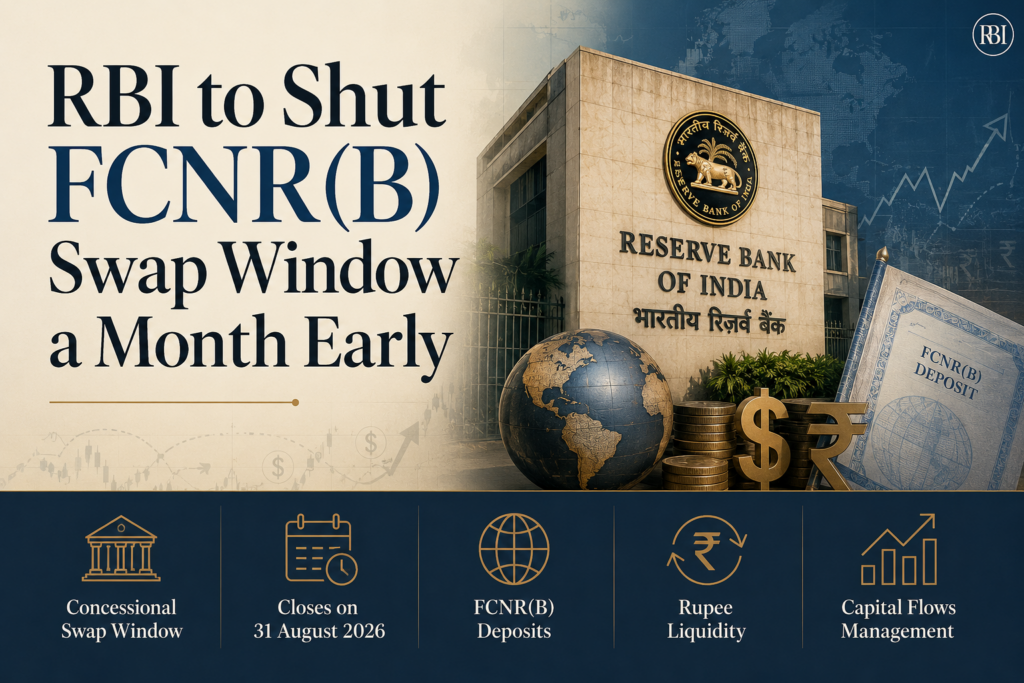
Why in the News
The Reserve Bank of India (RBI) will close its concessional Foreign Currency Non-Resident Bank (FCNR(B)) deposit swap facility on 31 August, ahead of the original 30 September deadline. The facility has already mobilised $52.3 billion.
How does the facility work?
- Dollar-rupee swap: Banks exchange foreign currency for rupees with RBI and reverse the transaction later at a pre-agreed rate.
- RBI absorbs the hedging cost, making FCNR(B) deposits more attractive.
- Helps banks manage exchange-rate risk while adding foreign currency resources to India.
What is FCNR(B)?
- Foreign Currency Non-Resident Bank deposit: Term deposit held by a Non-Resident Indian (NRI) in a permitted foreign currency.
- Principal and interest are repaid in the same foreign currency, so the depositor bears no exchange-rate risk.
Why was the facility closed early?
- Announced on 5 June and operational from 8 June.
- Mobilised $52.3 billion by 13 August.
- Banks expect around $20 billion more by month-end.
- RBI considered the response sufficient and further mobilisation unnecessary.
Key Risks
- Asset-liability mismatch: Deposits may mature together while assets have different maturities.
- Rollover risk: Banks need foreign currency when deposits mature.
- Reversibility: FCNR(B) deposits are debt creating and can leave at maturity.
- Currency risk: RBI assumes the hedging risk under the concessional swap.
- Deployment mismatch: Foreign currency raised must find suitable foreign currency assets or be swapped.
- Underlying external imbalance: Such inflows can temporarily ease pressure without addressing structural current account pressures.
“[2021] Consider the following:
1. Foreign currency convertible bonds
2. Foreign institutional investment with certain conditions
3. Global depository receipts
4. Non-resident external deposits
Which of the above can be included in Foreign Direct Investments?
(a) 1, 2 and 3
(b) 3 only
(c) 2 and 4
(d) 1 and 4
